From Voicemail Spirals to Adult Steadiness: A Care-First Reparenting Plan

The 9:38 p.m. Voicemail Loop
If you’ve ever replayed an old voicemail from your dad like it’s a crime scene, then spent the rest of the night drafting the “perfect” response in Notes—hi, this is for you.
Taylor sat across from me on a video call from her downtown Toronto condo, shoulders angled like she was trying to take up less space on her own couch. She told me it was 9:38 p.m. the night before when it happened again: TV paused, blue phone-glow lighting up her hands, earbuds in like a private tunnel. She hit play on the old voicemail and the room got weirdly quieter—like the air tightened around a single cadence shift.
“My throat clamps,” she said, pressing two fingers lightly to the base of her neck, “and my chest goes heavy. I’m not even listening for the words anymore. I’m listening for… approval.”
She described the loop in the same breathless order every time—play → analyze → rewind on the exact syllable → rewrite what she wished she’d said → cancel something restorative (yoga, dinner, sleep) → substitute productivity, because productivity feels like the fastest way to be okay.
The grief in her didn’t look like tears at first. It looked like a tight throat and a heavy chest, like she was bracing for a tone shift that might drop at any second—like standing under a speaker that could crackle into criticism without warning.
“I hate that a 20-second message can hijack my whole day,” she said. “I don’t even want him to change. I just want it to stop living in my body.”
I nodded, letting the silence land long enough for her nervous system to notice it wasn’t being graded here. “A voicemail can be old and still be loud,” I said. “And the goal tonight isn’t to win against it. It’s to find clarity about what it’s activating—and to give you something you can actually do, today, when it hits.”

Choosing the Compass: The Celtic Cross · Context Edition
I asked Taylor to take one slow breath in through her nose, then exhale like she was fogging up a mirror. Not as a ritual for the universe—just a clean, physiological handoff from spiraling to observing. While she breathed, I shuffled slowly, the sound of cardstock snapping together steady and un-dramatic.
“For this,” I said, “I’m using the Celtic Cross · Context Edition.”
For anyone wondering how tarot works in a situation like this: I’m not treating the cards like a fortune-telling machine. I’m using a spread that creates a chain of context—present trigger → deeper imprint → inner stance → integration. A trigger like a voicemail feels random until you map what it reliably wakes up inside you. The Celtic Cross does that naturally, and this version is tuned to name the specific imprint (“the old script”) and the exact reparenting stance you’re building now.
I told Taylor what to expect: “The first card will show what the voicemail activates in you right now. Another card will reveal the main block—what keeps the trigger in charge of your nervous system and your choices. And one key card will describe the inner caregiver you’re learning to embody—the voice that gets louder than the echo.”
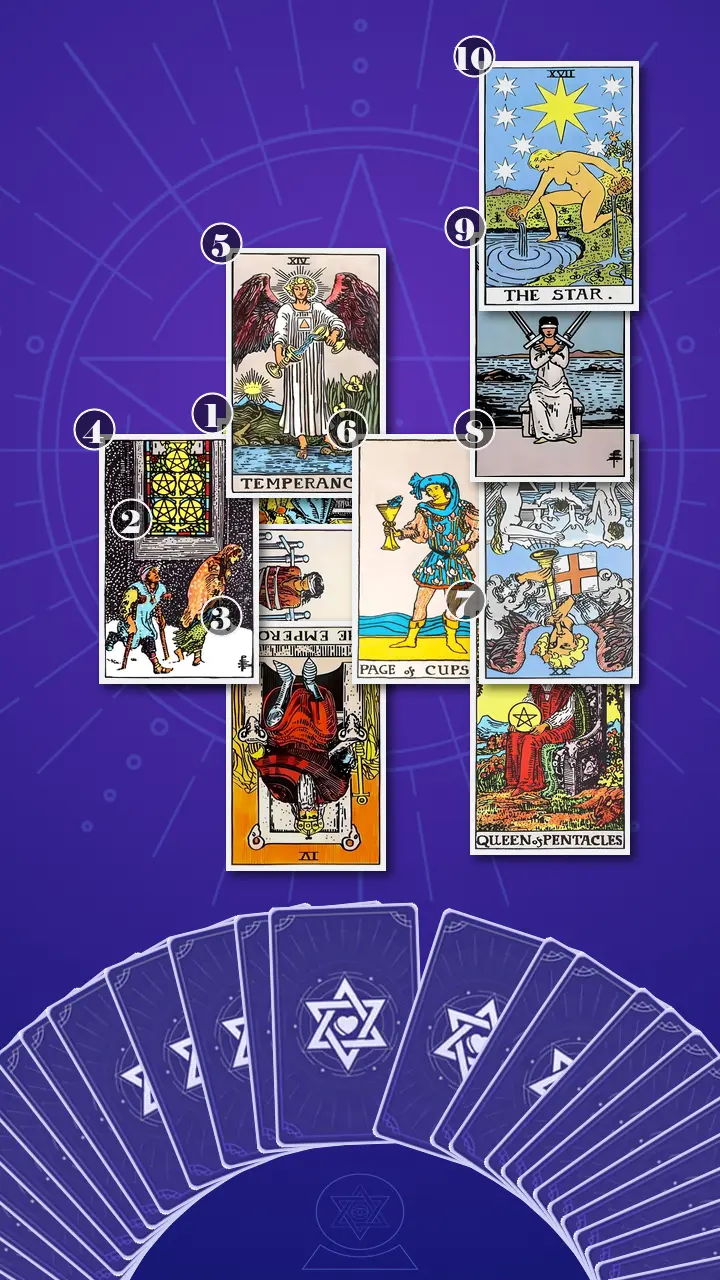
Reading the Map: Card Meanings in Context
Position 1: The Lived Present the Voicemail Activates
“Now flipping over,” I said, “is the card that represents what the voicemail is activating in you right now—the lived present.”
Six of Cups, reversed.
I described what I saw and then grounded it in her reality: “It’s after work in your Toronto condo and you tell yourself you’ll cook and decompress, but instead you open the voicemail tab like it’s a portal. You replay the same 20 seconds, looking for a ‘good dad moment’ hidden inside the tone. For a few minutes you feel closer to something—then you feel eight years old again, scanning for what you did wrong, and the rest of your night starts orbiting around earning relief instead of living your life.”
Reversed, the Six of Cups isn’t “sweet nostalgia.” It’s memory turning into a loop—comfort-seeking that accidentally tethers you to the past. The energy here is blockage: tenderness that can’t move forward because it keeps trying to get something retroactively from an old scene.
Taylor gave a small laugh that had no humor in it. “That’s… too accurate,” she said, blinking fast. “It’s kind of brutal.”
“I know,” I said gently. “And it’s not a character flaw. It’s a system. We’re going to map it.”
Position 2: The Main Block Keeping the Trigger ‘In Charge’
“Now we’re looking at the card that represents the main block—what keeps the trigger in charge of your nervous system and choices.”
Eight of Swords, upright.
“The main block shows up as a thought that feels like a fact: ‘If I don’t decode what he meant, I can’t calm down.’ So you over-explain emails, rehearse conversations, and draft perfect replies—because your mind believes perfection is protection. From the outside, nothing is stopping you. Inside, the blindfold is the story you can’t stop believing.”
This is an excess of Air—thinking as containment—until it becomes a cage. I told her the metaphor that always lands with people who live in Slack and Google Docs: “It’s like being stuck in a thread where you keep rereading the same sentence for tone, convinced the real meaning is hidden in punctuation. Your jaw is tight, your breath is shallow, and your brain goes: If I can decode him, I can calm down.”
Then I pointed to the symbol that matters most in the Eight: the bindings are loose. There’s space between the swords. “Your phone is in your hand,” I said, “but it’s not your boss.”
Taylor didn’t nod big. She nodded like someone trying not to cry in an elevator—small, tense, almost imperceptible. Relief and embarrassment crossed her face at the same time.
“You’re not weak for reacting—your nervous system is doing pattern recognition,” I added. “But we can change the order of operations.”
Position 3: The Unconscious Pattern Your Body Learned
“Now flipping over is the card that represents the unconscious pattern underneath—what your body learned to do automatically.”
The Emperor, reversed.
“Underneath the trigger is an internal authority system that learned ‘safety = being managed.’ When you hear his cadence, your inner voice turns into a strict manager: set rules, clamp down feelings, demand competence. And because that model never actually feels protective, you swing between craving external approval and rejecting structure altogether—then feeling even less steady.”
Reversed, The Emperor is imbalance: authority that doesn’t feel like protection, so it becomes control. It’s armor under robes—self-discipline that’s secretly fear.
In my other life on radio, I’ve heard this pattern in callers a hundred different ways. People don’t say, “My internal authority is unstable.” They say, “I don’t know why I can’t just calm down.” But the moment a certain voice hits their ears, their whole system snaps to attention like a metronome got set to panic tempo.
Taylor’s eyes flicked off-screen—toward where her phone probably was. “It’s like I become my own boss,” she said, “and I’m a terrible one.”
“That’s a clean insight,” I told her. “And it’s not the end. It’s a map coordinate.”
Position 4: The Old Script the Voicemail Taps Into
“Now this card represents the specific childhood/emotional imprint the voicemail taps into—the old script.”
Five of Pentacles, upright.
“The voicemail taps an old script of being outside the warmth. It’s the childhood feeling of seeing comfort ‘available’ somewhere—just not reliably for you. So today, even a neutral tone can land like exclusion. You stop asking, stop receiving, and start trying to be ‘good enough’ so you won’t feel the cold of not being met.”
The Five of Pentacles carries a deficiency of warmth—belonging that feels conditional. It’s the body-memory of standing in the snow while a window glows somewhere you don’t trust you’re invited into.
Taylor swallowed, and I watched her throat work like she was pushing down something that deserved air. “That ‘outside’ feeling is the worst part,” she said quietly. “It’s not even what he says. It’s… where I go.”
“Exactly,” I said. “The voicemail is the elevator button. The building is older.”
Position 5: Your Conscious Intention—What You’re Aiming For
“Now this card represents your conscious intention: how you want to reparent yourself and what you’re aiming for.”
Temperance, upright.
“What you’re aiming for is not erasing the voicemail or forcing forgiveness—it’s integration. You want to be the adult who can feel grief without drowning in it. In real terms, that looks like a repeatable blend: regulate your body first (breath, grounding), then name what’s happening in plain language, then choose one steady next step.”
Temperance is balance—one foot in water, one on land. It’s the opposite of “figure it out perfectly.” It’s “stay with yourself consistently.”
“That’s all I want,” Taylor said. “To be… normal about it.”
“Not ‘normal,’” I corrected softly. “Steady.”
Position 6: The Near-Term Opening if You Respond Differently
“Now this card represents what becomes available soon if you respond differently to the trigger—a near-term opening.”
Page of Cups, upright.
“If you respond differently, a near-term opening appears: instead of using the voicemail as the only emotional input, you start getting messages from inside. You pause after the trigger and ask, ‘What am I actually feeling right now?’—and something honest (sometimes surprisingly tender) surfaces. It’s not dramatic; it’s just new: feelings as information, not emergencies.”
This is Water in a healthier form—not backward-pulling nostalgia, but fresh emotion that can be cared for. The Page’s energy is availability: openness without panic.
As I said that, Taylor’s shoulders dropped maybe half an inch. It was subtle, but I’ve spent a decade listening to the body through sound; small shifts are still data. “I can feel that,” she admitted. “Just hearing you say ‘not emergencies’… my chest isn’t as tight.”
“That’s the fish in the cup,” I said. “The unexpected truth that appears when you stop interrogating the past.”
When the Queen of Pentacles Set the Thermostat
Position 7 (Key Card): The Inner Caregiver You’re Learning to Embody
I let the room settle before turning the next card. Even through a screen, I could feel the moment Taylor braced—like her system expected a verdict.
“Now,” I said, “we’re flipping the card that represents your reparenting stance today: the inner caregiver you’re learning to embody.”
Queen of Pentacles, upright.
Before I interpreted, I watched Taylor’s face do what it always does when someone is on the edge of a new pattern: her breath paused, eyes went slightly unfocused, then she swallowed like she was trying to hold her emotions in place.
Setup (the stuck moment): You’re on the couch, earbuds in, replaying the voicemail like it holds the final answer—while your body tightens and tomorrow’s rest plans quietly disappear from your calendar.
Delivery (the sentence that changes the order of operations):
Stop trying to earn safety from the voicemail, and start giving yourself safety on purpose—like the Queen of Pentacles, build a small, real sanctuary in your everyday choices.
I let that hang for a beat. No fixing. No rushing. Just a clean note sustained long enough to actually be heard.
Then I added, plainly: “Reparenting isn’t a feeling you wait for—it’s a care-and-boundary move you make in real time.”
Reinforcement (making it real in the next 10 minutes): “Try this once in the next 10 minutes,” I told her. “Put your phone face-down, set a 2-minute timer, and do one Queen-of-Pentacles care move—water, snack, tea, or a warm shower. Only after the timer, write one sentence: ‘Right now, I’m safe enough to ___.’ If it feels too intense, you can stop early—this is practice, not a test.”
Taylor’s reaction came in a three-step wave. First: her body froze—breath caught high, fingers hovering near her collarbone like she was waiting for impact. Second: the idea seeped in—her eyes glazed for a second, like she was replaying last night’s loop and seeing a new exit sign. Third: the release—she exhaled, long and shaky, shoulders dropping as if someone had finally taken a backpack off her spine.
And then—an unexpected flare. Her eyebrows drew together. “But if I stop trying to understand it,” she said, voice sharper, “doesn’t that mean… I’m admitting he never gave me what I needed?”
I didn’t talk her out of it. “Yes,” I said softly. “Sometimes that’s exactly what it means. The Queen of Pentacles doesn’t gaslight you into ‘it wasn’t that bad.’ She says: it was real, and I’m here now.”
This was the pivot from her starting state—flinch and tightness—toward the desired state: adult steadiness that can hold the memory without letting it run the day. The emotional transformation here wasn’t “no more triggers.” It was from earning safety through interpretation to giving safety through practice.
I asked her, “Now, with that new lens—think of last week. Was there a moment when you listened, got tight in the throat, and then cancelled something good for you? What would have happened if you’d done care first, meaning second?”
Taylor stared at the bottom corner of her screen like she was watching herself in a replay. “I would’ve eaten,” she said finally, almost embarrassed. “I would’ve… just eaten dinner.”
“That’s not small,” I said. “That’s leadership.”
Position 8: External Context and Ongoing Triggers
“Now,” I said, “this card represents the external context and ongoing triggers—what in your environment reinforces the old pattern.”
Judgement, reversed.
“Your environment keeps pulling you into ‘verdict mode’: voicemail notifications, camera roll memories, holidays, and even friends’ casual parent stories. The voicemail starts to function like a trumpet you can’t un-hear—summoning an old version of you. So you keep revisiting it, hoping for a final ruling that says you’re okay, and you delay living until you feel resolved.”
This is a blockage of forward motion: life on hold, waiting for a ruling that never arrives.
As I said “trumpet,” Taylor glanced down—probably at her phone—and made a tiny motion like turning it face-down. I could almost hear the notification badge in the air between us.
“You can stop mid-spiral,” I reminded her. “You don’t owe the loop a conclusion.”
Position 9: Hopes and Fears
“Now this card represents your hopes and fears—what you’re afraid will happen if you stop chasing clarity or approval.”
Two of Swords, upright.
Here’s how it translated in her life: the hope is peace, the fear is what the peace might reveal. The Two of Swords is protective indecision—crossed swords over the heart, blindfold on, holding your breath so you don’t have to choose a feeling.
It’s the mirror moment: “I’m fine,” while your chest is being held shut. It’s drafts unsent because committing to a stance feels dangerous.
“I think I’m scared that if I stop analyzing,” Taylor said, “I’ll just… feel everything.”
“That fear makes sense,” I said. “But the Queen isn’t asking you to feel everything at once. She’s asking you to feel enough, and then take one protecting step.”
Position 10: Integration Direction—What Healing Looks Like in Practice
“Now we’re at the card that represents integration direction: what healing looks like when you practice this consistently.”
The Star, upright.
“The Star as the integration direction points to healing through gentle self-trust, honesty, and emotional restoration. You don’t have to win against the voicemail; you can outgrow its power by repeatedly returning to your own steady light. Try tracking one small proof each day that you can soothe yourself without external confirmation.”
The Star is balance after hardship: not a dramatic glow-up, but a steady return to baseline. It echoes Temperance—the quiet, repetitive pouring. In Toronto terms, it’s streetlights on wet pavement, a quiet kitchen, the sound of water running while your phone stays face-down for once.
Care First. Meaning Second: Actionable Next Steps
I looked at the whole spread and told Taylor the story it was telling me.
The voicemail (Six of Cups reversed) wasn’t “just a memory.” It was a portal that pulled her into a younger role—then her mind clamped down (Eight of Swords) and tried to solve her way back to safety. Underneath, the internal authority imprint was shaky and harsh (Emperor reversed), so the system kept outsourcing steadiness to his tone. The old wound wasn’t only about him—it was about the feeling of being outside warmth (Five of Pentacles). Her conscious intention was integration (Temperance): regulate, name, choose. The near-term opening was emotional honesty without emergency (Page of Cups). The antidote—the center of gravity—was the Queen of Pentacles: consistent care plus protective structure. And the long game was The Star: tiny proofs that her own steadiness is real.
The cognitive blind spot was clean: you’ve been treating clarity as the entry fee for calm. But your transformation direction is the opposite: calm first, then meaning. Or, as I said to her: “Care first. Meaning second.”
Because I work with sound for a living, I added my own lens—my Music Pulse Diagnosis. “Taylor,” I asked, “what have you been playing on repeat lately—like the songs you put on without thinking?”
She winced. “Sad girl stuff. Phoebe. Also lo-fi when I’m trying to fix myself.”
“That makes sense,” I said. “Your playlist is showing grief and management. Tonight we’re going to give your nervous system a new soundtrack—one that supports the Queen’s steady temperature.”
I offered a simple plan she could start immediately—no spiritual performance, no ‘healing plan’ spreadsheet required:
- The One-Listen Rule (7-day container)If you choose to play the voicemail, play it once. Then close the app and put your phone face-down for 3 minutes with a timer. (If 3 feels impossible, start with 60 seconds.)Expect the “this is silly” backlash—that’s the Eight of Swords protecting the loop. You’re not forcing yourself to listen; you’re choosing a boundary if you do.
- 3-Sentence Reality Check (Notes app, no editing)Right after the timer, write: (1) “Today, I am safe because ___.” (2) “My worth today is not decided by his tone; it’s anchored in ___.” (3) “The next right step I can take is ___.”Set a 2-minute timer and stop when it ends. This is not a writing assignment. It’s you interrupting the courtroom.
- Queen-of-Pentacles + Sound: a 20-minute sanctuaryWithin 20 minutes, do one care move (protein snack, water, tea). While you do it, run a “Breath Soundtrack”: inhale 4 counts, exhale 6 counts, for 6 rounds. Put on one steady track underneath—low distraction, around 60–70 BPM, or soft brown noise if the city feels too loud.This is my “White Noise First Aid” for spirals: you’re giving your body a predictable sonic floor so your mind can unclench. Keep it boring on purpose—boring is safety.
Before we ended, I gave her a small BGM Prescription—three options she could rotate depending on the moment, because different triggers want different sound:
1) After-voicemail reset: one calming, low-lyric track (something ambient or instrumental) so her brain couldn’t keep arguing with words.
2) Bedtime structure: brown noise or rain sounds for 10 minutes while her phone charged across the room.
3) Morning TTC buffer: a steady-tempo playlist she only used for commuting—so the phone wasn’t the first “trumpet” of the day.

A Week Later: The Quiet Proof
Eight days later, Taylor messaged me: “I did the one-listen rule three times. I still got tight in the throat, but I didn’t cancel my yoga class. I ate dinner first. Also… the face-down timer made me mad the first day, which I think means it’s working.”
She added one more line: “I slept through the night. I woke up and my first thought was still ‘what if I’m not actually over it?’—but this time I made tea anyway.”
That’s the Journey to Clarity I trust: not the fantasy of never being triggered, but the reality of returning to yourself—over and over—until your inner parent becomes the loudest voice in the room.
When a 20-second voicemail can tighten your throat and reorganize your whole day around being ‘good enough,’ it makes sense that you’re exhausted—because you’ve been trying to build safety out of someone else’s tone.
If you didn’t have to earn safety from that old voice today, what’s one small, concrete care choice you’d be willing to give yourself first?