When Your Loan Balance Feels Like a Moral Verdict—and a Way Forward

Finding Clarity in the Portal Glow
You can run a whole campaign calendar at work, but one student loan portal login triggers a full-body shame spike.
Jordan (name changed for privacy) said that to me like they were confessing a glitch they couldn’t debug. They were 28, living downtown Toronto, dressed the way so many young professionals dress when they’re trying to look “fine”: clean lines, neutral colors, a phone that never stops lighting up.
They described a scene I’ve heard in a hundred variations, but theirs had weight in the details—9:47 PM on a Sunday, laptop fan humming like a tiny anxious engine, the room lit by that cold blue-white portal glow. One tab was the loan balance, another was a repayment calculator, and another was Instagram Stories—friends’ cottage weekends, “just bought a place” posts, a wedding reel that auto-played with sound off. Jordan’s stomach tightened as if bracing for bad news, jaw clenched so hard their cheek muscles ached, and then—like a reflex—they closed all the tabs “like they’re on fire.”
“I want financial freedom so badly,” they said. “But looking at the balance feels like… proof. Like it’s telling me who I am.”
Shame doesn’t feel like an idea. It feels like trying to breathe through a scarf pulled too tight—quiet, constricting, and somehow loud in your body.
I nodded, keeping my voice steady and human. “That makes so much sense. We’re not going to force a big life overhaul tonight. We’re going to name the story that turns data into a verdict—and then we’ll find one small next step that your nervous system can tolerate. Let’s make a map through the fog. Let’s find clarity.”

Choosing the Compass: The Celtic Cross · Context Edition
I asked Jordan to take one slow breath with me—nothing mystical, just a clean transition from spiraling to observing. As they exhaled, I shuffled the deck in a slow, even rhythm, the way you might smooth a tangled thread before you try to sew with it.
“Today,” I said, “we’ll use a spread called the Celtic Cross · Context Edition.”
For anyone reading along who’s ever wondered how tarot works in a real-world situation like debt anxiety: I use spreads like structured conversations. This version is designed to separate the surface trigger (what happens the moment you see the balance) from the blocker (the inner-critic loop) and the deeper root belief (the story about worth and safety underneath). Then it climbs toward integration: what supports you, what you’re afraid will happen, and what a realistic shift looks like if you choose steady, repeatable actions.
I told Jordan what to expect. “The first card will show that immediate portal moment—body, emotion, what you do in the first sixty seconds. The second card is the crossing energy—what keeps you stuck in the same loop. And the third card goes underneath, the deeper belief this number activates. From there we’ll move toward what you’re aiming for, and what kind of next steps actually work.”
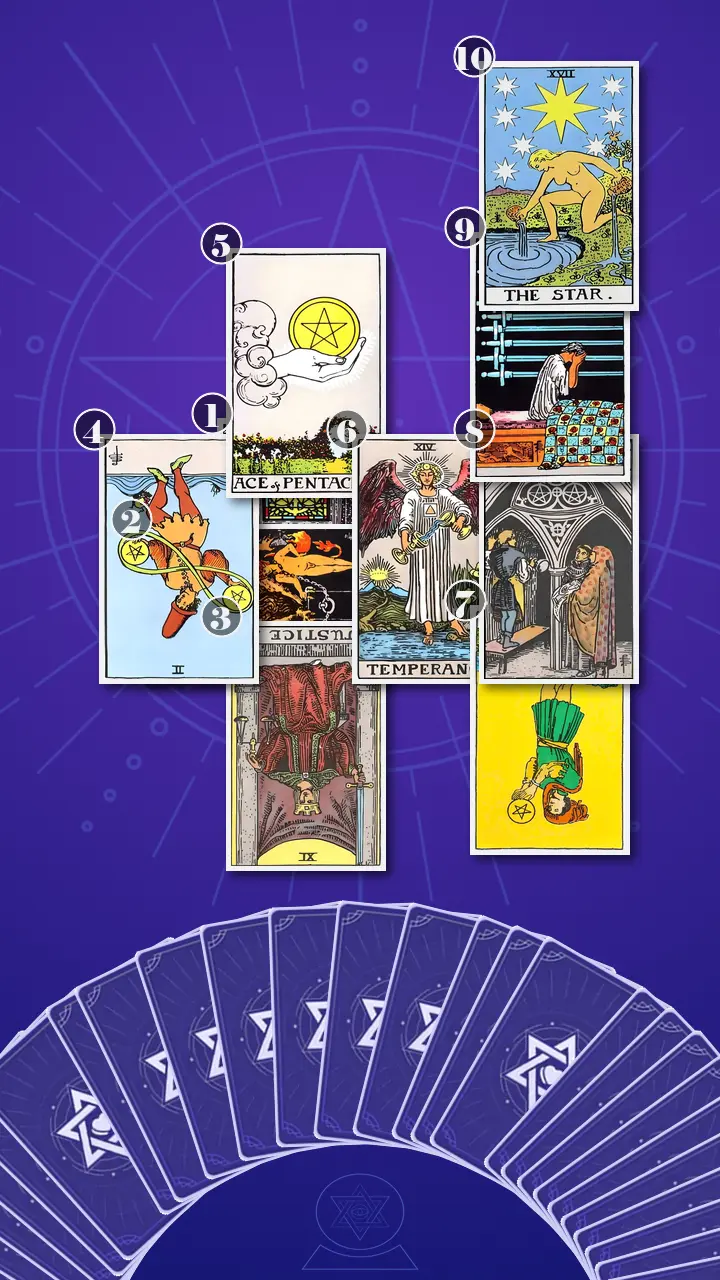
Reading the Map: Card Meanings in Context
Position 1: The Immediate Trigger Response
“Now we’re turning over the card that represents the immediate trigger response: what you do and feel the moment you see the loan balance.”
Five of Pentacles, upright.
I always notice how people react to this card before they say anything. Jordan gave a small, involuntary laugh—one of those laughs that’s half air, half bitterness.
“That’s… mean,” they said quietly. “Accurate. But mean.”
“It can feel that way,” I replied. “This card is the ‘outside-looking-in’ feeling. Two figures in the snow, limping past a lit window. In modern life, it’s exactly what you described: you open the portal, the number hits, and you instantly feel ‘behind’ compared to friends—even if your payment plan is workable on paper.”
I let it land in the body. “Five of Pentacles is contracted earth energy. It’s not just a thought. It’s your stomach dropping, your jaw bracing, your shoulders creeping up. The number becomes a cold weather system that convinces you you’re locked out of warmth.”
I asked the question the position demands. “Next time you open the portal, what’s the first physical reaction you notice—jaw, stomach, chest—and what do you do within the next sixty seconds?”
Jordan’s gaze lowered to the table. Their thumb rubbed the side of their index finger, over and over, like they were trying to erase a sensation. “I close it,” they admitted. “And I scroll. Like… Instagram or Netflix. Anything.”
“You’re not bad with money—you’re stuck in a shame-loop with a login screen as the trigger,” I said, gently but plainly, so the shame wouldn’t have room to multiply.
Position 2: The Blocker / The Voice That Crosses You
“Now we’re turning over the card that represents the blocker or tension: the inner-critic voice or attachment that keeps you stuck in the same loop.”
The Devil, reversed.
I didn’t dramatize it. I didn’t need to. This is one of the most ordinary cards in modern life: compulsion masquerading as control.
“This,” I said, “is the ‘only for a second’ loop.”
And I painted it the way it actually happens: you get a bank notification—RBC, TD, Tangerine, whatever—and your thumb moves before your values do. You tell yourself you’ll just peek. Then you refresh. Then you scan the interest details. Then you open a calculator. Then your chest gets hot and tight like you’re about to be scolded. And finally you slam the phone screen off as if the number is attacking you.
“Reversed,” I continued, “the chains are loose. That matters. It means you’re already noticing the trap. But the pattern is sticky because shame pretends to be motivation. One voice says, ‘If I shame myself hard enough, I’ll finally fix it.’ Another voice—exhausted—says, ‘I can’t do this right now. I’ll deal with it next weekend.’”
I watched Jordan’s face soften with reluctant recognition. Their shoulders dipped a fraction, then rose again, like their body didn’t yet trust it was allowed to relax.
“Close the portal on purpose—don’t wait until you’re in pieces,” I added. “That’s how we start breaking the chain: not by winning a mental argument, but by interrupting the loop with a boundary.”
Position 3: The Root Belief Underneath the Loop
“Now we’re turning over the card that represents the root belief: the deeper story about worth, control, or safety that the loan number activates.”
Justice, reversed.
I exhaled through my nose, not in frustration—more in recognition. Justice reversed is the inner courtroom.
“You’re not just looking at a balance,” I said. “You’re putting yourself on trial.”
I translated it into their actual nights: the midnight Google Sheet, color-coded, perfectly spaced columns. Not planning—prosecuting. Each purchase becomes evidence. Each choice becomes a moral label. The sword becomes your mind turned sharp against yourself. The scales become an unfair comparison between you and everyone you think is ‘ahead.’
“A balance is data. The verdict is optional,” I said, and I made sure my tone held steady on the word optional.
Jordan swallowed. “I know it’s just a number,” they whispered, “but it feels like a character report.”
“Exactly,” I said. “And Justice reversed says: somewhere along the way, you learned a rule that accountability must come with punishment. That you don’t deserve relief until you’ve suffered enough.”
I asked the deeper question. “If the balance felt like it proved something about your worth, what would it be proving—and who taught you that rule?”
Jordan didn’t answer right away. Their eyes unfocused for a moment, like a memory replaying on a screen only they could see. Then they shook their head once. “I don’t even know. It’s just… in me.”
“Sometimes it’s not one person,” I said softly. “Sometimes it’s culture. Sometimes it’s the way ‘adulting’ gets joked about until it stops being funny.”
Position 4: The Recent Pattern That Keeps Re-Creating the Spiral
“Now we’re turning over the card that represents the recent pattern: what has been happening that keeps re-creating the same emotional spiral around money.”
Two of Pentacles, reversed.
“Overloaded juggling,” I said. “Too many moving pieces, no stabilizer.”
In the card, the figure tries to keep two coins moving in an infinity loop while waves rise behind them. Reversed, the loop stops being flexibility and becomes fatigue.
“This looks like Friday after work,” I told Jordan, “switching between rent, groceries, subscriptions, and your loan payment. One unexpected cost hits—a transit pass reload, a prescription, a birthday dinner—and your brain decides the whole system is pointless. So you drop the money task entirely and tell yourself you’ll ‘reset’ next month.”
I made the energy dynamic clear. “This is not laziness. This is an unstable system. When the system wobbles, Justice reversed gets louder: ‘See? You can’t be trusted.’ Then the Devil loop kicks in to try to control the feeling.”
Jordan’s mouth tightened. “It’s like I have to solve everything at once or it doesn’t count.”
“That’s the infinity loop talking,” I said. “And it’s lying.”
Position 5: The Conscious Goal (and the ‘Perfect Fix’ Fantasy)
“Now we’re turning over the card that represents your conscious goal: what you think you ‘should’ do to fix this, and what you’re aiming for.”
Ace of Pentacles, upright.
“This is the part of you that wants a real, grounded fresh start,” I said. “Not ten new trackers. Not a punishment plan. A single tangible beginning.”
I pointed to the image: a hand offering a coin, a garden path through an archway. “It’s not showing you the entire journey. It’s showing you the next step you can actually touch. Autopay. One stable rule. One seed.”
I asked, “What’s the ‘perfect fix’ you think you should do—and what are you hoping it would finally let you feel?”
Jordan let out a breath that sounded like someone setting down a heavy bag. “Relief,” they said. “Like I could celebrate something without this… hovering.”
“Good,” I said. “We’re going to make relief something you practice, not something you earn at the end.”
When Temperance Spoke: The Rhythm That Ends the Shame Spiral
Position 6: The Next-Step Energy
I held my hand over the next card for a beat. The room felt quieter—not spooky, just attentive, like when the subway doors close and the whole car collectively pauses before the next station announcement.
“Now we’re turning over the card that represents the next-step energy: the most realistic way this shifts when you choose small, steady actions.”
Temperance, upright.
Temperance is measured balance. It’s the opposite of the shame-sprint. In the image, an angel pours water between two cups—patient, constant, not trying to prove anything.
Setup: I looked at Jordan and spoke directly to that familiar Sunday-night scene. “That moment—laptop open, portal glowing, stomach tight—usually ends with you closing the tab and telling yourself you’ll be ‘better’ next weekend. You get a few minutes of relief, and then the heaviness comes back, because nothing actually changed except your avoidance.”
Delivery:
Stop trying to burn off shame in one dramatic fix; pour small, steady choices like Temperance mixing water—until the number becomes just information.
I let silence do its job. Outside, somewhere down the street, a car hissed over wet pavement—Toronto winter sound, half slush, half rain. A reminder: seasons shift by repetition, not by force.
Reinforcement: Jordan’s reaction came in layers, like weather changing over a lake. First, a freeze—their breath paused, their eyes widening just slightly. Second, the mind trying to catch up—their gaze drifted off the card, unfocused, as if replaying every midnight spreadsheet sprint and every slammed-shut tab. Third, the release—an exhale from deep in the chest, shoulders dropping in a way they seemed surprised by, like their body had been holding a brace they didn’t know it was wearing.
Then the resistance arrived—honest, sharp. “But if I do it that way,” Jordan said, a flash of frustration in their voice, “doesn’t that mean I’ve been doing it wrong? Like… I’ve wasted time.”
I didn’t flinch. “It means you were doing what your nervous system could do under shame,” I said. “And now we’re changing the rhythm. Not because you failed. Because the old method wasn’t designed for you to succeed.”
This is where my family’s old Highlands wisdom and modern psychology agree: you don’t argue a storm into stopping. You build shelter, then you wait, then you step out in a measured way.
I leaned into my Nature Empathy Technique—my way of reading people through cycles, not just symptoms. “Think of your shame spike like sudden sleet,” I said. “It’s not proof you’re broken. It’s a weather front. Temperance is your forecasted plan: same day, same steps, small pour. You don’t have to be inspired. You just have to be consistent.”
“Now,” I asked, “with this new lens, can you remember a moment last week when this insight would’ve changed the outcome? A time you could’ve done a small ‘pour’ instead of a dramatic fix?”
Jordan blinked, once, slowly. “Tuesday,” they said. “On Line 1. I got an interest update email. I did the whole refresh-and-panic thing between stations.”
“That’s it,” I said. “Temperance doesn’t demand you become fearless. It teaches your body it’s safe to stay present with the number.”
And I anchored the transformation out loud: “This isn’t just about choosing a repayment strategy. It’s a shift from self-punishment to compassionate accountability—from ‘this number proves I’m a failure’ to ‘this number is information, and I can take one steady action.’”
The Integration Ladder: Self, Support, Fear, Horizon
Position 7: Self-Concept in the Money Story
“Now we’re turning over the card that represents self-concept in the money story: who you believe you are when you look at your finances.”
Page of Pentacles, reversed.
“This is beginner-shame,” I said. “The part of you that believes you should already know how to do this. So instead of learning one simple skill, you procrastinate—and then it feels even more embarrassing.”
Reversed, the Page’s curiosity collapses into hesitation. “It’s like staring at the pentacle and thinking it’s a personality test. ‘I’m not a finance person.’”
Jordan’s lips pressed together. “I hate how true that is.”
“Then let’s make it training, not identity,” I said. “Replace ‘failure’ with ‘student.’ Students aren’t morally wrong for being new.”
Position 8: External Realities and Supports
“Now we’re turning over the card that represents external realities and supports: systems, people, and structures that can help.”
Three of Pentacles, upright.
Jordan’s face changed at this—barely, but it was there. A tiny softening around the eyes. Relief-by-structure.
“Blueprint with a team,” I said. “This counters the Five of Pentacles isolation. It says you don’t have to do this alone, and you don’t have to turn it into a dramatic confession.”
I made it practical. “It can look like a 20-minute money buddy session—screen-share optional. Or a reputable nonprofit credit counsellor intro call. Or even using one bank budgeting tool as scaffolding. The energy here is ‘plan,’ not ‘verdict.’”
Jordan let out a small breath. “Okay,” they said. “That… doesn’t feel impossible.”
Position 9: Hopes and Fears
“Now we’re turning over the card that represents what you secretly hope for and what you’re afraid will happen if you face this directly.”
Nine of Swords, upright.
“This is the 12:36 AM movie reel,” I said softly. “Your mind trying to protect you by rehearsing worst-case scenarios: ‘stuck forever,’ ‘never catching up,’ ‘everyone will know.’”
In the card, the figure sits up in bed with hands over their face. “It’s not that you’re weak,” I told Jordan. “It’s that worry is loud at night. It turns planning into panic.”
Jordan’s throat bobbed as they swallowed. “I can’t tell if I’m panicking or just numb,” they admitted.
“That’s part of it,” I said. “When the nervous system gets overwhelmed, it swings between fire and freeze.”
I offered a gentle, modern reframe. “If shame actually worked, wouldn’t you be ‘fixed’ by now?”
Position 10: Integration Direction
“Now we’re turning over the card that represents the integration direction: the lesson and likely inner outcome if you work the pattern.”
The Star, upright.
The Star is not a lottery win. It’s orientation. A long-term guiding light that doesn’t demand urgency.
“This is what ‘finding clarity’ looks like over time,” I said. “Not the instant disappearance of debt, but the disappearance of the verdict feeling. The ability to look at reality with calm truth and a plan.”
I pointed to the steady pouring in the image. “Like Temperance, it’s water poured consistently—onto land and into the pool. Practical nourishment and emotional renewal at the same time.”
Jordan stared at the card longer than the others. “I want that,” they said. “I want it to be… less dramatic.”
“Less dramatic is the goal,” I said. “Boring can be healing.”
The One-Page Reset: Facts, Not Verdicts
I leaned back and stitched the whole spread into one story Jordan could carry out of the room.
“Here’s the arc,” I said. “When you see the balance, Five of Pentacles hits—instant exile, like you’re locked out of the ‘stable adult life.’ Then the Devil reversed crosses you: compulsive checking and avoidance, shame pretending it’s the only way to get control. Underneath, Justice reversed is the engine—an inner courtroom where numbers become moral verdicts. Two of Pentacles reversed shows the recent reality: too many moving parts, no stabilizer, so you collapse into all-or-nothing. You consciously want Ace of Pentacles: one grounded beginning. Temperance is the bridge: a repeatable rhythm that teaches safety. Page of Pentacles reversed says you’re treating learning like humiliation. Three of Pentacles says you don’t have to learn alone. Nine of Swords is the night fear-fuel. And the Star is the outcome direction: calm hope built on routine and support.”
“Your cognitive blind spot,” I added, “is thinking the only ‘real’ progress is a dramatic fix. That’s Justice reversed teaming up with the Devil: punish yourself into transformation. But the transformation direction is the opposite: compassionate accountability. Data becomes information, not a verdict. Consistency becomes the proof.”
Then I gave Jordan what they actually came for: actionable advice and next steps they could do this week, not next year.
- The Chains-Off Check-In (15 minutes)Once this week, set a 7–15 minute timer, open your loan portal, and write down only two facts: balance and minimum payment. When the timer ends, close the portal on purpose—even if your brain wants “one more refresh.”Expect the thought “this is too small to matter.” That’s the inner judge. The win is the boundary, not the perfect plan.
- One Follow-Up Action (pre-chosen)Immediately after you close the portal, do one pre-decided step: either turn on autopay for the minimum, or schedule a 10–15 minute call/request with your servicer (calendar invite counts as success).Do the action first, then feel your feelings after—so feelings don’t get to veto the habit.
- Facts / Verdicts Reset (2 minutes)Open a note titled “Facts / Verdicts.” Write one verdict thought you notice (e.g., “I’m irresponsible”), then rewrite it as a neutral fact (e.g., “I have a loan balance and a minimum payment due on X date”). Make one decision using only the Facts column.If you get stuck, say out loud: “A balance is data. The verdict is optional.” Hearing yourself matters.
I also offered one of my simplest protection-and-regulation tools—because money shame isn’t just cognitive; it’s energetic and physical.
“Use my walking meditation strategy,” I told them. “After you do the check-in, go for a 5–10 minute walk—no music at first. Let your brain latch onto environmental sounds: streetcars, footsteps, wind between buildings. It teaches your body, ‘I faced the number and I’m still safe.’ That’s Energy Protection in the most practical sense.”
Jordan frowned, not in disagreement—more like logistical panic. “But I can’t even find fifteen minutes,” they said. “Work’s a lot. My commute’s a lot. And when I finally get home, I’m cooked.”
I nodded. “Then we do the smallest true version. Seven minutes on a low-energy day counts. Writing the facts on a sticky note counts. Doing it on your TTC ride counts—open the portal between stops, write the two facts, close it when you hit your station. Remember: consistency quiets the inner judge faster than intensity does.”

A Week Later: The Quiet Proof
Seven days later, Jordan sent me a message that made me smile—not because everything was solved, but because something shifted from drama to practice.
“Did the timer thing on Tuesday,” they wrote. “Seven minutes. Wrote the two facts. Closed it on purpose. Set autopay for the minimum. Walked home from the station without headphones like you said. It was weirdly calming.”
They added, “I still had the ‘I’m behind’ thought. But it didn’t take over the whole night. I slept.”
That’s how a journey to clarity usually begins: not with certainty, but with a small, repeatable action that proves you can stay present.
For a moment, I pictured the Highland path my grandmother used to walk in winter—peat-dark earth, wind sharp enough to make you blink, and the simple truth that you don’t outrun the season. You move with it. Step by step. Same day, same steps.
When a loan balance feels like a character report, it makes sense that your stomach drops—because it’s not the number you’re bracing for, it’s the verdict you’ve been trained to expect.
If you didn’t have to earn the right to look at your own numbers, what’s one tiny, repeatable step you’d be willing to try the next time the balance shows up—just to prove to yourself you can stay present for 15 minutes?