Closing the Laptop at 9:30 p.m.: Escaping Sink Shame in Two Minutes

The 9:30 p.m. Sink Alarm
You can deliver a polished UX deck, but you’re eating out of the one clean bowl because the sink feels like a personal failure.
Jordan (name changed for privacy) said it like she was confessing to a crime she didn’t understand. We were on a video call—me in my tiny office at the Tokyo planetarium after the last school group had gone home, her in a small Toronto apartment where the kitchen was basically a permanent background character.
“It’s always the same,” she told me. “Around 9:30, I finally close the laptop… and the sink is right there.”
She angled her camera. The overhead light had that thin, buzzing hum that makes everything look harsher than it is. A ramen bowl sat near the drain, faintly sour in a way you can almost taste at the back of your throat. Her phone warmed her palm like a little heater as she held it, thumb already hovering—five minutes of scrolling promised as a “break.”
Her shoulders had crept up toward her ears, and her jaw looked like it was trying to hold her whole life together by clenching. The dish pile wasn’t huge, but in a small-apartment line-of-sight kitchen, it might as well have been a neon sign flashing: you’re behind.
“I can handle complex projects, but I can’t handle a sink,” she said. “If I can’t keep this under control, it means I’m not actually competent.”
In that moment, her overwhelm wasn’t an abstract feeling—it was like trying to walk through a narrow hallway carrying an armful of sharp-edged boxes, knowing one wrong shift will make everything spill loudly onto the floor.
I kept my voice gentle and plain. “I hear you. And I’m not going to treat the dishes like a character flaw.” I let a beat of quiet settle, like dimming the lights before a star show. “Let’s use tarot as a practical map today—work, body, home—so we can find clarity, and a next step that doesn’t require a heroic personality.”

Choosing the Compass: The Seven-Card Cast Spread
I asked Jordan to take one slow breath in, and one longer breath out—just enough to move her attention from “I should be able to fix this” to “What’s actually happening.” While she did that, I shuffled. Not as a mystical performance—more like a way to let the mind stop arguing long enough for a pattern to show itself.
“I’m going to use a spread called the Seven-Card Cast,” I said. “It’s compact, which matters here. When someone is already living with decision fatigue, too many cards can start to feel like more tabs open.”
For you reading this: the Seven-Card Cast works well for practical life problems—burnout, routines, work-life-home imbalance—because it separates the layers cleanly. One position for the visible symptom (the dish pile), one for the immediate blockage (the moment you freeze), one for the body-level root (what your energy is doing), plus context and mindset. And then it gives a bridge from insight to actionable advice in the last two cards.
“We’ll start with what the dishes are signaling right now,” I told her. “Then we’ll name the thought pattern that stops you at the sink. And I want to pay special attention to the pivot card—what can restore alignment without you having to wait for a mythical ‘cleaning day.’”
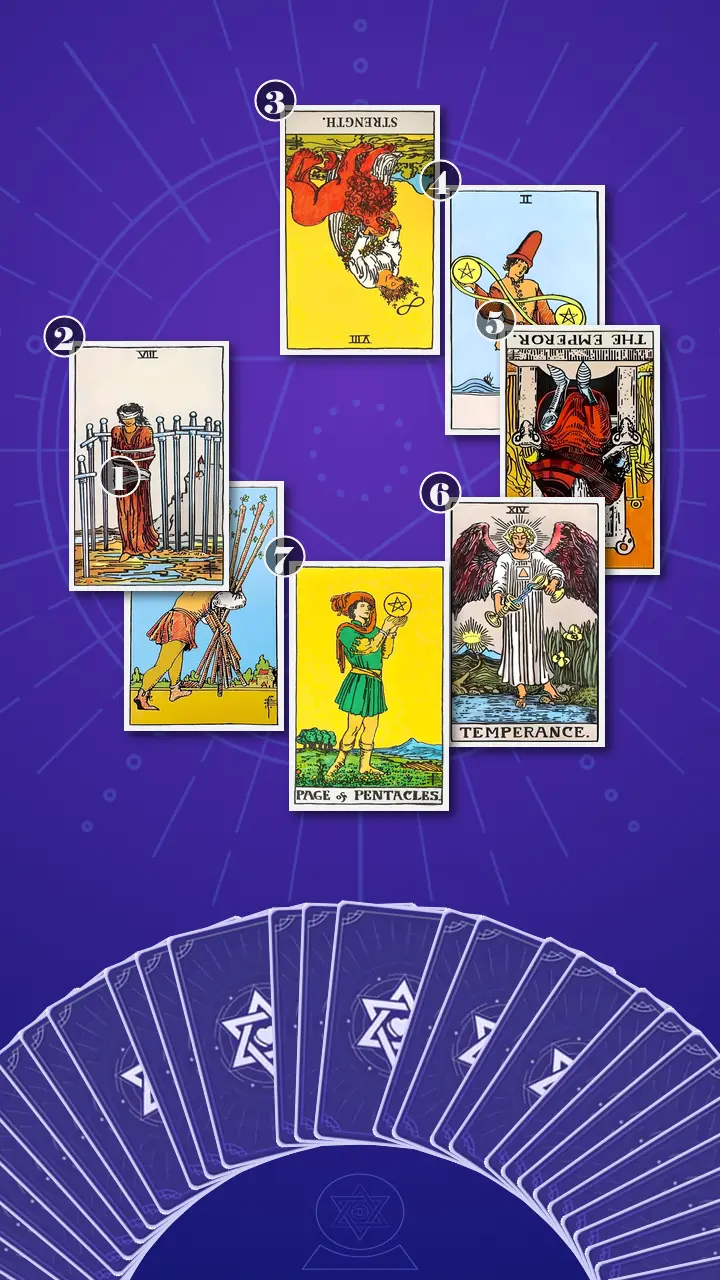
Reading the Arc: A Tarot Map for Burnout and Chore Paralysis
Position 1: The visible symptom right now
“Now we turn over the card that represents the visible symptom right now: how the dishes pile-up is functioning as a signal in daily life.”
Ten of Wands, upright.
I didn’t even have to reach for poetic language—this card is literal. A figure carrying too much, arms full, head down, vision blocked.
“This is like when you’re carrying ‘just one more thing’ all day—one more Slack reply, one more pixel-perfect tweak, one more doc—so when you finally look at the sink at 9:30 p.m., it registers as the last straw, not a simple task,” I said. “The dishes aren’t the problem; they’re the visible backlog of everything you’ve been carrying alone.”
Energy-wise, this is excess: too much output, too much proving, too much muscle through the day. The wands block the figure’s face the way an overcrowded to-do list blocks your ability to see one plate without seeing your entire life.
I added the line I wanted her nervous system to hear as truth, not criticism: “The sink isn’t calling you lazy. It’s calling your bandwidth out.”
Jordan let out a short laugh that sounded like it got caught on a bruise. “That’s… so accurate it’s kind of mean,” she said, but her eyes stayed on the card. Her fingers tightened around her mug, then loosened. Recognition, with a sting.
Position 2: The primary blocker
“Now we turn over the card that represents the primary blocker: the thought pattern or immediate pressure that stops follow-through at home.”
Eight of Swords, upright.
“This is the sink moment turning into a high-stakes project,” I told her. “The ‘right’ soap, the ‘right’ time, the ‘right’ order. And because it feels like a punishing form with too many required fields, you quit the form. Not because you can’t do it—because it’s punishing.”
That’s the Eight of Swords energy in blockage: air that should be clarity becomes a mental trap. The important detail is the loose ropes. The bind is real—because it feels real—but it isn’t tight.
I gave her the script I see in so many high-functioning perfectionists: “I need the right playlist, the right energy, the right time… nevermind.” Then I offered the counter-script, deliberately tiny: “One dish counts. One dish is movement.”
Jordan’s inhale paused as if her body had been bracing for a harsher verdict. Then she let out a slow exhale. “So I’m not uniquely broken,” she said quietly. Her gaze drifted away from the sink behind her, like the room had widened by an inch.
Position 3: The body-level root
“Now we turn over the card that represents the body-level root: what your nervous system and energy reserves are doing underneath the surface.”
Strength, reversed.
“This card is not about being ‘weak,’” I said. “It’s about the way you’ve been forcing willpower until it disappears. You push through the workday, and then at night your body goes heavy—arms like they’re filled with wet sand. The sink triggers shame, but the deeper issue is depletion.”
In reversed position, Strength is deficiency—not of character, of usable fuel. And the way you talk to yourself becomes part of the drain.
“Here’s the question this card asks,” I said, keeping my voice simple. “After work, do you talk to your body like a teammate… or like an employee?”
Jordan’s face shifted before she spoke—eyebrows pulled together, then softened. She swallowed. “Like an employee,” she admitted. “Like… ‘we’re not done yet.’” Her shoulders dropped a fraction, as if hearing it out loud made it undeniable.
I nodded. “And then the overcorrection hits. Weekend hero clean → crash → shame.” I gave her the blunt truth I’ve learned while watching planets keep time with relentless honesty: “If it only works on your best day, it’s not a system—it’s a fantasy.”
In my mind, I flashed to the planetarium’s projector—how even the brightest ‘burst’ of light is useless if the timing is wrong. Rhythm, not intensity, is what makes a sky readable.
Position 4: Recent work-life pattern
“Now we turn over the card that represents the recent work-life pattern shaping your bandwidth and routines.”
Two of Pentacles, upright.
“This is your calendar in card form,” I told her. “Hybrid days, last-minute requests, uneven meeting loads. You’re constantly adjusting and staying afloat, but home care never gets a stable slot. The dishes are what drop first because they don’t scream as loudly as work does—until they do.”
This card is balance-in-motion. Not grounded balance. Juggling balance. It keeps you moving, but it doesn’t give you an anchor.
Jordan nodded fast, like she’d been waiting for someone to name it without calling her dramatic. “It’s like I’m always on,” she said. “Even when I’m technically off.”
Position 5: The conscious rulebook
“Now we turn over the card that represents the conscious rulebook: standards, expectations, and the story you’re telling yourself about what the mess means.”
The Emperor, reversed.
“Okay,” I said, and I let myself get a little wry, because sometimes humor is the gentlest crowbar. “Meet your Inner Manager.”
I spoke in a mock policy-memo tone: “Competent people don’t let this happen. Relaxation is approved only after all surfaces are clean. Failure to comply will be interpreted as a failure of adulthood.”
The Emperor reversed is overcontrol that collapses into shutdown. A productivity app with impossible daily goals that resets your streak to zero if you miss one day. The kitchen becomes a courtroom, not a home.
Jordan made a sharp little “oh.” Her eyes watered, not in a dramatic way—more like her body was tired of being audited. “I’ve been turning my home into a test,” she said.
“Yes,” I said softly. “And this is where we pivot. Because structure can support you—without punishing you.”
When Temperance Poured Between Two Cups
Position 6: The balancing pivot
“Now we turn over the card that represents the balancing pivot: what shift can start restoring alignment across work, body, and home.”
The room felt quieter when I said it—like the planetarium right before the first star appears. Even through the screen, I could feel Jordan waiting for either a scold or a miracle.
Temperance, upright.
“Instead of waiting for a mythical ‘cleaning day,’ you build a gentle rhythm that fits your real energy,” I told her. “Two minutes after dinner. A usable sink. A small boundary around after-hours work. The change isn’t dramatic—it’s repeatable. And that’s what starts rebuilding trust with yourself.”
Temperance is balance through flow: a steady pour, not a flood. And because my life is built around celestial mechanics, I can’t help but see Temperance as an orbital lesson. When a system is overloaded, it doesn’t need a heroic thrust—it needs a tiny, consistent correction. In my own framework, I call this Orbital Resonance: detecting where your environment (Slack, deadlines, constant pings) is pulling your energy out of sync with your home rhythm. Your dishes are not a moral issue. They’re a resonance issue.
Jordan’s eyes narrowed like she was trying to read a subtitle she’d been missing for months. Her mouth opened, then closed.
It’s 9:30 p.m., you close the laptop, and the sink is right there—bright light, stale dish smell, phone warm in your hand—while your shoulders tense like you’re about to take a hit.
Your home isn’t asking for a perfect reset. It’s asking for a sustainable rhythm you can repeat on an average day.
Jordan’s reaction came in three clear waves. First, a physical freeze—her breath caught mid-chest and her hand stopped moving, thumb hovering above her phone as if the scroll reflex had been paused. Then, a cognition shift—her eyes unfocused for a second, like she was replaying every night she’d stood at the sink with the tap off and a plan she never started. Finally, emotion—her shoulders lowered on an exhale that sounded shaky and relieved at the same time.
“But… if that’s true,” she said, and there was a flash of anger under the relief, “doesn’t that mean I’ve been wrong? Like I did this to myself?”
I held her gaze. “It means you’ve been using the only strategy that ever got rewarded: push harder. At work, that strategy works—until it spills over. At home, it backfires because your body is already out of fuel.”
I let the next sentence land with care, because it’s the hinge for everything: “Mess is information, not a verdict.”
Then I gave her the bridge line exactly as Temperance demands—simple, practical, kind:
Stop treating the mess as a personal failure and start treating it as information, then practice one small, steady pour at a time like Temperance mixing the cups.
“Now,” I said, “use this new lens and tell me—last week, was there a moment when the sink showed up and you felt that hit in your shoulders? If this had been ‘information,’ what would it have told you?”
Jordan blinked hard. “It would’ve told me I needed to stop answering pings,” she said. “Not… punish myself with a Saturday deep-clean.”
That was the step from her starting state—shame-driven freeze and avoidance—toward the thing she actually wanted: calm, repeatable self-trust. Not certainty. Not perfection. Trust.
Position 7: The grounded next step
“Now we turn over the card that represents the grounded next step: a practical, repeatable action that rebuilds trust and reduces buildup.”
Page of Pentacles, upright.
“This is beginner energy,” I said. “Not because you’re childish—because the path forward is reps, not reinvention. One dish is a rep. A two-minute reset is a rep.”
The Page’s focus is balance in earth form: tangible, trackable, learnable. Not a grand identity makeover.
Jordan’s mouth tilted into a small, reluctant smile. “So… I can stop trying to design the perfect system,” she said.
“Yes,” I said. “You already know how to design systems. This time, we design for your average day. And remember: One dish is proof you’re not trapped.”
From Insight to Action: The Two-Minute Temperance Rhythm
Here’s the story the spread told in one line: you’ve been carrying too much (Ten of Wands), then your mind turns the sink into a threat (Eight of Swords), while your body is running on fumes (Strength reversed). Your schedule has trained you into constant adjustment (Two of Pentacles), and your Inner Manager makes home care a compliance test (Emperor reversed). Temperance offers a humane re-balance, and the Page of Pentacles asks for small, learnable reps.
Your biggest blind spot wasn’t “being messy.” It was believing that the only valid way to fix it is a perfect reset—so anything smaller feels pointless. The direction of change is clear: from “I need a perfect reset” to “I need a repeatable two-minute rhythm that matches my real capacity.”
I told Jordan, “In astronomy, we don’t ‘fix’ an orbit by yelling at it. We adjust the rhythm. Tonight, we’ll do the same.” Then I added the most important reframe for breaking an all-or-nothing cleaning cycle: “Stop-on-purpose is a skill, not quitting.”
These were her next steps—simple enough to do even when she was too tired to do dishes after work:
- The Two-Minute Temperance RhythmFor 7 days, right after dinner, set a 2-minute timer. Choose one category only (mugs OR plates OR utensils). Wash or load only what fits in 2 minutes—then stop when it rings, even if you could keep going.Expect your Inner Manager to say “two minutes is pointless.” That’s the point: you’re practicing consistency over intensity. If 2 minutes feels like too much, do 60 seconds—no catch-up.
- The Sink-Is-Usable StandardPick one “good enough” standard for this week: the sink is usable. Each night, clear just enough space so water can run and one mug can be washed.Write “Sink usable = I’m allowed to rest” on a sticky note near the faucet for one week. You’re replacing a harsh rule with a humane one.
- Slack-to-Kitchen Transition CueWhen you close your laptop, send one final message if needed (“Signing off, will pick this up tomorrow”). Then physically move the laptop to a shelf or closet before you touch the sink.This is my Solar Sail Principle in real life: use environmental resistance (the urge to keep working) as a signal to change direction. The physical move is the boundary.

A Week Later: The Quiet Proof
Six days later, Jordan messaged me a photo—not of a showroom kitchen. Just a sink with open space around the drain, a single mug drying by the faucet, and a timer still on the counter. “I stopped at two minutes and it made me mad,” she wrote. “Then I realized I was mad at the rulebook, not the dishes.”
She added: “I did the one-mug first move twice. It was stupidly helpful.”
Her change was light but real: she’d closed her laptop, put it away, and washed a few items without negotiating with herself for an hour first. She wasn’t magically cured of exhaustion. She was simply no longer making exhaustion mean she was failing.
In the soft, bittersweet way real life does it, she told me she celebrated by sitting alone with her tea, looking at the clear patch of sink like it was a tiny sunrise. The next morning, her first thought was still “what if I mess it up again?”—but this time, she exhaled and did the mug anyway.
That’s the Journey to Clarity I trust: not a perfect reset, but a sustainable rhythm you can repeat on an average day—Temperance’s steady pour becoming a new kind of self-respect.
When you’re staring at the sink with tight shoulders and a sinking stomach, it’s not really about plates—it’s that split-second fear that any mess means you’re not as competent as you look.
If you let your home be a place that supports you (not grades you), what would a ‘two-minute rhythm’ look like tonight—one small pour you’d actually trust yourself to repeat?
Every reading at AceTarot is a journey to connect with inner wisdom and empower your next step. The stories shared here are psychological mirrors, not private records—crafted to reflect universal emotional loops and help you find your own clarity. Learn more about our Journey to Clarity.