Friends Planning Trips Without You—And the Boundary That Stops Guessing

Finding Clarity in the 8:47 p.m. TTC Scroll
If you’re the friend who types a perfectly casual “Wait, is this open?” text, deletes it, and then tells yourself it’s ‘not worth it’—this is that freeze response (hello, group chat anxiety).
Jordan (name changed for privacy) came to me from Toronto with that exact question: “Trip plans without me—why do I freeze, and what’s one boundary step I can take?” She wasn’t asking me to predict whether she’d be invited. She wanted to understand why her body shut down—why her hands wouldn’t hit send—when her friends started planning in front of her.
She described it so clearly I could almost hear it: 8:47 PM on a Tuesday, on Line 1 heading south from Bloor-Yonge. Her phone warm in her palm as the group chat filled with Airbnb links and “who’s in?” polls. The fluorescent lights buzzing. The train rattling like a long exhale that never quite finishes. And then—her throat tightening like she swallowed a pebble, chest cinching, thumbs hovering over “Send” like it’s a trapdoor.
“I want to feel included,” she said, staring at her own locked screen like it could accuse her. “But the moment I consider asking, I’m sure I’ll sound needy. Like I’m begging for an invite.”
That’s the core contradiction right there: wanting to feel emotionally safe and included with your people, while fearing that speaking up will make you look “too much” and push you further out.
And the hurt she carried wasn’t loud. It was controlled—like a song turned down so low you can’t tell if it’s still playing, but it’s still eating up battery in the background.
I nodded, slow and steady. “We’re not here to make you cooler,” I told her. “We’re here to make things clearer. Let’s map what happens in that freeze moment—then find one boundary move that prioritizes clarity over perfect vibes.”

Choosing the Compass: The Four-Layer Insight Ladder Spread
I invited Jordan to take one breath with me—nothing mystical, just a clean transition. In my work (radio + music therapy), I’ve learned that a nervous system doesn’t shift because you tell it to. It shifts because you give it a new rhythm to follow.
As I shuffled, the cards made that soft papery hiss—like turning pages when you finally stop pretending you’re “fine” and start asking what’s true.
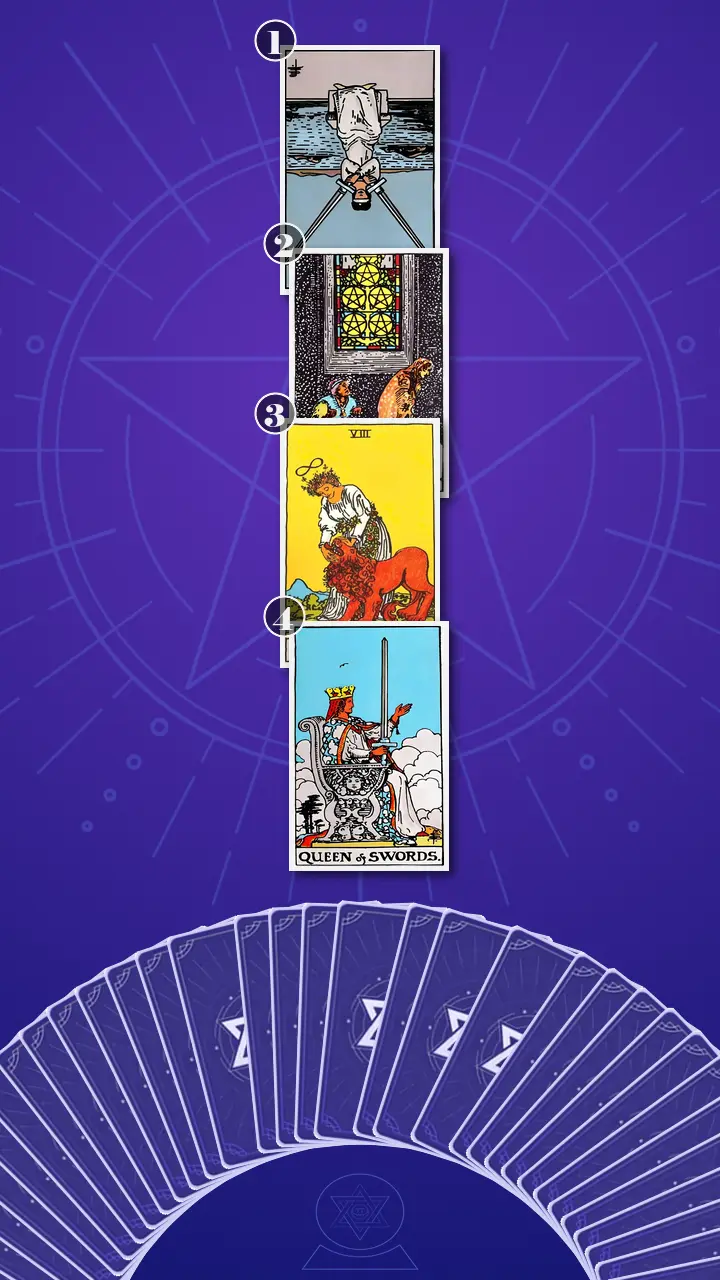
“Today I’m using a spread called the Four-Layer Insight Ladder · Context Edition,” I said. “It’s a four-card, linear ladder that’s especially useful as a tarot spread for feeling left out in a friend group—because it tracks your system from shutdown to one clean boundary step.”
And for you reading along: this spread works here because the question is about an internal nervous-system response (freezing) and a practical next move—not a prediction about who will invite whom. Four positions is the smallest complete container to move from symptom (freeze) to root (belonging fear) to pivot (regulation and self-respect) to a time-bound action you can take without trying to control anyone’s choice.
I pointed to the “ladder” structure. “Card one shows the freeze moment—what you do in the first sixty seconds. Card two shows what the freeze is protecting—what story or fear it’s trying to keep you from facing. Card three is the turning point—your inner capacity that restores steadiness. And card four is the one boundary step you can take this week.”
Reading the Ladder: From Freeze to a Single Boundary Step
The Freeze Moment — Two of Swords (Reversed)
“Now we turn over the card that represents The freeze moment: the most observable reaction pattern when you notice trip plans without you.”
Two of Swords, reversed.
And immediately, it translated itself into Jordan’s real life without effort: You’re on your couch after work in Toronto, laptop half-open, and your group chat suddenly turns into flight dates, Airbnb links, and inside jokes. You type: “Wait is this open to everyone?” then delete it. You open Notes to draft a ‘casual’ version, then close the app. Your throat goes tight, your hands feel weirdly frozen, and you decide you’ll “bring it up later” (but later never comes).
In tarot terms, the Two of Swords is about a stalemate—two impulses held in perfect tension. Reversed, that tension becomes a blockage. Not “you’re bad at communicating.” More like: your words lock up to protect your heart.
It’s Air energy (thought, language) that’s jammed. You can feel the feeling—hurt—but your system tries to survive it by going blindfold-first: mind-reading instead of asking. Crossed swords held close to the chest: guarding your softest place by freezing the conversation before it starts.
I said it plainly: “The spiral isn’t proof you’re dramatic—it’s proof you’re trying to stay safe without real information.”
Jordan didn’t nod like people do when they want to be polite. She let out a quick laugh that had no joy in it—more like a pressure release. “That’s… painfully accurate,” she said. “Even kind of brutal. The Notes app thing? I do that like it’s my job.”
I watched her fingers, how they curled and uncurling against her mug. A tiny freeze, then a tiny return.
“Exactly,” I told her. “Your first sixty seconds aren’t a character flaw. They’re a script. The work is noticing the script—then choosing a different line.”
What the Freeze Protects — Five of Pentacles (Upright)
“Now we turn over the card that represents What the freeze protects: the underlying fear about belonging, worth, and what it would mean to speak up.”
Five of Pentacles, upright.
This card is the ache underneath the behavior: You see the trip logistics and your brain instantly turns it into a belonging verdict: there’s a ‘warm room’ (their group) and you’re on the outside. Even if nobody said “you’re not invited,” your body reacts like you just got quietly rejected in public—cold stomach, sinking chest—and you start scanning for proof (who liked what, who replied fastest, who didn’t tag you).
In the Five of Pentacles, the scene is always the same: cold street, warm window. Not just “I missed a plan,” but “There’s warmth I can see, and I’m not allowed in.”
I said, “This is the belonging wound. The freeze is protecting you from a feared outcome: asking and hearing a ‘no’ that feels like public confirmation you don’t matter.”
Jordan swallowed—small movement, big meaning. Her eyes went slightly unfocused the way they do when a memory starts replaying without permission.
“I hate how much I care,” she admitted. “Like, I’m 27. Why am I still getting wrecked by a group chat?”
“Wanting to be included isn’t needy—it’s human. Abandoning yourself to look chill is what hurts,” I said gently. “The Five of Pentacles makes one plan mean everything. It turns logistics into a verdict.”
I also named the pattern in one clean line, because clarity loves simple cause-and-effect: “Trigger—trip plans without you. Belief—‘If I ask, I’ll look needy and get judged.’ Behavior—silence and delay. Short-term relief—no awkward moment. Long-term cost—no clarity, more resentment, more distance.”
In my head, I flashed back to my radio days: the way silence on-air feels like failure, so you start filling space with noise. Jordan’s version of “filling space” wasn’t talking—it was analysis. Refreshing. Re-reading. Searching for tone the way a producer searches for a glitch in a waveform. It looks like control. It feels like survival.
When Strength Spoke: Steady Courage Over Coolness
“Now we’re turning over the card that represents The turning point: the inner capacity to access so you can stay regulated and honest instead of shutting down.”
The room felt quieter as I flipped it—like even the city outside my window paused for a beat.
Strength, upright.
On paper, Strength is courage. But in real life, it’s nervous-system steadiness. It’s staying present with big feelings without being ruled by them.
And the modern translation landed exactly where Jordan lives: You feel the sting, and instead of performing ‘I’m chill,’ you do one regulating thing first: a slow exhale, feet on the floor, shoulders down. Then you send one grounded, human sentence—no speech, no apology tour—because you’re choosing self-respect over perfect social timing. You’re not trying to win the invite; you’re trying to end the guessing.
I leaned into my own specialty here—because sound tells the truth faster than our words do.
“Can I do a quick Music Pulse Diagnosis with you?” I asked. “When you’re in that TTC-scroll-and-freeze moment, what are you listening to—if anything?”
Jordan blinked. “Uh… I usually put on this playlist that’s basically… sad-girl indie,” she said, half-embarrassed. “It’s like I’m trying to feel it privately so I don’t leak it into the chat.”
“That makes so much sense,” I told her. “Your body is already playing a soundtrack: tight throat, tight chest, stuck hands. The playlist you choose can either widen your breath… or make the story feel even more final.”
Setup: It’s 8:47 PM, you’re on the TTC ride home, and you keep rereading the same three messages like the ‘real meaning’ is hidden between the emojis. You want to say something—anything—but you can feel your throat closing around the sentence before it’s born.
Delivery:
Not forcing yourself to be ‘cool’ or perfectly worded, but choosing steady courage—like Strength—so your boundary comes from calm self-respect, not panic.
I let it hang for a second. No extra words. Just air.
Reinforcement: Jordan’s body responded before her mind did. First, a tiny physiological freeze—her inhale caught, her fingers stilled mid-fidget. Then cognition seeped in: her gaze slid off the cards and went somewhere past my shoulder, like she was watching her own TTC reflection replay the moment her thumb hovered over “Send.” Then the emotional release: a long exhale that sounded almost surprised, and her shoulders dropped a full inch, as if she’d been carrying a backpack she forgot she put on.
“So I don’t have to be… chill,” she said slowly. “I just have to be… steady.”
“Yes,” I said. “And here’s the rule I want you to borrow from this card: Their answer is information. It’s not a verdict on your worth.”
I gave her a practice that matches Strength’s “soft grip,” not force: “Try the 10-minute One-Sentence Draft experiment. Set a timer for ten minutes. Write exactly two drafts of one message—no more. Pick the shorter one. Send it within 24 hours of noticing the trip planning. Then put your phone on Do Not Disturb for 20 minutes so you don’t spiral-refresh for a response. If sending feels like too much today, just pin the one-sentence draft in Notes. Your goal is steadiness, not self-punishment.”
Then I asked the question that turns insight into lived reality: “Now, with this new lens—can you think of a moment last week when this would have changed how you felt?”
Jordan nodded once, sharp. “Yesterday,” she said. “They were joking about dates, and I acted like I didn’t care. I literally felt my hands go numb.”
“That’s the exact pivot,” I told her. “This is you moving from silent mind-reading and shame-driven shutdown to steady self-respect and direct clarity-seeking. Not certainty. Not control. Clarity.”
One Boundary Step — Queen of Swords (Upright)
“Now we turn over the card that represents One boundary step: a single, doable communication move that creates clarity without trying to control the outcome.”
Queen of Swords, upright.
This is clean communication—honesty without the essay. And it’s painfully modern: Within 24 hours of noticing the trip planning, you send a short, clean message that names what you noticed and asks directly for clarity: “Hey—saw the trip chat. Is this a small-group thing, or should I be in the loop too?” Then you stop editing, don’t add five softening emojis, and you let their response give you real information instead of staying stuck in assumptions.
I said, “This is your boundary: one clear point, one open-handed question. Ask for clarity like it’s logistics, not a courtroom argument.”
Jordan made a face—half fear, half relief. “That text is… terrifyingly simple.”
“Good,” I smiled. “That’s Queen of Swords energy. And here’s your mantra before you hit send: One sentence. One question mark. No essay.”
I had her imagine the after-send moment too, because that’s where people backslide: phone face-down, heart racing, your fingers itching to add ‘lol’ or follow up with six justifications. “That urge isn’t intuition,” I said. “It’s your old image-management reflex trying to regain control.”
Jordan nodded, then pressed her palm against her thigh like she was anchoring herself to something real.
The One-Sentence Ask: Actionable Advice for Group Chat Anxiety
Here’s the story the full ladder told us, in one thread: Jordan’s surface pattern is the Two of Swords reversed—freeze, mind-read, draft in Notes, act fine. Under that is the Five of Pentacles—an outsider story that turns “a plan” into “proof I don’t belong.” Strength is the bridge: steadiness first, so you can speak without spiraling. And the Queen of Swords is the boundary: clean, direct clarity-seeking that doesn’t try to control the outcome.
The cognitive blind spot hiding in plain sight was this: Jordan was treating “sounding cool” as the highest priority—like if she could just find the perfect tone, she could avoid pain. But “perfect tone” is a trap when what you actually need is information. The transformation direction is simple and brave: from silent mind-reading to one clear, time-bound boundary request that prioritizes clarity over being perfectly chill.
I gave her next steps that were small enough to actually do—because real boundaries aren’t made of speeches. They’re made of repeatable moves.
- The 24-Hour Clarity TextWithin 24 hours of noticing trip logistics in the group chat, copy/paste: “Hey—saw the trip chat. Is this a small-group thing, or should I be in the loop too?”Two-draft limit: you’re allowed exactly two edits, then you send. If your throat feels tight, do a 60-second Breath Soundtrack first: inhale 4, exhale 6, for six rounds.
- Phone-Down Protocol (20-Minute DND)After you send, put your phone on Do Not Disturb for 20 minutes and physically change rooms (bathroom, kitchen, balcony)—anything that breaks the refresh loop.Use White Noise First Aid if your body spikes: play low, steady rain or brown noise at a comfortable volume for those 20 minutes—your nervous system needs steadiness more than an immediate reply.
- If It’s Vague, Ask One Follow-UpIf you get a fuzzy answer, send one logistics-style follow-up: “Got it—so should I assume I’m not included for this one?”Then stop. No arguing your case. Remember: their response is data, not judgment. If your fingers start drafting an essay, you’re back in Two of Swords—close the app and come back when your breath is slower.
Because I’m me, I also offered a tiny BGM Prescription—not as a “fix,” but as a support rail. “Pick three tracks,” I told her, “one for before you send (settle), one for after you send (hold), one for after you get the reply (process). You’re building a repeatable ritual of self-respect.”
A Week Later: Ownership, Not Certainty
A week later, Jordan messaged me. “I sent it,” she wrote. “Copy/paste. Two edits. No extra emojis.”
She told me she put her phone on Do Not Disturb and walked into her kitchen while the kettle heated, letting the hum fill the silence where overthinking usually rushed in.
Her friends’ reply wasn’t a movie-moment. It was real: “Oh my god, sorry—we assumed you were slammed with work. It’s kinda small this time, but let’s plan something soon?”
Jordan said it still stung—but it didn’t spiral. She didn’t turn it into a verdict.
She made herself a coffee, stared out at the street for a minute, and felt the quiet weirdness of clarity: lighter, but not euphoric. Her first thought the next morning was still, “What if I sounded needy?”—and then she laughed at herself, soft. “At least I’m not guessing,” she told me.
That’s what this Journey to Clarity looks like most of the time: not a dramatic transformation, but a small, steady decision to stop abandoning yourself to the Notes-app draft loop. A shift from performing chill to practicing self-respect.
And if you’re reading this with that familiar tight throat—hurt, wanting to be included, but afraid asking will prove you don’t belong—remember: you’re not alone in that exact human moment.
If you let “clarity over coolness” lead for one moment this week, what’s the smallest, most honest sentence you’d be willing to send—just to stop guessing?