From Self-Doubt to Proportionate Apologies: Pause Before You Hit Send

The Cursor That Felt Like a Verdict
If you’ve ever seen a friend’s shorter-than-usual text and immediately opened Notes to draft a long apology ‘just in case,’ welcome to over-apologizing + texting anxiety.
Alex showed up to our session from their Toronto apartment with the kind of tired that isn’t about sleep. It was 8:47 p.m. on a Tuesday for them—half-sitting, half-melting on the couch—phone glow turning their hands that pale aquarium-blue. I could hear the fridge hum through their mic, and every so often the streetcar outside gave that metal-on-metal squeal that makes your shoulders jump even when you’re used to it.
They toggled between iMessage and Apple Notes like it was a two-tab emergency. A friend had replied “lol.” Just that. No emoji. No follow-up. And in Alex’s body, it landed like a warning siren.
“I’m staring at this apology draft,” they said, thumb hovering over Send. “I’m not even sure I did anything. But if I don’t say sorry first, it feels like I’m risking everything.”
I watched their hand shake—not dramatically, but like a low-grade vibration you’d miss if you weren’t looking. Their throat worked like they were swallowing something sharp. Wanting closeness was right there in their voice. So was the fear of being seen as too much and getting quietly pushed out.
That kind of self-doubt can feel like trying to smooth a cracked screen with your bare thumb—pressing harder and harder, convinced the right amount of pressure will erase the damage.
“Okay,” I said gently. “Let’s not judge the draft. Let’s map the moment. We’re not here to ban apologies. We’re here to find clarity: what’s real, what’s fear, and what belongs to you.”

Choosing the Compass: A Celtic Cross for Over-Apologizing
I had Alex take one slow breath with me—not as a mystical ritual, just a nervous-system handrail. Then I shuffled while they held the question in mind: Why do I over-apologize to friends?
“I’m going to use the Celtic Cross · Context Edition,” I explained. “It’s a classic spread, but it’s especially good for situations like this because it traces a full chain: what you’re doing right now, what’s blocking you, what’s driving it underneath, and what your next workable pivot is.”
For readers who’ve ever wondered how tarot works in a practical way: a spread like this functions like a diagnostic map. You’re not getting a cosmic verdict. You’re getting a structured reflection—almost like a decision tree—so you can see patterns you can’t see when you’re in the spiral.
“We’ll pay extra attention to three positions,” I said. “Position 1 is the exact ‘thumb hovering over send’ moment. Position 3 goes deeper—the attachment or fear that keeps the reflex alive. And position 6 is the near-term pivot: the inner skill you can practice before sending any words at all.”
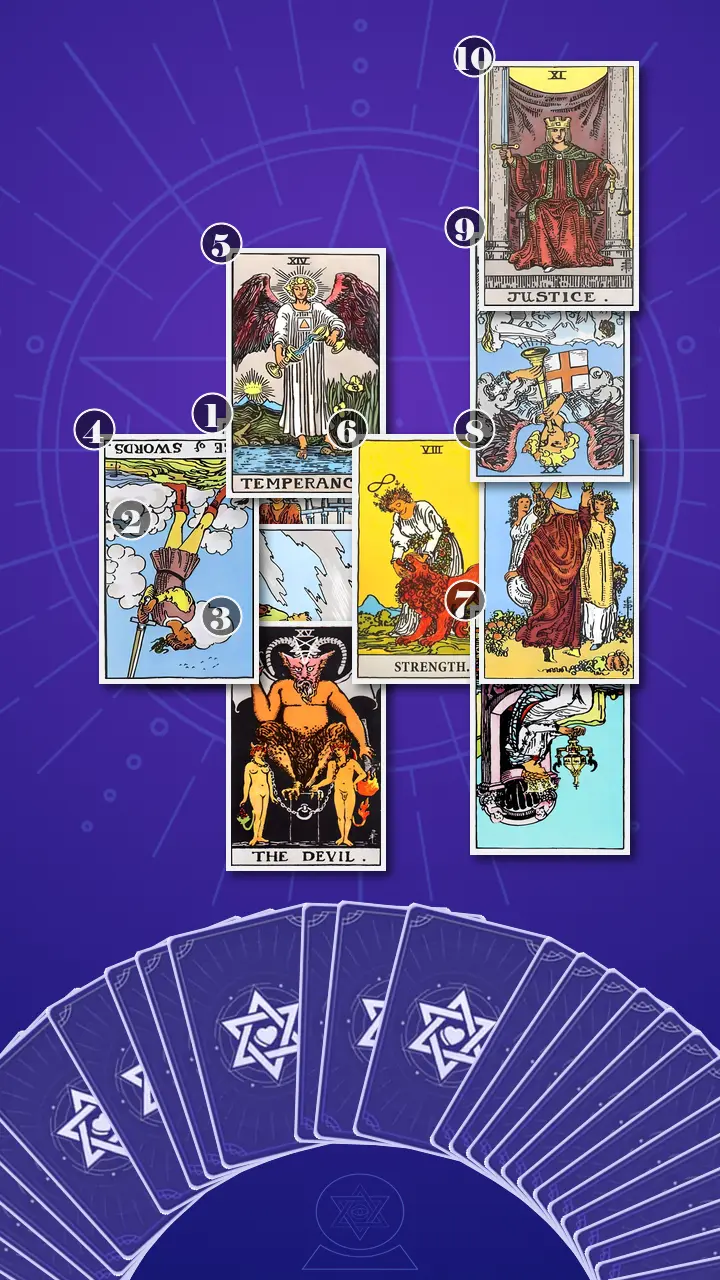
Reading the Map: The Air-Heavy Spiral
Position 1: The apology-draft moment
“Now flipping over,” I told Alex, “is the card that represents the apology-draft moment—what you’re experiencing right now in the act of over-apologizing.”
Eight of Swords, upright.
I didn’t have to reach for drama—the imagery did it. Blindfold. Loose bindings. A ring of swords that looks like a trap until you notice the open gap.
“This is like when Alex rereads a friend’s short reply and feels ‘stuck’ until they send a sorry text, even though nothing concrete has been said.” I looked back up at them. “The trap isn’t a fact. It’s an interpretation that’s gotten loud.”
In energy terms: this is blockage. Not because you’re incapable, but because your mind is treating uncertainty like it’s proof.
Alex let out a small laugh—dry, almost embarrassed. “That’s… yeah. That’s so accurate it’s kind of mean.”
“I know,” I said. “And I’m not saying it to be harsh. I’m saying it because there’s an exit here. The Eight of Swords always hides an exit in plain sight: What do you actually know right now? And what story are you adding?”
Their shoulders rose up toward their ears, then dropped a millimeter—like their body wanted to believe me, but didn’t quite trust it yet.
Position 2: The immediate block
“Now we’re looking at the immediate block—what makes it feel urgent to apologize, even without clear wrongdoing.”
Five of Swords, upright.
I pointed to the figures walking away and the scattered swords on the ground. “This card has a social aftertaste. It’s the fear of fallout. The fear that if you don’t ‘win’ the moment, you’ll lose the relationship.”
“This is like when Alex interprets a friend’s dry message as ‘I’m being pushed out,’ and the apology becomes a way to concede before there’s even a conversation.”
Energy-wise, this is excess—too much adversarial framing. You’re taking normal friction and converting it into a win/lose trial where someone has to be the bad one. And you rush to volunteer.
Alex’s jaw tightened; their eyes flicked to the side, like they were mentally pulling up a specific thread in their group chat.
“Yeah,” they said quietly. “I do the ‘I’ll just take the L’ thing. It ends the discomfort fast.”
“Exactly,” I said. “It ends the discomfort fast. The cost is that it also ends your leverage to find out what’s true.”
Position 3: The deeper driver
“Now we’re under the surface,” I said. “This card represents the deeper driver—the attachment or fear that keeps the over-apology reflex alive.”
The Devil, upright.
Alex went still. Not dramatic—more like their breath paused at the top for half a beat.
“Here’s the thing I want you to hear without shame,” I said, keeping my voice calm. “The Devil doesn’t mean you’re bad. It means you’ve got a loop. A compulsion. A pattern that pays you in relief.”
“This is like when Alex knows they’re over-apologizing but feels a jolt of relief only after getting a reassuring reply, reinforcing the habit.”
I leaned slightly closer to the camera. “Your apology draft is functioning like a subscription you keep renewing. Relief now. Cost later.”
Alex pressed their lips together. Their eyes got shiny—not crying, but close. A wince and a nod at the same time.
“I’m going to give you a sentence,” I said. “It’s one I use a lot because it cuts through the whole shame story.”
An apology isn’t a membership fee.
They exhaled like they’d been holding air in their chest for longer than they realized.
“I think I pay it,” Alex admitted. “Like… if I don’t pay with ‘sorry,’ I get logged out of the friendship.”
“That’s The Devil exactly,” I said. “Closeness versus self-erasure. Choice versus compulsion.”
There was an old Wall Street reflex that flickered in my mind—how traders talk about taking a loss quickly to stop the pain. Sometimes it’s smart risk management. Sometimes it’s panic. This felt like panic disguised as prudence.
Position 4: Recent conditioning
“Now flipping,” I said, “is recent conditioning—how recent communication habits or experiences reinforced this pattern.”
Page of Swords, reversed.
“This one is the Hypervigilant Messenger,” I said. “Upright, the Page is curious and direct. Reversed, that curiosity turns into surveillance—of them and of you.”
“This is like when Alex keeps toggling between the chat thread and the apology draft, trying to control how they’ll be perceived by choosing the perfect sentence.”
Energy-wise: excess Air. Too much analysis, not enough data. It’s like overfitting a model: one tiny data point—‘lol’—becomes a whole story that doesn’t generalize. You treat a normal loading screen in a friendship like a full outage you have to hotfix immediately.
Alex rubbed their thumb against their index finger—restless hands looking for an outlet.
“I call it being responsible,” they said. “But it feels… compulsive.”
“That’s a really clean observation,” I told them. “And it’s important, because responsibility is a value. Compulsion is a nervous-system strategy.”
Position 5: Conscious intention
“Now we’re at conscious intention—the kind of friend you’re trying to be, and what you think you ‘should’ do,” I said.
Temperance, upright.
The vibe in the room shifted just looking at it. Softer. Less windy. Less sharp.
“Temperance is the part of you that wants harmony without disappearing,” I said. “Not ‘never awkward.’ Not ‘always perfect.’ Just… proportion.”
“This is like when Alex pauses and chooses a simple, specific repair (‘I’m sorry I interrupted you earlier’) instead of a sweeping apology for their whole personality.”
Energy-wise: balance. Pacing. Mixing. One foot on land, one in water. You’re allowed to care and still keep your shape.
Alex’s face softened. “That’s what I want,” they said. “Accountable, not annoying.”
“Good,” I said. “Because the next card is about the skill that makes that possible.”
When Strength Spoke: Hand on the Lion, Phone Face-Down
Position 6: The near-term pivot
I held the deck still for a moment before turning the card. “This is the center of gravity,” I said. “This card represents the near-term pivot—the next inner skill to practice before sending messages.”
Strength, upright.
Even on a screen, I felt Alex react. Their thumb froze over their phone. A tiny stillness took the room, like the streetcar noise had moved farther away.
“This is like when Alex feels the urge to send the apology immediately, but instead takes a walk, breathes, and returns to the message with calmer clarity.”
Strength is often misunderstood as being tough. Here it’s the opposite: tenderness with boundaries. The hand on the lion isn’t domination. It’s gentle self-command.
As a former finance guy, I can’t help but see this through an ROI lens. One of my tools is something I call Network ROI Analytics—evaluating what you’re investing in and what it returns. Over-apologizing is a high-frequency investment with a brutal hidden fee: it buys short-term reassurance, but it drains long-term self-trust. That’s negative ROI.
Strength says: invest in steadiness first. Then communicate.
The moment you recognize the loop (Setup)
Alex nodded, but I could see the familiar panic still circling. They knew the pattern: friend replies with a simple “lol” or a thumbs-up, and suddenly they’re in Notes rewriting a paragraph-long apology—thumb hovering over send like it’s a social life-or-death button. Their brain wanted a guarantee. Their body wanted the tightness gone now.
The sentence that changes the move (Delivery)
Stop bargaining for belonging with frantic ‘sorry’ texts; practice gentle self-command like Strength—hand on the lion, breath in your body, then choose words that match the facts.
I let it sit in the air for a beat.
The 7-minute reset that makes it real (Reinforcement)
Alex’s reaction came in layers. First: a physiological freeze—eyes widening slightly, breath catching like they’d hit an unexpected line in a song. Second: the cognitive seep-in—their gaze unfocused, as if replaying a dozen threads where they’d begged for reassurance in polite clothing. Third: the release—an exhale that sounded like their ribs finally had room. Their shoulders dropped, not all at once, but in two little steps. Their hand lowered the phone to their lap.
“But if I don’t fix it fast,” they said, voice small, “what if they decide I’m… not worth it?”
“That fear makes sense,” I said, steady. “And Strength doesn’t argue with the fear. Strength holds it. Like a lion you don’t have to kill—you just don’t have to let it type for you.”
I guided them through what I call the 7-Minute ‘Facts First’ reset, right there in the session. “Set a timer for two minutes,” I said. “Phone face-down. Five slow breaths. Unclench your jaw if you notice it’s tight.”
“Then in Notes, write two bullets,” I continued. “(1) FACTS: what was actually said or done—verbatim if you can. (2) STORY: what your brain is predicting.”
Alex did it. I watched their throat move as they swallowed—less sharp this time. Their fingers typed slower. When they read it back to me, their FACTS were almost comically small compared to their STORY.
“Now,” I asked, “with this new lens—think back over the last week. Was there a moment when you apologized ‘just in case,’ and this would have changed what you sent?”
Alex blinked hard. “Yeah,” they said. “On Saturday. I sent two apologies in a row because someone didn’t react to my message. If I’d done this, I would’ve realized… nothing happened.”
“That,” I told them, “is the first step from urgent self-blame toward self-soothing. Not certainty. But steadiness.”
The Scales and the Group Chat: From Verdict Thinking to Fairness
Position 7: Alex’s role
“Now we’re looking at your role—how your emotional style and boundaries shape the pattern,” I said.
Queen of Cups, reversed.
“This card is deep sensitivity,” I explained, “but reversed, it can become emotional over-responsibility. You pick up other people’s moods like they’re your bags at the airport.”
“This is like when Alex senses a vibe shift at brunch and later apologizes for ‘ruining the mood,’ even though nobody asked for that and nothing specific happened.”
Energy-wise: spillover. Empathy turning into ownership.
Alex’s eyes narrowed in recognition. “I do that,” they said. “I feel like it’s my job to keep things smooth.”
“And I want to honor the care in that,” I said. “But I also want to name the cost: when you carry everyone, you train your friendships to meet you in a one-down position.”
Position 8: The friendship field
“This card represents the friendship field—what the social environment is actually offering,” I said.
Three of Cups, upright.
It’s hard to look at Three of Cups and stay convinced you’re about to be exiled.
“This is like when Alex’s friends are actually fine and ready to move forward, but Alex is stuck proving they’re ‘not a problem.’”
Energy-wise: support. Mutuality. The kind of community that can survive a weird tone or a missed emoji.
Alex’s mouth twitched—almost a smile, but cautious. “So… I’m not actually on probation?”
“Not according to this,” I said. “Your nervous system is acting like you are. But your environment looks more resilient than your fear predicts.”
Position 9: The emotional engine
“Now we’re at hopes and fears—the emotional engine behind the apology,” I said.
Judgement, reversed.
“This is the courtroom card,” I said. “Reversed, it’s inner tribunal energy. Every awkward moment becomes evidence. Every silence becomes a verdict.”
“This is like when Alex treats a friend’s delayed reply as a character assessment and tries to ‘clear their name’ with a long apology.”
I gave Alex a simple three-beat script, and they laughed—tight, but real:
“(1) Tiny cue. (2) Instant sentencing. (3) Apology as a plea deal.”
“Why do I do that?” Alex asked, and the question sounded like both frustration and grief.
“Because uncertainty feels unsafe,” I said. “And your brain would rather punish you than sit in the unknown.”
“If you can’t name the harm,” I added softly, “don’t write a whole verdict.”
Position 10: Integration
“Last card,” I said. “This represents integration—a healthier model of accountability and communication you can grow into.”
Justice, upright.
I felt myself relax when I saw it. Justice is clean. Not cold—clean.
“This is like when Alex sends a short, specific message if needed, or chooses not to apologize at all—and trusts the friendship can handle normal human imperfection.”
Energy-wise: balance again, but sharper. Temperance is the gentle mixing. Justice is the measured standard.
“Here’s the headline,” I told Alex. “Clarity is kinder than confession.”
They stared at the card, then down at their phone. “So the goal isn’t to never apologize,” they said. “It’s to stop… erasing myself.”
“Exactly,” I said. “You can be accountable without making yourself smaller.”
Facts First. Feelings Next. Text Last.
I pulled the whole spread together for Alex like a short story, because that’s what makes it usable in real life.
“Here’s what I see,” I said. “Your mind goes Air-heavy fast—Eight of Swords and Five of Swords—so a normal pause in texting feels like danger. Recent habits reinforce it—Page of Swords reversed—so you try to solve uncertainty with more words. Underneath, there’s an attachment loop—The Devil—where ‘sorry’ becomes a way to buy belonging. Your sensitivity (Queen of Cups reversed) makes you absorb other people’s moods, and then Judgement reversed turns it into a courtroom. The antidote is Temperance plus Strength: pace and steadiness. And the integration is Justice: proportionate responsibility and clear communication.”
“The blind spot,” I added, “is that you’re acting like reassurance is the only asset in the relationship. But when I run this through my Influence Credit Scoring lens—the way I measure relationship capital—you’re constantly extending credit to other people’s moods and calling it ‘being a good friend.’ That’s generous. It’s also exhausting.”
“The direction of change,” I said, “is exactly your key shift: from ‘I must apologize to stay safe’ to ‘I can pause, check the facts, and communicate with proportionate responsibility.’”
Then I gave Alex what they asked for—actionable advice they could do even on a TTC commute, even on a Sunday Scaries night, even with a throat-tightening ‘k’ staring back at them.
- The 20-Minute Apology PauseOnce per day this week, when you feel the urge to send an apology text, set a 20-minute timer and put your phone face-down. During the timer, write a one-sentence FACT statement in Notes (no interpretation): “What happened.”If 20 minutes feels impossible, do the 5-minute version. You’re not banning apologies—you’re adding a gap so you can choose.
- The Strength Body Anchor (Handshake Energy Exchange)Right before you hit “Send,” do 5 slow breaths. While you breathe, press your thumb gently into the center of your opposite palm (like a quiet handshake with yourself) and drop your tongue from the roof of your mouth. Then re-read your draft once.Treat the urge like a body wave, not a moral emergency. If you already sent the apology, your win is: don’t send a second follow-up apology.
- The Justice Checklist + One Clean LineBefore apologizing, ask: Action?Impact?Repair? If you can’t name Action/Impact, don’t send an apology. Send either nothing or one neutral check-in. If you can name it, use a proportionate template: “I’m sorry for [specific action]. Next time I’ll [specific adjustment].”If you’re unsure, do a single clarification swap once this week: “Hey—when you said ‘fine,’ did you mean busy, or upset with me?” Accept the first answer. No cross-examination.
To make it even easier, I offered Alex my “cocktail party algorithm” adapted for texting—three phases that keep you out of the over-explaining swamp:
Warm opener (one line) → One fact (one line) → One ask or repair (one line). That’s it. No press release. No self-erasure.

A Week Later: Ownership, Not Certainty
Eight days later, Alex messaged me a screenshot.
It was a group chat. Someone had replied with a flat “k.” The old version of Alex would’ve opened Notes, drafted a three-paragraph apology, and then stared at the cursor like it was judging them.
Instead, Alex had written two lines in Notes:
FACTS: “They said ‘k’ after I suggested Friday.”
STORY: “They’re annoyed and I’m being phased out.”
Then they waited 20 minutes. They didn’t send an apology. They sent a neutral check-in: “All good for Friday, or do you want to pick a different day?”
They told me, “My chest still got tight. But it didn’t become my whole night.”
That’s the real proof of a Journey to Clarity: not that fear disappears, but that you stop letting it write the entire script. You move from frantic confession toward grounded, proportionate communication—more Justice, less courtroom.
Clear doesn’t always feel euphoric. Sometimes it’s quiet: you sleep a full night, then wake up with the first thought still being, “What if I was annoying?”—and this time, you notice the thought, exhale, and don’t text it.
When a friend’s silence feels like a verdict, it makes sense that your fingers reach for “sorry” like it’s the only way to prove you still belong—right as your throat tightens and you start shrinking yourself mid-sentence.
If you gave yourself just a 20-minute pause before fixing anything, what’s one thing you might notice—about the facts, your body, or what you actually want to ask for?
Every reading at AceTarot is a journey to connect with inner wisdom and empower your next step. The stories shared here are psychological mirrors, not private records—crafted to reflect universal emotional loops and help you find your own clarity. Learn more about our Journey to Clarity.
Author Profile