The 11:57 p.m. Story Reply—and the One-Sentence Boundary Text

Finding Clarity in the 11:57 p.m. Story Reply
You’re a 20-something in a big city friend group where everything is “just jokes” until you see your friend’s name under your crush’s Story again and get a full-body stomach-drop.
Jordan (name changed for privacy) sat across from me in my little Toronto reading space—coat still on, phone face-down but basically vibrating with meaning. Outside, February slush hissed under tires. Inside, the radiator clicked like it had opinions. She kept rubbing her thumb along the edge of her phone case, over and over, like she was trying to sand down the urge to check.
“It’s not even… like… a relationship,” she said, and the way her jaw tightened made the word even feel like a lie she had to swallow. “But my friend keeps sliding into my crush’s DMs. And if I say something, I’ll look insecure. Jealous. Dramatic. But if I don’t say anything… I feel disrespected.”
Her jealousy wasn’t a dramatic speech—it was a physical glitch: a stomach-drop followed by a tight jaw and restless hands reaching for the phone, like her nervous system was refreshing a tracking page that never updates—except she’s the one paying the shipping fee.
I nodded, slow and steady, the way I used to on cruise ships when someone needed grounding more than answers. “We’re not here to decide whether you’re ‘the jealous friend,’” I told her. “We’re here to get you out of the DM fog and into clarity. Let’s make a map.”

Choosing the Compass: A Love Triangle Spread Tarot Reading
I asked Jordan to take one slow breath and hold the question in plain language: “What boundary do I set with my friend about my crush?” Not as a ritual for the universe—just a psychological handoff from spiraling to seeing.
As I shuffled, I explained what I was doing the way I would to any skeptical traveler at sea: focusing attention creates better decisions. Tarot, used well, is a mirror with structure.
Today, I told her, we’d use a Love Triangle Spread. It’s perfect when the stress is explicitly three-way—you, your friend, your crush—and you need relationship boundaries without forcing a prediction. This spread separates each person’s energy from the two connection-lines, so you stop mind-reading and start seeing where the breakdown actually is.
“Card one,” I said, “is the camera footage: what you’re doing and feeling right now. We’ll look at your friend’s pattern, your crush’s vibe, the two connection lines—and then the center of the triangle names the core truth you need to acknowledge. The last card lands it: what you can actually say and do this week.”
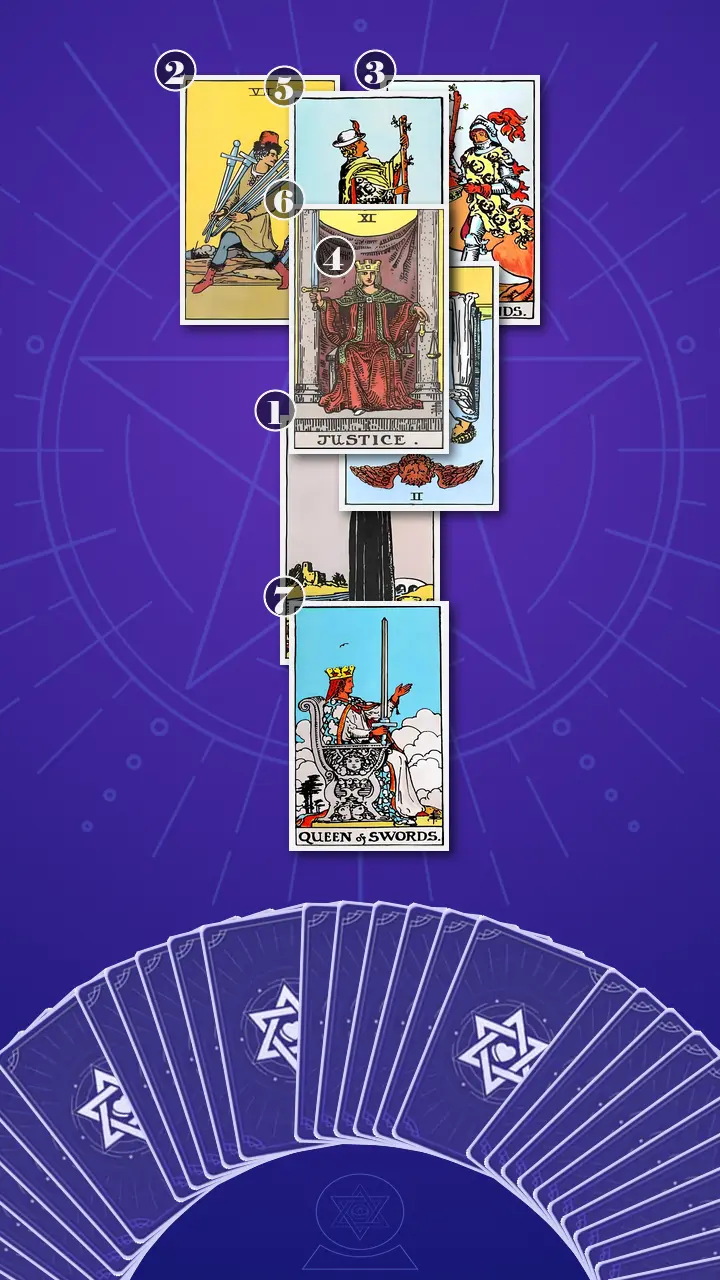
Reading the Triangle, Not the Group Chat
Position 1: The ‘Camera Footage’ of Your Reaction
“Now we’re turning over the card that represents what you’re doing and feeling right now in response to the DM behavior—the observable camera footage of your reaction,” I said.
Five of Cups, upright.
I didn’t soften it. I grounded it. “It’s 12:38 AM in your Toronto condo, the streetlight glow is cutting through the blinds, and your phone is literally warm from being opened and closed so many times. You see your friend’s name under your crush’s Story again and your stomach drops—then you do the whole loop: check who liked the post, tap through mutuals, scroll your DMs with your crush, scroll your DMs with your friend, open Notes to draft a text, delete it, tell yourself you’re being ‘chill,’ and still feel that tight jaw like you’re clenching down a sentence you deserve to say out loud.”
The Five of Cups is Water energy in excess—not “too emotional,” but too much attention poured into what feels spilled, stolen, or slipping away. The card’s figure stares at the loss so intensely they miss the two upright cups behind them: the options you still have, like clean communication and self-respect.
Jordan let out a small laugh that sounded like it had teeth. “Okay,” she said, looking down at the card, then up at me. “That’s… honestly brutal. Like—why is this so accurate?”
“Because you’re not irrational,” I said gently. “You’re reacting to ambiguity. And jealousy isn’t always a character flaw—sometimes it’s a signal that nothing has been said out loud.”
Position 2: How Your Friend Is Moving (Directness vs. Deniability)
“Now we’re turning over the card that represents how your friend is moving in this situation and what pattern it creates—directness versus deniability,” I said.
Seven of Swords, upright.
“Your friend’s moves live in the gray zone,” I told Jordan. “Reacting to your crush’s Story with a ‘😂’ or ‘ok but you look GOOD,’ sending a meme that’s basically flirting, or dropping a ‘we should all hang soon’ that conveniently turns into a private thread. If you ever called it out, she could instantly go, ‘What? I’m just being friendly.’ And that’s the point—the whole thing is built for plausible deniability, so you’re stuck doing DM detective work instead of having an actual, adult conversation.”
The Seven of Swords is Air energy in a blocked state: strategy without transparency. Not necessarily “evil”—but private moves designed to stay technically defensible. The body language of this card—sneak, glance back, keep it deniable—matches the emotional experience you described: your jaw tightens, your hands get restless, and you end up trying to prove something you can’t screenshot cleanly.
Jordan’s shoulders rose toward her ears like she was bracing for impact. Then she exhaled hard through her nose. “That’s the part that makes me feel crazy,” she said. “Because it’s never… enough.”
“You’re not ‘crazy’—you’re stuck in a DM ecosystem built for plausible deniability,” I said, and I watched her face soften at the relief of having the pattern named.
Position 3: Your Crush’s Vibe Right Now (Without Promising Anything)
“Now we’re turning over the card that represents your crush’s current energy and availability—what kind of attention they respond to right now,” I said.
Knight of Wands, upright.
“Your crush’s energy is fast, flirty, and responsive to whoever brings the spark,” I said. “They reply in five minutes when the chat is fun, drop a fire emoji, and keep it moving—more ‘let’s see where this goes’ than ‘let’s define this.’ In a DM-based social orbit, the room rewards bold pings and playful banter, not necessarily the person who’s quietly hoping it means something.”
This is Fire energy in excess—momentum-forward, stimulation-driven, not naturally structured around reassurance. It doesn’t mean they’re incapable of depth. It means the current environment rewards whoever initiates with confidence, which can make you feel like you’re competing in a game you didn’t agree to play.
Jordan’s fingers paused mid-fidget. “So it’s not that I’m… not enough,” she said slowly. “It’s that the whole system is like… whoever messages best wins.”
“Close,” I said. “It’s that the whole system rewards speed and heat. And your nervous system is asking for structure.”
Position 4: The Jordan–Crush Connection Line (Where Uncertainty Lives)
“Now we’re turning over the card that represents what’s actually happening between you and your crush—the container of your connection,” I said.
Two of Cups, reversed.
I felt the room quiet a little, the way it does when the truth isn’t dramatic—just specific. “Between you and your crush, it’s that painfully specific modern limbo: you have a vibe, but no container,” I said. “Maybe you’ve had a couple solid conversations, a few late-night replies, maybe even a ‘soft launch’ level of mutual liking—but nothing has been said clearly. So every time your friend slides into their DMs, your brain treats it like a threat alert: ‘See? I’m replaceable.’”
The Two of Cups reversed is relationship energy in deficiency: mutuality might exist, but it isn’t named, so your nervous system has nothing to stand on. This is where you start rewriting your messages to sound casual, waiting for them to “make it obvious,” and using social signals as proof because you don’t have an agreement.
I mirrored the “almost-but-not-actually” feeling out loud, like holding up a photograph: “You reread your crush’s last message, then stare at the typing bubble that never comes. Your brain says, ‘I’m fine, I’m chill,’ and your chest says, ‘Why does this feel like I’m falling?’”
Jordan went still—breath held, eyes unfocused for a beat—then she swallowed and nodded once. “That’s exactly it,” she said, voice smaller. “I keep telling myself it’s not serious, but my body disagrees.”
Position 5: The Friend–Crush DM Line (What It Represents)
“Now we’re turning over the card that represents what the friend–crush DM line represents and why it’s so activating,” I said.
Page of Wands, upright.
“The friend–crush DM line looks ‘light’ but functions like repeated bids for attention,” I said. “A story reaction here, a casual ‘how’s your week?’ there, a meme that’s basically a flirty check-in. It’s not a full-on declaration—it’s pinging the radar. And because your crush responds to heat and momentum, those small pings can snowball into a rhythm.”
This is Fire energy in initiation—not necessarily commitment, but relentless spark. And that’s why it hits you: it turns your private feelings into an invisible competition you never agreed to enter.
Jordan’s mouth tightened, then she made a face like she’d tasted something sour. “I hate that I feel like I’m in a race,” she said. “Like I’m auditioning to be chill.”
“Good,” I said, not unkindly. “That disgust is your self-respect waking up.”
When Justice Cut Through the DM Fog
Position 6 (Key): The Boundary Principle You Need to Name
I let my hands rest on the deck for a second. The radiator clicked again—sharp, punctual—like a gavel in a courtroom none of us asked to be in. “We’re turning over the core card,” I said. “The one that names the truth this triangle is teaching.”
Justice, upright.
“This is the moment you stop trying to win in the DM arena and choose a standard you can live with,” I said. “Justice is you deciding: ‘In my friendships, respect means you don’t privately flirt with someone I’m openly into.’ Not as a dramatic speech—more like a clean policy. No accusations. No trying to prove intent. One clear line—then you watch what happens.”
Justice is Air energy in balance: calm directness, fairness, consequences that aren’t emotional punishment. It’s the opposite of spiraling for proof.
In my mind, I flashed back to a transoceanic voyage years ago—tight quarters, too much champagne, three people with one unspoken tension. On a ship, you learn quickly: if you don’t name the protocol, the hallway becomes a rumor mill. The ocean doesn’t care about hints. It cares about navigation.
Jordan was still caught in the old loop—late night, phone warm, scanning Story replies like evidence, telling herself she’s “fine” while her jaw locks anyway. She wanted certainty without exposure, control without a conversation.
Not more DM detective work—choose Justice: name the line, define what respect looks like, and let clarity do the sorting.
She reacted in a chain so clear I could almost time-stamp it: first a freeze—her fingers stopped moving entirely, hovering above her phone. Then the cognitive hit—her eyes went slightly distant, like she was replaying every “😂” reaction and every “we should all hang” that turned private. Then the emotion arrived—her shoulders dropped a fraction, but her face tightened with a flash of anger.
“But if I say it like that,” she said, voice sharper, “won’t I look like I’m claiming him? Like I’m territorial?”
I didn’t argue. I switched modes.
“This is where I use what I call Social Role Switching,” I told her—something I taught crew members on international ships, and something I use in modern friend-group dynamics all the time. “Right now you’ve been stuck in Supportive Mode with your friend—laughing along, keeping it light, absorbing discomfort—while secretly running surveillance. Justice asks you to move into Assertive Mode: calm voice, clear line, no performance.”
I leaned in slightly. “Assertive Mode isn’t jealousy. It’s a boundary. And a boundary isn’t a punishment; it’s a definition.”
Then I invited her into practice, not performance, exactly the way I would on a night watch at sea: “Now, with this new lens—Justice instead of investigation—think back to last week. Was there a moment you could’ve felt different if you’d had one clear sentence to stand on?”
Jordan blinked fast, then slower. “Saturday,” she said. “When she replied to his Story and then acted like nothing. I literally… did timestamp math.” Her mouth twitched, half embarrassed, half relieved. “I could’ve just… named it.”
“That’s the shift,” I said softly. “From DM detective work and jealous embarrassment to calm clarity and self-respect. Clarity over surveillance.”
Position 7: The This-Week Stance (Warmth Without Waffling)
“Now we’re turning over the card that represents your healthiest next step—what you can actually do this week without escalating into drama,” I said.
Queen of Swords, upright.
“Queen of Swords is the text you can send without a paragraph, without jokes, without ‘lol I’m kidding but not really,’” I said. “It’s adult and steady: ‘I’m into them. When you DM them like that, it doesn’t feel okay to me. Please stop.’ Then you don’t debate motives—you watch behavior.”
This is Air energy in clean focus: direct, respectful, not cruel. The Queen holds the line and still leaves the door open for mature response. No receipts. No closing argument. Just the line.
Jordan exhaled, but then her forehead creased. “I don’t even know when I’d do this,” she said. “Work is insane. Slack all day. I’m in meetings. And then at night I’m fried and that’s when I spiral.”
“That’s real,” I said. “So we build a boundary like we build ship protocol: timing matters. You don’t make a navigation decision mid-storm if you can help it.”
The Clean Line Sentence: Actionable Advice Without Receipts
Here’s the story the spread told, start to finish: you’re in Five of Cups—hurt, fixation, and the lonely tunnel-vision of imagining you’re being replaced. Your friend’s Seven of Swords pattern keeps everything deniable, which forces you into monitoring and mind-reading. Your crush is Knight of Wands—responsive to momentum, not naturally offering structure. The major blockage is the Two of Cups reversed: the connection with your crush has a vibe but no container, so your system treats every DM as a threat alert. Justice moves you from emotion-and-fire reactivity into an Air standard—fairness, clarity, consequences. And the Queen of Swords gives you the delivery: warm-but-firm script, no over-explaining.
The cognitive blind spot is this: you’ve been trying to feel safe by collecting more data—more Story checks, more emoji audits, more “proof.” But the spread is blunt: the safety you want won’t come from better surveillance. It comes from a standard you’re willing to speak and follow.
So we choose the transformation direction Jordan came for: shift from hinting and monitoring to naming one clear, respectful boundary and following through on it.
- Write the Clean Line Sentence (2 minutes)Open Notes and write three versions of your boundary: (1) ultra-direct, (2) slightly softer, (3) in-your-natural-voice. Choose the shortest one that still names the line clearly. Read it out loud once.If your instinct is to apologize or joke, pause and rewrite it as a one-line Terms of Service: clear, boring, enforceable.
- Send the Queen of Swords text (pick calm timing)During a non-spiral moment (not 1 a.m., not right after a notification), send: “I’m into them. When you DM them like that, it doesn’t feel okay to me—please stop.” If she pushes for motives, repeat: “I’m not trying to argue intentions—I’m telling you what doesn’t work for me.”Use my ready-to-use script delivery: make eye contact (or imagine it), slow your speech in your head, and start with “I need…” if you’re saying it in person.
- Try a 24-hour DM Detective DetoxFor one day: no checking viewer lists, no scanning for her name under Stories, no backscrolling DMs for proof. If you slip, restart the clock—no self-roasting.When the urge hits, write what you’re hoping to find: proof, relief, control, reassurance. Naming it turns the compulsion into a choice.
And one more thing, quietly but firmly: Justice doesn’t only draw a line with your friend. It also asks you to stop outsourcing clarity with your crush. A low-pressure invite—“Want to grab coffee this week?”—creates real information. Likes don’t.

A Week Later: Ownership, Not Certainty
Six days later, Jordan messaged me. Not a paragraph—just a screenshot of a sent text bubble and two words: “I did it.”
Her friend had replied with surprise, a little defensiveness, then: “Okay. I didn’t realize. I’ll stop.” Not perfect. Not magical. But legible.
Jordan told me she celebrated in the most Toronto way possible: she sent the boundary, then sat alone in a coffee shop by the window for an hour—hands finally still, phone face-down—feeling both lighter and strangely tender, like peace came with a small cost.
That’s the real Journey to Clarity: not certainty, but ownership. Not winning the DM arena—choosing a standard you can live with.
When you’re trying so hard to look unbothered that you end up privately spiraling, it’s usually not the crush that hurts most—it’s the fear that asking for basic respect will cost you belonging.
If you let yourself stop chasing certainty through notifications for one day, what’s the one clean sentence you’d want to stand on instead?
Every reading at AceTarot is a journey to connect with inner wisdom and empower your next step. The stories shared here are psychological mirrors, not private records—crafted to reflect universal emotional loops and help you find your own clarity. Learn more about our Journey to Clarity.
Author Profile