Invited as a Plus-One, Left Alone—Then I Sent My Standard Text

Finding Clarity in the King West Fake-Scroll
You got invited as a plus-one, walked in relying on that one person as your social anchor, and then watched them disappear into the crowd—so you did the Toronto thing: pulled out your phone and pretended you were texting while your stomach dropped.
Taylor (name changed for privacy) sat across from me at my café table by the front window, the kind that always smells like toasted sugar and espresso because the grinder never really stops. Outside, Toronto was doing its late-winter gray. Inside, my little street felt warmer—steam hissing, cups clinking, someone laughing too loudly at a corner table.
“I don’t want to be dramatic,” she said, hands wrapped tight around her mug like it was an anchor. “But I also don’t want to feel disposable.”
She told me about 11:18 PM on King West: bass thumping hard enough to vibrate her ribs, air sharp with tequila and someone’s cologne. Her plus-one said brb and slipped into a circle. Ten minutes became thirty. She clutched her drink with both hands, phone warm in her palm, fake-scrolling like it was a job. Her face went hot, her throat tightened, and she kept smiling anyway—because leaving felt like it would brand her as “too much,” and staying felt like agreeing she could be left behind.
Humiliation is never abstract. In her body, it sounded like a tight throat trying to swallow embarrassment, like her jaw was holding back a whole second voice. It looked like that frozen politeness people mistake for “chill.”
“And then,” she added, eyes flicking down like she could still see the bar floor, “the next morning I kept checking Stories. Like… evidence.”
I nodded, slow. “We’re not here to make it a big trial. We’re here to find clarity—what boundary actually protects your self-respect, and what your next step is, without turning you into someone you’re not.”

Choosing the Compass: The Relationship Spread for Boundaries
I asked Taylor to take one breath that went all the way down—like she was letting her shoulders drop off her ears—and to hold one simple question in mind: Invited as a plus-one, then ditched—what boundary now?
I shuffled slowly, not as a performance, but as a reset. In cafés, we call it clearing the palate. In tarot, it’s the same: a clean moment between the spiral and the next decision.
Today, I used a Relationship Spread tarot reading—six cards, direct and structured. It’s the best fit when the point isn’t predicting what they’ll do next, but clarifying the dynamic and choosing boundary language that protects your self-respect.
Here’s why it works for this exact situation: it separates your lived experience from their pattern, and both from the group-energy dynamic that tends to swallow people whole. Then it funnels down into the real pressure point—what boundary decision you’ve been postponing—and opens back out into guidance and integration.
I told her what to watch for: the first card would show what this did to her nervous system and self-worth in the first 60 seconds; the fourth would name the “draft-delete” stall; and the fifth—advice—would give us clean words and a standard for future invites.
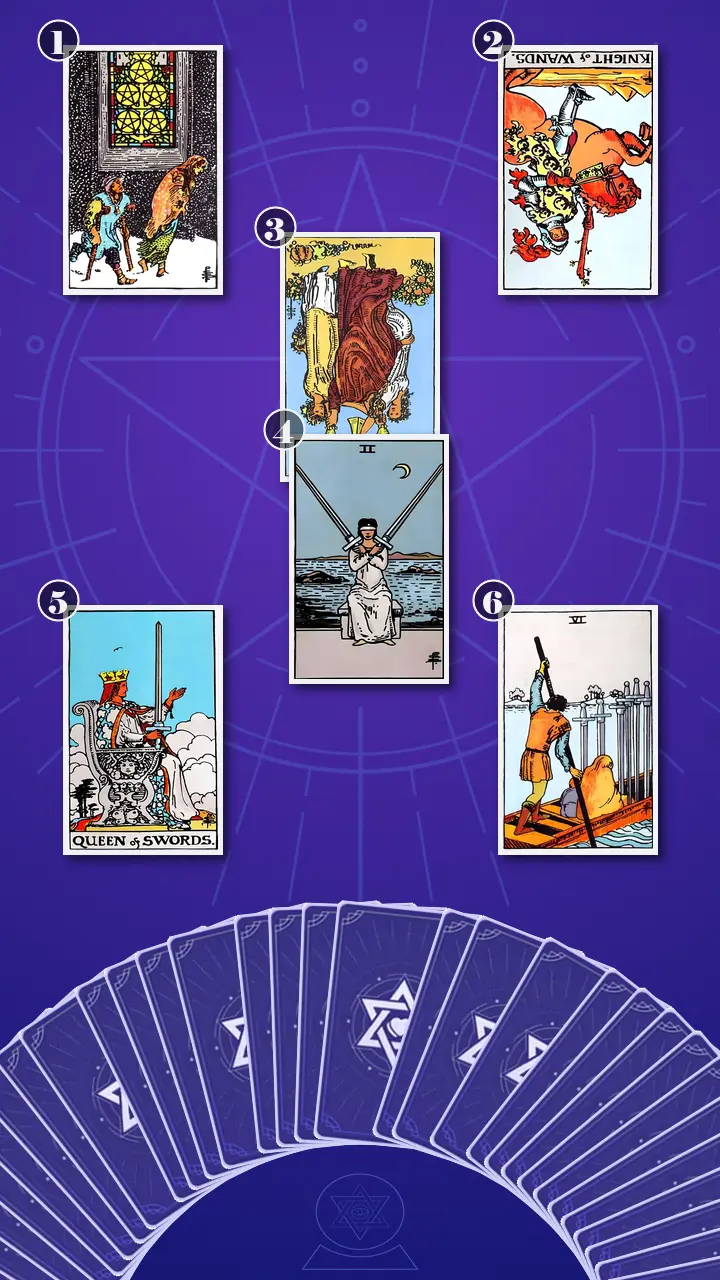
Reading the Map: From Being Left Out to Naming the Pattern
Position 1 — The moment it hit your body
“Now we turn over,” I said, “the card that represents Your lived experience in this situation: the most immediate impact on your self-worth, body, and behavior after being ditched.”
Five of Pentacles, upright.
I glanced at Taylor before I even spoke. Her eyes did that thing—narrowing slightly, like she was bracing for a mirror.
“This is,” I said gently, “you at a crowded birthday bar in Toronto, physically inside the plan but emotionally outside the circle of care. Your plus-one disappears, and you do the ‘don’t look alone’ routine: phone out, fake-scroll, polite smile locked on while your stomach drops. You tell yourself you’re being low-maintenance, but the real experience is: ‘I was invited, and still somehow left out.’”
The Five of Pentacles is Earth energy: tangible exclusion. Not philosophical. Not subtle. It’s the bright window of belonging right there—while you’re freezing outside it anyway. In this position, that energy is in excess: your body remembers the cold instantly, and your self-worth takes the hit before your mind can rationalize it.
“It wasn’t just awkward,” I added, letting the sentence land. “It was public optional-ness.”
Taylor made a small sound that was half-laugh, half-wince. “That’s… brutal,” she said, like she couldn’t decide if she felt seen or exposed. “It’s accurate. But brutal.” Her thumb rubbed the mug handle in a tight loop.
Position 2 — Their pattern when the room gets loud
“Now we turn over,” I continued, “the card that represents Their energy and likely motivation pattern: what they are bringing (or not bringing) that led to the ditching moment.”
Knight of Wands, reversed.
“This is the person who’s genuinely excited to bring you—until the room offers something shinier,” I said. “Once inside, their energy is impulse-first: they chase conversations, shots, and friend clusters, assuming you’ll ‘figure it out.’ Later they send a breezy ‘Sorry it got chaotic’ like that should cover it, without any real repair or responsibility for bringing you as a guest.”
Reversed fire is often blockage and inconsistency. Momentum without tracking impact. Not necessarily evil—just unreliable. The kind of energy that treats social plans like a highlight reel instead of a responsibility.
“So you’re not crazy for feeling stranded,” I told her. “This card says: don’t respond to promises. Respond to patterns.”
Her gaze shifted to the side, as if replaying the exact moment the plus-one vanished. “I keep trying to find a nicer explanation,” she admitted. “Like if I can frame it as ‘chaotic’ then I’m not allowed to be mad.”
Position 3 — What your connection defaults to under group pressure
“Now we turn over,” I said, “the card that represents The social-relational dynamic between you: what the connection defaults to under group pressure or social settings.”
Three of Cups, reversed.
I nodded at the image like it was familiar. “The group vibe is celebration on the surface, but it’s a closed loop without a bridge,” I said. “Everyone has in-jokes and history, and you can’t access the circle without your plus-one actively connecting you. You’re holding a drink, laughing at the right times, but functionally invisible—like you’re at the party but not in the party.”
This card isn’t saying you’re unlikable. It’s saying the dynamic is designed to make you the accessory unless someone bridges you in.
I watched her face as the meaning settled. She stared at the card, then blinked slowly. “So it wasn’t just me being weird,” she said quietly. “It’s the dynamic.”
Exactly. That’s the turning point: shame becoming pattern recognition. And it’s why people end up googling things like invited as a plus one then left alone what do I do at 2 a.m.—because they’re trying to turn a stomach-drop into logic.
Position 4 — The draft-delete limbo
“Now we turn over,” I said, “the card that represents The true issue to address: the boundary decision you’ve been postponing and what makes it feel risky.”
Two of Swords, upright.
“You know it wasn’t okay,” I said, “but your nervous system chooses a freeze strategy: you draft the honest message, then delete it, then send something casual so you don’t risk sounding needy. You stay in limbo because deciding feels like it could cost you the invite—and you’d rather swallow the humiliation than face the possibility of being dropped.”
The Two of Swords is Air energy in lock: not a lack of intelligence, but an internal stalemate. You’re protecting connection by withholding truth, and it feels safer—until it becomes a quiet kind of self-abandonment.
I leaned in slightly. “This is where I want to name something without shaming it: “Low-maintenance cool” is a coping strategy, not a personality trait. It’s how you manage the risk story: If I call this out, they’ll think I’m clingy. If I say nothing, I’m agreeing I can be left behind.”
She pressed her lips together, then exhaled through her nose. “I literally drafted it,” she said. “Like a press release. Then I deleted it and sent a meme.”
“That,” I said, “is the Two of Swords wearing a very modern outfit.”
When the Queen of Swords Spoke: A Boundary That Isn’t a Plea
Position 5 — The words that draw the line
I let the café noise fade into the background for a second—the espresso machine clicked off, and in the pause, the room felt suddenly precise.
“Now we turn over,” I said, “the card that represents Boundary guidance: the clearest way to name what is and isn’t okay, including tone and standards for future invites.”
Queen of Swords, upright.
“This,” I said, “is you sending one concise message that names the behavior and sets the standard, without managing their feelings: no apology preface, no meme, no essay. The vibe is calm and direct: ‘If I’m coming with you, I need a check-in and an intro. Otherwise I’m going to pass.’ It’s not a threat—it’s a gate with a latch.”
In my café language, this is where I use my signature lens—Milk Foam Layer Analysis. Because boundaries fail when we confuse the foam with the coffee.
“Your ‘lol all good’ text?” I said. “That’s foam. It’s surface-level social smoothing. The Queen is coffee: the actual substance. She doesn’t need ten sentences to be valid.”
And this is where I brought in my other tool—Social Espresso Extraction. “Every social context has an optimal extraction time,” I told her. “Too short and it’s sour—nothing gets said. Too long and it turns bitter—overexplaining, apologizing, trying to manage their reaction. The Queen of Swords is the perfect shot: quick, clean, and complete.”
She swallowed. I could see the reflex to soften, to add an emoji, to pad the truth so it wouldn’t cost her belonging.
She whispered, almost like she was asking permission, “But if I bring it up… I’m scared I’ll look needy.”
I nodded once. “Then we’re going to say it the Queen’s way—without begging, and without punishing.”
The Aha Moment (Setup)
She was right back in that next-morning loop: phone in bed, rereading the thread, then checking Stories like she was trying to prove she was allowed to be hurt. Her mind wanted the perfect phrasing that would guarantee she wouldn’t get left again.
The Aha Moment (Delivery)
Not “keep it cool so you don’t get left,” but “name the standard clearly and let your words be the blade that draws the line,” like the Queen of Swords.
The Aha Moment (Reinforcement)
Her body reacted in three clear beats.
First: a tiny freeze. Her breath paused like she’d stepped into cold air. Her fingers stopped moving on the mug handle, suspended mid-loop.
Second: the meaning seeped in. Her eyes went slightly unfocused, not drifting away from me, but drifting inward—like she was replaying the bar scene with new subtitles. I watched her jaw unclench a fraction, as if she’d been biting down on a sentence for days.
Third: the release. A long, shaky exhale left her chest. Her shoulders dropped, and then she blinked fast, the way people do when something is both relieving and terrifying. “So… I don’t have to be chill to deserve basic care,” she said, voice thin but steadying. Then, more complicated: “But if I say this, doesn’t it mean I should’ve said something back then? Like… did I mess up?”
“No,” I said, firm and kind. “It means you survived the moment the only way you knew how. Now we give you a better tool. And we’re not going back to argue with your past self.”
I let a small silence happen, the way a café goes quiet for half a second when someone drops a spoon. “Now,” I asked her, “using this new lens—can you remember one exact moment last week when this insight would’ve changed how you felt? Maybe the instant your phone came out as a prop?”
She nodded, eyes shining. “When I started fake-scrolling,” she said. “I could’ve just… left. Or texted, ‘Hey, I’m alone.’ But I was trying to look unbothered.”
“That’s the shift,” I said. “This isn’t only about what to text someone who ditched you at a party. It’s a move from humiliation-driven freeze and ‘low-maintenance cool’ performance toward calm self-respect and clear standards for access.”
I tapped the Queen lightly. “And here’s the reframe you need to keep: Your boundary isn’t a punishment; it’s a standard for access to you.”
Position 6 — What happens when you stop living in the replay
“Now we turn over,” I said, “the card that represents Integration if you hold the boundary: how you restore steadiness and what changes in your behavior and access going forward.”
Six of Swords, upright.
“After you state the standard,” I said, “you stop living in the replay. You choose movement over rumination: you decline the next invite if it’s vague, you arrive separately when needed, and you let distance be a form of self-respect. It’s quieter than confrontation—more like choosing calmer water than proving a point.”
This is Air in balance: your mind becoming a boat instead of a courtroom. Not erasing what happened—carrying the lesson without letting it stab you from inside the hull.
I felt my own little flashback—twenty years of watching people choose the wrong table in my café because they were afraid to ask for the one they wanted. They’d stand by the door, pretending to scroll, waiting for someone else to decide their comfort for them. The difference between a good espresso and a bad one is seconds. The difference between self-respect and self-abandonment can be a single sentence.
“And I want you to remember this,” I added, voice softer. “You don’t need to make it a big thing to make it a real thing.”
The One-Text Boundary: Actionable Next Steps That Don’t Spiral
I pulled the whole spread together for her in plain language.
“Here’s the story the cards are telling,” I said. “You got hit with real exclusion (Five of Pentacles). The other person’s pattern is hot-and-cold follow-through in loud social settings (Knight of Wands reversed). The shared dynamic under group pressure is ‘fun’ without active inclusion (Three of Cups reversed). Then you froze and tried to keep access by staying ‘easygoing’ (Two of Swords). The remedy isn’t a fight—it’s clean language and a standard (Queen of Swords). And once you do that, you move toward calmer water—less checking, less rehashing, more choosing steadier plans (Six of Swords).”
“The cognitive blind spot,” I said carefully, “is thinking your only two options are: say nothing and keep belonging, or speak up and lose everything. The Queen shows a third option: state the standard once, then let their response teach you how close they get to be.”
“Stop arguing with yourself in drafts—say it once, cleanly, and watch what they do.”
Then I gave her the smallest, most workable next steps—because clarity that doesn’t become action is just another kind of scrolling.
- Write the Two-Sentence “Plus-One Standard”Open Notes and write exactly two sentences: one fact + one standard. Example: “When you invited me as your plus-one and then disappeared, I felt stranded. If I’m coming with you, I need a check-in and an intro, otherwise I’ll pass next time.”Set a 7-minute timer. If you feel the urge to add a third sentence to soften it, name it—“that’s my low-maintenance reflex”—and keep it at two.
- Send Once + Do Boundary Aftercare (No Evidence-Gathering)If you choose to send it, send it once (no emojis, no apology preface). Then put your phone on Do Not Disturb for 30 minutes and do something physical: a quick shower, a short walk, or tidying one small area.Use my “Social Espresso Extraction” rule: don’t over-steep. One clean shot, then step away—no rewriting, no checking Stories, no rereading their typing bubbles.
- Ask the Plus-One Clarity Question Before You Say YesBefore you accept any plus-one-style invite this week, ask: “Are we arriving and sticking together, or is this more of a meet-there-and-mingle thing?” If the answer is vague (“we’ll see,” “it’ll be chaotic”), protect yourself: arrive separately, bring your own friend, or decline.If asking feels awkward, frame it as logistics: “Just so I can plan my night.” Treat their response as data, not a debate.
I added one of my café-born tools—my Social Thermometer. “Think of closeness like coffee temperature,” I told her. “Some people are ‘hot espresso friends’—intense, fun, but they burn if you sip them like daily comfort. Some people are warm and steady. Your boundary is you choosing the right temperature for your nervous system.”

A Week Later: Calmer Water, Not Perfect Certainty
A week later, Taylor texted me a screenshot—two sentences, clean. No emoji bandage. No five-paragraph disclaimer. Under it she wrote: “I sent it. Then I walked from King to Spadina and didn’t open Instagram once.”
Her update wasn’t a movie ending. It was something better: proof. She’d stopped treating her needs like contraband.
She told me she slept through the night for the first time since the bar. In the morning, her first thought was still, What if that was too much?—and then, softer, she caught herself and almost smiled. The difference was she didn’t pick up her phone to punish herself with evidence.
That’s the real Journey to Clarity: not forcing certainty, but trading performance for self-respect—one honest standard at a time.
When you’re standing in a crowded room trying to look fine, the humiliation isn’t just being alone—it’s the quiet panic that asking for basic respect will be the thing that proves you don’t belong.
If you didn’t have to perform “chill” to stay included, what’s the smallest standard you’d want to name—just once—so your body can stop bracing?
Every reading at AceTarot is a journey to connect with inner wisdom and empower your next step. The stories shared here are psychological mirrors, not private records—crafted to reflect universal emotional loops and help you find your own clarity. Learn more about our Journey to Clarity.