From Praise-Induced Self-Doubt to Self-Trust: A Grad School Case

Finding Clarity in the 1 a.m. “Great Work” Whiplash
If you’re a London grad student who gets a “great work” from your professor and your first instinct is to reopen the doc and look for what you ‘missed’—hi, welcome to praise-triggered imposter syndrome.
Maya said it like she was confessing a bad habit. On my screen, she was still in the UCL library—10:56 p.m., fluorescent light flattening everything, the quiet hum of laptop fans and chargers like insects. She kept toggling between an Outlook email and a Word doc. The tea beside her had gone cold and skin-thin. Every time she scrolled, her shoulders rose another millimetre, like her body was bracing for impact.
“He literally wrote, Great work—strong argument,” she told me, voice low so she wouldn’t break library desk culture. “And my stomach just… dropped. I keep thinking, what did I miss? What if he’s being nice? What if the next draft is when I get exposed?”
I watched her thumb press the trackpad in quick, nervous taps—refreshing the email thread the way people refresh flight trackers. Praise had hit her like a spotlight, not a blanket.
Her self-doubt didn’t look like a vague mood. It looked like a tight chest and a buzzing, restless stomach that showed up right after good news—like her nervous system heard applause and translated it into: inspection is coming. Wanting to trust recognition versus fearing being exposed as not actually competent—that was the tug-of-war right there, visible in the way she couldn’t let the screen go dark.
“We’re going to treat tonight like a little Journey to Clarity,” I said gently. “Not to force confidence. Just to map the loop, find the lever, and give you a next step that doesn’t cost you your sleep.”

Choosing the Compass: Why the Celtic Cross Works for Imposter Syndrome
I was in a quiet staff room at the Tokyo planetarium, between school tours. A model of Saturn sat on the shelf behind me, its rings catching the desk lamp. I asked Maya to take one slow breath—not as a mystical ritual, just as a clean transition. Then I shuffled, the familiar friction of cards like a metronome.
“For your question—Professor says ‘great work’… why do I feel like a fraud, and what’s my next step?—I’m going to use the Celtic Cross,” I told her.
For anyone reading along who’s ever Googled ‘tarot spread for imposter syndrome and next step’: the Celtic Cross is useful because it doesn’t just give a vibe. It shows a chain. It separates what’s happening on the surface (the immediate spiral) from the deeper mechanism (why praise hits like danger), and it places your real environment—academia, mentorship, standards—right next to your internal story so you don’t collapse into either self-blame or “it’s all external validation.”
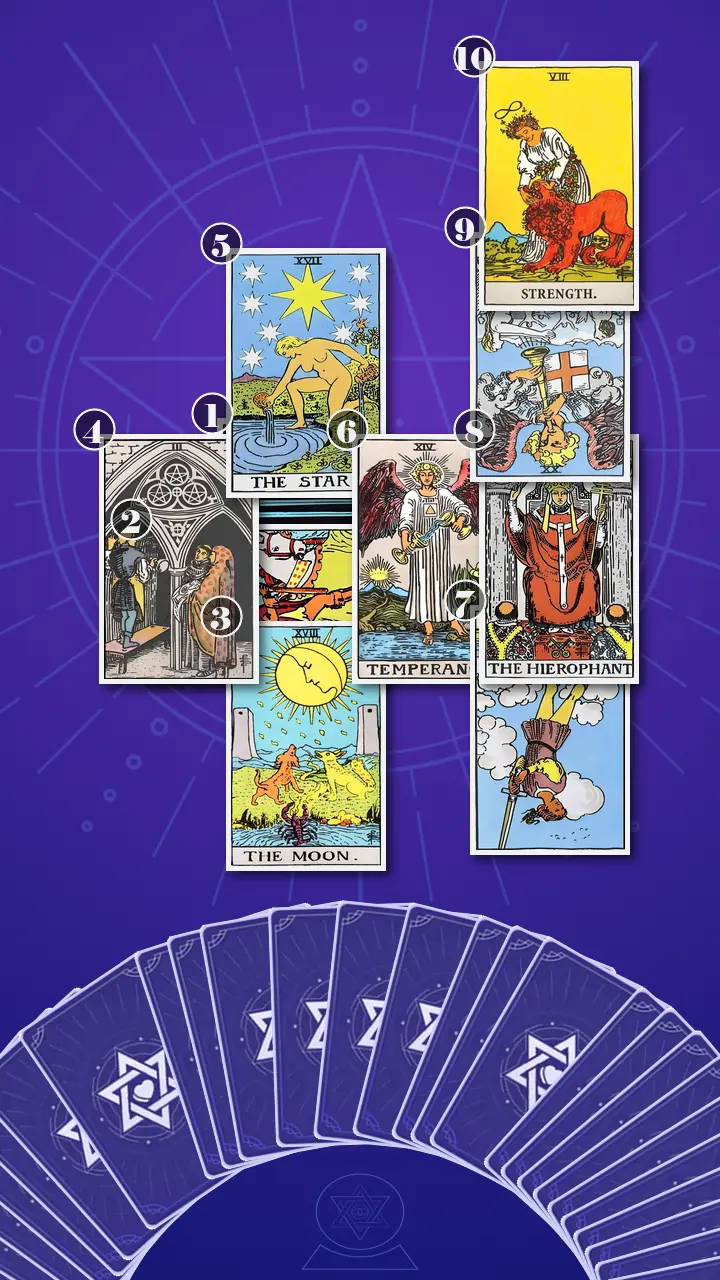
In this spread, the center cross is the inner knot: the present symptom, the main block, the hidden driver, recent context, conscious aim, and the near-future direction. Then the side “ladder” moves from self → environment → hopes/fears → integration. It’s like reading a night sky: you start with the brightest thing you can’t ignore, then you trace the constellations into a shape that actually makes navigation possible.
“The first card will show your immediate pattern after praise,” I said. “The crossing card shows what stops the compliment from landing. The root goes underneath—what fear is powering it. And one card will answer the part you asked most clearly: what’s my next step?”
Applause That Feels Like Inspection: Reading the Map in Context
Position 1 — Presenting symptom: the immediate reaction pattern
“Now flipped over,” I said, “is the card that represents your presenting symptom: the immediate, observable reaction pattern after receiving praise.”
Nine of Swords, upright.
I didn’t have to reach for an abstract meaning. The card practically narrated her night back to her.
“It’s 1:13 a.m. and you’re in bed with your laptop cracked open, rereading ‘Great work’ like it’s evidence in a trial,” I said, keeping my voice calm and modern. “The room is dark except for the blue light of the screen, and instead of feeling relieved, you start scanning your own paragraphs for the hidden flaw that would ‘explain’ why the praise can’t be real.”
This is Air energy in excess—thoughts overproducing, looping, turning one kind sentence into an emergency briefing. Not intuition. Not discernment. Just rumination with a badge that says “responsible.”
Maya let out a laugh that didn’t fully become a laugh—more like a wince with sound. “That’s literally my life at 1 a.m.,” she said. Then she exhaled, long and shaky, like she’d been holding her breath since the email arrived.
“Good,” I said softly. “Not because it’s fun. Because when we can name the loop, it becomes observable. And what’s observable is workable.”
Position 2 — Primary block: what prevents the compliment from landing
“Now we’re looking at the card that represents your primary block,” I said, “what specifically prevents the compliment from landing internally.”
Six of Wands, reversed.
“In your life,” I translated, “this looks like: in a seminar or an email thread, the praise lands publicly enough that it feels like everyone can now see you. Instead of letting it register as success, your brain translates it into pressure: ‘Now I have to maintain this.’ You minimise it out loud, then privately plan extra work so you won’t be caught slipping.”
Reversed, this card isn’t ‘failure.’ It’s visibility feeling unsafe. Applause getting misread as inspection. Like an algorithm that takes one positive signal and spikes the difficulty level to expert mode without asking you.
I heard the soft click of Maya’s jaw as she tightened it. She didn’t even notice she’d done it until I mirrored it—touching my own jawline, just a hint, to bring her back into her body.
“This is why I say imposter syndrome can be triggered by praise,” I told her. “The praise isn’t processed as ‘data that you did well.’ It’s processed as ‘a setup for exposure.’”
Then I gave her a sentence to keep—simple enough to outlast the spiral.
Praise isn’t a new bar—it’s information you’re allowed to keep.
She nodded once, sharp. “Yeah. It’s like—he said it, and all I hear is, ‘Now don’t mess up.’”
“Exactly,” I said. “And if you can’t receive the win, you’ll keep paying for it in sleep.”
Position 3 — Hidden driver: the deeper fear powering the ‘fraud’ feeling
“Now flipped over,” I said, “is the card that represents the hidden driver: the deeper fear-based assumption feeding the fraud feeling.”
The Moon, upright.
“Here’s the modern version,” I said. “It’s like you can’t fully measure whether you belong in the program—so your brain invents a scary story to explain the uncertainty.”
This is not irrationality. It’s ambiguity intolerance. The Moon is where the mind fills gaps. Where an unknown becomes a verdict. Where a half-lit phone screen in a quiet hallway becomes a projector for every worst-case interpretation.
On the card, there’s a dog and a wolf: two voices. One practical—you’re learning, feedback is normal. One feral—they’re about to realise you’re not qualified. And between them, a winding path: not a straight line, not a final answer, but a real journey through partial light.
Maya went quiet in a different way than before. Her eyes didn’t dart as much. The spiral, for one moment, lost momentum—like fog thinning when the wind shifts.
“I hate not knowing,” she admitted. “Like… what if I’m the only one who doesn’t get it?”
“That’s The Moon’s trick,” I said. “It makes your uncertainty feel like evidence. But uncertainty in grad school is… weather. Not a verdict.”
Position 4 — Recent context: the evaluation history behind this moment
“Now we’re looking at the card that represents your recent context,” I said, “what kind of feedback and evaluation history set the stage for this moment.”
Three of Pentacles, upright.
“This is the grounded counterweight,” I said. “It’s like you got feedback in office hours—real review, real criteria—and still acted like the evaluation didn’t happen, as if your work wasn’t actually seen.”
In the card, someone’s work is being looked at inside a structured space. It’s craft. Mentorship. Standards. Earth energy in balance: competence that can be observed, not just felt.
“This matters,” I told her. “Because your professor’s ‘great work’ didn’t come from vibes. It came from expertise. From someone who knows what strong argumentation looks like.”
Maya swallowed and stared at the card on her screen like she was letting herself consider a new hypothesis. “So… it wasn’t random,” she said.
“Exactly,” I said. “Your feelings lag behind the facts, but the facts still count.”
Position 5 — Conscious aim: what you want to feel instead
“Now flipped over,” I said, “is the card that represents your conscious aim: what you think you should do, or want to feel, instead.”
The Star, upright.
“This is you reaching for a rhythm that doesn’t cost you sleep and self-respect,” I said. “Like you want to work hard, but not with your nervous system on fire.”
In modern terms: it’s the desire to stop treating every calendar block like a punishment schedule. To stop growing Zotero folders faster than the actual argument. To let a ‘study with me’ video be company, not a soundtrack to self-attack.
The Star is not about forcing yourself to believe you’re amazing. It’s about repair. It’s about re-centering after stress—so you can move forward without needing constant proof.
“You want steadiness,” I said. “Not just another A-plus.”
“Yeah,” Maya whispered. “I want to feel… normal. Like I can just do the next thing without it being a whole identity crisis.”
When Temperance Poured Between Two Cups
Position 6 — Next step direction: how to respond to praise without spiraling
I held the next card for a beat before turning it over. Not for drama—for attention. In the planetarium, I spend my life watching people rush past the moment the stars appear, already asking what comes next. This card deserved a pause.
“We’re flipping the card that represents your next step direction,” I said. “The most helpful near-term way to respond to praise without spiraling.”
Temperance, upright.
“This is calibration,” I told her. “Measured. Timeboxed. One pass. Like following a recipe: enough heat to cook it, not so much it burns.”
In my head, a quiet astronomy flashback surfaced—Hohmann transfer orbits, the way spacecraft don’t brute-force their way across space. They shift trajectory with a measured burn at the right time. Not constant thrust. Not panic.
Maya was stuck in the opposite: as soon as she got praise, she added thrust everywhere. All at once. All night.
Setup (I slowed my words): you know that moment—“great work” hits your inbox, and within minutes you’re back in the document, scrolling like you’re searching for the one sentence that will expose you. You get trapped in I must make the next draft flawless so you can’t be questioned.
Delivery (I let it land as its own thing):
Stop treating “great work” as a reason to raise the bar to impossible heights; start mixing effort and rest like Temperance pouring between two cups.
I didn’t fill the silence. I let it echo—like a planetarium dome after the lights dim, when everyone suddenly hears their own breathing.
Reinforcement: Maya’s body reacted in a chain I’ve learned to watch for. First, a tiny freeze—her fingers stopped mid-scroll, hovering above the trackpad. Then cognitive seep-in—her gaze unfocused, like she was replaying her own Tuesday night: email, stomach drop, doc reopen, “just one more source.” Then, the release: a breath pushed out from low in her chest, almost a laugh but softer, and her shoulders sank by a full inch.
“But if I don’t push,” she said, and there was a tremor of anger under it, an unexpected edge, “doesn’t that mean I was… wrong? Like I made all that effort for nothing?”
I nodded. “That reaction makes sense. Temperance isn’t calling you lazy. It’s calling you proportional. The effort you made wasn’t worthless—it built skill. But the panic-proofing part? That part is like burning extra rocket fuel in orbit because you don’t trust gravity to hold you. It feels safer. It also exhausts you.”
This is where I brought in one of my own tools—my Black Hole Focus, event horizon theory applied to concentration and boundaries. “A black hole’s event horizon is a line you don’t cross,” I said. “Not because you’re weak. Because physics changes past that point. Your work needs an event horizon, too: a boundary where ‘helpful revision’ stops and ‘fear-driven rewriting’ begins.”
I saw Maya’s eyes widen—just a little—like the metaphor gave her a handle. “So the boundary is… the horizon,” she murmured.
“Yes,” I said. “And Temperance is the pour: one measured adjustment inside the horizon. Not a rewrite tornado.”
Then I invited her into the moment that makes this practical, not poetic. “Now,” I asked her, “with this new lens—can you think back to last week? Was there a moment when you got praise and the spiral started… where one improvement and one boundary would have made you feel different?”
Maya stared at the email tab. “Yesterday,” she said. “I reopened it at midnight. I told myself I was being diligent. I was… terrified.”
“That’s the shift,” I said. “From tight self-doubt toward grounded self-trust. Not overnight. But observable.”
Position 7 — Self stance: the internal role you’re playing
“Now flipped over,” I said, “is the card that represents your self stance: the internal role you’re playing that keeps the loop going.”
Page of Swords, reversed.
“This is self-surveillance,” I told her. “It’s like treating every seminar comment as a test, then spending hours rehearsing what you ‘should’ have said instead of extracting one lesson and moving on.”
Reversed, the Page’s curiosity gets blocked and turns into nitpicking. Communication becomes a courtroom. You draft and redraft a question email, delete it, then Google for hours so you don’t risk sounding ‘stupid.’ Air energy again, but jumpy—wind without direction.
Maya made a face. “I literally have a draft email sitting there,” she admitted. “I’ve rewritten it five times.”
“Temperance needs a Page-of-Swords tweak,” I said. “We’ll give you a clean question—three sentences max—so you show up as a learner, not a defendant.”
Position 8 — External frame: the academic structure and support available
“Now we’re looking at the card that represents your external frame,” I said. “The academic environment, mentor dynamic, and available structure.”
The Hierophant, upright.
“This is the part of academia that can stabilise you,” I said. “Rubrics. Office hours. Milestones. Legitimate evaluation channels.”
In modern terms, it’s remembering you can ask for criteria, examples, and next steps—instead of guessing alone at 1 a.m. what ‘good enough’ means. The praise didn’t come from the void; it came from a system that knows what good work looks like.
“Your professor’s praise isn’t random,” I told her. “It’s information. If you use the structure, you don’t have to mind-read.”
Maya’s shoulders stayed down. That alone felt like progress.
Position 9 — Hopes vs fears: the praise you want, the verdict you dread
“Now flipped over,” I said, “is the card that represents your hopes and fears: what you secretly want the praise to mean, and what you fear it could expose.”
Judgement, reversed.
“This is wanting a final absolution,” I said, “and fearing a final verdict.”
She didn’t need me to over-explain it; she looked like someone recognising a private thought caught on paper.
“I want it to mean I belong,” she said. “Like… permanently.”
“And the fear,” I reflected, “is that any comment could turn into a summoning. Like you’re one question away from being exposed.”
I offered her a phrase I use often when people are stuck in evaluation anxiety: You’re not on trial—you’re in development.
Judgement reversed is blocked self-recognition. Temperance helps because it replaces ‘verdict-seeking’ with process: you define what good-enough completion looks like, then you stop. You let learning be iterative, not identity-threatening.
Position 10 — Integration: the inner quality available if you engage consciously
“Now we’re looking at the card that represents integration,” I said. “What becomes available when you practice that next-step approach.”
Strength, upright.
“This isn’t ‘power through,’” I told her. “This is quiet self-trust. Firm but kind self-leadership.”
In modern life, it looks like hitting submit without rereading ten times. Walking to class with your shoulders down. Letting doubt exist in the passenger seat without letting it grab the wheel.
“Strength is the opposite of punishment,” I said. “It’s gentle consistency.”
And I meant it in the most practical way: gentle consistency beats panic-proofing.
The One Improvement + One Boundary Method: Actionable Next Steps
I leaned back and let the spread resolve into one story, the way I’d trace a constellation for a school group—point by point until the shape appears.
“Here’s the arc,” I told Maya. “Your present pattern (Nine of Swords) is the midnight replay: praise arrives, and your mind turns it into a threat. The block (Six of Wands reversed) is that visibility feels unsafe, so success gets translated into pressure and you try to ‘earn it again’ with overwork. Underneath, The Moon feeds it with uncertainty—if you can’t measure belonging, your brain invents a verdict. But the facts are Earth-solid: Three of Pentacles shows you’ve been genuinely evaluated within standards. The Star shows what you want isn’t more achievement; it’s steadiness. Temperance is the bridge: calibration instead of escalation. And Strength is the outcome available when you practice that—humane courage, not perfection.”
“Your cognitive blind spot,” I added, “is that you’ve been treating praise like a temporary loan you must pay back immediately—with interest. That’s why you can’t keep it.”
“The direction of transformation,” I said, “is exactly this: shifting from trying to prove you deserve praise through extra effort to practicing receiving evidence of competence and letting it stand—without immediate overcorrection.”
Then I gave her concrete steps. Not a new personality. A process experiment.
- The 10-Minute Temperance PlanBefore you touch the doc again, set a 10-minute timer and write two bullets: (1) ONE improvement you’ll make next (one paragraph clarity pass, one citation check, one restructure), and (2) ONE boundary you’ll keep (hard stop time, “no new sources after 6 p.m.,” or a 45-minute timebox). When the timer ends, close the doc.If your chest tightens and your brain starts prosecuting you (“but what if…”), keep only the boundary bullet. Boundary-first still counts.
- Create an “Event Horizon” Rule (Black Hole Focus)Pick one line you will not cross tonight—for example: “No new sources after 6 p.m.” or “One revision block only (5:30–6:15).” Treat it like physics: past the horizon, fear-driven rewriting pulls you in.Name it in your calendar or Notes exactly once. The goal is to prevent ‘just one more’ from becoming an all-nighter.
- Send the 3-Sentence Clarification EmailUse the Hierophant’s structure as support. Send a concise message (max 3 sentences): “Thanks for the feedback—what specifically made it strong? For the next step, what’s one area you’d focus on improving?” Then stop editing and hit send.If you’re tempted to write a self-defence essay, cut it. You’re asking for criteria, not permission to exist.
“And one small add-on, if you want it,” I said, “because Six of Wands reversed needs a way to let wins count.”
I offered her my Shooting Star Notes approach—thirty seconds, no drama. “After any compliment,” I told her, “write a two-line credit log: (1) copy the exact phrase they praised, (2) name one concrete choice you made that led to it. Then stop. It’s a quick capture before the moment burns up.”

A Week Later: The Quiet Proof
A week later, Maya messaged me from a rainy morning on the Victoria line. Her text was short—almost stubbornly ordinary: “I did the 10-minute plan. One improvement, one boundary. I stopped at 6:15 even though I wanted to keep going. I slept.”
She added, “I sent the 3-sentence email. I didn’t reread it ten times. He replied with one concrete thing to focus on. It felt… normal.”
There was a bittersweet tenderness in it—the kind of growth that isn’t fireworks. More like: she finally closed her laptop, made tea, and sat in the quiet of her flat for a minute, a little proud and a little shaky, because calm can feel unfamiliar when you’ve lived on adrenaline.
That’s the real Journey to Clarity I care about: not certainty, but steadier pacing. Not erasing doubt, but meeting it with Strength—gentle consistency over panic-proofing.
When someone says “great work,” and your chest tightens anyway, it’s not because you’re incapable—it’s because being seen feels like a verdict, so you try to outrun exposure by working even harder.
If you treated that praise as simple data—not danger—what would one proportional next step look like this week: one small improvement you’d choose, and one boundary you’d let stay in place?