The “Still On Tonight?” Draft—And the One-Line Deadline That Stuck

Day-of Confirmation Anxiety and the 2 a.m. Texting Limbo
You’ve typed “still on for tonight?” then deleted it, then retyped it with a joke, then added “no worries if not!”—because the fear of sounding needy is louder than your actual need.
When Alex (name changed for privacy) came into my café in Toronto, she sat down like someone trying to look casual while carrying a backpack full of bricks. The street outside still had that weekday-after-work edge—cars hissing over damp pavement, a TTC streetcar bell in the distance, people walking fast like they had somewhere to be even if they didn’t.
“It’s not even the canceling,” she said, pulling her phone from her tote like it had its own gravity. “It’s the waiting.”
She described the same scene I’ve heard in a hundred variations—8:47 p.m. on a Tuesday, lying in bed in a downtown apartment, blue phone-glow on the ceiling, radiator clicking in little metallic sighs. She refreshes iMessage again. Her jaw tightens. Her fingers keep reaching, like the phone is a hot pan she can’t stop touching. She drafts a check-in text she doesn’t even want to send, because she wants closeness, but she’s terrified that needing clarity makes her “too much.”
Texting limbo turns a normal plan into a full-time job in your head.
As she talked, I watched her body do what her words didn’t fully admit: shoulders inching up, breath getting shallow, a little swallow like she was trying to push the feeling down her throat. That particular kind of anticipatory dread always reads to me like being over-caffeinated on an empty stomach—your mind buzzing, your chest tight, and no real fuel under it.
“I get it,” I told her, keeping my voice soft but steady. “We’re going to aim for something really practical today: not ‘how do I care less,’ but how do we create clarity so your brain can stand down. Let’s try to draw a map for the fog.”

Choosing the Compass: The Relationship Spread · Context Edition
I slid a small espresso toward her—not as a cure, just as a comfort. In my café, coffee isn’t a performance. It’s a pause. I asked her to take one slow breath before she sipped, the way I do when I’m teaching a new barista: focus first, then move.
While she held her question in mind—They only confirm plans day-of. What boundary stops my overthinking?—I shuffled my well-worn tarot deck on the marble table. Not as a mystical show. As a transition. A way of telling the nervous system: we’re doing something different now.
“Today I’m using a spread I call the Relationship Spread · Context Edition,” I said. “It’s built for relationship communication boundaries—especially when the issue is relational, but the solution has to be self-led.”
For you reading this: the reason this spread works for day-of confirmation anxiety is that it separates three things people blur together when they’re spiraling: your internal response, their planning style, and the loop the two of you accidentally create. Then it drops down into what you can actually control (structure) and what’s inflaming the whole thing (the psychological trigger), before landing on the exact boundary language that reduces ambiguity.
“The first card shows you right now—what you do when plans aren’t confirmed,” I told Alex. “The second shows them—without judging, just their style. The third is the dynamic between you. And the last card is the boundary: the words and follow-through that end the mental noise.”
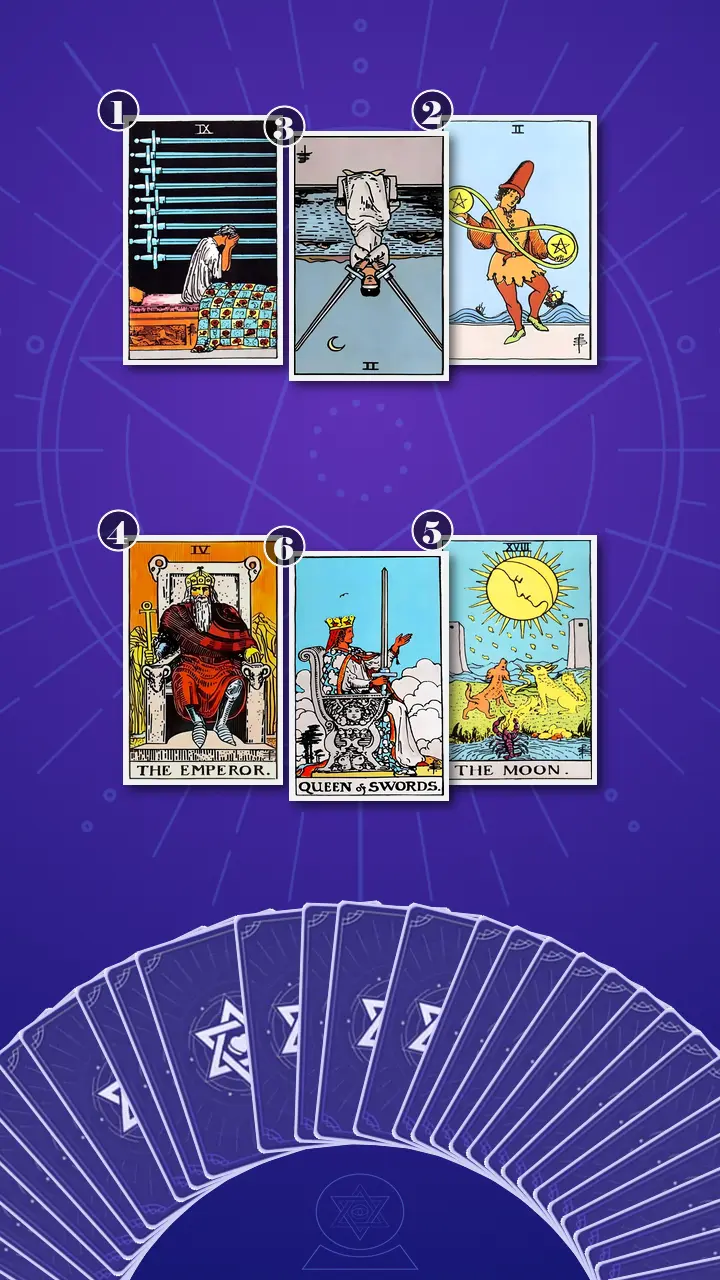
Reading the Map: Six Cards, One Boundary
Position 1: Your Overthinking Loop
“Now we turn over the card representing you right now: your observable mental/behavioral response when plans aren’t confirmed,” I said.
Nine of Swords, upright.
I didn’t even need to reach for a poetic interpretation. The card did it on its own: the person upright in bed, hands over their face, swords lined up like intrusive thoughts you can’t turn off.
“This is late, you’re in bed, and the plan still isn’t confirmed,” I said, using the plainest translation possible. “You reread the thread like it’s evidence, draft three versions of ‘still on?’—one casual, one funny, one overly polite—and your body stays on alert. Tight chest. Clenched jaw. Like the outcome will decide your worth by morning.”
The energy here is excess Air: too many thoughts, too much interpretation, not enough grounding. In my café language, it’s like over-extraction—when water runs through the grounds too long, and what you get isn’t more coffee, it’s more bitterness. Overthinking feels like “getting more information,” but it’s actually extracting pain from uncertainty until it tastes like certainty.
I leaned in a little, gentle but clear. “Let’s do the courtroom version your brain is already doing.”
“Exhibit A: they watched your story.”
“Exhibit B: no reply.”
“Exhibit C: you don’t want to look needy.”
“Verdict: you’re an option.”
Alex let out a small laugh that had no humor in it. Her shoulders held tight anyway.
“That’s… yeah,” she said. “It’s so accurate it’s almost mean.”
“It’s not mean,” I said. “It’s patterned. And patterns can be changed.”
Position 2: Their Planning Style (No Moral Verdict)
“Now we turn over the card representing them right now: their likely planning/communication style,” I said.
Two of Pentacles, upright.
“This is the juggler,” I told her. “They’re not necessarily trying to mess with you—they’re juggling. They confirm based on how the day shakes out: work runs late, social energy changes, other plans compete. To them, it’s adaptability; to you, it feels like your time is endlessly adjustable and always second in line.”
The energy here is balance under motion: not evil, not careless by default—just someone used to living inside an infinity loop of ‘we’ll see.’ And when that infinity loop meets your Nine of Swords, your mind starts trying to solve their flexibility like it’s a riddle you can win.
“Their uncertainty doesn’t get to rent space in your calendar for free,” I added, and I saw Alex’s eyes flick up—like that sentence landed somewhere under her ribs.
Position 3: The Shared Dynamic (Where You Go Silent)
“Now we turn over the card representing the relationship dynamic: the interaction pattern created when your need for clarity meets their day-of confirmation habit,” I said.
Two of Swords, reversed.
“This is the part of you that tells yourself you’re being chill,” I said, “but you’re actually frozen.”
In modern life: you don’t book a class, don’t text other friends back, don’t start cooking—because you’re bracing for a last-minute yes or no. Your defenses are crossed (no direct ask), and the pressure builds until you either overtext or go cold.
Reversed, the energy is blockage collapsing into overwhelm. The blindfold isn’t peaceful; it’s sensory deprivation. Your nervous system can’t regulate without information, so it makes information out of anything—punctuation, response time, Instagram story views.
Alex nodded once, tight. She didn’t look at the card; she looked at the edge of the table, like she was seeing her own calendar with that suspicious “pending” gap.
Position 4: Your Strength (The Structure You Can Control)
“Now we turn over the card representing strengths you can use: the personal resource that helps you set structure and protect your time,” I said.
The Emperor, upright.
This card always feels like a deep exhale in the middle of a messy story. Stone throne. Armor. A calm, pre-decided standard.
“You already have this,” I told her. “You decide—before you’re triggered—that your time has a structure. You treat your calendar like a protected resource. Weeknights need a confirm-by time, and if it doesn’t happen you don’t ‘wait harder’—you choose your own plan. It’s not a power move; it’s self-leadership.”
The Emperor’s energy is containment. Not coldness—containment. In my world, it’s espresso machine maintenance. If I don’t do the boring, scheduled care—clean the group head, check the pressure—everything gets chaotic during the rush. Not because the machine is “bad,” but because structure is what makes consistency possible.
Alex’s shoulders dropped a fraction, like her body recognized the relief of a policy.
“I could do that,” she said, then immediately grimaced. “But it’s the awkward part. Like… who am I to set rules?”
“You’re the person who has to live inside your own evening,” I said. “That’s who.”
Position 5: The Trigger That Fuels the Spiral
“Now we turn over the card representing the challenges that fuel overthinking: the psychological trigger that keeps the uncertainty loop alive,” I said.
The Moon, upright.
The café seemed to go quieter for a second—just the low hiss of steaming milk behind the counter, a spoon tapping ceramic somewhere far away. The Moon always does that. It changes the light in a room.
“This is Moon-fog storytelling,” I told her. “The silence becomes a fog where your brain starts making up street signs. You read into response times, punctuation, story views. Your body scans for danger, and you try to solve uncertainty with interpretation—until the situation feels heavier than the plan ever was.”
The energy here is excess Water—emotion and imagination filling gaps where facts aren’t available. It’s like the algorithm filling in the blanks: no data, so your brain serves you the most emotionally sticky story.
This is where my Stress Flavor Profile lens always clicks into place: Moon-fog makes you over-extract. You keep running water through the same grounds—checking, scanning, re-reading—trying to get something clean. But what you get is more bitterness and a racing heart. Not because you’re dramatic. Because your system is trying to create safety out of ambiguity.
Alex’s mouth tightened; she swallowed, then let out a slow breath. “The worst part,” she said, “is I can feel myself doing it. Like I’m on the King streetcar, the lights are flickering, and I’m convincing myself a story view is evidence.”
“Exactly,” I said. “So the fix isn’t ‘interpret better.’ It’s ‘change the informational environment.’”
When the Queen of Swords Drew a Line in Daylight
Position 6: The Boundary That Stops Overthinking
I let my hands rest on the deck for a beat. “We’re turning over the integrating advice now,” I said, “the boundary language that reduces ambiguity and stops the cycle.”
Queen of Swords, upright.
Her sword is raised—not to threaten, but to be unmistakable. And her open palm says: I’m available, and there are conditions.
In real life, this is daylight language. Not paragraphs. Not disclaimers. Not a closing argument designed to manage someone else’s reaction. It’s one line, and then your life continues.
Here’s the setup I named out loud, because Alex wasn’t the only person who needed to hear it: it’s that 5 p.m. moment—Slack quiet, phone in your hand, calendar still blank—like your night is paused until someone else decides whether you’re worth confirming. That pause is the trap.
Not endless "maybe" waiting—name a clear deadline and cut the mental noise with the Queen’s single, upright sword.
Alex had a reaction chain so physical it made the whole reading feel real in my bones: first, she went still—breath paused, fingers hovering above the lip of her cup. Then her eyes unfocused for a second, like her mind replayed every “pending” evening in fast-forward. Then she exhaled, long and shaky, and her shoulders lowered as if she’d been holding a bag she forgot she was carrying.
“But if I do that…” she started, and there was a flash of anger under the fear. “Doesn’t it mean I’ve been doing it wrong? Like I’ve been letting this happen?”
I kept my voice warm. “It means you learned a survival strategy—stay easygoing, stay available—and it helped you avoid a clear no. That’s not ‘wrong.’ It’s just expensive.”
I tapped the Queen’s sword lightly with my fingertip. “This isn’t punishment. It’s clarity. A deadline isn’t an ultimatum—it’s a door you close so you can live your evening.”
And then I invited her in, right on the edge of the insight: “Now, with this new lens—time-based and action-based—think back to last week. Was there a moment when you checked your phone for the fifth time, and if you’d had a confirm-by time, your body would’ve softened instead of tightening?”
Her eyes got a little glossy, not in a dramatic way—more like her nervous system was relieved to be understood. “Thursday,” she said. “I literally didn’t eat dinner because I kept thinking I’d have to ‘be ready’ if they texted.”
“That,” I said gently, “is the shift beginning—moving from anticipatory dread and self-doubt to relieved clarity and self-respect. Not because they changed, but because you did.”
The One-Line Boundary and the Backup Plan
I slid the cards into a clean line and told her the story they’d been telling all along.
“When plans aren’t confirmed, you go into Nine of Swords—your mind turns into a courtroom and your body pays the bill. They operate like the Two of Pentacles—juggling, flexible, deciding late. Together, you land in Two of Swords reversed: you go quiet to seem chill, then resent the silence, then feel forced into last-minute decisions. The Moon is the accelerant—no facts, so your brain writes plot. The Emperor says: make a policy. And the Queen of Swords says: speak it once, clearly, then follow through.”
“Here’s the blind spot,” I added, because this is where people usually slip: “You’ve been treating a direct boundary like it’s a referendum on whether you’re ‘needy.’ But the real issue isn’t your need. It’s the open loop. You’re not asking for devotion. You’re asking for scheduling clarity.”
Then I gave her next steps that were small enough to do, even if her stomach flipped while doing them. I didn’t want a grand speech. I wanted a working system—confirmation deadline and backup plan—so her evening didn’t stay on hold.
- Write Your Weeknight Policy (The Emperor)Open your Notes app and write one sentence: “For weeknights, I need confirmation by ___ p.m.; if not, I make other plans.” Screenshot it so Future You can’t pretend you didn’t decide.If you’re unsure, start with a softer window (like 3 p.m.) and adjust later—policies can evolve, but they must exist.
- Send the Daylight Deadline Text (Queen of Swords)Send one clean line: “Hey—just so I can plan my night: if I don’t hear by 4 p.m., I’ll assume it’s not happening and I’ll make other plans.” Then stop talking.One line. No courtroom. No closing argument. If you feel the urge to add jokes/disclaimers, you’re negotiating yourself.
- Close the Maybe: DND + a Physical Task (Two of Swords Reversed)After you send the text, put your phone on Do Not Disturb for 60 minutes. During that hour, do one physical thing you need anyway (groceries, laundry, a brisk walk).If an hour feels impossible, do 20 minutes. In my café I call it a “riposo for your nervous system”—a scheduled pause so you don’t over-extract your mind.
I also used one of my own little diagnostics, because Alex’s body was giving us data. I nodded at the cappuccino in front of her; the foam had fallen and the cup had cooled fast.
“That’s a Cup Temperature Scan,” I told her. “When your energy drops this quickly, waiting time feels twice as loud. So your boundary isn’t just social—it’s physical. You’re not being ‘too much.’ You’re being over-spent.”
“Default-no,” I said, and watched her flinch a little, “and then self-yes. If the confirmation doesn’t happen by your time, your plan isn’t ‘sit and seethe.’ Your plan is: go live your evening.”

A Week Later: The Quiet Proof
A week later, Alex messaged me a screenshot. One line sent at 11:58 a.m. Another line received at 5:17 p.m. And in between: nothing. No frantic follow-ups. No spiral paragraphs.
“I did it,” she wrote. “I set 4 p.m. I put my phone on Focus. I booked a class. They texted late, and I said I made other plans. My hands were shaking, but… I ate dinner like a normal person.”
She didn’t sound euphoric. She sounded steady. That’s what clarity often looks like in the real world.
Submitted the class booking, then celebrated by sitting alone at a café for twenty minutes—warm cup in both hands, a little lonely, a little proud. The night wasn’t perfect, but it was hers.
When I think about her reading, I think about what the cards did best: they didn’t tell her what they meant. They showed her what the pattern meant—and exactly where her leverage was. Clarity became a standard, not a craving.
When plans stay unconfirmed, it can feel like you’re standing in the hallway with your coat on—trying to look chill while your chest tightens, because asking for clarity feels like risking the truth about whether you matter.
If you gave your evening a confirm-by time this week, what would you want to do with the freed-up mental space between “sent” and “answered”?