When a Manager 1:1 Feels Like a Verdict: The Draft-and-Ask Flip

Finding Clarity in the Monday Morning Calendar Glare
You’re 29, newly promoted in a mid-size tech company, and a single “1:1” calendar invite can hijack your whole nervous system before you even click it—classic calendar invite dread.
Taylor (name changed for privacy) told me that line almost word-for-word, and I could hear the shame hiding under it—like she was confessing something embarrassing instead of describing a completely normal nervous system doing what it learned to do.
She’d booked with me from Toronto, and when we got on video she was still wearing her commute: coat half-off, hair tucked behind one ear, the kind of expression you get after riding Line 1 southbound while holding coffee and trying not to spill your life. She described the moment in detail—9:08 AM, TTC screeching into a station, her phone vibrating, and that bright Google Calendar preview flashing: “1:1 — Taylor + Manager.” No agenda. The screen glare too bright. The train too loud. Her chest going rigid like a seatbelt locking.
“I hate how much one meeting can hijack my whole day,” she said. “I want it to be supportive. Like… it’s literally my manager. But my body treats it like I’m being called into the principal’s office.”
I watched her swallow as she said it—tight throat, braced chest, like she was holding her breath on purpose even though no one had asked her to.
Her question was simple, but not small: “My manager invited me to a 1:1. What past authority wound is running me… and what’s one step I can actually take?”
In my work—radio, music therapy, tarot—I’ve learned that clarity isn’t always a lightning bolt. Sometimes it’s a tiny unclenching. So I said, “Let’s make today a journey to clarity. Not to predict what your manager will do—but to name what your body thinks is happening, and give you one real move you can practice before that meeting.”

Choosing the Compass: The Four-Layer Insight Ladder
I invited Taylor to put both feet on the floor and take one breath that was just a fraction longer on the exhale. Not because it’s mystical—because it’s a nervous system handrail.
As I shuffled, I told her what I tell most people who come in with workplace anxiety: “Tarot is amazing at showing you the story you’re currently inside—especially the hidden rule underneath your reactions. Once we can see the rule, you can renegotiate it.”
Today I chose an original spread called the Four-Layer Insight Ladder · Context Edition. I like it for questions like ‘Why do I panic when my manager schedules a 1:1 with no agenda?’ because it doesn’t waste time trying to read your boss’s mind. It goes straight to the internal pattern that turns a neutral invite into a threat signal.
For you reading this, here’s why the ladder works: it’s the minimum structure that still covers the whole arc—(1) what you do on the surface when the invite lands, (2) the root authority imprint underneath, (3) the inner shift that restores self-authority, and (4) one grounded step you can take in the real workplace context. It’s the difference between spiraling and actually preparing.
I also previewed the map so Taylor knew we weren’t going to float in abstraction:
“The first card shows your immediate spiral routine—what your body does in the first ten minutes. The second card reveals the authority wound driving it. The third is the turning point—your inner authority stance. And the last card is one do-this-next step to walk into the 1:1 with agency.”
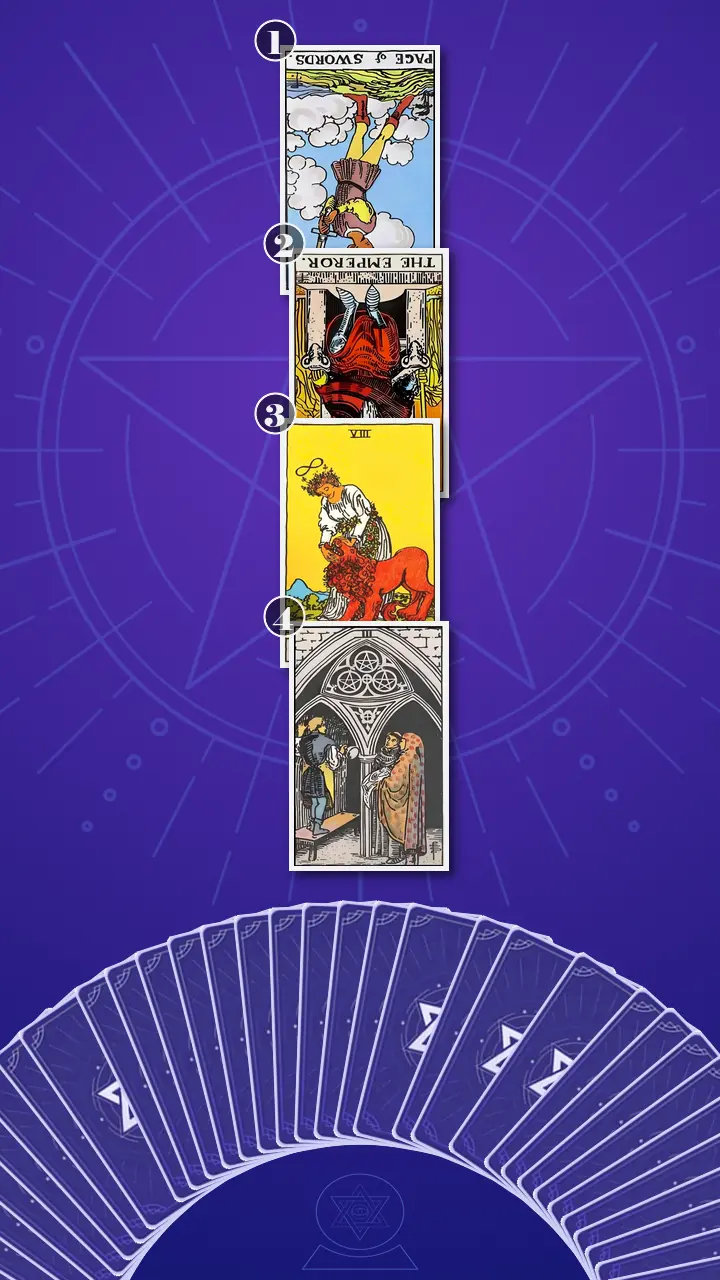
Reading the Map: From Spiral Routine to the Root Rule
Position 1 — The Present Layer: Your Spiral Routine in the First 10 Minutes
I turned over the first card. “Now flipping, is the card that shows Taylor’s immediate, observable reaction pattern to the manager 1:1 invite—the presenting problem behavior lens.”
Page of Swords, reversed.
Even before I interpreted it, Taylor’s eyes narrowed in recognition, like she’d just seen her own browser history on a projector.
“This card is literally the moment you described,” I said. “It’s 3:12 PM on a Wednesday in Toronto. A Google Calendar notification pops up: ‘1:1 — Taylor + Manager.’ No agenda. Your stomach drops before you even click it. Within minutes you’re in Slack search typing your own name, scrolling back through threads to see if anything could’ve sounded ‘off.’ You open a doc titled ‘1:1 agenda,’ write three bullet points, then spend 45 minutes rewording them to sound un-attackable—less like a person, more like a press release.”
The Page of Swords is a mind that learns through observation. Reversed, that energy gets blocked and overheated—Air turned sharp. Instead of clarity, you get threat-scanning: mind-reading your boss on Slack, tone-decoding neutral messages, rewriting to sound unimpeachable.
I kept my voice gentle but direct. “This is important: If you’re editing to sound unimpeachable, you’re not preparing—you’re bracing. And bracing feels productive, but it’s not the same as planning.”
Taylor’s reaction surprised her. It wasn’t a nod. It was a small, bitter laugh—then she stopped as if she’d revealed too much. I watched a three-step micro-chain ripple through her: her breathing paused (freeze), her gaze slid off-camera as if replaying the last invite in her head (cognitive seep), and then her shoulders dropped a millimeter with that laugh (release).
“That’s… rude,” she said, but her mouth was trying not to smile. “Like, it’s true. It’s so true it’s kind of cruel.”
“I’m on your side,” I told her. “Also—a 1:1 invite isn’t a verdict. It’s information. This card is showing us the exact routine your body runs before you even have any data.”
Then I asked the question that matters for this position: “Right after you see the invite land, what are you trying to prevent from happening?”
She didn’t hesitate. “Being surprised. Being caught not knowing. Looking like I don’t deserve the promotion.”
Position 2 — The Root Layer: The Authority Template Your Body Copies and Pastes
I turned over the second card. “Now flipping, is the card that reveals the past authority wound or learned lesson about power/evaluation that is running the current response—the underlying fear and core contradiction.”
The Emperor, reversed.
There’s a particular coldness to The Emperor reversed. Upright, The Emperor is structure that protects you. Reversed, that structure becomes a pressure system—authority as punishment, hierarchy as danger.
I used what I call a scorecard flashback frame, because that’s the nervous system language in so many feedback-heavy tech workplaces.
“Under the spiral is a hard internal rule,” I said. “Authority isn’t a collaborator—it’s a judge. So a neutral check-in feels like a scorecard you didn’t know you were taking. You can almost feel yourself getting smaller—smoothing your voice, over-explaining, trying to be ‘low-maintenance’ so no one has a reason to scrutinize you.”
I let it land, then said it in second person—because that’s how these old rules talk: “If you’re not perfect, you’re not safe. If you admit a gap, you’ll be punished or labeled ‘not ready.’”
Taylor’s chin tipped up, but her eyes went shiny in that way that isn’t tears yet—just heat behind the eyes. “My manager is… fine,” she said. “She’s not even harsh. But my body acts like she is.”
“Exactly,” I said. “This card isn’t accusing your manager. It’s naming the internalized Emperor—an older template that equates authority with domination. And it creates the contradiction you’re living in: wanting managerial support and growth vs fearing authority contact will expose you as incompetent. You want the 1:1 to be support. Your body hears a gavel.”
Because my work is rooted in sound and behavior, I added one diagnostic move that often makes this real fast. “Can I ask something a little unusual? When you get the invite and start spiraling, what do you put on—music-wise?”
She blinked. “Honestly? I don’t even notice. I… scroll. Or I’ll put on something intense so I can ‘focus.’ Like… high-energy EDM. Or I’ll replay the same one song.”
“That’s helpful,” I said. “I call it Music Pulse Diagnosis. Your recent listening can show me what your nervous system is trying to do. High-intensity tracks during a spiral often mean your body is trying to outrun discomfort—like adding more RPMs to a car that’s already skidding.”
Taylor exhaled hard through her nose—half recognition, half annoyance. “So I’m basically… soundtracking my own panic.”
“You’re soundtracking your survival strategy,” I corrected. “And it makes sense, given the Emperor reversed underneath. But we can choose a different soundtrack once we know what’s actually happening.”
When Strength Held the Lion Gently
Position 3 — The Transformation Layer: Calm Inner Authority in the Room with Power
When I reached for the third card, the room felt quieter—not because the city outside stopped, but because Taylor stopped filling the silence with mental rehearsal. Even through a screen, I could hear the background: faint HVAC hum, a distant streetcar bell, her laptop fan kicking on like a tiny anxious metronome.
“Now flipping,” I said, “is the card that identifies the most healing inner authority stance you can embody to meet authority without shrinking—the key shift.”
Strength, upright.
Strength is one of the most misunderstood cards in workplace contexts. It’s not ‘be confident.’ It’s regulated courage. It’s staying with yourself while your nervous system wants to leave the room.
The image matters: gentle hands on a lion. Not wrestling it. Not pretending it isn’t there.
Setup (the moment you know): Taylor was stuck in that exact loop: the invite hits, her chest braces, and she starts scrolling old Slack threads like there’s a hidden clue that will keep her safe. She thinks if she can control the tone and the facts, she can avoid the freeze—avoid being seen as “not ready.”
Delivery (the sentence that changes the posture):
Stop treating authority as a threat you must outsmart, and start meeting it with steady inner strength—like holding the lion gently instead of bracing for its bite.
I let the silence sit for a beat, the way I would after a heavy song ends on radio—no rush to talk over the last note.
Reinforcement (the body catches up): Taylor’s face went still first, like her features were waiting for permission to move. Then her eyebrows pulled together—not sadness, exactly. More like: wait, so I’ve been doing it the hard way? Her hands, which had been gripping her mug, loosened one finger at a time. She swallowed, then surprised herself by sounding slightly angry. “But if I stop outsmarting it… doesn’t that mean I’ve been wrong? Like I’ve been overreacting this whole time?”
I watched the three-step reaction chain again: a tiny freeze in her breath, her eyes unfocusing as if an old memory rewound, then a shaky exhale that didn’t feel like relief yet—more like the first crack in a shell.
“No,” I said, steady. “It means you adapted. Strength doesn’t shame the lion for being a lion. It doesn’t call your fear stupid. It just says: we’re not letting the fear drive the meeting.”
Then I brought in my most practical bridge from tarot to nervous system change—what I call a Breath Soundtrack. “Strength is a tempo,” I told her. “When your chest is braced, your body is running fast music internally—tight, quick, defensive. We’re going to switch you to a slower beat.”
I tapped my desk softly, like a metronome at about 60 beats per minute. “Try this: inhale for 4 beats, exhale for 6. Don’t make it dramatic. Just enough to soften your jaw and drop your shoulders two centimeters. That’s ‘holding the lion gently’ in real time.”
And then I asked the question I always ask after a key insight, because it turns a beautiful idea into lived truth: “Now, with this new perspective, use it to look back. In the past week, was there a moment—maybe a Slack ‘quick check-in?’ message—where this would’ve changed how you felt?”
Taylor looked down and nodded slowly. “Tuesday. My manager wrote, ‘Can we do a quick check-in later?’ No emoji, no context. I literally started building a case in my head. Like… exhibit A, exhibit B.”
“That’s the Emperor reversed scorecard,” I said. “Strength says: you can be nervous and still be in charge of yourself.”
And because my job is to make this usable, I gave her one sentence to hold onto—simple enough to say with a shaky voice: “I’d like your input on priorities, because I’m seeing two competing directions.”
The Verdict-to-Workshop Flip: One Draft, One Question
Position 4 — The Action Layer: Turning the 1:1 Into a Working Session
I turned over the fourth card. “Now flipping, is the card that gives one realistic, do-this-next step you can take to enter the 1:1 with more agency and less mind-reading.”
Three of Pentacles, upright.
“This is the workshop card,” I said. “It’s collaboration and shared standards. It’s what happens when the conversation has an object—work on the table—instead of just a vibe you have to decode.”
I grounded it in the real-life scenario: “One step that changes the whole tone: bring something real and ask for targeted craft feedback. For a marketing role, it might be a one-page campaign brief, a draft slide, a short performance snapshot, or a three-line status update. You open the 1:1 with: (1) one win, (2) one current blocker, (3) one question. Then you ask a Three of Pentacles question: ‘What would good look like here?’ or ‘Which metric matters most for this call?’”
Taylor’s shoulders dropped again, but this time her face didn’t tighten afterward. Her eyes got practical. “That… actually feels doable,” she said. “Like I’m giving the meeting a job.”
“Exactly,” I said. “You’re flipping it from courtroom to workshop.”
When I zoomed out and looked at all four cards together, the story was clean.
The Page of Swords reversed was the visible loop: the 1:1 invite lands and your mind opens forty tabs—Slack search, calendar rereads, rewriting the same three bullets—trying to prevent surprise critique. The Emperor reversed explained why it feels so urgent: an old authority template that says, ‘If I’m not perfect, I’m not safe.’ Strength was the turning point: regulated confidence—staying connected to yourself instead of trying to outsmart power. And Three of Pentacles grounded it into a single workplace move: bring a draft, ask one real question, build shared standards.
The blind spot I named gently, because it’s common in “feedback culture” environments: you’ve been treating clarity like a thing you must earn by being flawless. But the transformation direction here is the opposite—Clarity is not neediness. It’s leadership. The key shift is to stop mind-reading authority for danger signals and start leading the conversation with one clear request and one concrete draft.
Taylor gave me one last resistance, and I respected it because it was real: “But I can’t do some long prep. My calendar is chaos. I barely have five minutes before these meetings.”
“Then we do the five-minute version,” I said. “And if five minutes is impossible, we do the two-bullet version. The goal isn’t perfection. It’s changing the frame.”
- White Noise First Aid (90 seconds, right when the invite lands)Open a brown-noise or white-noise track in your earbuds (on the TTC, at your desk, wherever you are). While it plays, do 3 slow cycles of inhale 4 / exhale 6, and relax your tongue from the roof of your mouth. This is you choosing Strength before your brain starts building a defense case.If you feel silly, do it anyway—but quietly. Your nervous system doesn’t care if it’s cool; it cares if you exhale.
- The 5-Line 1:1 Agenda (One Win / One Blocker / One Question)Set a 5-minute timer in Notes. Write exactly: (1) one win you can say in one sentence, (2) one blocker you want help with, (3) one direct question you want answered. Title it “1:1 agenda” and stop editing when the timer ends.Treat the urge to perfect your wording as a signal, not an instruction. When the timer ends, you’re done—bring it as-is.
- Bring-a-Draft Method (Turn it into a workshop)Pick one tangible artifact: a draft slide, a brief, a metrics screenshot, or a 3-line status update. Open the 1:1 with: “I want to leave today with clarity on X.” Then place the artifact “on the table” (share screen or send it) and ask: “What would ‘good’ look like here?”If you start to feel flooded mid-meeting, say: “Give me a second to think,” take one inhale 4 / exhale 6, and continue. That pause is Strength in business casual.
Because sound is my lane, I also gave her a small BGM Prescription—not to be cute, but to make the new pattern easier to access:
“Choose one track that sits around 60–70 BPM (lo-fi, soft instrumental, anything that doesn’t spike you). Make it your ‘agenda-writing track.’ Your brain learns by association. Over time, the song becomes a cue: we’re not bracing, we’re preparing.”

A Week Later: The Quiet Proof
A week later, Taylor messaged me: “I did the two-bullet version in the elevator. Win + question. And I brought a screenshot of the campaign numbers.”
Her manager’s 1:1 still wasn’t her favorite part of the week. She still felt that first body spike when the invite landed. But she wrote, “I didn’t search Slack for clues. I opened with ‘I want to leave today with clarity on priorities.’ We literally talked through the draft like a working session. I left with an actual next step.”
She added something bittersweet that made me believe her: “After, I sat alone in a coffee shop for like an hour. Not even celebrating—just… feeling how quiet my head was.”
That’s how change looks most of the time. Not fireworks. A quieter brain. A jaw that unclenches without you noticing. A meeting that becomes a container for alignment instead of a courtroom for your worth.
When a simple 1:1 invite makes your throat tighten and your brain start building a defense case, it’s not because you’re weak—it’s because some part of you still thinks authority equals a verdict, even when you’re just trying to get support.
If you didn’t have to earn safety in that room, what’s the one clear thing you’d actually ask for in the first two minutes of the 1:1?