From Code Review Dread to Steadier Self-Trust: Shipping PRs in Public

Finding Clarity in the 11:40 p.m. Diff Glow
You were literally about to log off, then the GitHub notification lands and suddenly you’re doing “just one more cleanup commit” instead of requesting review.
Jordan (name changed for privacy) said it like a confession and a joke at the same time, the kind you only tell someone who won’t turn it into a personality flaw. They were 28, Toronto-based, junior-to-mid on a product team where PRs are basically your public record. “It’s not even that the code is broken,” they added. “CI is green. But my brain… isn’t.”
In my mind’s eye I could see the scene because they described it with the precision of someone who lives there: 11:40 p.m. on a Tuesday, condo bedroom, laptop balanced on their knees. The blue-white diff glow staining the sheets. Trackpad warm under the thumb. Eyes stinging like they’d been staring into winter light too long. Their jaw clenched so hard it could’ve cracked a molar as they renamed two variables and rewrote the PR description to sound more “senior”—even though checks had been green for an hour.
They weren’t asking whether their code was good. They were asking what pattern they were stuck inside the moment visibility hit. Because the core contradiction was loud in the room: want to be seen as competent and respected in review versus fear that one imperfect choice will expose you as not good enough.
The feeling in Jordan wasn’t just anxiety. It was like trying to breathe through a hoodie someone had cinched tight at the neck—air technically available, body acting like it wasn’t safe to take it.
I nodded, letting the silence do a little work. “I get it,” I said. “We’re not here to ‘fix your personality.’ We’re here to map the mechanism—so the next time that notification hits, you have options. Let’s do a small Journey to Clarity: not prediction, just a clearer read on what’s running you.”

Choosing the Compass: The Four-Layer Insight Ladder for Code Review Anxiety
I asked Jordan to put their phone face down and take three slower breaths—not as a ritual for the universe, but as a handoff from Slack-speed to nervous-system speed. While they breathed, I shuffled and listened the way I learned on long ocean crossings, reading tiny shifts in posture the way some people read weather.
“Today I’m using an original spread,” I told them, “called the Four-Layer Insight Ladder · Context Edition.”
For you reading along: this spread works especially well for pull request perfectionism and code review anxiety because it doesn’t drift into fate. It maps the system: the immediate felt state, the meaning you attach to the trigger, the belief underneath, the behavior loop it creates—then it gives you an integrating principle and a one-week practice. Trigger → belief → behavior → antidote → next step. Compact. Behavioral. Actionable.
I laid the cards in a vertical ladder like an elevator ride: top card as the headline (what’s happening in mind/body), then descending into trigger frame, core belief, and the autopilot pattern. The fifth card is the bridge—your corrective energy. The sixth is the landing: what you can actually do this week when you’re tempted to polish at midnight.
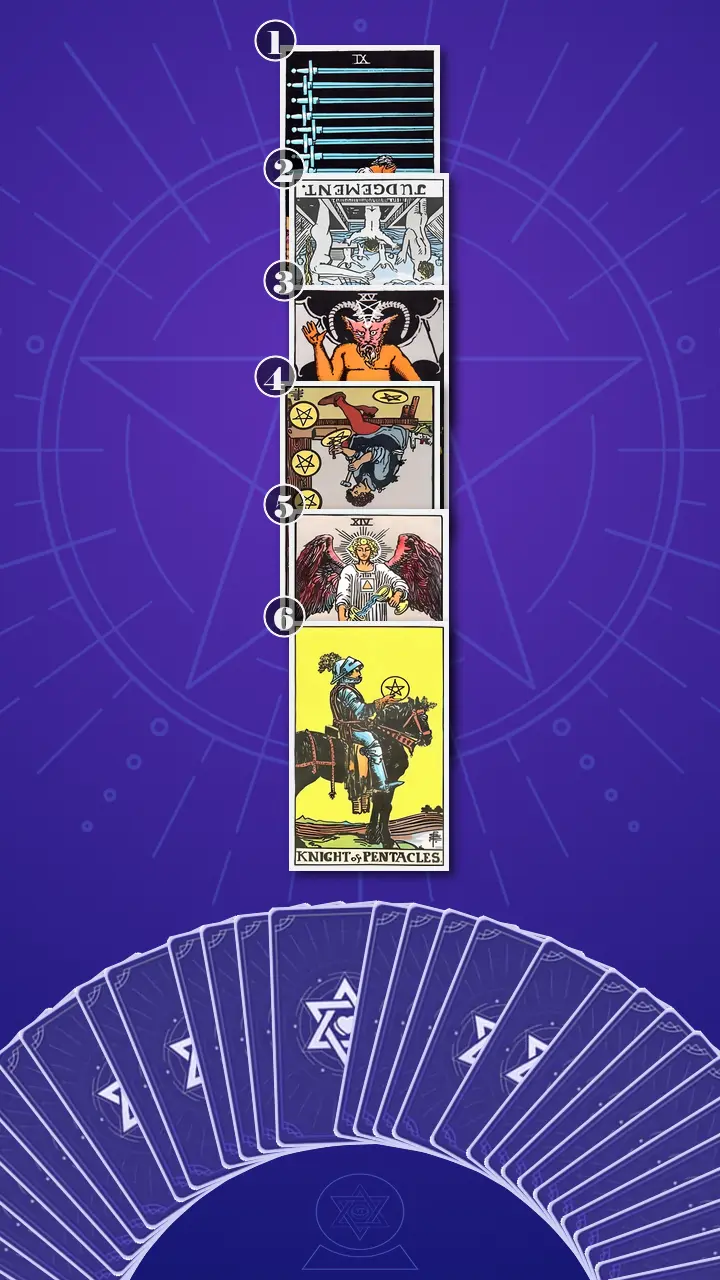
Reading the Ladder: From the Inner Courtroom to the Collaboration Loop
Position 1 — Surface experience: when the review request hits
“Now we turn over the card representing the surface experience: the immediate mental/emotional state when the PR review request hits.”
Nine of Swords, upright.
I didn’t have to dramatize it; Jordan already lived inside this card. It’s after midnight and you’re in bed with your laptop open, re-reading the PR diff like it’s an exam you can still study for. CI is green, but your brain is running worst-case simulations: a senior engineer quoting one line, a thread you can’t recover from, the shame hangover. You keep ‘just checking’—but your shoulders stay tight because you’re not checking for bugs; you’re checking for evidence you don’t belong.
In energy terms, this is Air in excess: thinking so hard it becomes a sealed room. Your mind tries to protect you by running a pre-mortem, but it traps you in a loop where relief only arrives through more checking.
Jordan let out a short laugh that didn’t reach their eyes. “That’s… brutally accurate,” they said, voice dry. “Like, why are you reading my browser history.” Their fingers rubbed their own knuckles, a tiny self-soothing move.
Position 2 — Trigger frame: what “requested your review” translates to
“Now we turn over the card representing the trigger frame: what the review request is being interpreted as.”
Judgement, reversed.
Immediately, the scene wrote itself the way it always does with this card: A GitHub “review requested” notification hits and your brain instantly frames it like a public ruling: approve = you’re legit, request changes = you’re exposed. You start drafting explanations in your head before anyone even comments, then you delay the review by polishing because you’re trying to control the verdict instead of inviting collaboration.
Reversed, Judgement is a blockage of evaluation energy: feedback gets misread as a final sentence. I watched Jordan’s shoulders inch up toward their ears as if they’d heard a sound only they could hear.
“It’s like a trumpet,” I said, using the echo that was already hanging in the air. “Phone buzz, the GitHub bell icon, Slack pings fading into the background—and your inner monologue goes, This isn’t feedback, this is a sentence. Courtroom, not collaboration.”
Jordan exhaled sharply—half relief, half annoyance at being seen. “Yes. Exactly. And then I’m already writing a defense statement in my head.”
“Stop writing PRs like legal briefs,” I said, gentle but direct. “Start writing them like invitations.”
This is where my Jungian training always kicks in: the mind isn’t irrational here. It’s trying to keep belonging intact. It’s just using an outdated strategy.
Position 3 — Core belief: the attachment underneath the perfectionism
“Now we turn over the card representing the core belief: the deeper attachment driving perfectionism in this moment.”
The Devil, upright.
People expect melodrama from this card. In real life it’s usually subtler: You’re not actually chasing better code anymore—you’re chasing safety. The compulsion shows up as: “If I can make this PR read like someone senior wrote it, I won’t get embarrassed.” The work becomes a way to avoid that stomach-drop feeling of being ‘less than’ in public, so perfection turns into a cage you keep reinforcing with extra effort.
Energy-wise, The Devil is attachment in excess. A tight grip masquerading as “high standards.” In Jungian terms, it’s the Shadow bargain: If I perform perfectly, I won’t have to feel unworthy. The problem is the bargain never pays out. It just renews the contract with higher interest.
I asked, “If you’re brutally honest, what are you trying to purchase with perfection—respect, belonging, protection from embarrassment?”
Jordan didn’t look at me right away. They stared at the edge of the card like it was a line of code they were afraid to run. “Belonging,” they said, quieter. “Like… if there’s a flaw, they’ll finally realize I shouldn’t be here.”
Position 4 — Pattern in action: productive limbo and diminishing returns
“Now we turn over the card representing the pattern in action: the concrete perfectionism behavior loop after the trigger.”
Eight of Pentacles, reversed.
This card is the one that makes engineers laugh and wince at the same time. You keep pushing tiny cleanup commits—renames, formatting, comment rewrites—because it feels safer to be busy than to be reviewed. Each micro-edit gives a quick hit of control, but the PR stays in limbo and the dread stays on. The craft is real, but it’s flipped into diminishing returns: more effort, not more clarity.
Reversed, the Eight is Earth energy blocked: effort without closure. And the echo showed up instantly—Jordan’s jaw tightened, shoulders climbed, and their eyes did that tab-switching thing even without a laptop in front of them.
I narrated the loop the way it happens, timestamp by timestamp, because that’s how you catch it in the wild:
“11:47 p.m. — rename a variable because ‘it reads junior.’ 12:06 a.m. — format a file and rewrite two comments because ‘someone might nitpick.’ 12:31 a.m. — edit the PR description again so it sounds ‘more senior,’ like wording can prevent criticism.”
Jordan made that tight, pained laugh. “Micro-optimizing is still avoidance if it keeps you invisible,” they said, like they were testing the sentence on their own tongue.
“Exactly,” I replied. “And I want to name something cleanly: CI is green. Your nervous system isn’t. Those are different problems. You’ve been trying to solve a nervous-system threat with more linting.”
Position 5 — Corrective energy (Key Card): the bridge back to flow
The room got noticeably quieter before I even turned the card. Outside my window, a streetcar bell rang faintly—Toronto’s own little trumpet—and then faded. “We’re flipping the turning point,” I said. “The card that changes the story.”
Temperance, upright.
Before I interpreted it, I used my signature method—Energy State Diagnosis—because Jordan’s pattern wasn’t just mental; it was a three-dimensional leak.
“Environment leak,” I said, “is the late-night screen glow, the diff in bed, the GitHub bell icon showing up when your body wants downshift. Relationship leak is the imagined senior engineer as judge. Self leak is the belief that one imperfect choice equals not belonging.”
Temperance is what happens when those leaks get regulated. You treat the PR thread like a mixing process, not a trial. You set a boundary in the description—what feedback you want—and when comments arrive, you translate them into small, testable changes instead of rewriting the whole PR (or yourself). You’re still careful, but it’s regulated care: steady breath, clear scope, one change at a time.
In energy terms, Temperance is balance restored: not less care—calibrated care. And because I’m Venetian by origin, I can’t help seeing it like this: some nights your system behaves like a canal gate stuck half-closed. You keep forcing water through with effort, but the pressure spikes. Temperance is learning to regulate the current so it can move without flooding you.
Jordan’s face tightened for a second, defensive. “But if I stop treating it like a verdict,” they said, “doesn’t that mean I’ve been… wrong? Like I made it all bigger than it is?”
That reaction mattered. I stayed with it. “It means you’ve been protecting yourself,” I said. “And now you’re updating the protection strategy.”
The Aha Moment (Setup → Delivery → Reinforcement)
It’s late, CI is already green, and you’re still in bed with your laptop open—renaming one more variable and rewriting the PR description to sound more senior, because being seen feels like being graded.
You’re not here to survive a verdict; you’re here to pour, mix, and refine—like Temperance moving water between two cups—until ‘good enough to share’ becomes your new normal.
Jordan went through a three-step micro-reaction chain so clear I could almost timestamp it. First, a brief freeze: their breath caught, and their hands stopped moving in their lap like a process that had been killed. Then cognition seeped in: their eyes unfocused for a beat, like they were replaying a specific PR thread, hearing the imagined tone of a “requested changes” comment. Then emotion released: their shoulders dropped a full inch, jaw unclenched, and they exhaled as if they’d been holding air since the notification first hit.
“A PR review isn’t a verdict on your worth—it’s a mixing bowl,” I added, keeping the language practical. “Your job is to bring something coherent and tested; the team’s job is to help refine it. You don’t become ‘safe’ by being flawless—you become steadier by iterating in public with clear boundaries.”
They swallowed, eyes a little wet but not collapsing. “Okay,” they said. “So what would it look like to… mix, not plead?”
“Right now,” I replied, “use this new frame and look back at last week. Was there a moment—hovering over ‘Request review,’ rewriting the description—that would’ve felt different if you’d remembered you’re inviting collaboration, not walking into court?”
Jordan nodded slowly. “Tuesday. I could’ve requested review at 4:30. Instead I waited until midnight and hated myself for it.”
“That’s the shift,” I said. “Not from ‘bad’ to ‘perfect’—from review-triggered dread and over-polishing to collaboration-minded iteration with steadier self-trust.”
Position 6 — One-week practice: grounded follow-through
“Now we turn over the card representing the one-week practice: the most grounded next step that turns insight into a repeatable PR process.”
Knight of Pentacles, upright.
This one always feels like a relief because it’s not glamorous; it’s repeatable. You run the same simple PR routine every time: brief context, one question for reviewers, tests green, one readability pass, request review. No midnight over-polish, no epic re-explanations. You ship at a steady pace—even with a little discomfort—and that consistency slowly retrains your brain to see review as normal work, not a one-off performance.
Energy-wise, the Knight is Earth in balance: definition-driven execution instead of perfection-driven overwork. It’s also where I bring in one of my Instant Adjustment Techniques—because you need a move you can do between meetings, not a personality transplant.
“When the bell icon hits,” I told Jordan, “do a 20-second reset: drop your shoulders, unclench your jaw, exhale longer than you inhale. Then ask one question: Is my next action about correctness/clarity—or about buying control? That question is your canal gate.”
The Temperance Header: Actionable Next Steps for PR Perfectionism
I pulled the whole ladder into one story so Jordan could feel how clean the mechanism actually was.
“Here’s why it keeps happening,” I said. “The Nine of Swords is the immediate spiral—your brain doing worst-case rehearsal. Judgement reversed is the meaning-frame that lights the match: review becomes a verdict, like an app store rating for your worth. The Devil is the hidden contract—flawless equals safe. Eight of Pentacles reversed is how that contract performs: endless tiny commits, ‘productive limbo,’ like a Notion page you keep reorganizing instead of shipping the doc. Temperance is the medicine: mix and refine instead of self-rewrite. And the Knight of Pentacles is the practice: done isn’t a feeling—it’s a checklist you can repeat.”
The cognitive blind spot was simple and brutal: Jordan had been treating visibility as danger, so their brain kept “solving” visibility with more polishing. The transformation direction was equally clear: move from “I must earn safety by being flawless” to “I earn growth by iterating in public with clear boundaries.”
I gave them a small set of moves—nothing heroic, just repeatable.
- Write a 2-line Temperance HeaderBefore you click Request review, add two lines at the top of your PR description: (1) “Feedback requested on: ___ (one specific thing).” (2) “Definition of done: CI green + one readability pass.”Expect your brain to say “this is cringe” or “they’ll think I’m incompetent.” That’s Judgement reversed. Do the 10-minute version first—then stop editing.
- Run one timed readability pass (then ship)Set a 25-minute timer for exactly one polish pass (names, comments, formatting). When the timer ends, request review—no second pass tonight.If anxiety spikes, shrink it: set a 3-minute timer and fix only one small readability thing. The goal is a repeatable “done,” not a perfect feeling.
- Use the “one comment → one testable commit” ruleWhen feedback arrives, translate it into one small, testable change (one commit) instead of a global rewrite of the PR—or yourself. If something isn’t changing in this PR, say: “Thanks—parking this for follow-up.”Temperance is mixing, not obeying. You get to choose what to integrate. Boundaries are part of collaboration.
Before we closed, I offered one more Modern Life Adaptation—because sometimes the nervous system needs a non-work reset to stop refreshing the diff like it changes your worth. “After you request review,” I said, “close the diff tab. Do a 10-minute grounding task: refill water, take a short walk, or even organize ten photos in your camera roll. Something that tells your body, we’re not in court.”

A Week Later: The Quiet Proof of Steadier Self-Trust
A week later, Jordan messaged me a screenshot: their PR description with the two-line Temperance Header at the top. Under it, a simple comment thread—normal, human, not catastrophic. “I requested review at 4:28,” they wrote. “Felt exposed. Didn’t die.”
They told me they celebrated in the least cinematic way: alone at a café after work, laptop closed, just letting their shoulders come down. The next morning, the first thought was still, What if I missed something?—but this time it arrived softer, and they smiled like they recognized an old app trying to run on a new OS.
That’s the Journey to Clarity I care about: not certainty, but a steadier internal posture. Review stops being a verdict. It becomes a collaboration loop—an iterative mixing process that makes the work, and your self-trust, more stable.
When the review request hits, your body braces like it’s about to be publicly ranked—and you’d rather spend another hour “fixing one more thing” than risk one imperfect choice being mistaken for not belonging.
If you treated your next PR as “good enough to share + clear about what you want feedback on,” what would you change about the way you hit “Request review”—just this one time?