I Shared Big News, They Changed the Subject—So I Made One Clear Ask

Finding Clarity in the 12:13 a.m. Thread Reread
If you’ve ever felt your excitement collapse in real time because someone changed the subject right after your announcement, and then you spent hours decoding punctuation like it’s evidence, you’re not alone in that post-share silence.
Taylor (name changed for privacy) sat back on my couch with her phone face-down on her thigh like it was hot. She was 27, Toronto born-and-busy, the kind of early-career professional who can sound unbothered on a Monday morning call—and then get absolutely wrecked by one lukewarm text on a Wednesday night.
She described it like a scene she couldn’t stop replaying: 12:13 AM in her downtown condo, lamp off, phone brightness at 20%, thumb hovering over the chat. The screen had that soft blue glow that makes everything feel more final after midnight. She scrolled up to the exact line where she’d shared her big news… and then to the quick pivot. Her stomach dropped like an elevator with a cut cable; her throat tightened, not quite a sob, not quite a swallow.
“It wasn’t even that they said something mean,” she said. “They just… switched topics. And now I can’t stop thinking, what does that mean?”
Her question was simple on the surface—“I shared big news; they changed subject—how do I read reciprocity?”—but I could hear the deeper contradiction underneath: wanting clear mutual support when you share something important, while fearing that asking for reciprocity will make you seem needy… or worse, rejected.
She let out a short, embarrassed laugh. “I don’t need a parade,” she said, eyes flicking to the side. “I just need a normal amount of excitement.”
I nodded, steady and plain. “That hurt makes sense,” I told her. “And we’re not going to treat your hurt like it’s a character flaw. Let’s turn this texting reciprocity confusion into something we can actually see clearly—so you’re not stuck rereading the thread like it’s going to change.”
“A map,” she whispered, almost relieved by the word.
“Exactly,” I said. “A Journey to Clarity. Not to force a perfect outcome—just to stop chasing fog.”

Choosing the Compass: The Relationship Spread · Context Edition
I asked Taylor to put one hand over the tight spot in her throat and take two slow breaths—not as a mystical thing, just a nervous-system thing. Then I shuffled while she held the question in her mind: What am I actually looking at here—lack of care, lack of capacity, or a pattern I need to name?
“Today,” I said, “we’ll use something I call the Relationship Spread · Context Edition.”
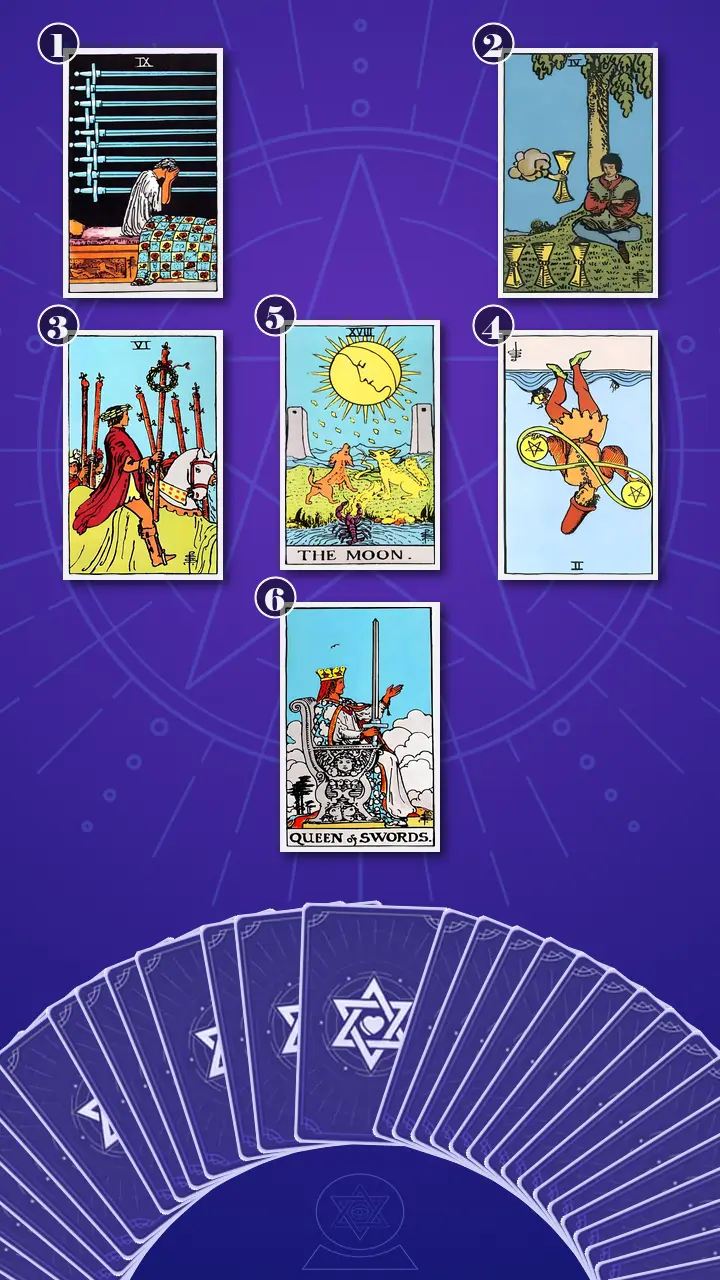
For readers: this spread is a micro-adjusted relationship spread designed for one specific modern moment—you share something big, and they pivot. It’s six cards because that’s the smallest structure that still separates capacity from care, reduces mind-reading, and produces actionable advice you can actually use in your next message. It creates a clean progression: current sting → their bandwidth snapshot → your emotional bid → the reciprocity reality check → the unspoken “fog” → one empowered next step.
I showed her the layout with two columns—you vs them on the top row, then what you offered versus what’s actually being exchanged. One card sits in the center like a hinge: what’s unspoken. The last card lands at the bottom as the grounded path forward.
“The first card will show how your mind is making meaning right now,” I said. “The center card will name what’s feeding the ambiguity loop. And the final card—our bridge—will give you one clean move: one message, one question, no overexplaining.”
Reading the Exchange: Card Meanings in Context
Position 1 — Your internal state right now: Nine of Swords (upright)
“Now turning over the card representing your internal state right now: the immediate meaning you’re making of the subject change and how it’s shaping your next move,” I said.
The Nine of Swords, upright.
I didn’t have to dramatize it. Taylor’s whole situation was already inside the picture: you’re lying in bed at midnight with your phone two inches from your face, rereading the exact moment you shared the news and the exact moment they pivoted. You draft three different follow-ups—one casual, one funny, one overly detailed—then delete them all because every version feels like it might expose how much you care.
“This card is Air energy in excess,” I explained—“thought on overdrive. It’s your brain trying to prevent rejection by running simulations. But the cost is that the simulations become their own pain.”
Taylor’s mouth twisted, and then she gave me the kind of laugh that has no humor in it. “That’s… so accurate it’s kind of mean,” she said, rubbing her palm over her sternum like she could smooth the feeling down.
“If you’re counting emojis like it’s data,” I said gently, “you’re not crazy—you’re stuck in ambiguity math.”
She exhaled hard through her nose—the sharp exhale of recognition—and for the first time, she didn’t look like she was bracing for me to tell her she was being “too much.” She looked like she was finally being described.
Position 2 — Their current bandwidth: Four of Cups (upright)
“Now turning over the card representing their current bandwidth: what they’re bringing to connection in this moment (not a verdict, just a snapshot of capacity),” I said.
The Four of Cups, upright.
“This is the ‘present but not emotionally tuned in’ card,” I told her. “They’re technically there, but replying on autopilot between tasks, stress, or distraction. It feels like you placed a meaningful moment right in front of them and they didn’t pick it up.”
In terms of energy: this is Water in deficiency—not a lack of feeling as a personality trait, but a lack of emotional availability in the moment. The subject change can come from avoidance, preoccupation, or simply not having the skill to meet someone’s joy cleanly.
Taylor’s eyes narrowed in a way that surprised me—not angry exactly, more like she was trying to keep herself from being too understanding. “So… it could be ‘they’re overloaded,’” she said, “and not ‘my news was stupid.’”
“Yes,” I said. “And we don’t use that to excuse them. We use it to stop sentencing yourself.”
Position 3 — Your bid for connection: Six of Wands (upright)
“Now turning over the card representing your bid for connection: what you were hoping would be met when you shared the big news,” I said.
The Six of Wands, upright.
“Your ‘big news’ wasn’t just information,” I said. “It was an invitation: Be proud with me. Hype me a little. Ask me one question. You wanted your win witnessed by someone you care about—again, not a parade, just a genuine mirror back that says, ‘This matters.’”
This is Fire in balance: warm, bright, human. Not clingy. Not excessive. Just a normal desire for shared celebration.
Taylor swallowed, and her eyes went glassy for a second. “Yeah,” she said quietly. “I wanted them to come back with ‘Wait—tell me everything.’”
The room felt very still then—the kind of quiet you get when someone finally stops editing their own desire down to something smaller.
Position 4 — Reciprocity reality check: Two of Pentacles (reversed)
“Now turning over the card representing the reciprocity reality check: the exchange pattern showing up here, and where it feels uneven or overloaded,” I said.
Two of Pentacles, reversed.
“This is the card of juggling—except reversed, the juggling isn’t sustainable,” I said. “The reciprocity dynamic looks like you doing invisible balancing work: adjusting your tone, your reply speed, your availability, your expectations to keep the connection feeling ‘okay.’ Meanwhile, you’re running a mental spreadsheet of who asked questions, who showed enthusiasm, who carried the conversation. The subject change becomes the start of a juggling act that only you are performing.”
I watched Taylor’s face as I spoke, and I could almost see the internal tabs open—iMessage, Instagram Stories, Notes app titled ‘signs they care,’ a hidden KPI dashboard for affection. In my work as a perfumer, I learned that too many top notes at once don’t create clarity—they create noise. This card is that: too many micro-adjustments, too much signal-chasing, not enough structure.
“Here’s the inner monologue this card describes,” I said, keeping my voice calm and plain:
Be chill, they’re busy. Then—They don’t care. Pull back. Then—No, don’t be petty. Reply normal. Then—Reply slower to match their energy. Then—Wait, why am I checking my phone every five minutes?
“It’s like A/B testing your personality to get a fair reaction,” I added. “And it’s exhausting.”
Taylor’s shoulders lifted toward her ears, then dropped. She pressed her lips together and nodded once, hard—like she was trying not to cry and not to laugh at the same time. “Oh wow,” she said. “I do that. I literally do that.”
“This is the main blockage,” I said. “Not because you’re ‘too much.’ Because this dynamic asks you to do all the stabilizing.”
Position 5 — The unspoken layer: The Moon (upright)
“Now turning over the card representing the unspoken layer: projection, assumptions, or missing information that’s feeding the ambiguity loop,” I said.
The Moon, upright.
The Moon always changes the lighting in a reading. Even in daytime, it brings night-mode thinking into the room: everything feels more personal, more final, more symbolic than it actually is.
“In the blank space after the subject change,” I said, “your mind fills in the silence with a story: ‘I don’t matter.’ You bounce between extremes—pull away to protect yourself vs over-explain to earn warmth—because uncertainty feels unbearable. The real problem becomes the fog between what happened and what it ‘means.’”
“A subject change is a data point, not a verdict on your worth,” I said, and I saw her eyes pause on the sentence like it had weight.
To make the fog navigable, I did something I do often—my version of sensory psychology in plain language. “Let’s separate pixels from pictures,” I told her. “You can’t zoom a blurry screenshot into certainty.”
I opened a small facts-vs-story list on my notepad, right there between us:
Fact: You shared the news.
Fact: They responded, then pivoted.
Missing: A follow-up question / celebration.
Story your brain wrote: ‘If I mattered, they would have asked one question.’
Taylor blinked twice, slow. Her gaze unfocused for a second—like she was replaying Sunday 10:34 PM with Netflix paused, fridge humming, building those two extreme towers: they don’t care vs you’re dramatic. Then her breathing deepened, just a notch.
“So I’m writing a whole movie from one scene,” she said.
“Exactly,” I replied. “And The Moon isn’t here to shame you for it. It’s here to show you where you need a flashlight.”
Position 6 — Empowered next step: Queen of Swords (upright)
I let my hand rest on the deck for a beat. “This next card,” I said, “is the bridge—the one that turns ‘What does it mean?’ into ‘Here’s what I need; can you meet me there?’”
“Now turning over the card representing your empowered next step: a clear, self-respecting way to seek clarity or set a boundary without overexplaining,” I said.
Queen of Swords, upright.
Even the air felt cleaner around her. The Queen’s open sky is always a contrast to The Moon’s fog—daylight after doom-scrolling. Not cold. Just clear.
Setup: I could see Taylor back on her couch on Sunday at 10:34 PM, Netflix paused, rereading the thread like it was going to reveal a secret—while her stomach kept dropping every time she hit the subject change. She wanted relief so badly that her fingers almost typed, “All good lol,” just to end the discomfort.
Delivery:
Don’t keep searching for warmth in the fog; step into Queen of Swords clarity and say what you needed out loud, once.
There was a quiet pause after I said it—like the sentence had to land in her body before it could land in her mind.
And then, unexpectedly, her face tightened. “But if I say it out loud,” she said, voice sharper for a second, “doesn’t that mean I’m… asking for attention? Like, doesn’t that make me the problem?”
I stayed with her without rushing. “That reaction,” I told her, “is exactly why this is the bridge card. You’ve been trying to get clarity without risking a clear answer. The Queen doesn’t ask for attention—she asks for information and respect.”
Then I brought in my Social Pattern Analysis—the way I diagnose hidden interaction barriers without turning people into villains. “When I look at reciprocity,” I said, “I don’t start with a single moment. I look at the interaction pattern: bids, responses, and repairs. Your system right now treats silence like a verdict. The Queen turns it into a clean test: one bid, one ask, then we watch what they consistently choose.”
I added, softly but clearly—because it mattered that she heard it in plain language: “You don’t have to grade your worth by their reaction. Ask one clear question that invites honesty—then trust the pattern you see.”
Reinforcement: Taylor’s reaction came in a three-step wave. First, she froze—breath held, fingers hovering as if she were about to type and couldn’t. Then her eyes went distant for a heartbeat, like she was watching herself draft-and-delete the “lol anyway” follow-up on repeat. Finally, she let out a long, shaky exhale, and her shoulders dropped in a way that made her look suddenly younger.
“Okay,” she said, quieter now. “What would I even say?”
“Set a five-minute timer,” I replied. “In your Notes app, write a two-sentence message: (1) name the impact—‘I felt deflated when the convo shifted,’ (2) ask one question—‘Do you have the bandwidth to celebrate with me for a minute?’ If your body feels too activated, you can stop and come back tomorrow—no forcing. The win is clarity, not immediate comfort.”
I watched her read those lines back to herself, lips moving slightly. Her throat bobbed with another swallow—still tender, but less trapped.
“Now,” I asked her, “using this new lens—can you think of a moment from last week when you could have asked one clean question instead of rereading for half an hour?”
She nodded, almost annoyed at how obvious it suddenly looked. “Tuesday,” she said. “On the TTC. I was literally… toggling between iMessage and Instagram like it was my job.”
“That’s the shift,” I said. “From ambiguity-driven rumination and worth-grading to calm self-respect, direct clarity, and pattern-based reciprocity.”
The One-Message Boundary: From Insight to Actionable Next Steps
I gathered the spread into a single story for her, the way I’d blend a fragrance formula into something you can actually wear: top notes are what hits first, heart notes are what stays, base notes are what you live in.
“Here’s what the cards say happened,” I told Taylor. “A subject change stung (Nine of Swords), and your mind tried to solve a relational wound with analysis instead of data. Their response shows muted presence (Four of Cups)—capacity may be low, or emotional engagement may be a weak skill. Your bid was clean and human: you wanted to be seen (Six of Wands). But the dynamic right now has you doing the balancing alone (Two of Pentacles reversed), and The Moon shows the real trap: you’re forced to guess in the space where a simple question could give you truth. The Queen of Swords is your way out: one direct ask, no chase, then observe what they consistently choose.”
“The cognitive blind spot,” I added, “is thinking you have only two options: either stay ‘chill’ and swallow it, or confront them with a speech. There’s a third option: one clean question. Clarity doesn’t need a speech.”
Then I gave her a small, concrete plan—things you can do even if your stomach drops when you open the chat.
- The 90-Second “Facts vs Story” NoteBefore you text, open Notes and write: (1) what was literally said, (2) what was missing, (3) the story your brain wrote, (4) one calm question that would clarify it. Do it on your lunch break, on the TTC, or while your Netflix is paused—wherever the spiral usually starts.Set a timer. When it ends, stop. The point is to get clarity, not to produce a thesis.
- The Queen of Swords Two-Sentence Text (One Ask, No Chase)Send one message during daylight hours (Daylight Message Rule): “I wanted to share this because it mattered to me. When the convo shifted, I felt a little deflated—do you have the bandwidth to celebrate with me for a minute?” Then do not send a second follow-up to soften it.Write it in Notes, read it out loud once, and hit send without adding jokes, “lol” padding, or apologies for having news.
- The 7-Day Pattern Check (Pattern Over Pings)For one week, notice whether they reliably ask follow-up questions, remember details, and show up when you share wins—without you prompting or performing. This turns “What did that one text mean?” into “What do they consistently choose?”If you feel yourself about to run the emoji-count spreadsheet, close the app and write one line instead: “Reciprocity is what they consistently choose—not what I can successfully decode.”
Before we wrapped, I offered her one of my perfumer’s interventions—something physical to anchor the new behavior. “If your body spikes before you send the message,” I said, “use a cleansing citrus spray—bergamot or grapefruit works well. One mist, one inhale. It’s not magic; it’s a sensory reset. It tells your nervous system, ‘We’re in the present, not in the fog.’”

A Week Later: Ownership, Not Certainty
Six days later, I got a short message from Taylor. No screenshots. No ten-paragraph analysis. Just: “I sent the two-sentence text at 9:15 AM. My throat still did the thing, but I didn’t add ‘lol.’ They replied: ‘I’m sorry—I was stressed and missed it. Tell me everything.’ I feel… calmer. Like I didn’t have to audition for care.”
That’s the kind of proof I trust: not a dramatic transformation, but a small shift from chasing meaning to requesting clarity. The Queen of Swords didn’t make Taylor unfeeling. She made her self-respecting.
And if I zoom out, this is what tarot gave her in practical terms: a way to stop treating “they changed the subject after I shared good news” as a referendum on her worth, and start treating it as something observable—capacity, communication, and patterns—plus one direct ask that protects her dignity.
When someone changes the subject after your big news, it can hit like your excitement wasn’t just ignored—it was graded, and you’re left swallowing the tight-throat feeling of “maybe I’m asking for too much” while still wanting a normal amount of celebration.
If you didn’t have to decode this moment like a crime scene, what’s the one calm question you’d actually want to ask—just once—so you can watch the pattern instead of chasing the fog?