The Zoom Moment My Throat Locked—and the One Line That Bought Me Time

Finding Clarity in the 10:12 a.m. Mute Button Moment
You’re a high-performing, likable coworker—until one person’s sharp tone hits and you suddenly go quiet like your mic got muted (freeze response at work).
Taylor (name changed for privacy) said it like she was confessing something embarrassing, not naming something real. “I know it’s not a big deal,” she told me, then swallowed like the words were stuck halfway down. “But my body acts like it is.”
She painted the scene without even trying: 10:12 AM on Zoom, camera on, that flat fluorescent buzz above her desk, Google Doc open with neat bullet points. Then a coworker cuts in—slightly sarcastic, slightly impatient—and her throat tightens so fast it’s like someone yanked a drawstring inside her neck. Her jaw clamps. Her shoulders inch up toward her ears. Her eyes drop to the agenda like it’s a life raft.
“I had a point,” she said. “A good one. And I just… let it die.”
When she described the aftermath, I could hear the rhythm of it: silence now, control later. Slack open at 4:38 PM, typing indicator blinking like a countdown, five versions of the same message drafted and deleted until it’s so polite it stops being true. Competent adult on paper, invisible in the room.
The feeling underneath wasn’t vague “anxiety.” It was alarm—like a fire door slamming shut inside her chest the second a familiar tone appears. Like her mind switches into read-only mode mid-meeting: no edits, no comments, just silent observing.
“We can work with this,” I said gently. “Not by forcing you to ‘be confident,’ but by figuring out what exact switch is flipping—and what one small step helps you stay you in the room. Let’s use tarot the way I use radio: as a tool to find the signal inside the noise, and get you to clarity.”

Choosing the Compass: The Four-Layer Insight Ladder Spread
I asked Taylor to take one slow breath—not as a ritual, not as magic, just as a clean transition from spiraling into observing. I shuffled while she held the question in mind: “Coworker sounds like my bully—why do I shut down, and what’s one step I can take?”
For this, I used a spread I love for workplace trigger responses: Four-Layer Insight Ladder · Context Edition. It’s built to move from the visible moment (what happens in your body), down into the root trigger (why it’s bigger than the present), then name the shadow loop that keeps you stuck, and finally climb back up through a turning point, support, and one practical next step.
For anyone wondering how tarot works in a situation like this: I’m not using the cards to predict what the coworker will do next. I’m using them to map a pattern—symptom → root → block → pivot → support → action—so we can stop treating your freeze response at work like a personality flaw and start treating it like a system that can be led.
I told her what to expect: the first card would show the shutdown moment as it actually happens. The second would reveal what’s being activated underneath. The fourth card—right in the middle—would be our hinge, the turning point that restores choice. And the last card would answer the question she kept coming back to: “Okay, but what do I do—one step?”
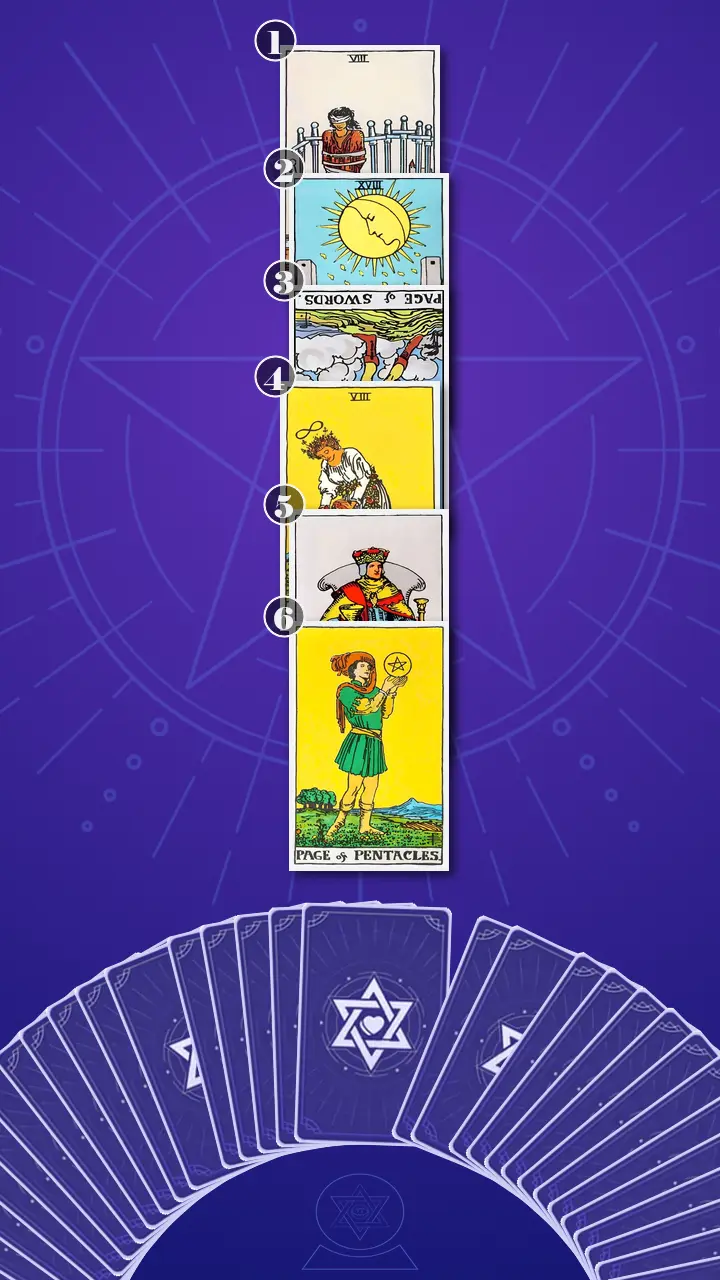
Reading the Ladder: From Tone to Truth
Position 1: The Observable Shutdown Moment
“Now flipping over is the card that represents the observable shutdown moment: what your body and behavior do when the coworker’s tone hits.”
Eight of Swords, upright.
And immediately, the card did what it always does when someone is describing “I go blank in meetings”: it made the invisible visible.
I grounded it in her real life, exactly as it shows up: It’s 10:12 AM in a cross-functional meeting. You’ve got your bullet points open and your cursor blinking in the doc. Then that coworker speaks—same sharp cadence, same “are you serious?” edge—and your body does the thing: jaw clamps, throat tightens, shoulders creep up. You stare at your notes like they’re a life raft… You let the moment pass… and quietly watch other people decide the direction you actually had a solid point about.
In energy terms, Eight of Swords is blockage—not a lack of intelligence or preparation, but a narrowing of options in the nervous system. The blindfold matters: you can’t “see” the present clearly when your body is bracing for an old script. And the bindings being loose matters too: the “can’t” feels locked, but in the current room, it isn’t.
I used a split-screen the way I do when I’m producing a show and two audio tracks are competing. “On the left,” I said, “is the meeting: camera on, notes open, your voice disappearing. On the right is the Slack draft graveyard: version one through five. And in your head it’s like rapid-fire browser tabs: Don’t get targeted. Say it perfectly. Better say nothing.”
Taylor gave a small laugh that sounded like it had a bruise under it. “That’s… brutal,” she said. “But yeah. That’s exactly it.”
Her eyes didn’t leave the card. Her fingers pinched the edge of her notebook, then loosened, like her hands were rehearsing what her throat couldn’t.
Position 2: The Deeper Trigger Beneath the Surface
“Now flipping over is the card that represents the deeper trigger: what past-linked fear is being activated beneath the surface.”
The Moon, upright.
I felt the room go quieter in that specific way it does when someone realizes they’re not “overreacting”—they’re remembering.
I translated it into the modern scene the card was already holding: You’re walking back from the kitchen with your coffee and you hear their voice from two desks away—before you even catch the words, your brain writes the plot. ‘They’re annoyed. They’re about to call me out. Everyone will see I don’t belong here.’ Nothing concrete has happened yet, but you’re already in a hallway-from-years-ago version of yourself, bracing for a public takedown.
This is The Moon’s signature move: ambiguity becomes threat. It’s not that you’re “too sensitive.” It’s that your system learned to treat tone as an early warning siren.
“Nothing happened yet,” I said, keeping my voice steady, “and your body is responding like it already did.”
Then I gave her the line I wanted her to borrow this week: “A trigger can be real even when the current room isn’t dangerous.”
Her shoulders lifted on an inhale—almost a flinch—then dropped a millimeter when she exhaled. That tiny drop was important. That was her system learning there’s a difference between a forecast and a fact.
Because I’m me, and because sound is my language, I asked one more question. “What have you been listening to after these meetings? Like… what’s on your ‘recently played’?”
Taylor blinked. “Uh. Mostly angry girl pop? And then… weirdly, a lot of brown noise at night.”
That’s my Music Pulse Diagnosis in action: the songs you reach for when you’re activated are often a diary your nervous system kept when your brain was too busy editing. Anger music after a meeting isn’t “dramatic.” It’s your body trying to complete a response it wasn’t allowed to have in the room.
Position 3: The Shadow Loop That Keeps You Stuck
“Now flipping over is the card that represents the shadow loop: the thought/communication pattern that keeps you stuck in silence.”
Page of Swords, reversed.
“This,” I told her, “is the Slack/Teams tone-anxiety card.”
I brought in her exact life pattern: After the meeting, you open Slack and draft a reply to a simple question. You rewrite it five times: too direct, too soft, too many emojis, too formal, too defensive. You read their last message for ‘tone’ like it’s a forensic document… Eventually you send a watered-down version that doesn’t include the ask you actually needed—or you don’t send it at all until hours later.
Reversed, Page of Swords is excess Air—too much scanning, not enough landing. It’s vigilance turned inward until it becomes self-silencing. In the body, it looks like that jittery internal weather: shoulders up, breath high, eyes tracking for danger instead of tracking the actual conversation.
I watched Taylor’s gaze sharpen when I said the part her brain thought was “just being careful.” “You’re doing sentiment analysis on punctuation marks,” I said. “Not reading the message.”
Then I gave her the interruption phrase, clean and simple: “Tone isn’t a verdict. It’s just data—ask for the rest.”
The energy shift I want here is from interpretation to inquiry. One neutral question can puncture this whole loop because it drags the conversation back into facts.
Taylor’s mouth pressed into a line, then she nodded once—small, but decisive. Her foot, which had been tapping under the table, finally stilled.
Position 4: The Turning Point That Restores Choice (Key Card)
“Now flipping over is the card that represents the turning point: the inner capacity that interrupts the freeze and restores choice.”
When I turned it, the air in the room felt like it held still for half a beat—like the second before a song drops into a chorus.
Strength, upright.
Strength isn’t “clap back.” It’s not winning. It’s keeping your nervous system online long enough to choose.
The trigger hits mid-sentence. You feel the freeze rise. Instead of pushing through or disappearing, you take one slow breath you can actually feel in your ribs, keep your shoulders down, and buy yourself two seconds. Then you say one clean line—calm, not apologetic… ‘Can we slow down for a second? I want to make sure I’m tracking what you’re asking for.’
Setup: Taylor was right back in it for a second—cursor blinking in her notes, that familiar sharp tone landing, throat tightening, mind going white, like she was back in a hallway where silence used to keep her safe.
Stop trying to outthink the trigger; practice gentle courage that holds the lion long enough for your voice to return.
Reinforcement: The reaction came in layers—the way truth does when it hits a body before it hits a story. First, she went still. Not calm-still. Freeze-still. Her breath paused halfway in, like her ribs forgot their job. Second, her eyes unfocused, not on me, not on the card—somewhere behind it, where an old memory was replaying at high speed. Third, she exhaled, long and shaky, and her shoulders dropped in a way that looked almost unfamiliar, like she didn’t realize she’d been holding them up all day.
“But that means I have to… do something in the moment,” she said, and there was a flash of anger in it—at the coworker, at her own body, at the whole unfairness of it. “What if I can’t? What if I just go blank again?”
“Then we don’t try to be fearless,” I said. “We try to be present for two seconds.”
This is where I brought in my most practical signature tool: a Breath Soundtrack. “Your nervous system responds to rhythm faster than it responds to logic,” I told her. “So we’re going to give it a beat it can follow.” I tapped a slow, steady tempo on the table—about 60 BPM, resting heart pace. “Inhale for four counts. Hold for one. Exhale for six. That long exhale is the ‘lion leash.’ It tells your body: we’re not being chased.”
Then I asked her, exactly as I always do at this hinge: “Now, with this new lens—regulation first—can you think of one moment last week when a two-second pause would have changed how you felt?”
Taylor’s fingers moved to her throat, just lightly. “Wednesday,” she said. “They said, ‘So… are we doing this or not?’ and I felt like… I was about to get mocked.”
“That,” I said, “is the difference between starting in alarm-driven disappearance and moving toward calm courage—gentle firmness under pressure. Regulate first, then speak—presence breaks the old bully script.”
Position 5: The Support Resource You Can Borrow
“Now flipping over is the card that represents your support resource: what emotional capacity you can borrow to stay steady in the moment.”
King of Cups, upright.
I love this card for career crossroads moments where you’re not sure if you’re being “too sensitive” or if it’s disrespect—because it doesn’t force you to pick a narrative. It teaches containment.
You notice the internal surge—shame, anger, that stomach drop—without having to perform it or obey it. You anchor to something physical (hand around a warm mug, feet flat inside your sneakers under the desk) and respond like someone who’s allowed to take up space: respectful, clear, not over-explaining.
Energetically, King of Cups is balance: calm on the surface, choppy underneath, and still—steady. “You don’t have to match their energy,” I told her. “You can let them be choppy. You stay you.”
Taylor’s posture shifted as if she was trying on that “adult energy.” She sat back a little. Her chin lifted a fraction. It wasn’t dramatic—just enough that I could see her remembering she had a spine.
Position 6: One Step You Can Try This Week
“Now flipping over is the card that represents one step: a small, practical action you can try this week to rebuild voice and self-trust.”
Page of Pentacles, upright.
This is Notion/Google Docs energy: one reusable template beats a perfect one-off performance.
You pick one sentence you can actually remember when you’re activated, and you treat it like practice—not proof of your confidence… You use it once this week in real time, even if your voice shakes. The win is not that you felt fearless; it’s that you stayed present long enough to act on the ground.
Page of Pentacles is grounding. It takes everything we found—Moon fear, Sword scanning, Strength pause—and turns it into one repeatable micro-action. Not a personality makeover. A rep.
“One sentence is enough to give you your choice back,” I said.
She blinked hard, like she was holding back a rush of emotion that didn’t quite fit into “work.” Then she nodded. This time the nod looked like consent—not to the coworker, but to herself.
The One-Sentence Dignity Script (and the Soundtrack to Use It)
Here’s the story the spread told, cleanly: when the sharp tone hits, your body snaps into the Eight of Swords corridor—options narrow, voice disappears. The Moon explains why it feels disproportionate: old bullying material is getting activated, and ambiguity becomes a humiliation forecast. Page of Swords reversed keeps the loop running by making you do mind-reading and perfection editing instead of real communication. Strength is the hinge: regulation restores choice. King of Cups is your stabilizer: calm-but-not-small. And Page of Pentacles is the install: one doable rep this week.
Your cognitive blind spot isn’t “I’m weak.” It’s this: you’ve been trying to solve a body alarm with better wording. That’s why you keep rewriting Slack messages. You’re negotiating with the lion instead of holding it.
The transformation direction is simple and specific: shift from trying to prevent all discomfort by disappearing to practicing a single, repeatable pause-and-name step that re-establishes choice.
And because I’m Alison Melody, I’m going to make it even more doable by giving you an audio cue. Your nervous system loves a consistent signal.
- The 2-Second HingeBefore your next meeting, write at the top of your notes: “Give me a sec—I want to answer clearly.” When the tone hits and you feel your throat tighten, exhale slowly, drop your shoulders once, and say that line out loud.If it feels awkward, make it even smaller: “Let me think for a moment.” You’re not performing confidence—you’re buying time.
- Tone-to-Fact Reality CheckPick ONE default clarifying question for the week: “Can you clarify what you mean by that?” Use it the first time you notice you’re mind-reading tone. Say it once, then stop talking.If it’s async (Slack/Teams), send it as a single line—no preamble, no apology—then close the laptop for 2 minutes so you don’t spiral-edit.
- Send the V1 (Clean, Calm, Short)Create a “v1 reply” note with two templates: (1) “Here’s what I can do by EOD.” (2) “I can do A or B—what’s the priority?” The next time you rewrite a message for the third time, paste the template and hit send.Tell yourself: “Send the v1. Your nervous system doesn’t need perfect—it needs proof.” Then do a 60-second reset—refill water, look out a window, or take a short walk.
To support all of this, I gave her a BGM Prescription—not as spiritual fluff, but as a way to condition the “pause” into her body before she needs it:
Track 1 (meeting prep, 3 minutes): a 60 BPM instrumental (anything steady, low lyric load) so her breath can lock into that 4–1–6 rhythm without effort.
Track 2 (after a triggering interaction, 5 minutes): low-frequency brown noise or a soft fan sound—my White Noise First Aid—to stop her brain from replaying tone like courtroom evidence.
Track 3 (end of day, 10 minutes): a gentle “frequency cleansing” style track in the 396–528 Hz range if she likes it, or simply a warm ambient pad—something that helps her body complete the stress wave without needing to draft five more messages in bed.

A Week Later: Ownership, Not Certainty
Six days later, I got a voice note from Taylor while I was setting up mics for my radio segment. The background sounded like streetcar rails and a lobby echo—Toronto in motion.
“Okay,” she said, and I could hear the disbelief and pride tangled together. “It happened. Same tone. I felt the throat thing start. And I did the exhale. I literally said, ‘Give me a sec—I want to answer clearly.’ And then I asked, ‘Can you clarify what you mean by that?’”
She paused. “No one got mad. No one ‘pounced.’ They just… clarified. And I stayed in the room.”
Her micro-win wasn’t that she felt fearless. It was that her body learned a new association: speaking doesn’t automatically equal danger. One rep. One brick of self-trust.
The bittersweet part was honest too: she slept a full night, but she told me her first thought in the morning was still, “What if I sounded stupid?”—and then, softer: “But I did it anyway.”
That’s the whole Journey to Clarity, right there. Not certainty. Ownership. From alarm-driven disappearance to calm courage and gentle firmness under pressure—one breath, one line, one moment at a time.
When a familiar tone hits and your throat tightens, it can feel like you’re fighting two battles at once—trying to be competent in the room while your body is bracing to be publicly reduced again.
If you didn’t have to win or prove anything this week—just stay present—what’s one small sentence you’d be willing to try the next time that familiar tone shows up?