From Renewal Guilt to Adult Terms: Renegotiating the Family Plan

Finding Clarity in the Autopay Jump-Scare
You’re 27, financially fine on paper, but a family phone plan renewal email still gives you the exact same stomach-drop as a parent-teacher conference—classic “small bill, big strings” energy.
Jordan (name changed for privacy) said that to me like it was a confession and a joke at the same time—like if they laughed first, it wouldn’t sting.
They’d booked a late evening session, and I could picture why before they even finished sitting down: that specific kind of tired where your phone isn’t just a device, it’s a tiny courtroom you keep reopening. Jordan described 8:57 p.m. in their Toronto condo living room—the carrier renewal email glaring white-blue on the screen, the fridge hum somehow louder than their thoughts, their thumb hovering over Reply and never landing. Notes app open. Group chat muted but not really muted, because your body still hears it.
“It’s such a small bill,” they said, rubbing their palm against their jeans like they could erase the feeling, “but it makes me feel weirdly trapped.”
I watched their throat move when they swallowed. The words got stuck there, not dramatic—mechanical. Like a drawstring pulled too tight. And in their stomach, guilt sat like a knotted headphone cord: small, portable, impossible to ignore, always catching when you try to move.
They wanted to know what loop they were in—money, privacy, guilt—and why a phone plan renewal was turning into decision fatigue and a full-body stress response. Cheaper to stay, safer to leave. Easy either way on paper, and somehow impossible in the nervous system.
“We can make this practical,” I told them, warm but precise. “Let’s not treat you like a problem. Let’s treat this as a pattern. We’ll use the cards to draw a map through the fog—toward clarity and a next step you can actually do.”

Choosing the Compass: The Transformation Path Grid (6)
I invited Jordan to take one slow breath in through the nose and out through the mouth—not as a ritual for the universe, but as a reset for the body. Then I shuffled, steady and unhurried, the way I blend a fragrance: not to force a mood, but to let the real notes rise.
“For this,” I said, “I’m using a spread called the Transformation Path Grid (6) · Context Edition.”
And for you reading along: this is one of my favorite layouts for modern micro-boundary problems—things that look tiny (a bill, a login, a renewal) but carry a whole emotional contract underneath. A simple decision spread can compare carriers and prices, but it won’t reliably surface the hidden exchange dynamic: support with strings attached, unspoken access, and the guilt that keeps you defaulting into renewal.
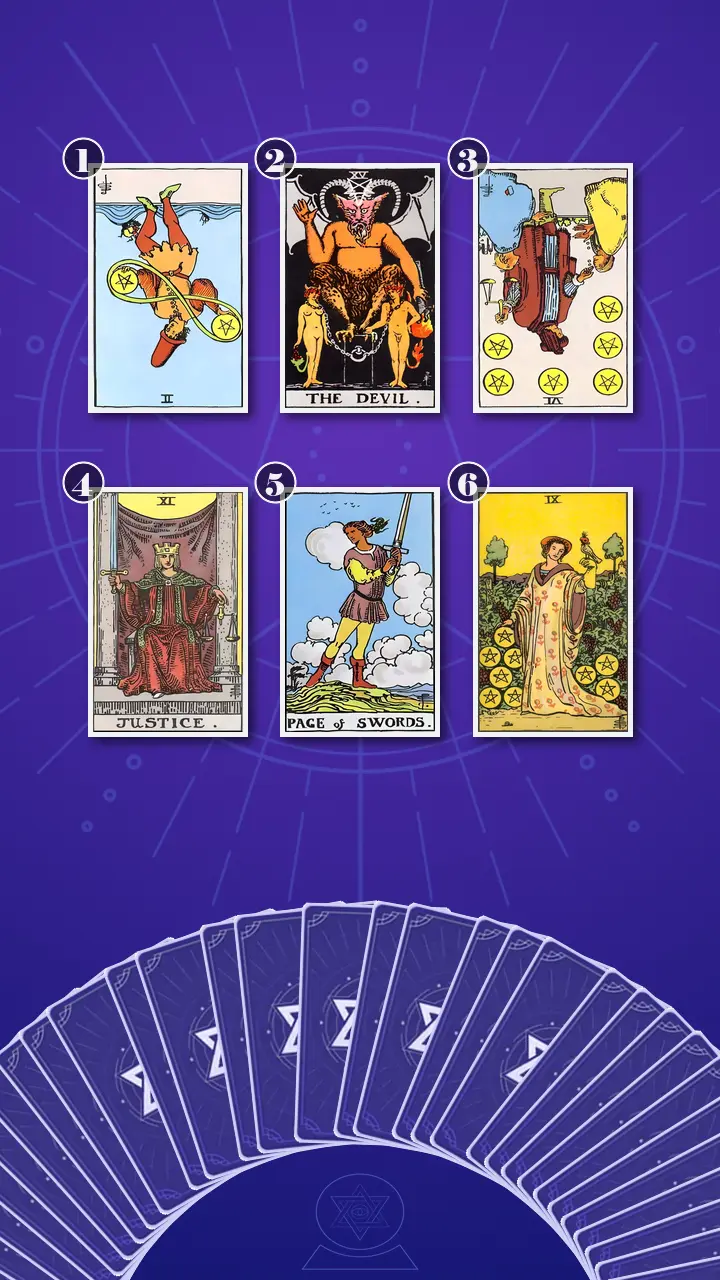
This grid is a 2x3 map. The top row shows the loop mechanics—current state, blockage, root. Then we drop to the bottom row—catalyst shift, action step, integration—so insight doesn’t just feel true; it becomes actionable advice and next steps.
“We’ll start with what you’re doing on autopilot,” I told Jordan, “then name what’s hooking you, then get underneath it. After that, we’ll look at the turning point—the perspective that makes this solvable—and finish with one concrete move and what a calmer new normal could actually feel like.”
Reading the Map: Card Meanings in Context
Position 1 — The Habit Loop You Can See: Two of Pentacles (reversed)
“Now turning over the card that represents your current state snapshot of the money-privacy-guilt loop,” I said, “this is Two of Pentacles, in reversed position.”
I pointed to the figure’s uneven stance and that infinity-loop ribbon, the way it keeps both coins in motion. “This card is you on the TTC after work with the carrier app open,” I said, translating it directly into their life, “doing tiny calculations that somehow feel life-or-death. You’re juggling cost, privacy, and ‘being a good adult child’ like they’re equal variables—so nothing lands.”
Reversed, the energy isn’t balanced juggling. It’s overextension—a wobble. A system that looks functional because it stays in motion, but the motion is actually the avoidance. “The moment you get close to choosing,” I added, “you reopen another tab, rewrite the text again, promise yourself ‘this weekend.’ That’s the loop.”
Jordan let out a short laugh—sharp at the edges, like they didn’t mean to make noise. “That’s… brutal,” they said. “Like, accurate, but brutal.” Their shoulders lifted and dropped, the way they do when they’ve been caught doing something they thought was private.
“I’m not here to roast you,” I said gently. “This is just data. If we can describe the behavior without shame, we can change it without drama.”
I tapped the rough sea in the background. “And notice: the stress doesn’t pause just because you’re ‘handling it.’ You can be doing the math perfectly and still feel contracted. That tells me the numbers aren’t the whole problem.”
Position 2 — The Hook That Keeps You Defaulting: The Devil (upright)
“Now turning over the card that represents what is actively keeping the loop in place,” I said, “we have The Devil, upright.”
In modern life terms, it landed exactly where Jordan had been living: the plan isn’t just a plan anymore—it’s a permission structure. “Even if nobody is actively being controlling,” I said, “the fact that someone else holds the account can make you hesitate to ask for basic privacy. The chain is the belief that love and support come with automatic access to you.”
I watched Jordan’s jaw tighten the second I said “access.” It was subtle, but it was there—the body’s truth before the mind can translate.
“Here’s the ‘small bill, big strings’ scene,” I continued, using the image the way I’d use a scent note to pull a memory forward. “A family group chat pings: ‘Renewal’s coming up!’ And it lands like a hook. Your inner monologue goes: It’s not that I’m broke… it’s that I’m not fully mine. Convenience versus consent. Help versus access.”
The Devil’s chains in the card are loose. That’s the part I always want clients to see: the trap is maintained by an unspoken agreement, not permanent fate. The energy here is a blockage, but it’s also a map. It says: you’re acting like you have no choice because the cost isn’t money—it’s belonging.
Jordan nodded once, uneasy. A small exhale. Not shame—recognition. The kind of “called out” that feels oddly relieving because it’s specific.
As a perfumer, I pay attention to emotional flows the way other people pay attention to tone in a meeting. In my work, I call this Family Energy Diagnosis: where does the air get heavy? Where does it get sweet with obligation? Jordan’s whole system tightened around one invisible ingredient—indebtedness—like a base note that won’t evaporate.
Position 3 — The Uneven Exchange Underneath It All: Six of Pentacles (reversed)
“Now turning over the card that represents the underlying imbalance driving the guilt and privacy tension,” I said, “this is Six of Pentacles, reversed.”
“You can afford your own plan,” I told Jordan, grounding the reading in their reality, “but emotionally, it feels like you need a ‘good enough reason’ to want independence. And that’s what keeps you drafting gratitude paragraphs before you’ve even stated what you need.”
I pointed to the scales in the card. “This is the fairness question. Not the vibe question.” Reversed, the energy is imbalance—help that doesn’t feel clean, even if the intent is loving. It can accidentally create hierarchy: who sets the terms, who feels like the kid, who’s expected to prove gratitude.
Jordan’s fingers worried the edge of their sleeve. “I hate that it feels like… leverage,” they said, voice low. “Because they’re not trying to be villains. It’s just—if I bring it up, it turns into a whole thing.”
“Exactly,” I said. “No one has to be a villain for a structure to feel intrusive. Sometimes the account setup is the hierarchy. The scales are built into the logistics.”
And then, because Jordan had been living in spreadsheets and Reddit threads—r/PersonalFinanceCanada rabbit holes, “best phone plan 2026” searches—I said the line I often use as a pivot: “Stop trying to solve an emotional contract with a spreadsheet.”
They blinked, like something inside them had finally sat down.
When Justice Held the Scales: The Turning Point That Makes It Solvable
Position 4 — The Reframe: Justice (upright)
“Now turning over the card that represents the turning point perspective that reframes the issue into something solvable,” I said, and I let my voice slow, because this was the center of the whole map, “we have Justice, upright.”
The room felt quieter. Not mystical—just focused. Like when your Slack finally stops pinging and you can hear your own thoughts again.
Justice is scales plus sword: fairness plus a boundary that’s stated, not hinted at. In modern terms, it’s a clean Google Doc titled Phone Plan Terms with bullet points—no vibes, no subtext, just clarity.
Setup (the stuck moment): If you’ve ever stared at an autopay/renewal email on a weeknight, thumb hovering over “Reply,” running the numbers like it’s a math problem—while your body reacts like it’s a loyalty test—you already know this isn’t just about the bill.
Delivery (the line that changes the frame):
Stop treating this like a loyalty test and start treating it like a contract—hold the scales steady and use the sword to name your boundary.
I let that sit for a beat. No extra explanation. Just air.
Reinforcement (what I saw happen in Jordan’s body): Their breathing stopped for half a second—like a tiny freeze response, eyes fixed on the card. Then their gaze went unfocused, as if they were replaying every deleted draft in their Notes app, every time their thumb hovered and their throat tightened. Finally, the breath came out in a long, shaky exhale, shoulders dropping in a way that looked almost unfamiliar on their frame. Their mouth opened like they were going to argue, then softened into a small, stunned smile that had more relief than happiness in it.
“But… if I make it a contract,” Jordan said slowly, “then I’m not accusing them. I’m just… updating terms.” They rubbed their throat once, like the words were finally moving. “That feels… possible.”
“Yes,” I said. “And this is where my Conflict Transformation System comes in. When tension is stuck, it’s usually because the conversation is happening in the wrong language. You’ve been speaking ‘feelings and belonging’ while trying to solve ‘logistics and consent.’ Justice translates it. It says: keep the love, update the paperwork.”
I leaned in, practical. “Here’s the one-line rule Justice gives us: Money can be shared; access has to be consented. You’re not asking to be less loved—you’re asking to be less managed.”
Jordan’s eyes went glossy, not in a dramatic way—just that quick brightness that shows up when someone feels seen and slightly braver at the same time.
“Now,” I asked them, “with this new lens—contract clarity instead of loyalty test—think back to last week. Was there a moment when the group chat pinged or the renewal notice hit, and this would have made you feel different?”
Jordan nodded immediately. “Monday. I was at my hybrid-office desk—Slack going off, calendar stacked—and the family chat popped up: ‘We should renew the plan this week.’ My jaw clenched, and I just… smiled at my monitor.” They paused. “If I’d had this sentence, I could’ve just… scheduled a call. Like an adult.”
“That’s the shift,” I said, anchoring it plainly. “This is you moving from guilt-driven silence and privacy anxiety toward grounded self-respect—by making terms explicit and making access consent-based.”
Position 5 — The Bridge Into Real Life: Page of Swords (upright)
“Now turning over the card that represents a concrete next step for communication and boundary-setting,” I said, “this is the Page of Swords, upright.”
If Justice is the reframe, the Page is the text you actually send. The cursor blinking. The phone warm in your hand. The temptation to add three apology sentences because you want the message to be emotionally padded, like bubble wrap.
“This card is you sending the short message you’ve been avoiding,” I told Jordan, using the modern translation exactly as it showed up in their life. “A quick call request. A direct question about account access. A clear statement about renewal timing. No ten-paragraph explanation.”
The Page’s energy is curious-but-firm. It asks clean questions. It doesn’t plead. It doesn’t do a moral essay. It tolerates a little wind.
Jordan’s shoulders lifted again, reflexively. “I always worry short will sound… cold,” they admitted.
“Here’s your correction,” I said, gentle but coach-clear: “Short doesn’t mean cold. Clear doesn’t mean cruel. The Page isn’t rude. It’s direct.”
Position 6 — The New Normal: Nine of Pentacles (upright)
“Now turning over the card that represents integration—what it looks like when money and privacy align with self-respect,” I said, “we have the Nine of Pentacles, upright.”
This card is a walled garden: privacy as a container, not secrecy. It’s the moment your phone becomes a personal device again, not a tiny leash. It’s paying what you agreed to, and knowing exactly who can see what—because you designed it that way.
“Notice how your body feels when the decision is rooted in self-respect rather than guilt,” I told Jordan. “Because that’s how you’ll know you’re not just making a financial choice—you’re making an adulthood choice.”
And because I work with scent and memory, I added one more thing: “This is ‘privacy by design beats privacy by hope.’ The garden wall isn’t hostility. It’s structure.”
The One-Note ‘Plan Terms’: From Insight to Actionable Advice
I looked at the whole grid again—Earth cards reversed at the top: the unstable money-logic juggling (Two of Pentacles reversed), the chain of unspoken access (The Devil), the root imbalance of who sets the terms (Six of Pentacles reversed). Then the pivot: Justice arriving like an adult voice in the chat. Then Air: Page of Swords, the actual message. Then Earth, mature this time: Nine of Pentacles, calm ownership.
“Here’s the story your cards are telling,” I said, keeping it tight and real. “You’ve been trying to keep peace by staying in motion—researching, drafting, deleting—because stillness would force a boundary. The hidden hook is that savings feel like emotional debt, and debt feels like access. The blind spot isn’t that you don’t know what to do; it’s that you’re hoping the relationship will ‘understand’ without you naming terms. Justice says: don’t hint. Define.”
“Your transformation direction,” I continued, “is exactly this: shifting from ‘I must earn belonging by staying financially entangled’ to ‘I can be loving and grateful while setting explicit terms for money and access.’”
Jordan nodded, then flinched a little—an unexpected, practical resistance. “But I literally can’t even get ten minutes without it turning into feelings,” they said, voice tight again. “They’ll ask why. They’ll get hurt.”
“That makes sense,” I said, meeting reality, not arguing with it. “So we design the conversation like we design a calm room: reduce the emotional static first, then keep the language logistical. We’re not forcing anyone to feel fine—we’re giving the nervous system a cleaner channel.”
Because I’m Luca, and I’m a perfumer as much as I’m a reader, I offered one of my exclusive strategies—not as a gimmick, but as a practical tool: dialogue atmosphere enhancement with calming scents. “Before you send the text or make the call,” I said, “put a drop of lavender or a soft bergamot on your wrist. One inhale. Not to ‘fix’ feelings—just to signal safety. Then we keep the message short.”
- The Two-Sentence Terms ScriptOpen Notes (or your Notion inbox if that’s where your life lives). Write two sentences: (1) what you’re choosing (renew with terms OR switch by a date). (2) what access you need (e.g., “I need my line/account access to be private going forward.”). Keep it strictly payment + access—no backstory.Aim for “clear enough,” not “perfect.” If your throat tightens, take three slower breaths and stop. This is practice, not a performance.
- The 10-Minute Renewal Call (Calendar It)Send one message in under 60 seconds: “Hey—can we do a quick 10 min call about the phone plan renewal? I want to clarify payment + account access.” Title the calendar invite “Phone plan renewal logistics.”Expect a guilt spike right after you hit send. That’s the loop defending itself. Don’t negotiate with it—just breathe and let the message stand.
- Delete-the-Apology Padding EditBefore you hit send, delete all cushioning phrases (“sorry,” “I know I’m being extra,” “it’s probably nothing,” “I don’t want to make this a thing”). Keep only logistics. If you get pulled into emotions during the call, use one repetition line: “I’m grateful—this is just about privacy and logistics.”Clear language protects both sides. It keeps you from over-explaining, and it keeps them from guessing what you mean.

A Week Later: Ownership, Not Certainty
Six days later, I got a message from Jordan. Not an essay. Just a screenshot: a calendar event titled “Phone plan renewal logistics — 10 min,” and beneath it, the sent text thread. Two sentences. No apology-padding. No manifesto.
“My throat still did the thing,” they wrote. “But I sent it anyway. And the call was… normal? A little awkward, but normal. We clarified who has access and what needs to change. I didn’t die.”
The bittersweet part came in the next line: “I slept through the night for the first time in weeks, but when I woke up my first thought was still, ‘What if I made it weird?’—and then I remembered the terms. And I could breathe.”
That’s the real Journey to Clarity. Not a dramatic break. Not perfect confidence. Just a clean agreement and a quieter nervous system—proof that adulthood can be structured, not fought for.
When a ‘tiny’ monthly bill makes your throat go tight, it’s usually not about the dollars—it’s the feeling that staying comfortable means staying reachable in ways you didn’t actually consent to.
If you let this be a terms conversation (not a loyalty test), what’s one sentence you’d be willing to say this week that protects your privacy while staying honest about your gratitude?