From Report-Card Pressure to Self-Trust: Shipping Small Wins This Week

The 9:38 p.m. Report Card Spiral
If you’ve ever found an old report card or awards folder and instantly started mentally re-ranking your whole adult life as “ahead/behind” (hello, comparison fatigue), this is for you.
Jordan showed up to our session from a Toronto condo, camera angled slightly too low—the classic “laptop on the kitchen counter” setup. It was 9:38 p.m. on a Wednesday, and the light from their screen made everything look a little sterile: the pale countertop, the mug of tea gone lukewarm, the faint reflection of their own face in the black border of the monitor. Somewhere through the wall, a neighbour’s bass thumped on a steady loop, like a heartbeat that wasn’t theirs.
“I was just organizing old folders,” they said, like they didn’t want to admit it out loud. “And I opened this scanned report card.”
I watched their throat work as they swallowed. Their shoulders were lifted almost imperceptibly, like their body was bracing for impact. The nostalgia hit first—warm, dusty-sweet, the way paper can smell like a different version of you—and then the drop: chest tightening, jaw locking, that restless I should be doing more energy that keeps you upright long after your body wants to lie down.
Jordan’s voice got sharper, more efficient, like they were presenting a slide deck to an invisible panel. “It’s weird. I don’t miss school. I miss knowing exactly how I was doing. I read that report card and suddenly my Notes app turned into… a syllabus. New goals, new metrics, new rules. And then I just bounce between polishing and procrastinating. I keep upgrading the plan instead of doing the thing.”
The contradiction sat between us as plainly as a glass of water: they craved reassurance they were still the “top student” through measurable wins, and they feared that if they stopped achieving, they’d discover they weren’t actually enough.
“Okay,” I said gently. “First—nothing about this is dramatic or silly. It’s human. And it’s also very fixable.”
I leaned in, not to intensify it, but to keep them company inside it. “Let’s make this a Journey to Clarity. Not a journey to a perfect answer—just clarity. We’re going to figure out what story that old report card is still trying to make you live inside, and we’ll choose one next step that’s small enough to complete this week.”

Choosing the Compass: The Celtic Cross Spread
I asked Jordan to put their phone face down for thirty seconds. “Before we name the story,” I said, “we name the sensation. Is your jaw clenched? Chest tight? Shoulders up?”
They exhaled, surprised by the question. “Jaw. Definitely.”
That’s where my family’s work always begins—what I call Body Signal Interpretation. In the Highlands where I was raised, we didn’t argue with weather; we noticed it. Your body is weather, too. A clenched jaw is a kind of inner frost: the moment you start preparing to be evaluated.
I had them take one slow breath, hand lightly resting at the hinge of their jaw, not to “fix” it—just to make contact with it.
Then I shuffled my deck, slow and steady, not as a performance, but as a transition. A small ritual that tells the mind, We’re leaving the loop and entering a map.
“For this question,” I told them, “I’m going to use the Celtic Cross.”
And for you, reading along: the Celtic Cross is one of the most practical spreads for this exact kind of problem—when you’re not asking for a prediction, but for a clear psychological chain. It shows (1) what’s happening right now, (2) what blocks you, (3) where the pattern was installed, (4) what recently reactivated it, and (10) the most supportive direction forward. It’s structured enough to hold anxiety, but roomy enough to hold complexity.
“We’ll read the center first,” I said, “then we’ll climb the right-hand staff like a ladder—from your current self-talk up toward integration.”
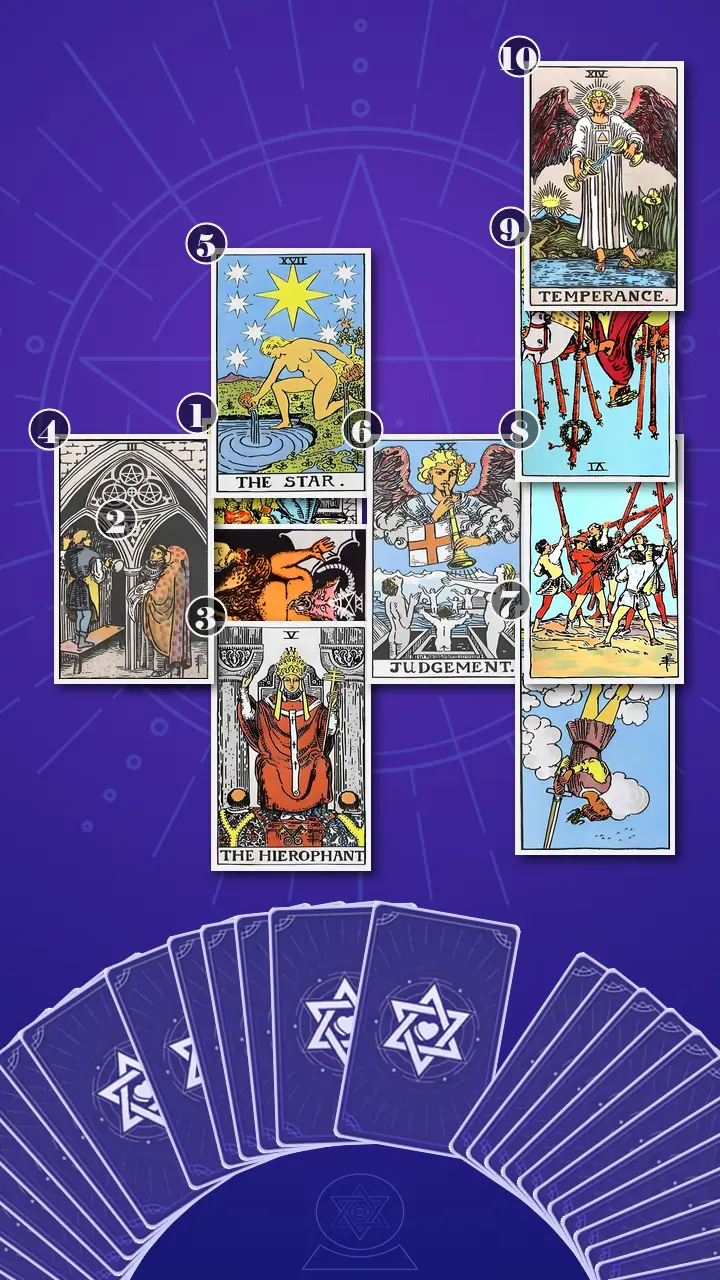
The Cards That Named the Loop (and Why It Feels So Personal)
Position 1: The present moment — the spiral you run on autopilot
“Now turning over is the card that represents the present moment: how the old report-card story is showing up right now in daily thoughts and behavior,” I said.
Six of Cups, reversed.
I didn’t need to dramatize it. The image did that on its own: the quiet courtyard, the child offering a cup with a flower—sweetness that can become obligation when it’s turned into a token you owe.
“That old report card isn’t a memory—it’s a measuring stick,” I said, and I saw Jordan’s eyes flick to the side like they’d been caught. “This is exactly like finding that scan and suddenly treating it as the ‘real’ evaluation. Then you try to bring that grading system into your job, your relationships, your body, your sleep.”
Reversed, the Six of Cups isn’t saying the past is bad. It’s saying memory is in an excess state—too strong, too loud, pulling you backward. Nostalgia becomes a rubric. Childhood praise becomes a contract.
Jordan let out a small laugh—quick, sharp, and a little bitter. “That’s… so accurate it’s kind of rude,” they said.
“I know,” I replied softly. “But accuracy is a form of kindness when it gives you options.”
Their hand drifted up again toward their jaw without them noticing. I clocked it and filed it away. Their body was already telling the truth their mind was still negotiating.
Position 2: The central block — what makes the next step feel like a verdict
“Now turning over is the card that represents the central block: what keeps the overachiever pattern gripping your choices and making the next step feel loaded,” I said.
The Devil, upright.
People hear that name and panic. I don’t. The Devil is mechanics. Attachment. The part of you that thinks safety comes from control.
“Look at the loose chains,” I said. “They could step away. But the chain feels tight because of the agreement underneath it.”
I translated it the only way it matters: “This is like when your deliverable is ready, but you keep adding ‘one more improvement’ because submitting it feels like risking your identity.”
The Devil here is a blockage state—your worth is outsourced to a metric, and the metric demands more payment every week: more polish, more proof, less rest.
Jordan’s eyes narrowed, not in disagreement, but in recognition that stung. They nodded once, stiffly.
“And I want you to hear this clearly,” I added. “You’re not trapped by the metric. You’re negotiating with it.”
Position 3: The root imprint — where the rubric voice came from
“Now turning over is the card that represents the root imprint: the early conditioning that taught you what ‘good enough’ means and why you still chase it,” I said.
The Hierophant, upright.
The pillars. The formal blessing. The keys. School energy, institutional approval, the comfort of clear rules—and the cost of letting those rules become your inner religion.
“This is the inner authority voice,” I said. “Not a villain. A teacher. It taught you: there is a correct way to be good, and proof is safety.”
In an excess state, the Hierophant becomes rigid. It turns adulthood into a classroom you never graduate from.
Jordan’s gaze dropped. When they spoke, it was quieter. “I was praised early for being… responsible. Smart. The kind of kid teachers loved. It felt like… being safe.”
“Of course it did,” I said. “Belonging is a nervous-system event. It lands in the body. Which is why, years later, your jaw still clamps when you sense evaluation.”
Position 4: Recent past — the last evaluation cycle that reactivated the pattern
“Now turning over is the card that represents the recent past reinforcement: the last cycle of evaluation or comparison that reactivated the pattern,” I said.
Three of Pentacles, upright.
Work on display. Observers. A blueprint in hand. The modern translation is painfully simple: performance reviews, portfolio culture, being seen by “the right people.”
“This is like only feeling calm after someone senior praises your work,” I said, “and until then, you keep editing as if you’re trying to secure a guaranteed grade.”
In a balanced state, this card is mastery and collaboration. Here, it’s showing you how easily mastery gets tangled with approval—because they look similar from the outside, but they feel different inside.
Jordan’s foot bounced off-screen. I could hear it through the faint vibration in the laptop mic, the way anxiety finds a rhythm if you don’t give it one on purpose.
Position 5: Conscious aim — what you want beyond grades
“Now turning over is the card that represents the conscious aim: what you say you want now beyond grades, and what you’re reaching for emotionally,” I said.
The Star, upright.
The Star is one of my favourite cards to read for overachievers because it never shames ambition. It just asks for honesty. It’s a clean night sky after too much fluorescent lighting.
“This is you wanting a career that still grows,” I said, “but the growth feels nourishing and honest instead of like a constant audition.”
The Star is balance—water poured onto land and into the pool. Real-world life, inner life. It says: you’re not trying to win harder. You’re trying to heal.
Jordan’s face softened in a way they didn’t seem to allow themselves often. “Yes,” they said. “I don’t want to become less… capable. I just want to stop feeling like I’m… being graded in my own living room.”
Position 6: Near future — the next developmental move
“Now turning over is the card that represents the next developmental move: the kind of self-assessment that helps you release the old story and choose a next step,” I said.
Judgement, upright.
This is where people assume the card is punishment. It isn’t. It’s awakening. It’s a signal that cuts through noise.
“Picture this,” I said, following the card’s echo the way it wanted to be spoken. “Your calendar invite is the trumpet. Short, clear, unavoidable. It cuts through thirty-seven open tabs.”
Jordan’s mouth twitched, almost a smile. The recognition was there.
“This isn’t a sentence,” I told them. “It’s a signal.”
Judgement is a rebalancing—a re-evaluation that liberates. It hints that you can change the standard without changing your ambition. You can write a new rubric that fits adult life: values-based instead of grade-based.
I saw their shoulders drop a fraction. Not relief exactly—more like the first millimetre of space in a place that’s been clenched for years.
Position 7: Self-position — how your mind tries to stay safe
“Now turning over is the card that represents your inner stance, self-talk, and the way you’re currently trying to stay safe,” I said.
Page of Swords, reversed.
Windy sky. Raised sword. The Page is curiosity in motion—until it flips into vigilance.
“Curiosity becomes self-surveillance when you’re trying to pre-empt judgement,” I said, and I watched the phrase land in their body before it landed in their mind.
Modern translation: rereading messages, turning feedback into a case file, drafting Slack updates like legal documents because you’re trying to control the verdict.
This is an excess of Air—too much scanning, too much interpretation. It’s smart, but it’s exhausting.
Echo moment—Devil + Page reversed. I painted the micro-scene in plain daylight detail: “Cursor hovering over ‘Send.’ Slack open on the side. And your brain running a legal defense: If I can predict every objection, I can’t be judged. Visibility versus safety. Competence versus worth.”
Jordan froze—breath held for half a beat, fingers hovering mid-air like they were about to close a tab. Then their eyes unfocused as if a memory replayed. Then: an exhale, long and embarrassed.
“Oh,” they said, quietly. “I do that.”
“Yes,” I said. “And you’re not broken. You’re negotiating with an old metric using the only tools you were taught.”
Position 8: Environment — the pressure field around you
“Now turning over is the card that represents the social and workplace atmosphere that intensifies comparison, FOMO, or performance pressure,” I said.
Five of Wands, upright.
I let it turn cinematic, because that’s how it feels: “TTC escalator. LinkedIn notifications. Office chatter about comp bands. Everyone swinging their own stick—lots of motion, no direction.”
This is Fire in a scattered state—ambient competition. Even when nobody is attacking you, the noise makes your nervous system act like it’s defending a thesis.
Jordan nodded hard. “It’s like… even rest feels irresponsible. Like I’ll fall behind.”
“Exactly,” I said. “This card reduces shame. It’s not all in your head. The system is loud.”
Position 9: Hopes and fears — what recognition means to you
“Now turning over is the card that represents your hope/fear engine: what recognition means to you, and what you’re afraid will happen if you stop overachieving,” I said.
Six of Wands, reversed.
Victory wreath, crowd behind—then reversed: the wobble. Craving applause, distrusting it, fearing it won’t arrive, fearing it will trap you on the stage if it does.
“This is like getting a compliment,” I said, “and immediately searching for the ‘real grade’ behind it.”
Reversed, it’s a deficiency of nourishment from recognition. Praise doesn’t sink in. The goalposts move. The treadmill keeps running.
Jordan’s jaw flexed again, like a muscle remembering its job. “If I stop pushing,” they admitted, “I’m scared I’ll disappear into average.”
“Thank you for saying that out loud,” I said. “That fear is the engine. Now we can work with it.”
When Temperance Poured Between Two Cups
Position 10: Integration and next step — the most supportive direction
I turned the final card slowly. The room felt quieter, even through a screen. Outside Jordan’s window, the city glow blurred against the glass—winter air turning every streetlight into a soft halo. It was the kind of Toronto night that makes you feel like you’re living inside a snow globe.
“Now turning over is the card that represents integration and next step: the most supportive direction when you act from self-trust rather than grades,” I said.
Temperance, upright.
The angel pours water between two cups—steady, patient, not dramatic. One foot on land, one in water. A path toward the sun that doesn’t look like a sprint; it looks like a rhythm.
“This is the antidote,” I said. “Not quitting excellence. Maturing it.”
Setup: I named the moment I knew they’d recognize. “You find the old report card, and within five minutes your Notes app turns into a midnight rubric: new goals, new metrics, new rules—anything except the one small thing you could actually finish and share this week.”
Stop chasing a perfect grade and start mixing your effort with care, like Temperance pouring between two cups until it becomes a sustainable ‘enough.’
I let it sit for a beat. The neighbour’s bass faded between songs, and in that thin quiet I could almost hear Jordan’s mind trying to object—and failing to find the words.
Reinforcement: “Let’s make this physical,” I said. “Set a 10-minute timer. Open the one deliverable you’ve been over-editing. Do a Temperance Pass: (1) pick one tiny improvement that changes clarity—not polish, (2) make it, (3) save and send, or schedule-send.”
“When the timer ends, you stop—even if it’s imperfect,” I continued. “And if your chest tightens or your brain starts bargaining—‘just one more tweak’—pause and put a hand on your jaw for one slow breath. You’re allowed to stop mid-urge.”
Jordan’s reaction came in three layers, like a tide changing direction.
First: stillness. Their breath caught. Their eyes widened slightly—an involuntary, animal moment, like the body saying, Wait, you’re telling me I can stop?
Second: seep. Their gaze drifted off-camera, unfocused, as if their brain replayed a dozen nights of cursor-hovering and self-made deadlines. Their shoulders began to lower, millimetre by millimetre, as if gravity was finally allowed back in.
Third: release—with complexity. They exhaled, but it wasn’t pure relief. There was a flash of irritation, too, their voice suddenly tight. “But if I do it that small… doesn’t that mean I’ve been doing it wrong? Like—this whole time?”
I didn’t rush to soothe. I respected the anger. It was part of the thaw.
“No,” I said, calm and steady. “It means you were doing what worked in a school system designed around grades and scarcity. You were running an outdated operating system because it kept you safe once.”
“Temperance isn’t calling you out,” I added. “It’s calling you forward. Into a rhythm your nervous system can survive.”
This is where I brought in my other lens—Elemental Balance—because this spread was practically teaching it. “Notice how your cards move,” I said. “Water-heavy memory (Six of Cups reversed), Earth-based evaluation (Three of Pentacles), then Air turbulence (Page of Swords reversed) and Fire noise (Five of Wands). Temperance brings Water and Earth back into harmony: feelings and real-world action calibrated together.”
“Now,” I asked, “with this new lens—can you remember a moment last week when this insight would’ve changed how you felt?”
Jordan swallowed. Their jaw unclenched slightly, like a fist opening. “Yesterday,” they said. “I had a Slack update drafted. It was fine. And I just… kept rewriting because I imagined someone replying with a question and me looking stupid.”
“That’s it,” I said. “That’s the pivot point.”
Temperance is the shift from decision fatigue and scorekeeping to self-trust through small, finished experiments. Not a new report card. A repeatable rhythm.
From Scorekeeping to a Repeatable Rhythm: Actionable Next Steps
I set the cards in a simple line so Jordan could see the story without the overwhelm.
“Here’s the chain,” I said. “Six of Cups reversed shows the trigger: the past grading the present. The Hierophant shows why it hooks you: an internal school rubric that equates approval with safety. The Three of Pentacles shows how it got reinforced recently: work being assessed, and your body learning to wait for a ‘grade’ before relaxing. The Devil shows the current bind: worth chained to results. The Page of Swords reversed shows the coping: self-surveillance, over-explaining, mental legal briefs. The Five of Wands shows the environment: constant comparison noise. But The Star shows your real desire: healing, spaciousness, integrity. Judgement shows the next move: a liberating re-evaluation. And Temperance shows the method: blend output with recovery until it’s sustainable.”
“The blind spot,” I told them, “is that planning feels like progress because school rewarded planning. But in adult life, planning can be a form of hiding when visibility feels like a test.”
“The direction,” I said, “is your key shift: from proving your worth with perfect metrics to practicing self-trust through small, finished experiments you can actually complete this week.”
Then I gave them a path that didn’t require a personality transplant—just a new rhythm.
- The 10-Minute “Temperance Pass” (Draft → One Review → Ship)Set a 10-minute timer. Open the one deliverable you’ve been over-editing (Slack update, one-page memo, deck cleanup). Choose ONE clarity edit (not polish), make it, then send—or schedule-send for 9:12 a.m.—and close the tab.Expect the thought: “This is too small to matter.” That’s the old rubric talking. You’re not allowed to add new requirements after the timer starts—only edits that improve clarity.
- The “New Rubric” Sticky Note (3 values, not grades)Write a tiny rubric for your next step with three criteria: (1) useful to someone, (2) aligned with what I actually care about, (3) finishable this week. Before you start working, ask: “Which of these three am I prioritizing right now?” and pick just one.If it becomes a full Notion page, you’re back in avoidance mode. Reduce it until it fits on one sticky note.
- Recovery as Part of the System (my Water-Flow Reset)Right after you ship, do a 5-minute recovery cue on purpose. My favourite is the shower water-flow meditation: stand under the water and let your shoulders drop on each exhale, like you’re rinsing “being graded” out of your muscles.If you can’t shower, do the 5-minute balcony energy awakening practice: step outside, feel the air on your face, and name three neutral sensations (temperature, sound, light). Completion needs a body signal, not just a checkmark.
Jordan blinked at the list like it was suspiciously simple. “But what if I do that,” they asked, “and it’s not… impressive?”
“Then it’s finished,” I said, kindly. “And finished is a valid standard. A repeatable rhythm beats a perfect grade.”

A Week Later: Quiet Proof, Not a Perfect Grade
Five days later, Jordan emailed me a screenshot. It wasn’t a promotion announcement. It wasn’t a new certification badge. It was a scheduled Slack message—set for 9:12 a.m.—with two short lines and no defensive paragraph underneath.
“I did the Temperance Pass,” they wrote. “My jaw freaked out for like 30 seconds. Then I stopped anyway. I showered right after like you said. It felt… weirdly grown-up.”
They added one more sentence: “I didn’t feel amazing. But I felt done.”
That’s the kind of clarity I trust—the kind that shows up as a small, completed action, not a grand identity rewrite.
Bittersweet proof, in under fifty words: they shipped, then sat alone in a coffee shop near Union with their laptop closed, hands still restless for a minute. The city moved around them. The urge to “do more” rose—then passed. They took one real sip of tea while it was still hot.
When you’ve spent years being lovable in measurable ways, it can feel physically unsafe to stop grading yourself—like if you loosen your grip for even one day, you’ll slide straight into “average” and disappear.
If you didn’t need to prove anything this week—just practice trusting yourself—what’s one small, finishable thing you’d be willing to ship and then let be done?