Mail pile, overdue readings, empty fridge: restarting momentum in 10 minutes

Finding Clarity in the Sunday-Night Fridge Hum
If you’re a grad student in a small city apartment and your mail pile has become a physical obstacle course, you already know the executive-overwhelm spiral.
Jordan (name changed for privacy) sat across from me on a video call from her Toronto studio, the kind where the front door, kitchen, and “desk area” all share the same handful of steps. It was late—Sunday late—when the week feels like it’s already leaning its full weight against your ribs.
She angled her camera for a second and I caught the scene like a still frame: bare feet on cold kitchen tile, fridge door open, the fan humming louder than it should. Mustard. A carton of oat milk that was basically air. A lonely onion rolling against the crisper drawer. In the hallway, the mail pile by the door caught the light like it was glowing.
“I keep telling myself I just need one day to catch up,” she said, voice tight in that careful way people get when they’re trying not to cry or snap. “Groceries, readings, mail, everything. But then I… don’t. I plan it so hard in my head and then I just—freeze.”
I watched her shoulders inch up as if bracing for impact. Her breath kept snagging high in her chest, like starting anything might set off an alarm. Overwhelm, up close, often looks like a body trying to become furniture—heavy limbs, a tight chest, and the strange sense that moving first is risky.
“You’re not broken,” I told her. “Your system is overloaded. And we can work with that. Let’s try to turn this fog into a map—something that gives you clarity and a next step that doesn’t require a heroic reset.”

Choosing the Compass: The Transformation Path Grid
I asked Jordan to put one hand on her chest for ten seconds—just long enough to notice where the “starting is risky” sensation lived—then to let her exhale drop her shoulders by a millimeter. Not as a ritual for luck. As a reset for attention.
While she breathed, I shuffled my well-worn deck on my desk in Tokyo, the same desk where I write planetarium scripts about orbital periods and seasonal drift. People think the sky is dramatic; most of its power is repetition. Tarot works the same way for me: it’s a way to see the pattern underneath the noise.
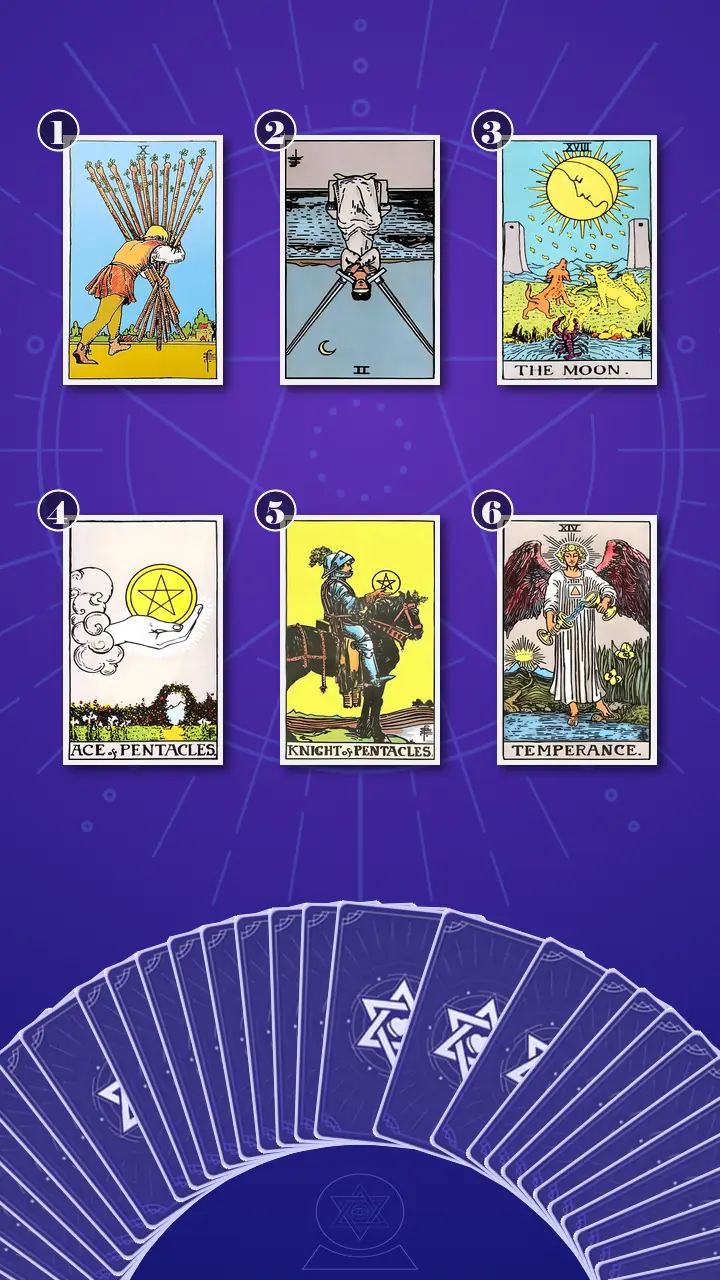
“Today I’m using a spread I designed for moments exactly like this,” I said. “It’s called the Transformation Path Grid (6) · Context Edition—a tarot spread for everyday overwhelm and backlog paralysis.”
For you reading along: this spread isn’t about predicting some grand outcome. It’s built to translate an executive-overwhelm spiral into a workable sequence: visible symptoms → precise blockage → root driver → catalytic entry point → actionable rhythm → integration. It’s basically a diagnostic dashboard that takes you from ‘my apartment is yelling at me’ back to ‘here’s one thing I can do in ten minutes.’
“The top row is your problem row,” I told Jordan. “What it looks like, what blocks you, and what fear feeds it. The bottom row is the solution row: the smallest foothold, the next-week method, and what balance looks like once it’s working.”
Reading the Map: The Problem Row
Position 1: The Backlog You Can See
“Now I’m turning over the card that represents your current snapshot—what overwhelm looks like in observable daily life,” I said.
Ten of Wands, upright.
“This is you carrying three invisible backpacks at once: coursework readings, life admin (mail, emails, forms), and basic survival (food). None of it is catastrophic alone, but together it blocks your view,” I said, keeping my voice plain and practical. “The card’s image is someone so loaded down they can’t even see the road. That’s what a backlog does: it turns ten small tasks into one blinding wall of too much.”
I added the line I use when I want someone to stop treating their life like a single boss battle: “Your backlog isn’t a single monster—it's a bunch of unfinished loops.”
Jordan’s eyes flicked off-screen toward the door like the mail pile was listening. She didn’t disagree. She just swallowed, like her throat had turned dry.
Position 2: The Choke Point
“Now I’m turning over the card that represents your primary blockage—the exact choke point that prevents a first step,” I said.
Two of Swords, reversed.
“This is the moment you stand in front of the mail pile—or the reading list—like it’s a bomb you’re afraid to cut the wrong wire on,” I told her. “Instead of choosing one low-stakes first step, you try to create a perfect system—new apps, new lists, new schedules—because choosing feels like admitting what you can’t do. The result is a lot of mental motion and zero completed loops.”
As I spoke, I pictured the iconic Toronto version of this card: Robarts Library, a laptop open, twenty minutes spent renaming Notion headings, jaw clenched, then packing up without reading a single page—calling it ‘getting organized.’ Busy brain, still hands.
Jordan let out a short laugh that had no joy in it. “Okay, wow,” she said. “That’s… painfully accurate. Like, kind of rude.”
I nodded. “Accurate doesn’t mean you’re bad. It means we can work with reality. And here’s the pivot point: Planning is not the same as choosing.”
Her reaction came in a small chain: first a freeze—her breath paused mid-inhale; then her gaze went unfocused, like she was replaying last Tuesday night; then a slow exhale loosened her shoulders by a fraction, as if her body finally believed it wasn’t being judged.
Position 3: The Fear Under the Freeze
“Now I’m turning over the card that represents your root driver—the underlying fear or belief that makes the backlog feel unsafe to touch,” I said.
The Moon, upright.
“The backlog feels scarier than it is because it’s undefined,” I said. “Before you open an envelope or start the reading, your mind fills in the gaps: late fees, missed expectations, everyone else coping except you. It’s not the task that freezes you—it’s the story your brain tells in the dark about what the task will mean about you.”
In my planetarium work, The Moon is never just ‘mystery’ to me—it’s reflected light. It’s the mind working with partial data and trying to complete the picture. Under stress, it completes it with monsters.
“Let’s borrow a simple antidote,” I offered. “Facts before story. Five minutes. What’s one fact you could verify—how many pages are assigned, what the mail actually is—before you decide what it says about you?”
Jordan’s face softened the tiniest bit, like she’d been holding her breath for weeks and someone finally handed her a chair.
When the Knight Chose a Walking Pace
Position 4: The Smallest Foothold
“Now I’m turning over the card that represents your catalyst—the smallest grounded entry point that restarts momentum without a total life reset,” I said.
Ace of Pentacles, upright.
“A single, tangible start,” I said, and I intentionally slowed down, like a camera zooming in. “Three groceries in a bag on your counter. One envelope opened and placed in a labeled spot. One 10-minute reading block completed with a tiny note. It’s not impressive—and that’s the point. This is the first ‘quieting’ move that turns overwhelm from a fog into something you can hold.”
Jordan glanced toward her kitchen counter, then back at the screen. “So… like, ‘one coin’,” she said, almost testing the words.
“Exactly,” I replied. “One thing. Then the next thing.”
Position 5: The Next 7 Days (Key Card)
The air in my room always changes a little when we reach the method card—the one that has to hold real life, not just insight. I turned the next card over and felt that familiar click of inevitability, like a planet settling into its orbit.
“Now I’m turning over the card that represents your next-step plan—the most realistic approach for the next seven days to create follow-through,” I said.
Knight of Pentacles, upright.
“This is the part of you that stops waiting to feel motivated and builds a small routine that doesn’t require mood,” I told her. “One daily ‘first loop’—ten minutes. One tiny food-support action. One small admin action. You move slowly and you finish what you start.”
I could see Jordan about to argue with it—like her brain wanted to say, Ten minutes can’t possibly fix this. That’s the setup moment: the laptop open, the mail pile in the hallway, the empty fridge, the brain trying to solve an entire life in one frantic burst… then the body going heavy and refusing to move.
Stop waiting for the perfect reset day; choose the Knight’s steady pace and carry one small task across the finish line at a time.
Jordan’s reaction came in layers. First, a flash of irritation tightened her mouth—an almost angry grief for every Sunday she’d lost to the fantasy of “tomorrow.” Then her shoulders dropped as if a strap had snapped loose. Her eyes went wet, not in a dramatic way—more like the body’s quiet agreement when something finally matches the truth. She pressed her lips together, swallowed, and whispered, “So I don’t have to… fix everything?”
“No,” I said gently. “And here’s why this works.”
As an astrophysics nerd, I think in boundaries. I pulled in my signature lens—Black Hole Focus. “A black hole’s event horizon is a line where things stop escaping and stop expanding into infinity,” I explained. “Your tasks don’t need more motivation—they need an event horizon. Ten minutes is your event horizon. The task is not allowed to grow beyond it. That’s how we keep ‘one envelope’ from turning into ‘rebuild my entire admin system.’”
“Consistency beats intensity here,” I added, because the Knight doesn’t do heroic. He does repeatable.
I watched her do a three-step micro-shift: 1) her fingers unclenched from the edge of her mug; 2) her gaze softened, like the scary story lost a bit of contrast; 3) she exhaled, a sound that wasn’t relief so much as permission.
“Now,” I asked, “with that new lens—ten minutes as an event horizon—can you think of a moment last week when this would’ve changed how you felt? A time you spiraled into planning instead of choosing?”
Jordan nodded slowly. “Tuesday. I kept tweaking Notion. If I’d just… read five pages and stopped… I would’ve at least done something.”
Position 6: What Balance Looks Like
“Now I’m turning over the card that represents integration—what balance looks like when the new approach is working,” I said.
Temperance, upright.
“This is the opposite of the sprint-and-collapse cycle,” I told her. “Your week becomes a blend instead of a swing. You’re not sprinting with panic on Monday and disappearing by Wednesday. You keep the mail from becoming a pile, the readings from becoming a cliff, and the fridge from becoming a crisis by making small pours of effort across the week.”
The angel in Temperance pours between two cups like it’s nothing dramatic. That’s the point. The win is a quieter nervous system and a space that supports you instead of shouting at you.
From Insight to Action: Closing Tiny Loops
I summarized what the grid had shown us, in one clean story: the Ten of Wands was the visible overload—mail, readings, food—merged into one heavy “should.” The Two of Swords reversed was the choke point: switching between tasks, over-systeming, and calling it planning, because choosing felt dangerous. The Moon underneath was the undefined backlog effect—worst-case stories filling the gaps. Then the Ace of Pentacles offered the antidote: one tangible foothold. The Knight of Pentacles turned that foothold into a method: a walking-pace routine that closes loops. Temperance promised the integration: a blended week that’s workable, not perfect.
“Your blind spot,” I told her, “is that you keep measuring progress by how much you fix in one go. That keeps pulling you back toward the fantasy of a perfect catch-up day. The transformation direction is smaller and kinder: from trying to ‘catch up on everything’ to completing one tiny, concrete loop at a time—until your environment starts giving you proof you can follow through.”
Then I gave Jordan a plan that didn’t require a personality transplant—just a tiny structure.
- The “One Coin” Start (Today)Pick ONE: (1) open one envelope and place it in a single “Needs Action” folder, (2) read five pages and write a 2-sentence summary, or (3) buy three staples (eggs + rice + frozen veg is a classic). Do it once, fully.Choose the easiest, not the most important. The goal is a closed loop, not a moral victory.
- The 10-Minute “First Loop” Timer (7 Days)Once per day, set a 10-minute timer. Do one loop only—mail OR reading OR food-support. When the timer ends, stop on purpose, even if you feel like you could keep going.Stopping on purpose is part of building trust. If 10 minutes spikes panic, do 5, 2, or even 30 seconds—then stop.
- Two-Basket Mail “Processing Lane” (Tonight)Put two containers by the door: “Open Today” (max 5 items) and “Later/Admin.” Move everything into “Later/Admin” without opening it. Only five pieces are allowed in “Open Today.”This turns the entryway from a shame pile into a lane. You’re reducing visual noise first; processing comes second.
Before we ended, I taught her one more tiny tool from my own kit: Shooting Star Notes. “After each 10-minute loop,” I said, “take 30 seconds to capture the next action on one line. Not a plan—one line. Like a shooting star: quick, bright, and gone. It keeps your brain from reopening the entire galaxy.”

A Week Later: The Apartment Turns Down Its Volume
Six days later, I got a message from Jordan: “I did the timer thing. I opened one envelope on Saturday and it was literally just a dental reminder. I almost laughed.”
She added, “Also I did the three staples. There are eggs in my fridge. I know that sounds dumb but it made me feel… less doomed.”
I could picture it: not a perfect life reset, just a small counter scene—one folder with one piece of mail inside, a grocery bag with three reliable things, a laptop with five pages actually read. Quiet proof. The kind that makes your shoulders drop without you noticing.
That’s the real Journey to Clarity I see again and again: not a sudden transformation, but a shift from overwhelmed freeze and guilty self-criticism to grounded balance through steady, repeatable follow-through. A rhythm that your nervous system trusts because it’s survivable.
When your space is full of reminders you’re behind, it can feel safer to touch nothing at all—because opening one letter or one PDF feels like it might confirm you’re not actually in control.
If you didn’t have to “catch up on everything,” what’s the one tiny loop you’d be willing to complete this week—just to prove to yourself that starting doesn’t have to be a trap?