When Life Admin Collapses in Burnout: The 10-Minute Container Shift

Finding Clarity in the 11:47 p.m. Life Admin Collapse
At 11:47 p.m., you open your banking app, see the overdue notice, close it, and then doomscroll until 1 a.m. because the admin feels louder than sleep.
Jordan (name changed for privacy) said it like they were reading a weather report—flat, almost bored—except their fingers kept tightening around their phone like it might ring and bite. We were on a video call, and behind them I could see a Toronto kitchen table that had become a control tower: laptop half-open, a gym bag slumped by the door, and a single piece of mail turned face-down like it was radioactive.
“It’s not even one big disaster,” they told me. “It’s an overdue bill, a bunch of missed calls, and I’m paying for a gym pass I’m not using. I can do hard things at work. I cannot do… the simple stuff.”
The exhaustion wasn’t abstract. It sat in their body like a weighted blanket soaked in rainwater—heavy limbs, a tight band gripping the back of the head and neck, and that low-grade buzz of restlessness that makes ‘real rest’ feel weirdly impossible.
I kept my voice gentle and plain. “We’re not here to prove you’re functional. We’re here to find the next step that actually sticks. Let’s draw a map through the fog—something you can use tomorrow morning, not just understand tonight.”

Choosing the Compass: The Energy Diagnostic Map (7)
I asked Jordan to take one slow breath and put both feet on the floor—nothing mystical, just a nervous-system cue that says, we’re here. While they exhaled, I shuffled and watched their shoulders drop a millimeter, like a jacket finally unzipping.
“Today we’ll use a spread called the Energy Diagnostic Map (7) · Context Edition,” I said. “It’s designed for moments like this—when the question isn’t ‘What’s my destiny?’ but ‘Why is my system shutting down, and what’s the smallest stabilizing move?’”
For you, reading along: this spread works because burnout isn’t a single failure. It’s a loop that spans practical life admin (bills, calls, the gym pass), emotional capacity, and self-worth pressure. A simple grid layout keeps the reading grounded and actionable—exactly what you want when you’re dealing with decision fatigue and that frozen, braced-for-impact feeling.
“Here’s how we’ll read it,” I continued. “Card 1 is the surface snapshot—what burnout looks like right now. Card 4 is the core blockage—the engine of the loop. Card 6 is the key transformation—the one shift that changes the system, not just one symptom.”
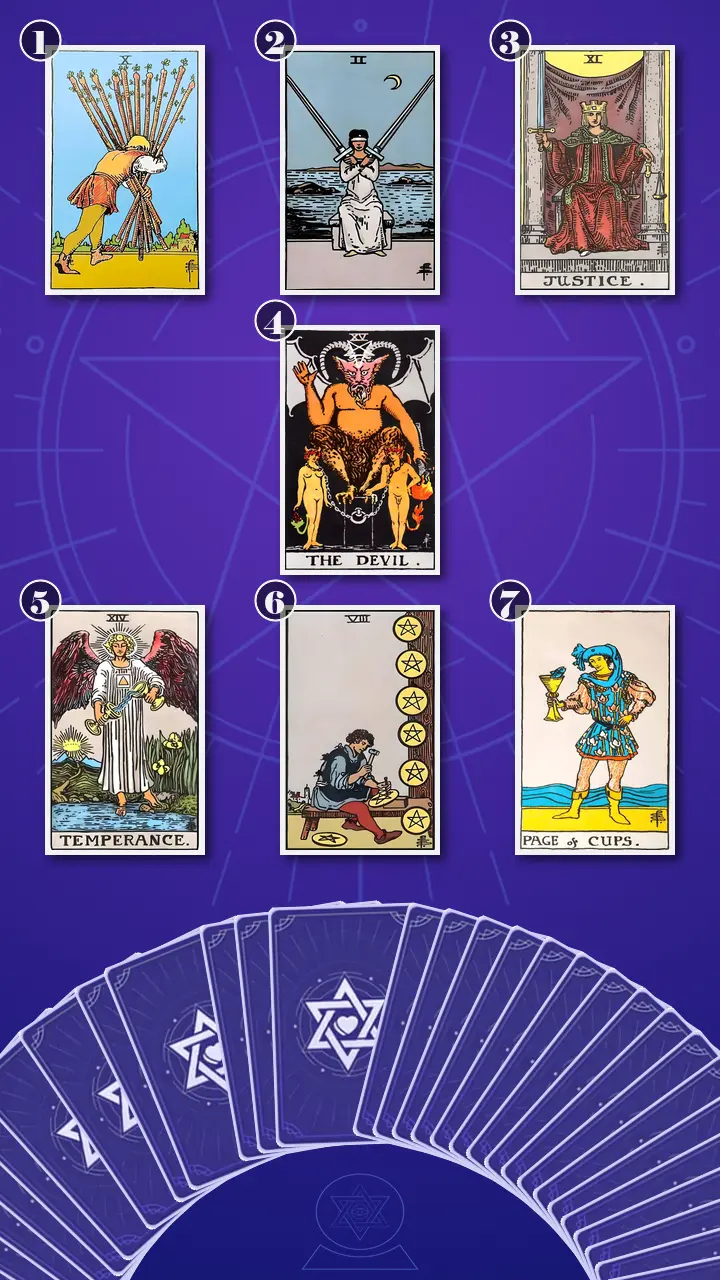
Reading the Map: What’s Visible, What’s Stuck, What’s Pressing
Position 1: The Weight You’re Carrying in Plain Sight
“Now we’re turning over the card that represents your surface energy snapshot—what burnout looks like in your daily life admin.”
Ten of Wands, upright.
I tapped the image lightly. “This is the moment when one more work task, one more financial reminder, and one more self-standards checklist all end up in the same mental tote bag. Even opening the overdue bill feels like lifting another heavy bag, and the destination—feeling normal again—disappears behind the load.”
In energy terms, this is excess: too much output, too much carrying, too much ‘I’ll just push through.’ The figure’s face is blocked by the wands—like you can’t even see priorities clearly, let alone choose them.
Jordan let out a small laugh that didn’t reach their eyes. “That’s… honestly too accurate. Like, kind of brutal.”
I nodded. “Brutal, but not moral. The backlog is heavy, not moral. This card doesn’t accuse you. It reports the load.”
Position 2: The Freeze Response Disguised as ‘Later’
“Now we’re turning over the card that represents your inner tug-of-war—the mental-emotional mechanism that keeps you not opening or returning the next small task.”
Two of Swords, upright.
“This is the phone-on-silent moment,” I said. “You see a missed call, your chest tightens, and you choose low-stakes laptop busywork instead of opening the message—because a blindfolded part of your mind is trying to avoid the emotional hit.”
The Two of Swords is blockage: not laziness, not lack of intelligence—protective avoidance. Crossed swords take effort. It’s work to hold everything at bay.
I asked, “When a missed call appears, what’s the exact sentence your brain says that makes you freeze?”
Jordan’s eyes flicked away from the camera, like they were searching the wall for a safe answer. “It says… ‘If I answer, I’ll have to deal with whatever it is right now.’ And I don’t have the capacity.”
“That’s the card,” I said quietly. “A part of you thinks the call is a live wire.”
Position 3: The Deadline That Doesn’t Care How Tired You Are
“Now we’re turning over the card that represents external pressure—what the environment demands right now and why it feels urgent.”
Justice, upright.
Justice landed like a paperweight. “This is the bank-fees-and-callback-window reality check,” I said. “The due date and the unanswered number don’t negotiate. So the only useful question becomes: which one fair decision gets made today?”
Justice is balance—but it’s also structure. Scales are what’s owed and what’s due. The sword is the clean cut of a decision and a boundary.
I felt my old Wall Street brain flicker on for a second—the same way it did when a contract had a clause you couldn’t charm your way around. “In finance,” I told them, “we don’t argue with settlement dates. We build a plan that respects them. Justice is that energy: clear, fair, and time-aware.”
Jordan swallowed. Their shoulders rose, then fell. “So it’s not ‘I should feel ready.’ It’s… ‘This exists.’”
“Exactly,” I said. “Objective timeline, subjective energy. Both are true.”
The Loose Chain at the Center of the Loop
Position 4: The Shame Subscription You Keep Paying
“Now we’re turning over the card that represents the core blockage—the deepest self-reinforcing pattern behind the burnout-procrastination loop.”
The Devil, upright.
“This,” I said, “is the self-binding loop where the ‘should be able to handle this’ story turns rest, exercise, and admin into another test. You keep paying for the gym pass and other ‘healthy plans,’ but the chain is shame, not the membership fee.”
The Devil is attachment—a draining contract you keep renewing because it promises control. The chains are loose in the picture. The trap is real, but it isn’t locked.
“Here’s the loop as I’m seeing it,” I continued, naming it plainly so it couldn’t hide in the dark: “A reminder hits—bill, missed call, gym notification. Your mind flashes, ‘If I face this, I’ll see how behind I am.’ Your body treats that as danger. So you postpone, mute, swap in easy tasks, or scroll. Relief drops in for a second. Then the cost arrives: late fees, more calls, more guilt, more depletion. And the next reminder feels heavier.”
Jordan flinched like the words had touched a bruise; then their breath left in one long exhale. Their fingers—tight around the phone—loosened.
“I hate how true that is,” they said. “It’s like… if I’m not on top of things, I’m not a real adult.”
“That sentence,” I replied, “is the Devil’s favorite script.”
When Temperance Poured Between Two Cups
Position 5: The Resource You Can Access Without Forcing
“Now we’re turning over the card that represents your usable resource—what you can genuinely access right now without forcing motivation.”
Temperance, upright.
“This is the Tuesday that becomes manageable only when you pair one admin task with one genuine recovery action,” I said. “Pay one bill, then make tea. Return one call, then take a short walk. Not as a reward you earn, but as regulation that keeps your nervous system from rebelling.”
Temperance is balance and integration. One foot on land, one in water: practicality and emotion. Two cups pouring: pacing, not pressure.
Jordan’s face softened in a way that looked almost unfamiliar to them. “So not ‘gym or nothing.’ More like… ‘a two-cup day.’”
“Exactly,” I said. “A recipe, not a sprint.”
The Craftsman’s Answer to Burnout
Position 6: The Turning Point That Changes the System
The air in the room shifted the way it does right before a market opens—quiet, attentive. “Now we’re turning over the card that represents the key transformation—the most effective shift that changes the system, not just one symptom.”
Eight of Pentacles, upright.
“This is the recovery-as-practice moment,” I said. “You return one call before checking email. You mark one checkbox in Notes or Notion. You repeat the same tiny motion until it stops feeling like a crisis.”
In energy terms, the Eight of Pentacles is balance moving toward stability: steady Earth energy. It doesn’t ask for inspiration. It asks for a bench, a tool, and one small unit of work.
Jordan blinked slowly. I could see the heroic comeback fantasy flicker behind their eyes—the one where they wake up Saturday and finally ‘fix everything’ and become the person who never misses a call again.
So I brought in my own lens—the one I built in boardrooms and trading floors, then carried into tarot. “When I look at this card,” I told them, “I don’t see hustle. I see a 3-scenario forecast—a Risk-Reward Matrix the way we’d model options before a decision.”
“Scenario A,” I said, “is the heroic catch-up day: high effort, high emotional activation, low probability of repeating when you’re out of fuel. Scenario B is avoidance: low effort now, but compounding fees and compounding dread—terrible long-term expected value. Scenario C is this card: a 10-minute micro-routine. The payoff isn’t dramatic. The payoff is repeatable. And repeatable is how you rebuild self-trust.”
Jordan’s mouth opened like they were about to argue—and then closed again. Their gaze dropped to the card.
Stop treating recovery like one perfect comeback day; start building it like a craft—one pentacle at a time.
For a beat, Jordan went still. Their breathing paused—tiny freeze. Then their eyes unfocused, like they were replaying that 11:47 p.m. scene: the banking app glow, the overdue notice landing, the reflex to slam it shut and escape into the scroll.
When they inhaled again, it was deeper. Their shoulders lowered a fraction, and I watched their jaw unclench the way you don’t notice you’re clenching until it stops. There was relief—and also a strange dizziness, like stepping off a treadmill that’s been running too long.
“But if I make it small,” they said, voice tight with a flash of anger, “doesn’t that mean I’ve been doing it wrong this whole time?”
I didn’t rush the answer. “It means you were surviving with the tools you had. And now you’re choosing tools that match reality.”
Then I anchored it as a container, not a test—because burnout needs boundaries more than pep talks. “Set a 10-minute timer. Choose one bill or one call. Finish only what fits inside the timer, and stop. If that feels too activating, pause and come back later—this is a container, not a test.”
I leaned in. “Now—using this new perspective—can you remember one moment last week when this insight would’ve changed how you felt? Even by five percent?”
Jordan stared at the ceiling for a second. “Tuesday,” they said. “I opened the bank app. I could’ve… just paid the minimum and stopped. Instead I closed it and scrolled until my eyes burned.”
“That’s the shift,” I said. “From numb, braced-for-impact overwhelm to steadier self-trust built through small, repeatable follow-through. Not a new personality. A new practice.”
Position 7: A Softer Week That Still Moves Forward
“Now we’re turning over the card that represents the next-step landing—how to carry the change into the coming week without it becoming another all-or-nothing project.”
Page of Cups, upright.
“This is the softer landing,” I said. “You notice the dread under the to-do list and answer it with a small, honest script instead of self-attack—like calling back and saying you’re overloaded but available at a specific time.”
The Page of Cups is balance moving into gentleness. Feelings are information, not emergencies. It’s the part of you that can say, “I’m out of fuel,” without turning it into a verdict.
The One-Page Plan: Next Steps You Can Actually Execute
I summarized what the cards were saying as one coherent story: The Ten of Wands shows you’ve been carrying too much for too long, and it has finally leaked into life admin—the overdue bill, the missed calls, the gym pass guilt. The Two of Swords explains the freeze: reminders trigger a protective shutdown, so you trade the scary task for busywork or scrolling. Justice is the outside world tapping the glass—deadlines, fees, call-back windows—objective even when your energy isn’t. The Devil is the engine: shame and control turning every reminder into a referendum on your competence. Temperance offers the bridge—pair effort with regulation. The Eight of Pentacles is the unlock—practice, not proof. And the Page of Cups keeps it humane—curiosity instead of self-punishment.
Jordan’s cognitive blind spot showed itself clearly: they were treating the backlog like a single giant verdict—If I look, I’ll prove I’ve lost control—instead of a queue of small, solvable items. The transformation direction was equally clear: move from “I must fix everything today” to “I will complete one concrete, high-leverage task in a timed container, then stop.”
Jordan hesitated. “But I can’t even find 10 minutes,” they said. “My mornings are Slack, iMessage, email—three stress streams before I’m fully awake.”
I nodded, boardroom-direct but kind. “Then we build a container that wins against your environment. Not motivation. Structure.”
I used one of my own tools here—my SWOT-TAROT rapid assessment—to keep it practical: Strengths (you can do hard things at work), Weaknesses (energy depletion, phone dread), Opportunities (tiny routines that create visible proof), Threats (shame loop + compounding fees). Then we chose two actions that were low-drama and high-leverage.
- The 10-Minute Backlog Pass (Temperance Container)Tonight or tomorrow after work, set a 10-minute timer. Open your banking app and pay or verify one bill item (minimum payment counts). When the timer ends, stop—even if you feel like you could do more.If 10 minutes feels too big, do the 3-minute version. Don’t keep going just because you finally opened the tab; the point is a bounded container, not a heroic catch-up day.
- One Call Before the Scroll (Eight of Pentacles Micro-Routine)On weekday mornings, return one missed callbefore checking social media or news. Use the same one-sentence script every time: “Hi, I saw your call and I’m calling back now.” Then tick one visible box in Notes/Notion/paper.Keep it tiny enough that resistance can’t turn it into a project. Repetition matters more than size, and a missed day doesn’t cancel the pattern.
- The Two-Cup Close (Recovery Right After Admin)Immediately after the 10-minute task, do one real recovery action: tea, shower, a 10-minute walk, or sitting by the window with no screen. Treat it as part of the plan, not a reward.If your body starts to buzz or your jaw tightens, that’s your cue to stop and regulate. A timer can be kinder than a pep talk.

A Week Later: Ownership, Not Certainty
A week later, Jordan messaged me from the Line 1 train—short, almost startled. “I did the 10-minute thing. Paid the minimum. Stopped. Then made tea like it was part of the task. I didn’t spiral.”
They added, “Also… I called one number back before checking headlines. It was literally nothing. I hate that I’ve been carrying it like a rock.”
That’s what a Journey to Clarity looks like in real life: not a full reset day, not a personality makeover—just the first believable proof that you can meet reality without collapsing. One concrete task is a real plan.
When your phone lights up and your shoulders go tight before you even check who called, it can feel like one overdue bill is really asking a bigger question: whether seeing the backlog will prove you have lost control.
If you let the next step be small on purpose, what would you choose to put inside a 10-minute container today?
Author Profile