From Living Like a Transcript to Learning in Public: A Self-Worth Shift

The 11:47 p.m. Figma Loop That Feels Like a Report Card
If you’re a late-20s designer in a big city who treats every Slack reply like a pop quiz, you’re not alone—and yes, it gets worse around performance review season.
Taylor showed up on my screen from her downtown Toronto condo, shoulders pitched forward like she’d been holding them up all day. Behind her, the kitchen counter was the only clean surface left; the rest of the apartment looked like the week had been lived hard. Her laptop was open, Figma still on-screen, and the glow made her face look a little colder than the room probably was.
“I told myself I’d do one last tweak,” she said, rubbing two fingers at the center of her chest like she could physically press the feeling down. “And then I realized I’m doing that thing again. Where ‘done’ feels like… being judged.”
She swallowed, and I watched the motion ripple down into her stomach—like her body was bracing for an unseen verdict. The shame wasn’t dramatic; it was practical, heavy, and familiar. Like trying to breathe with a seatbelt locked tight across your ribs.
Then she said the part that made it click why she’d booked: “I went to my parents’ place last weekend. I found old report cards. And now my self-worth feels… graded. Like I’m still living inside a classroom.”
I nodded, letting that land. “Okay,” I said gently. “You’re not lazy—you’re living like your life is a transcript. And I’m not saying that to label you. I’m saying it because it’s a pattern with mechanics, which means we can actually work with it.”
I kept my voice warm and plain. “Let’s use tarot the way I use a star map at the planetarium: not to hand you a destiny, but to help us find the shape of the loop, where it began, and what the next small exit looks like. We’re aiming for clarity—not perfection.”

Choosing the Compass: How the Celtic Cross Helps You Stop Living for the Grade
I work as a tour guide at a Tokyo planetarium, and after ten years of pointing at constellations for strangers, I’ve learned something simple: people don’t calm down when you tell them to “stop worrying.” They calm down when you show them where they are on the map.
So I asked Taylor to take one slow breath and hold the question in a concrete way: Why does my self-worth still feel graded when I see those report cards—or when I get feedback now? Then I shuffled, not like a ritual meant to impress, but like a reset button: hands moving, mind focusing, nervous system shifting gears.
“Today we’ll use the Celtic Cross spread,” I said, speaking to her and also to you, the reader. “This topic needs the full chain: symptom → conditioning → what keeps it reinforced in adult life → the near-term inner shift → the direction you can grow into. The Celtic Cross is built for that. It separates what you’re doing now from the older voice that taught you to do it, without blaming you for having learned it.”
I pointed to the structure on my table. “The first card will show your current inner experience—how self-worth is being treated like a score right now. The crossing card shows the core block, the thing that keeps the grading system in place even when you know it’s unfair. And there’s a near-future position that often reveals the next available shift—something you can practice, not just understand.”
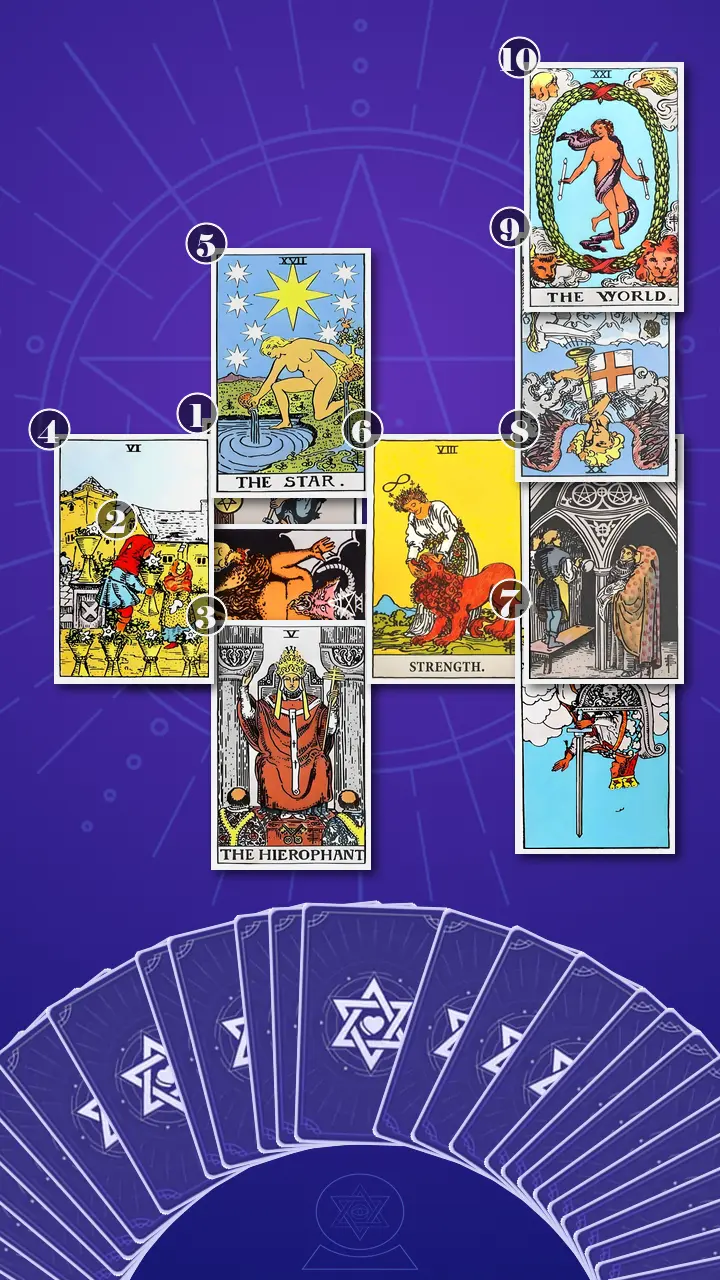
Reading the Map: Card Meanings in Context (When Life Feels Like a Transcript)
Position 1 — The current inner experience: how self-worth is being treated like a score right now.
“Now flipping over the card that represents the current inner experience,” I said, “we have Eight of Pentacles, reversed.”
I angled the card toward the camera. “This is the craftsman card—practice, repetition, skill-building. Reversed, it’s when practice stops being learning and starts being penance.”
And I used the life-scene the card was already speaking in: “It’s 11:47 PM and you’ve reopened the same Figma file for the fourth time. You’re adjusting spacing, renaming layers, rewriting microcopy—work that already meets the brief—because hitting ‘send’ feels like turning in an exam. You’re not chasing excellence; you’re chasing the moment your body finally stops bracing for judgment.”
Taylor let out a small laugh—quick, bitter, almost disbelieving. “That’s… too accurate,” she said. “Even a little cruel.”
I didn’t flinch. “I get why it feels cruel,” I said. “But notice what it’s actually showing: you’re not broken. You’re skilled. You’re working. The energy isn’t missing—it’s blocked at the finish line because ‘finishing’ has been wired to ‘verdict.’”
I tapped the neat row of pentacles on the card. “See how they line up like a scoreboard? Like a KPI dashboard. It’s tidy. Countable. And emotionally… never satisfying.”
Her mouth pressed into a thin line, and her eyes went a little glassy, the way they do when someone recognizes themselves in a pattern they didn’t choose.
Position 2 — The core block: what keeps the “grading” system in place even when you intellectually disagree with it.
“Now we’re turning over the crossing card—the one that represents the core block,” I said. “This is The Devil, upright.”
I kept it modern and precise. “You tell yourself you don’t care about the metric, the grade, the stakeholder approval—and then you feel compelled to check anyway. Slack, dashboards, comments, likes: not because you’re curious, but because not checking makes you feel unsafe. The trap isn’t the tool; it’s the belief that approval is oxygen.”
The Devil’s energy, in plain language, is bondage through coping: a behavior that started as protection becomes a chain you keep reaching for. It’s not about you lacking discipline. It’s about your nervous system confusing control with safety.
“Look at the chains,” I said, pointing. “They’re loose. That’s the part that matters. This bind feels absolute, but it’s maintained partly by participation—because the discomfort of not checking spikes faster than the long-term cost.”
She inhaled sharply, like she’d been caught in the act by someone kind. Then she nodded once, heavy. “Yeah,” she said. “I can feel the panic if I don’t.”
I added one of my anchor lines softly: “Checking is a coping strategy, not a personality trait.”
Position 3 — The root conditioning: where the need for a verdict began and what it is trying to protect.
“Now flipping the card that represents the root conditioning,” I said, “we have The Hierophant, upright.”
I felt my own small internal flashback: standing in the planetarium’s dark dome, explaining to a school group how we inherit a sky-map from culture before we ever choose one for ourselves. People think they’re looking at stars; they’re often looking at a story about stars.
“There’s an internal ‘teacher voice’ that still runs your standards,” I told Taylor. “There is a right way, a top tier, and being acceptable means passing. Even in adult work, you’re reacting to critique like it’s a moral evaluation, because that’s how early systems trained you to interpret grades—as truth about you.”
The Hierophant is institutional gravity. This card doesn’t blame your family or your teachers. It names the system: a structure that taught you, early, that someone else gets to define the rubric for who you are.
This is where my own lens naturally clicked in—my Galactic Gravity Analysis. “Think of that old school system like a massive planet,” I said. “When you’re young, you orbit it. The rules are its gravity. You don’t choose the orbit—you just learn to survive inside it. Later, you leave the building, but the orbit can stay. Your adult work feedback pulls you back into the same path because your body remembers the gravity.”
Taylor’s eyes dropped to the table in front of her. Her fingers pinched the edge of a napkin, then released it. “So it’s not just… me being dramatic,” she murmured.
“No,” I said, steady. “It’s you being conditioned. And that means you can un-condition it.”
Position 4 — The recent trigger: the past material (memories, objects, comments) that reactivated the pattern.
“Now we’re turning over the recent trigger,” I said. “Six of Cups, upright.”
I let the image do what it does: time-slip. “You’re at home, you open a drawer, and there they are: report cards, awards, old notebooks. It hits fast and irrational: you feel younger, smaller, and suddenly desperate to be ‘good.’ The papers aren’t just memories—they’re cues that reactivate the old loop of approval = safety.”
I slowed down. “Your body remembers the rubric even when your mind doesn’t agree with it.”
Taylor blinked hard once. Her throat moved like she was swallowing something that didn’t want to go down.
“My mom said—like, casually—‘You were always such a good student,’” she said. “She meant it as a compliment. But it felt like… being assigned a role again.”
“Exactly,” I said. “Nostalgia isn’t always sweet. Sometimes it’s a keycard that opens an old nervous-system file.”
Position 5 — The conscious desire: what you hope will be true about your worth and your future self.
“Now flipping the conscious desire,” I said, “we have The Star, upright.”
The air changed just talking about it. The Star always feels like softer light. “You’re craving a life where feedback can land without collapsing your self-esteem,” I told her. “Not a bigger win, not a higher score—just a steadier relationship with yourself. You want to create from curiosity again, where progress is measured by values and consistency, not constant proving.”
In energy terms, The Star is balance—a steady pour instead of sudden verdicts. “It’s two kinds of progress,” I said. “One vessel is skill. The other is self-trust. Right now the transcript mindset only tracks one of them.”
Taylor’s shoulders lowered a millimeter, like her body heard the word steady and recognized it as a real need, not a luxury.
When Strength Spoke: Calm Hands on the Inner Lion
Position 6 — The next available shift: a near-term way your system can begin to soften and re-train.
I held my breath for a half-second before flipping the next card. “This is the near-future position,” I said. “The next available shift.”
The card turned over: Strength, upright.
“You feel the urge to over-edit and keep checking, and instead of obeying it or fighting it, you meet it,” I said. “You set a timer, do one clean review, then you send the work. Your anxiety doesn’t vanish—but you don’t punish yourself for having it. That’s Strength: calm hands on the ‘grader panic,’ choosing respect over score-chasing.”
Strength is regulated fire. Not self-control through violence. Self-control through relationship.
And this was the moment I brought in my most useful cosmic tool for what she was actually dealing with: not “motivation,” but a generational gap inside her own psyche. “I call this Light-Year Communication,” I told her. “Because that teacher-voice? It’s old light. It was emitted years ago. It arrives in your body now and feels current, but it’s not.”
I leaned closer to the camera. “Strength is you learning to translate that old signal without letting it drive the ship. Like: ‘Thanks, I know you think a perfect score keeps us safe. But we’re 28 now, and safety comes from how we treat ourselves while we learn.’”
She didn’t nod right away. Her face tightened with a quick flash of resistance—anger, almost. “But if I stop… doesn’t that mean I was wrong?” she asked. “Like, I built my whole life on being good at school. On being impressive. If I let go of that… what do I have?”
I let that question be real. “It doesn’t mean you were wrong,” I said. “It means you were doing what worked in the environment you were in. In school, grades were a system of access. The problem is when that system becomes your identity.”
Then I guided us into the aha moment, exactly where her story had been stuck.
The Aha Moment (Setup)
In my mind, I saw the scene she’d described: her sitting on her parents’ floor in Scarborough, the manila folder open, the percentages staring back like they were still live data. Her stomach dropping like the grade was still a verdict she had to survive.
The Aha Moment (Delivery)
Not “tame yourself into a perfect grade,” but hold your inner lion with calm hands—Strength is self-respect practiced, not a score earned.
I let the silence do its work.
The Aha Moment (Reinforcement)
Taylor’s reaction came in waves—the kind you can’t fake. First: a small freeze. Her breath paused, and her eyes went unfocused, like she’d been yanked out of the present and dropped into a memory. Second: the thought landing. I watched the muscles along her jaw soften, then tighten again, as if her brain was trying to argue and her body was quietly refusing the argument. Third: the release. She exhaled, long and shaky, and her shoulders dropped in a way that looked almost unfamiliar on her frame—like she’d forgotten they were allowed to rest while anxiety still existed.
“So I don’t have to… earn the right to be okay,” she whispered, and there was sadness in it—bittersweet, like realizing you’ve been paying a tax you didn’t owe.
“That’s exactly it,” I said. “And your worth doesn’t need to be proven by a score; it can be built through steady, compassionate self-trust.”
I watched her blink again, slower now. “Now,” I continued, “use this new lens and look back at last week. Was there a moment—one Slack message, one tiny critique—where this would’ve changed how you felt in your body?”
She stared at the corner of her screen like she was replaying a clip. “A PM said, ‘Can we explore one more direction?’” she said. “And I… immediately decided I was failing.”
“That right there,” I said softly. “That’s the shift. From ‘I need a perfect score to be safe’ toward ‘I can learn in public and still respect myself.’ This isn’t just about work. It’s your nervous system graduating from the internal classroom.”
Evidence, Chains, and the Old Verdict: The Rest of the Ladder
Position 7 — Self-image in the pattern: the role you play when you feel evaluated.
“Now we’re turning over the card for self-image in the pattern,” I said. “Queen of Swords, reversed.”
“You try to be ‘objective’ about yourself and end up issuing verdicts,” I told her. “One critique becomes a full identity rewrite. You reread messages to find the hidden meaning, like you’re grading yourself with a rubric you never agreed to. Your intelligence turns into a blade pointed inward.”
In energy terms, this is excess Air gone sharp—clarity becoming sentencing. “Reversed, she’s not discernment,” I said. “She’s cross-examination.”
And this is where the loop became visible enough to name. I used the ‘courtroom’ structure because her mind already lived there.
“Exhibit A: one critique,” I said. “Exhibit B: a delayed reply. Exhibit C: a Slack message that’s just ‘k.’ And then the Verdict: ‘I’m not actually good. I’m going to be exposed.’”
Taylor’s hand went to her stomach like she was steadying something. She gave a tiny, heavy nod—no drama, just recognition.
Position 8 — External reinforcement: people, culture, and structures that mirror “being graded,” including supportive feedback dynamics.
“Now we’re turning over the environment,” I said. “Three of Pentacles, upright.”
“Your environment is built around collaboration and review,” I told her. “Crits, stakeholders, performance cycles. That’s not going away. The difference is whether feedback is a shared plan for the work—or a secret grade you assume you’re failing.”
I gave her the line I wanted her nervous system to memorize: “Feedback is information about the work, not a verdict about your worth.”
In energy terms, the Three of Pentacles is balanced Earth: structure that can support you—if you stop treating every structure like a courtroom.
Taylor frowned thoughtfully. “So it’s not that I have to escape feedback,” she said. “I have to… stop turning it into my identity.”
“Yes,” I said. “You don’t need a new job to fix this. You need a new relationship to evaluation.”
Position 9 — The emotional engine: what you secretly hope for and what you fear will happen if you stop performing.
“Now we’re turning over hopes and fears,” I said. “Judgement, reversed.”
“This is like when you want to believe you can outgrow the report-card mindset,” I said, “but you still wait for some external signal to ‘announce’ you’re finally worthy.”
Reversed Judgement is blocked renewal—staying under an old sentence because choosing your own evaluation feels risky. “There’s hope here,” I told her. “You want liberation. But you fear that if you stop performing, you’ll be exposed as average—and that average will mean unlovable.”
Taylor’s eyes narrowed slightly, like she didn’t love being seen that clearly. Then she sighed, the kind that comes from deep in the chest. “Yeah,” she said. “I don’t want to be impressive. I just want to feel safe.”
Position 10 — Integration direction: what becomes possible if you practice a new relationship to evaluation and identity.
“Finally,” I said, “the outcome—not a fixed prediction, but an integration direction. We have The World, upright.”
“This is like when you can receive feedback, improve your work, and still feel intact,” I told her. “Because your identity isn’t hanging on being top-of-class.”
The World is wholeness. Not ‘A+ forever.’ Not ‘never get critiqued.’ More like: your worth becomes the whole living system—sleep, relationships, play, values, learning—held inside one container. A single grade can’t represent it, so it stops being the ruler you die by.
Taylor’s face softened into something quieter than hope: relief with a little grief mixed in, like realizing she’s allowed to stop auditioning.
Actionable Advice: The Eclipse Plan for the Inner Grader (Your Next Steps)
I gathered the spread into a single story, the way I’d summarize a night sky for someone seeing it for the first time.
“Here’s the through-line,” I said. “Your present is Eight of Pentacles reversed: endless refining because ‘done’ feels like judgment. The Devil crosses it: the checking and proving is a chain that offers temporary relief, then deepens the belief that you can’t stop. The root is the Hierophant: an internalized school/system voice that taught you worth equals passing. Six of Cups shows why the report cards hit so hard—your body time-travels. The Star is what you consciously want: steady self-renewal. Strength is the bridge: calm, firm self-respect while anxiety is still present. Queen of Swords reversed is how you maintain the system—courtroom language inside your head. Three of Pentacles says feedback will remain, so the goal is collaboration, not escape. Judgement reversed shows the fear of retiring old verdicts. And The World says this is solvable: you can integrate into a self that isn’t measurable.”
“The blind spot,” I added, “is thinking that harshness is accuracy. It isn’t. It’s just an old curriculum. The transformation direction is exactly what Strength taught us: from ‘I need a perfect score to be safe’ to ‘I can learn in public and still respect myself.’”
Then I offered her a simple framework from my toolkit—my Solar Eclipse Mediation. “An eclipse is when something bright gets temporarily covered,” I said. “Not destroyed. Covered—so you can see the corona, the edge, what’s usually invisible. We’ll use that as a three-step conflict resolution between you and the inner grader.”
- One-Timer Submit (Strength as a product constraint)Pick one deliverable this week. Set an 18-minute timer for exactly one review pass: scan for real issues (accessibility, alignment, copy clarity), make fixes, and send/submit when the timer ends—even if your body wants “one more pass.”If panic spikes (“This is irresponsible”), treat it as a body signal, not a command. Start with 8 minutes if needed. The goal is “done and respectful,” not “perfect and numb.”
- The Two-Sentence Reframe (Eclipse Step: Cover the verdict)When the inner grader starts its courtroom drama, write two sentences: (1) a precise observation (“The stakeholder wants one more option.”) and (2) the next step (“I’ll draft two variations by 3 PM.”). Keep it brutally concrete.This uses your sharp Queen-of-Swords mind without letting it sentence you. If you catch yourself adding a third sentence that starts with “because I’m…”—stop. That’s the verdict sneaking back in.
- Hard Stop Ritual (Calm hands on the laptop lid)Three nights this week, set a stopping time (ex: 10:30 PM). Close the laptop, plug it in to charge across the room, and do a non-graded activity for 10 minutes (shower, stretch, tea, one chapter of a novel).If you break the stop time, you didn’t “fail.” Just notice what story pulled you back—usually “I’ll be exposed.” Put a sticky note near your screen: “This is info about the work, not a verdict about me.” Read it once before you reopen anything.
She stared at the list like it was both simple and strangely radical. Then she did the most honest thing: she pushed back.
“But I don’t have the five minutes,” she said, a little sharp with fatigue. “Like, I get home and my brain is already sprinting. Even the idea of a ritual sounds like another thing I could fail at.”
I nodded. “That’s the transcript voice trying to turn self-respect into another assignment,” I said. “So we make the bar lower than your inner grader knows how to respect. Eight minutes. One sentence. Ten minutes of tea. Strength isn’t the absence of anxiety. It’s choosing respectful action while anxiety complains.”

A Week Later: Quiet Proof Without a Final Grade
A week later, Taylor messaged me. Not a paragraph. Not a performance review. Just: “Did the 18-minute timer. Sent it when it went off. My stomach hated it. Nothing bad happened. Also… I slept.”
She told me she still felt the first pang the next morning—What if I’m wrong?—but this time she noticed her jaw clench, exhaled, and said out loud, “I can learn in public and still respect myself.” Then she made coffee and didn’t open Slack until she was actually at her desk.
That’s the Journey to Clarity in real life: not a grand ceremony, but a new baseline you can feel in your shoulders. A tiny loosening. A little more room in your chest. A life that starts to look like practice, not punishment.
When your chest tightens over a single comment or an old report card, it’s not because you’re failing—it’s because some part of you still believes belonging is something you have to pass for.
If you didn’t have to earn a perfect score to be safe this week, what’s one tiny place you’d let yourself be a learner—on purpose?
Every reading at AceTarot is a Journey to connect with inner wisdom and empower next step.
Learn more about our Journey to Clarity.