From Braced Uncertainty to Grounded Curiosity: Your First DNA Match DM

Finding Clarity on the TTC: The Notification That Hits Like a Verdict
You’re a late-20s city person who can write a flawless Slack update—but one DNA match message has you stuck in a Notes app draft-delete loop.
That was the first thing Jordan (name changed for privacy) said to me, and even through a video call I could feel the way their voice tried to sound casual while their body was doing the opposite.
They told me about 8:47 a.m. on Line 1 in Toronto: standing by the doors, tote bag strap digging into their shoulder, fluorescent lights humming like an overworked fridge. Their phone buzzed—New close DNA match—and the screen felt suddenly too bright, like someone turned a spotlight on their ribs. Their chest tightened the way it does right before you get called into a meeting you didn’t schedule.
“I opened the match page,” they said, “took a screenshot, and immediately started Googling what to say to a DNA match first message like it was… urgent. And then I just—froze.”
Jordan’s life rhythm sounded familiar: stable day job, a calendar that looks full on paper, and this one tab in the background that never closes. On commutes, right before bed, during that weird five-minute gap after dinner—open the DNA app, zoom in on the shared percentage, check again, then hop to Notes and type Hi— and stop.
“I don’t want to be the plot twist in someone else’s life,” they added, and the sentence landed with the weight of a meteor you hear after it’s already hit the ground.
Uncertainty doesn’t always look like panic. Sometimes it’s quieter: like holding your thumb over “Send” the way you’d hover a finger above a hot stove—knowing you’re not touching it yet, but feeling the heat anyway. With Jordan, it lived as a tight chest and a jittery, braced alertness, like their whole nervous system had been asked to audition for belonging.
I let a beat of silence settle—my version of dimming the planetarium lights before the first star appears.
“We’re not going to hunt for the perfect first question,” I said. “We’re going to find a respectful doorway. Something consent-first. Something you can actually send without turning it into a trial.”

Choosing the Compass: The Four-Layer Insight Ladder Spread
I’m Laila Hoshino. For ten years I’ve guided people through a Tokyo planetarium—teaching the calm math of celestial motion to crowds who arrive stressed and leave quieter. I also read tarot, and I don’t treat it like fog. I treat it like a map: symbols that help you name what’s happening in your body and choose a next step you can live with.
I asked Jordan to take one slow breath—not as a ritual, just as a reset. “Let your eyes soften,” I said, “and think about one specific moment: the app open, the message box waiting, your chest tightening.” While they did, I shuffled slowly, the cards making that familiar paper whisper like distant rain on a dome roof.
“Today I’m using a spread I call the Four-Layer Insight Ladder · Context Edition,” I explained. “It’s built for moments when the action is simple—send a message—but the meaning feels identity-sized.”
For readers who like to know how tarot works in a practical way: this isn’t a fortune-telling timeline. It’s a diagnostic ladder. We read across the top row to see the loop—what’s happening now, what’s blocking you, what fear is feeding the block. Then we step down to the bottom row to find the bridge, the first sendable move, and the boundary posture that keeps you steady afterward.
A big, complex spread would add more noise. A quick three-card “advice” pull often skips the fear mechanics that make the message feel impossible. This ladder keeps it minimal—but complete.
“We’ll start with what this match is activating right now,” I told Jordan, “then we’ll name the stall pattern, then the fear underneath. After that we’ll find your bridge—your pacing rule—and end with the exact kind of first question to ask, plus how to handle whatever happens next without spiraling.”
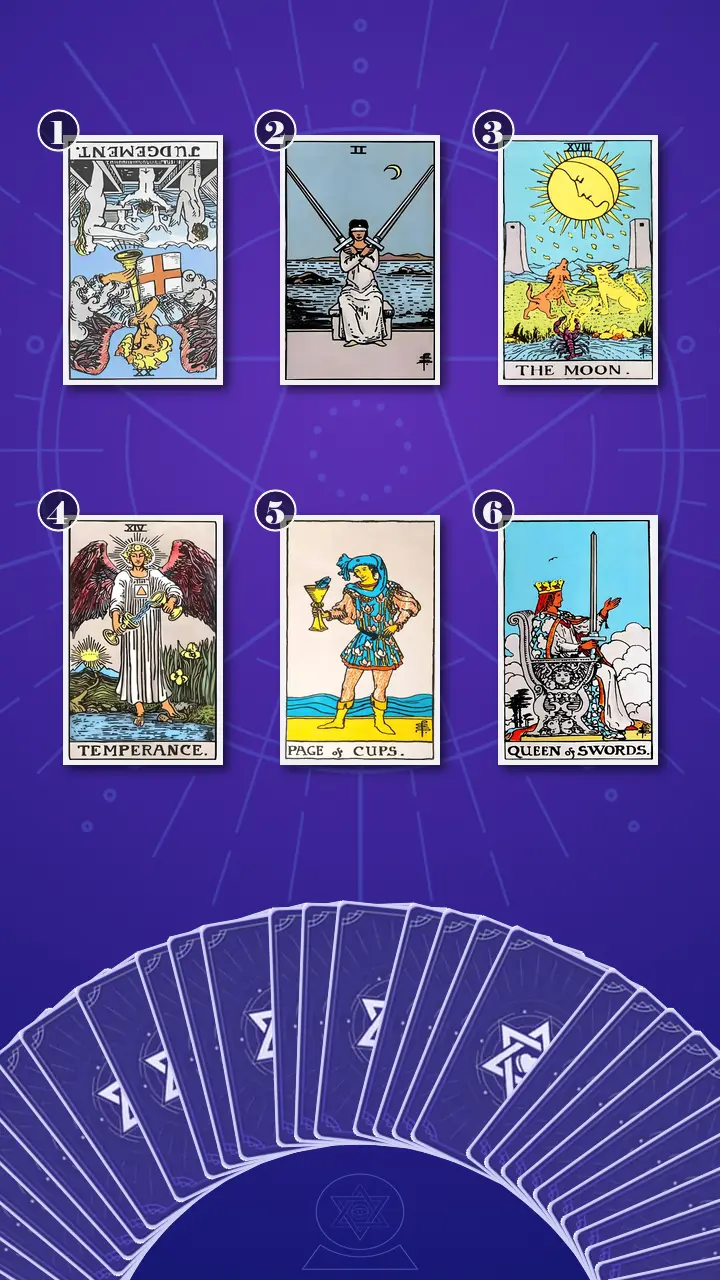
Reading the Map: The Freeze, the Fog, the Story in Your Head
Position 1 — Surface Reality: Judgement (Reversed)
“Now we turn over the card that represents surface reality right now: what the DNA match is activating in you and how it’s showing up behaviorally.”
Judgement, reversed.
I didn’t have to reach for anything mystical to translate it. In modern life, Judgement looks like a high-priority notification—an alert that doesn’t feel optional. And reversed, it’s the moment you keep the notification unopened because opening it would make it real.
“This is exactly what you described,” I said. “You get the match alert on the subway or in line for coffee, and your brain doesn’t file it under ‘new information.’ It files it under ‘verdict.’ Like: this means something about who I am.”
Reversed energy here isn’t evil or wrong. It’s blockage: the awakening is happening, but you’re delaying integration. You keep the whole moment suspended—because as long as you don’t message, you don’t have to find out what their response would imply about belonging, family, identity, any of it.
Jordan’s mouth twitched into a small, bitter laugh—surprised and not entirely amused. “That’s… way too accurate,” they said. “It’s almost rude.”
“It’s not rude,” I replied, gentle but firm. “It’s your nervous system trying to protect you from an outcome you can’t control.”
In my head, I had a flash of the planetarium’s schedule board—meteor showers, conjunctions, the predictable elegance of orbit. People love certainty when it comes with dates and diagrams. But family truth doesn’t arrive like a comet you can time to the minute. It arrives like weather. The card was showing me that Jordan was trying to treat weather like a calendar event.
Position 2 — Immediate Blockage: Two of Swords (Upright)
“Now we turn over the card that represents the immediate blockage: the specific mental/behavioral pattern that stops you from asking anything at all.”
Two of Swords, upright.
I pointed to the image: the blindfold, the crossed blades, the still water behind her. “This is the ‘being careful’ pose that turns into not choosing,” I said. “Silence as self-protection.”
In Jordan’s life this card is the frozen cursor scene: the blinking text bar in the message box like a metronome you can’t shut off. They toggle between two fears—too direct vs too vague—like they’re trying to locate a sentence that removes all risk from a human interaction.
I spoke it the way it tends to sound in someone’s head:
If I’m direct, I’m dangerous.
If I’m vague, I’m shady.
So I’ll… do nothing.
That’s not strategy. That’s a shield.
The energy here is deficiency disguised as control: you’re collecting “data” while wearing an emotional blindfold. The longer you don’t reach out, the more the match turns into a mythic figure in your mind. The app becomes a stage. Your draft becomes a performance. And you never get to the part where it becomes a conversation between two humans.
Jordan exhaled—small, relieved, like their lungs had been holding a coin they could finally drop. Their head tipped in a slow nod, eyes flicking down toward their own phone as if they could see the cursor blinking through the screen.
“Yeah,” they said quietly. “I keep telling myself I’m being respectful. But I think I’m just… hiding.”
Position 3 — Underlying Fear: The Moon (Upright)
“Now we turn over the card that represents the underlying fear: what you’re afraid the first question could trigger or reveal about belonging and identity.”
The Moon, upright.
My voice lowered a little—not for drama, but because this card is tender. “The Moon is what happens when there’s not enough information, and your mind tries to fill the gap so you can feel prepared,” I said. “It’s uncertainty with high-definition imagination.”
I watched Jordan’s eyes do that familiar thing: focus narrowing, like their brain was already opening tabs.
“This is late-night phone glow energy,” I continued. “You’re alone, the room is quiet, and your brain starts generating a full cinematic universe off a name and a percentage.”
And The Moon loves to send push notifications—except they’re from your own fear:
What if they’re angry?
What if I blow up a family?
What if I don’t belong?
What if they ignore me and it proves something about me?
I let that sit for a second, then gave the pivot line the card was begging for:
“That’s not information. That’s fear filling the empty space.”
The energy here is excess—not of intuition, but of projection. The Moon isn’t saying the match is secretly dangerous. It’s saying your nervous system treats uncertainty like danger, so your mind becomes an algorithm that recommends worst-case scenarios because worst-case scenarios keep you “engaged.” Like doomscrolling, but internal.
“Let’s do a quick reality split,” I said. “Known vs assumed.”
Jordan swallowed. Their throat moved like they were trying to push down a lump of static.
“Known,” I prompted.
“We matched on the app,” they said. “We share a percentage. They have a name. That’s… basically it.”
“Assumed?”
Jordan’s laugh came out thin. “Everything else. I’ve written a whole movie.” Their eyes went slightly unfocused, like they could see that movie playing on the back of their eyelids. Then—softer—“I’ve been reacting to a story, not a person.”
“Exactly,” I said. “And we can respect that fear without letting it run the keyboard.”
When Temperance Spoke: A Bridge Made of Pacing, Not Perfection
Position 4 — Bridge Resource: Temperance (Upright)
“Now we turn over the card that represents the bridge resource: the inner stance that helps you move from overthinking into respectful contact.”
The moment before I flipped it, the room on my end went especially quiet—the way it does in the planetarium when the last chatter fades and everyone realizes they’re about to see something they can’t unsee.
Temperance, upright.
Temperance is the opposite of a flood. It’s regulated flow: the angel pouring between two cups, one foot on land and one in water. It’s the card that says, “You don’t have to solve the entire story in one message. You just need a safe container for it to unfold.”
And this is where I used the tool I’ve developed from years of translating space into human terms—my Light-Year Communication lens.
“In astronomy,” I told Jordan, “distance changes everything. If a star is four light-years away, you’re not seeing it in real time. You’re seeing it with delay. That doesn’t mean you’re doing it wrong. It means you’re working with reality.”
“A DNA match is like that,” I continued. “There’s emotional distance and informational distance. You can’t collapse it instantly with one perfect question. Temperance is you respecting the light-year gap—sending a signal that’s clear, kind, and paced, then allowing time for a response to travel back. That’s not weakness. That’s how contact works.”
Jordan’s shoulders were still high—braced uncertainty—like they were waiting for me to tell them the one “right” question that would guarantee safety.
I gave them the setup, the exact moment they’d described:
You know that moment on the TTC when you open the DNA match page, screenshot the shared percentage, start a message with “Hi,” and then your chest tightens like you’re about to step on a live wire?
Temperance is the alternative to treating that moment like a performance. It turns it into a recipe—like moving from chaotic group chat energy to a calm 1:1 thread with clear pacing.
Then I delivered the line I wanted them to carry like a steady hand on a railing:
Stop treating one message like a final verdict; start pouring the conversation in measured steps, like Temperance’s cups.
I paused. Not to be dramatic—because this kind of insight needs air around it.
Jordan’s reaction came in a chain, layered and human:
First, a physical freeze—like their breath caught mid-inhale and didn’t know where to land. Their eyes widened a fraction, pupils adjusting as if a light had shifted. Their hands, which had been clasped tight, loosened without them noticing.
Second, the cognition seeped in. Their gaze drifted slightly past the camera, unfocusing the way people look when they’re replaying a memory. I could almost see the Notes drafts labeled “DNA message v3 FINAL final” flickering behind their eyes, each one an attempt to build a guarantee out of wording.
Third, the emotional release—quiet, but unmistakable. Their shoulders dropped. Not all at once, but like a jaw unclenching you didn’t realize you were holding. They let out an exhale that sounded like relief with a thin edge of grief attached to it.
“So… I’ve been acting like I only get one shot,” they said, voice a little rough. “Like if I mess up the opener, I lose my chance to know where I come from.”
“Yes,” I said. “And that’s the identity charge. But Temperance is asking for a different move: one fact, one intention, one permission-based question. Then you stop editing.”
I leaned in slightly. “Now, with this new lens—measured steps, not verdict—think back to last week. Was there a moment when you spiraled over tone or templates, where this would have let you feel different?”
Jordan’s eyes got shiny, not in a dramatic way—more like the body finally having permission to be honest. “Last night,” they admitted. “I wrote an essay. Deleted it. Then I went on Reddit and read a thread about someone getting blocked. I didn’t even send anything, and I still felt… rejected.”
“That’s the transformation right there,” I said softly, anchoring it. “This is you moving from braced, identity-charged uncertainty into grounded curiosity—with pacing and boundaries. Not certainty. Self-trust.”
Position 5 — Actionable First Step: Page of Cups (Upright)
“Now we turn over the card that represents the actionable first step: the best kind of first question to ask that opens dialogue with consent and low pressure.”
Page of Cups, upright.
I smiled, because this card is a relief after all that Air-and-Moon tension. “This is the gentle messenger,” I said. “It’s a warm message bubble, not a dossier. It’s you allowing yourself to be a person instead of a carefully written legal document.”
In modern terms: write the opener like a kind DM, not a formal email. Soft posture. Brief. Honest. Non-demanding.
“Page of Cups asks a first question that checks for consent, not lineage,” I said. “Not ‘Who are your parents?’ Not ‘Why did this happen?’ The first question is about comfort and pace.”
Jordan gave a reluctant little smile, like their face had been waiting for permission to do that.
“You’re allowed to be curious without interrogating,” I told them. “That’s the Page.”
Position 6 — Integration: Queen of Swords (Upright)
“Now we turn over the card that represents integration: how to hold boundaries and clarity after you ask, regardless of the response pace.”
Queen of Swords, upright.
Her sword is up, but her other hand is open. Truth and an invitation. Clarity without chasing.
“This is your posture after you send,” I said. “You decide ahead of time that you won’t stalk their socials for context, you won’t send five follow-ups, and you won’t turn silence into a story about your worth.”
Here the energy is balance—clean Air, not frozen avoidance. The Queen doesn’t need the other person to validate her to stay composed. She can handle truth. She can also handle a ‘no’ or a slower pace without making it mean she doesn’t belong anywhere.
Jordan sat a little straighter. Not rigid—steadier. “I want that,” they said. “I want to be clear without… begging.”
“Good,” I replied. “Because clarity is built in steps, not demanded upfront.”
From Insight to Action: The Two-Sentence Doorway (and the Boundary That Keeps You Steady)
I told Jordan what the spread had said in one continuous story, so it could feel coherent instead of like six separate opinions.
“This match hit you like Judgement reversed—a wake-up call that felt like a verdict,” I said. “Then Two of Swords stepped in: silence as a shield, because choosing felt risky. The Moon made the risk feel even bigger by generating an entire backstory and reacting to it like it was confirmed. Temperance is your bridge: pace the truth like measured pouring, respecting the ‘light-year delay’ of real human response. The Page of Cups gives you the sendable opener—warm, consent-forward. And the Queen of Swords is what protects you afterward: one clear follow-up rule, no chasing, and no turning their capacity into your value.”
“Your cognitive blind spot,” I added, “is that you’ve been treating the first message like a one-shot performance—like you’re on trial. But the transformation direction is different: move from outcome-control to consent, context, and a low-pressure invitation to share.”
Then I gave them the practical structure—simple on purpose, because simple is not careless. It’s regulated.
- The Temperance Draft (10 minutes)Set a timer for 10 minutes. In Notes, write exactly two sentences: (1) a neutral fact about the match + platform + approximate percentage, and (2) a consent-based question about chatting and what pace feels comfortable.Read it once out loud. Make only ONE edit for clarity (not tone-perfecting), then save as Draft. If it’s late-night and you know you’ll spiral, don’t send—schedule the send for a lunch break or calm morning.
- Swap “identity extraction” for consentReplace any “Who are your parents?”-style question with: “If you’re open to it, would you be comfortable chatting a little about how we might be related, and what pace feels okay for you?”If it feels too simple for something this big, that’s your nervous system craving a contract. Remind yourself: Consent beats perfection every time.
- Queen of Swords follow-up rule (so you don’t spiral)Decide now: if there’s no response in 10–14 days, you’ll send one short check-in—then stop. Draft the check-in today: “Just wanted to check if you saw my message—no pressure either way.”Mute app notifications for 48 hours after you send (or pick one daily check-in window). Silence is data about timing/capacity, not a verdict on you.
As we wrapped, I added one timing note—my gentle nod to celestial mechanics. “If you send when you’re already braced—midnight in bed, phone glow, worst-case algorithm running—you’ll pay for it with hours of rumination. Pick a calmer orbit: a lunch break, a morning coffee, a moment your body isn’t already in fight-or-flight.”

A Week Later: Ownership, Not Certainty
Six days later, Jordan messaged me.
“I sent it,” they wrote. “Two sentences. One reread. No essay.”
They told me they hit send at 12:18 p.m., sitting on a bench outside their office with a sandwich they barely tasted. Their hands still shook a little, but it was the kind of shaking that comes with doing something real—not the jittery, trapped energy of endless rehearsal.
They didn’t get an immediate reply. And here was the bittersweet part—clear but still human: Jordan said they slept through the night for the first time in weeks, then woke up and their first thought was still, What if I did it wrong? Only this time, they caught themselves… and didn’t open ten tabs. They made coffee. They went to work. They let the light-year delay be what it was.
That, to me, is the quiet proof of this Journey to Clarity: not that life instantly resolves, but that you stop treating uncertainty like a personal indictment. You become someone who can open the door without demanding the whole story on the doorstep.
When one DNA match makes your chest tighten, it’s not because you’re “too much”—it’s because you’re trying to earn belonging by getting the first sentence perfectly right.
If you didn’t have to control the outcome, what would a two-sentence, consent-first hello look like in your voice—just enough to open the door, not force the whole story?