From Sunday Dread to a Weekly Rhythm: Balancing Work, Money, and Dating

The 10:22 p.m. “One Last Check”
If you’re a late-20s city professional whose Sunday night ‘wind-down’ is rotating between Slack, your bank app, and Hinge—hello, Sunday Scaries.
Taylor said it like she was confessing a harmless habit. But her body told the truth first: shoulders lifted like she’d forgotten how to put them down, one palm pressed to the center of her chest as if to keep something from slipping.
She described last night—10:22 p.m., Toronto condo, laptop glow flattening her face into that tired blue. The kitchen light was still too bright even from the bedroom, and the dishwasher had that steady hum that somehow made the whole place feel like it was working harder than she was. “I told myself: one last check,” she said. “Then I’m in the loop. Slack. Gmail. Bank balance. Hinge. Back to Slack. Like… I’m not even reading. I’m scanning.”
It landed in my mind like an image from a trading floor: a wall of monitors, a constant stream of numbers, and the illusion that if you watch hard enough, risk disappears. Taylor wasn’t “relaxing.” She was running a private emergency drill.
“Sunday Scaries aren’t laziness—they’re what happens when your nervous system thinks three parts of life need answers at the same time,” I told her. “Work, money, dating. You want them to feel aligned. But you’re scared that if you prioritize one, you’ll fall behind in the others.”
Her eyes flicked up, sharp with recognition. The dread in her sounded like a physical thing: like trying to breathe through a tight chest while your stomach stays jumpy, as if it’s waiting for bad news. Like having 27 browser tabs open and your laptop fan screaming, but refusing to close anything because one tab might be ‘important.’
“Let’s not treat this as a personality flaw,” I said, keeping my voice steady on purpose. “Let’s treat it like a system that’s out of sync—and draw a map back to clarity.”

Choosing the Compass: The Energy Diagnostic Map (7)
I asked Taylor to take one slow breath in, then a longer one out—nothing mystical, just a clean handoff from the week’s noise into a single question. While I shuffled, I watched her hands. They kept hovering toward her phone on the table, like a reflex that didn’t need permission.
“Today, we’re going to use a spread I built for exactly this kind of Sunday-night anxiety loop,” I said. “It’s called the Energy Diagnostic Map (7) · Context Edition.”
For anyone reading this who’s ever wondered how tarot works when the problem isn’t one choice but a repeating pattern: this is why I like diagnostic spreads. In Taylor’s case, a classic timeline would flatten three interacting domains—work, money, dating—into one storyline, and the Sunday scaries are not one storyline. They’re a feedback cycle. This spread separates what’s happening on the surface from the inner tug-of-war, the external pressure, the core blockage, and then it gives a grounded next step that you can actually try within seven days. No predictions. Just pattern recognition and actionable advice.
I showed her the layout like a dashboard: Card 4 sits in the center like an engine light. Cards 1–3 build the top row—symptom, inner tug, external pressure. Cards 5–7 build the bottom row—resource, key shift, and the “land it in real life” action.
“The middle card,” I added, tapping the center position, “is what keeps the loop alive. And the key-shift card is the reframe that makes the whole system easier to run.”
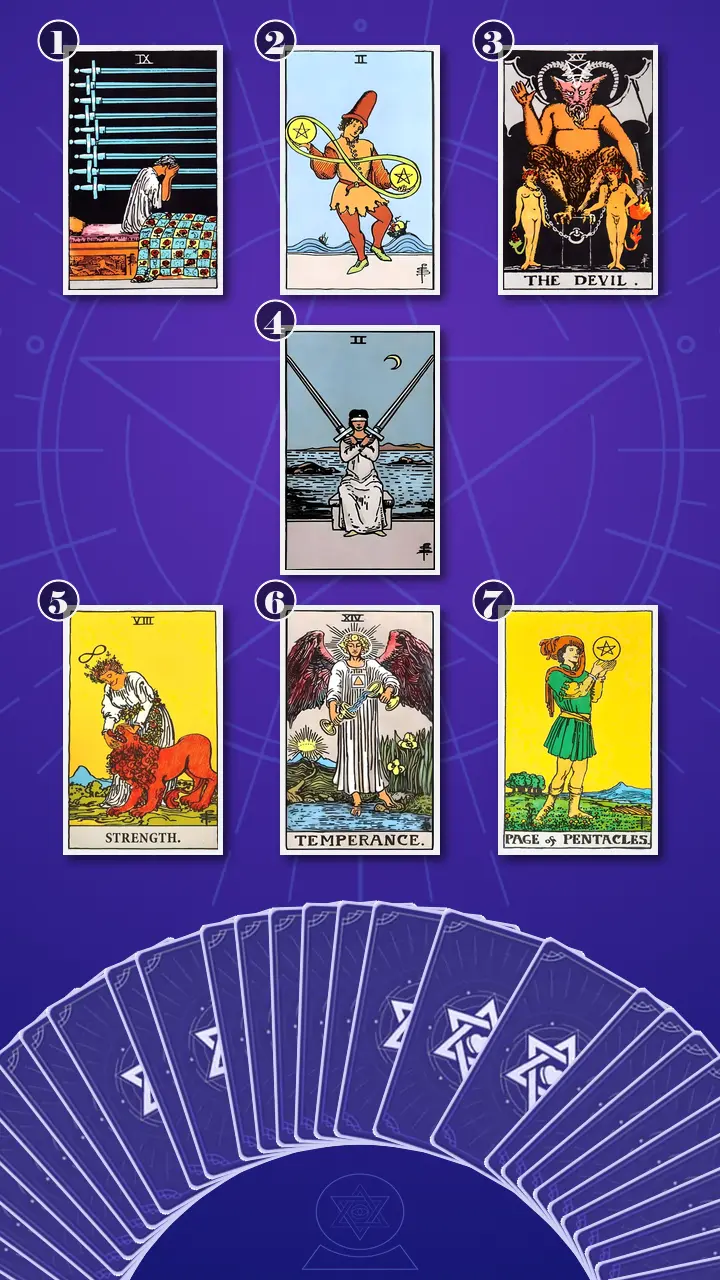
Reading the Dashboard: A Tarot Spread for Work–Money–Dating Alignment
Position 1: Surface symptom — what Sunday scaries look like in real time
“Now we turn over the card that represents Surface symptom: how Sunday scaries show up in real time across work, money, and dating behaviors,” I said.
Nine of Swords, upright.
Even before I spoke, Taylor gave a small, almost-laugh—dry, a little bitter. “Yeah,” she said. “That’s… kind of brutal.”
“It can feel personal,” I replied, “but it’s descriptive, not accusatory.” I pointed to the image: someone sitting up in bed, hands to face, the room dark. “This card is the lived experience you described. Late Sunday night, you’re in bed doing the three-app loop—Slack/email, then your bank balance, then a dating app—while your chest feels tight and your stomach won’t settle. You’re not getting new information; you’re trying to buy reassurance.”
Energetically, the Nine of Swords is excess Air—thoughts multiplying faster than reality requires. It’s the mind rehearsing pain in advance, like it’s trying to prevent it. On trading desks, we call it “running scenarios.” Useful in moderation. Torture when you do it at midnight, alone, with no decision attached.
“Think of last Sunday night,” I asked gently, using the spread’s framing. “What was the exact sequence—what app did you open first, second, third—and what did you hope that next refresh would make you feel?”
She swallowed, eyes dropping to the table. “Prepared,” she said. Then, quieter: “In control.”
Position 2: Inner tug-of-war — the juggling act pulling you in different directions
“Now we turn over the card that represents Inner tug-of-war: the juggling act and competing priorities that pull you in different directions,” I said.
Two of Pentacles, upright.
“Monitoring isn’t the same as managing,” I said, because I’ve watched too many brilliant people confuse motion with progress.
I traced the infinity loop around the pentacles. “This is you toggling between your work calendar, a budgeting app, and a dating app like you’re running three departments with one brain. You’re talented at keeping things moving—but the constant switching means you never get the relief of finishing. Balance becomes ‘not dropping anything’ instead of ‘choosing what matters.’”
This is the kind of balance that looks competent from the outside and feels like sprinting between three group chats and answering none of them well—just enough to avoid being “the person who disappeared.”
Here’s the contrast I offered—because the card asked for it: there are two kinds of balance.
One is exhausting balance: switching tabs, juggling, triaging, moving tasks around in Notion/Trello for an hour and calling it progress because it looks organized.
The other is calm balance: choosing one weekly anchor so your attention can actually land.
Taylor exhaled like she’d been holding air since Friday. “So it’s not that I’m failing,” she said. “It’s that I’m… looping.”
“Exactly,” I said. “Adaptive in the short term. Expensive long term.”
Position 3: External pressure — the systems and cultural messages turning life into a scoreboard
“Now we turn over the card that represents External pressure: what systems, expectations, or cultural messages intensify the stress,” I said.
The Devil, upright.
I didn’t soften it, but I didn’t dramatize it either. “This is the scoreboard,” I said plainly. “Responsiveness at work. The number in your savings. The number of matches. Culture whispers that if you’re not optimizing, you’re falling behind.”
The Devil’s chains are loose—always the detail people miss. “Like notifications you technically can turn off,” I said, “but don’t. Because the fear of missing something feels bigger than the cost of constant monitoring.”
Taylor’s reaction came in a quick sequence: her breath paused; her eyes unfocused for half a second like she was watching her own TTC reflection over the blur of the city; then her jaw set, not with shame—more like anger, clean and brief.
“I hate how… measurable everything feels,” she admitted. “Like my bank balance is a moral report card.”
“That’s the Devil’s favorite trick,” I said. “Making metrics feel like worth.” I let the question land without moralizing. “Who benefits when you stay in refresh mode?”
She gave a tiny shrug that meant: not me. And also: okay, I see it.
Position 4: Core blockage — the stuck point keeping all three areas out of sync
“Now we turn over the card that represents Core blockage: the key stuck point that keeps the three areas out of sync,” I said.
Two of Swords, upright.
“Indecision is a boundary you didn’t know you set,” I said, and Taylor flinched—not defensively, more like it hit a tender spot she’d been protecting.
I described the modern version exactly as it shows up: the frozen draft scene. The phone screen dimming on an unsent text. Slack muted instead of answered. Budget categories left unopened because choosing one rule means admitting you can’t control every outcome.
Then I offered the split-screen inner monologue I hear constantly in high-pressure, early-career clients:
If I choose work, I fail at dating.
If I choose dating, I’m irresponsible.
If I choose money, I’m boring.
“This card isn’t about you not trying,” I said. “It’s about you protecting yourself by not choosing—because choosing means risking regret or disappointing someone. Even you.”
The blindfold is protection. The crossed swords at the chest are the cost: a held breath that never fully releases. And when you don’t choose, work, money, and dating each try to take the whole stage—so Sunday becomes the collision.
I asked the position’s direct question: “What decision or boundary have you been postponing because it would force you to disappoint someone or risk being ‘wrong’?”
Taylor stared at the Two of Swords for a long beat. Her fingers curled, then relaxed. “I don’t have a Sunday cutoff,” she said. “And I keep my dating texts vague. ‘Maybe.’ ‘This week is nuts.’ Because if I say what I want, it’s… real.”
“That’s the Gatekeeper archetype,” I said softly. “It keeps you safe from overwhelm—and it also blocks intimacy and direction.”
Position 5: Available resource — support you can access without perfect circumstances
“Now we turn over the card that represents Available resource: a strength, value, or support you can access without needing perfect circumstances,” I said.
Strength, upright.
Strength is the moment the reading stops being about pressure and starts being about capability. I pointed to the gentle hand on the lion. “Your real resource is calm, kind self-control,” I told her. “The ability to feel Sunday dread without letting it run the whole night.”
In my old Wall Street life, people thought control meant intensity—more hours, more vigilance, more caffeine. But the best risk managers weren’t frantic. They were steady. They had a nervous system that could hold uncertainty without escalating.
“This card says: instead of forcing yourself into more planning,” I continued, “practice a gentler form of control—closing the laptop at a planned time, breathing through the discomfort, and trusting you can handle Monday without constant surveillance.”
Taylor’s shoulders dropped a millimeter. Not a cure. A sign of space.
Position 6: Key shift — the reframe that creates real alignment (Key Card)
“Now we turn over the card that represents Key shift: the most important reframe that creates alignment between work, money, and dating,” I said. “This is the bridge.”
The room got quieter in that very specific way it does when someone stops performing competence and starts listening for truth.
Temperance, upright.
Setup (the loop you’ve been stuck in): It’s Sunday night, your phone is warm from refreshes, and you’re chasing that one feeling—certainty—by checking work, money, and dating like they’re all due at once. You’re trying to make Monday safer by thinking harder, but the thinking just multiplies the tabs.
Delivery (the sentence that changes the pattern):
Stop chasing extremes and constant optimization; start blending your priorities on purpose, like Temperance pouring between two cups.
I let it sit there, un-rushed. You can’t speed-run a nervous system into trust.
Reinforcement (what I watched happen in her body): Taylor went still—first a freeze, like her whole system paused to check if it was safe to believe that sentence. Her eyes widened just slightly. Then her gaze softened, drifting to the card’s image: one foot on land, one foot in water, liquid moving in a measured stream between two cups. Her throat moved in a swallow that looked like letting something go down for the first time.
Her hands, which had been clasped tight, unclenched. A breath left her—not dramatic, more like the quiet release you feel when you finally close a laptop that’s been overheating all day. And then there was a flicker of vulnerability right after the relief, that tiny dizzy edge of, Wait—if I stop optimizing, what am I without the effort?
That’s where I brought in my own diagnostic framework—my Transition Roadmapping, the same structure I used when I watched companies prepare for IPOs: not by doing everything at once, but by building a rhythm that investors could trust. “Temperance is basically saying you don’t need a perfect life upgrade,” I told her. “You need a repeatable operating cadence. A weekly rhythm that makes outcomes more likely because your system is predictable—in the best way.”
Then I translated it into her actual life dashboard: “Work, money, dating each get a measured pour. None of them gets your whole nervous system. You’re not ‘choosing one forever.’ You’re choosing sequence and ending.”
I said the line I wanted her to keep: “Alignment isn’t a life upgrade—it’s a rhythm you can repeat.”
And I asked the question that turns insight into memory: “Now, with this new lens—can you think of a moment last week when this would’ve changed how you felt?”
She blinked fast, like she was trying not to cry and also trying not to make it a big deal. “Thursday,” she said. “I got a date invite, and I didn’t answer for two days because I was waiting to see how work would go. I thought I was being responsible. I was just… scared.”
“That’s the shift,” I said. “From Sunday dread and constant monitoring to cautious confidence built from follow-through. Temperance doesn’t ask you to be fearless. It asks you to be intentional.”
Position 7: Next-step landing — the low-drama action that syncs your week
“Now we turn over the card that represents Next-step landing: the most practical, low-drama action that syncs your week in the next seven days,” I said.
Page of Pentacles, upright.
“This is the Apprentice,” I told her. “Not flashy. Not perfect. Just consistent.”
I gave her the modern translation: “You stop trying to fix your whole life in one evening and choose one tangible anchor for the next seven days—one money action you can complete, one work clarity you can hold, or one dating step with a clear boundary. You track completion, not perfection, and let that create trust.”
Then I said it the way a good habit needs to be said—like a pledge, not a punishment: “One week. One anchor. Completion over perfection.”
From Monitoring to Managing: Actionable Next Steps for Sunday Night Anxiety
Here’s the story the full spread told—clean and connected.
The Nine of Swords showed the symptom: Sunday night becomes a mental emergency drill, stealing sleep and peace. The Two of Pentacles explained why: you juggle work, money, and dating in the same hour, mistaking constant switching for stability. The Devil named the outside amplifier: hustle culture, comparison fatigue, and app-driven metrics that blur into a single scoreboard of worth. At the center, the Two of Swords revealed the real constraint: you avoid choosing a boundary, so nothing feels truly decided—your priorities stay in draft mode. Strength offered the resource: nervous-system steadiness, a kinder control that ends the spiral without self-attack. And Temperance delivered the transformation direction: integration through a repeatable rhythm. Finally, the Page of Pentacles grounded it: one small commitment you can actually keep for seven days.
The cognitive blind spot was simple and sneaky: Taylor believed more monitoring would create more safety. But the spread showed the opposite—monitoring was feeding the loop. The transformation direction was the key shift: from trying to optimize every domain at the same time to choosing one stabilizing rhythm and letting alignment come from consistency.
So I gave Taylor a plan that matched Temperance and Page of Pentacles: small, time-boxed, end-on-purpose. Not a full life overhaul.
- The Sunday Time-Box Trio (20/20/20)On Sunday evening, set three separate timers: 20 minutes Work (pick Monday’s top 1 task + confirm your first meeting), 20 minutes Money (do one concrete action like paying one bill or transferring a set amount), and 20 minutes Dating (send one intentional message OR schedule one date OR take the app off your home screen for the night). When each timer ends, you stop on purpose.If 20 minutes feels too activating, do 10/10/10. Define “urgent” in advance (a direct call/text from your manager, not a Slack channel update) so your brain can’t argue forever.
- The “No More Tabs” CutoffSet an alarm labeled “No more tabs.” When it goes off, physically close the laptop and put your phone on the charger across the room for 30 minutes. Your only job in that 30 minutes is to let your body come down—shower, stretch, read two pages, anything non-screen.Expect discomfort. The win condition is not “I felt calm.” It’s “I ended the checking ritual on purpose.” If anxiety spikes, do five slow exhales (longer out than in) and keep the ending anyway.
- Two-of-Swords Unblindfold (one sentence boundary)Write one boundary as a sentence you could actually say: “I don’t check Slack after 8 p.m. on Sundays.” or “I can do Tuesday or Thursday—tell me what works.” Put it in your Notes app and read it once before you open any apps on Sunday night.If your brain says, “But what if something urgent comes in?” answer it like a systems person: create an exception rule (direct call/text only). Everything else can wait 12 hours.
As a small add-on—because my old life taught me how much mornings matter—I suggested she borrow my Trading Floor Opening Simulation on Monday: ninety seconds of posture, voice, and breath before she opens Slack. Not to “hype” herself up, but to signal to her body: I’m choosing readiness, not panic-prep.

A Week Later: The Quiet Proof
The following Sunday, Taylor didn’t message me an essay. She sent one screenshot: her alarm that read “No more tabs.” Under it, one line: “I did 10/10/10. I slept.”
She told me she’d answered the date invite with a clear, simple message—Tuesday or Thursday. No apology. No vague “maybe.” She still felt a wobble afterward, staring at her sent text like it was a performance review. Then she made tea, put her phone on the charger across the room, and let the night be a night.
It wasn’t a perfect week. She still woke Monday with that first thought—What if I’m behind? But this time, she noticed it, exhaled, and didn’t reach for three apps like they were oxygen.
That’s what a real Journey to Clarity looks like in practice: not certainty, but ownership. Not a total upgrade, but a rhythm you can repeat.
When Sunday night turns into you checking work, money, and dating like they’re one combined scoreboard, it makes sense that your chest tightens—because you’re trying to prove you’re in control before Monday even arrives.
If alignment didn’t mean ‘fixing your whole life’ but just choosing one rhythm you can repeat this week, what’s the smallest boundary you’d want to try on for Sunday night?