From Subscription Creep to a Clean Boundary: Rebalancing Without Spreadsheets

Finding Clarity in the 9:47 p.m. Scroll
If you’re a late-20s city professional who keeps telling yourself you’ll ‘cancel after this week’—and then a renewal hits and you get that tight-chest “how did my budget get like this?” moment… welcome to subscription creep.
Taylor (name changed for privacy) sat down across from me in their Toronto condo living room with the kind of careful posture people take when they’re bracing for bad news. It was 9:47 PM on a Sunday—finance admin o’clock, a close cousin of the Sunday Scaries. Their laptop was open on the coffee table, and their phone kept warming their palm the way it does when you’ve been staring at one screen too long. A half-cold tea sweated onto a coaster. The charger brick buzzed faintly, like a trapped fly. A Presto card and a couple loose coins sat near the TV remote as if they’d been dropped there mid-thought.
They flipped between their banking app and three “Manage Subscription” pages, taking one more screenshot “for comparison.” When they scrolled past two renewals landing on the same day, I watched their chest tighten—small, but unmistakable—like a seatbelt snapping into place a second before impact.
“It’s not that expensive,” they said, voice flat in that way that’s trying to be reasonable. “But why do I feel broke anyway? I keep meaning to cancel and then the charge just… happens.”
I let a beat of silence do its work. “So the surface problem is the renewals,” I said. “But underneath, it’s the feeling that your budget is being decided by defaults. And then there’s that fear—if you cut the wrong thing, life gets smaller, or it proves you ‘can’t manage.’”
They nodded, then exhaled like they’d been holding air in their ribs all day. The stress around their subscriptions wasn’t loud. It was syrupy—like trying to move through thick grey honey while your phone keeps buzzing, and every buzz says, decide now.
“Let’s not make this a moral thing,” I told them. “We’re not here to shame you into a joyless spreadsheet. We’re here to find clarity—one clean next step that gives you breathing room.”

Choosing the Compass: The Horseshoe Spread for Subscription Renewals
I asked Taylor to put the phone face-down for a moment and take one slow breath in, then a longer breath out—not as ceremony, but as a hinge. A nervous system needs a threshold between spiraling and choosing.
“Today, we’ll use the Horseshoe Spread · Context Edition,” I said, sliding the deck between my palms the way I’d been taught on nights when Highland wind rattled old windowpanes. “It’s practical. It shows the loop and the lever.”
For you, reading along: this spread is ideal for problems that look like logistics—recurring expenses, money stress, decision fatigue—but have a psychological mechanism underneath. The horseshoe’s arc helps us track how a pattern formed, where it’s stuck, and what single move breaks autopilot. It’s less “predict your future,” more “see your system clearly.”
“We’ll start with what normalized the pattern,” I said, “then look at the present imbalance. The top card is the obstacle—the story that makes this feel harder than it is. And at the end, we land on one next step: a boundary you can actually do this week.”
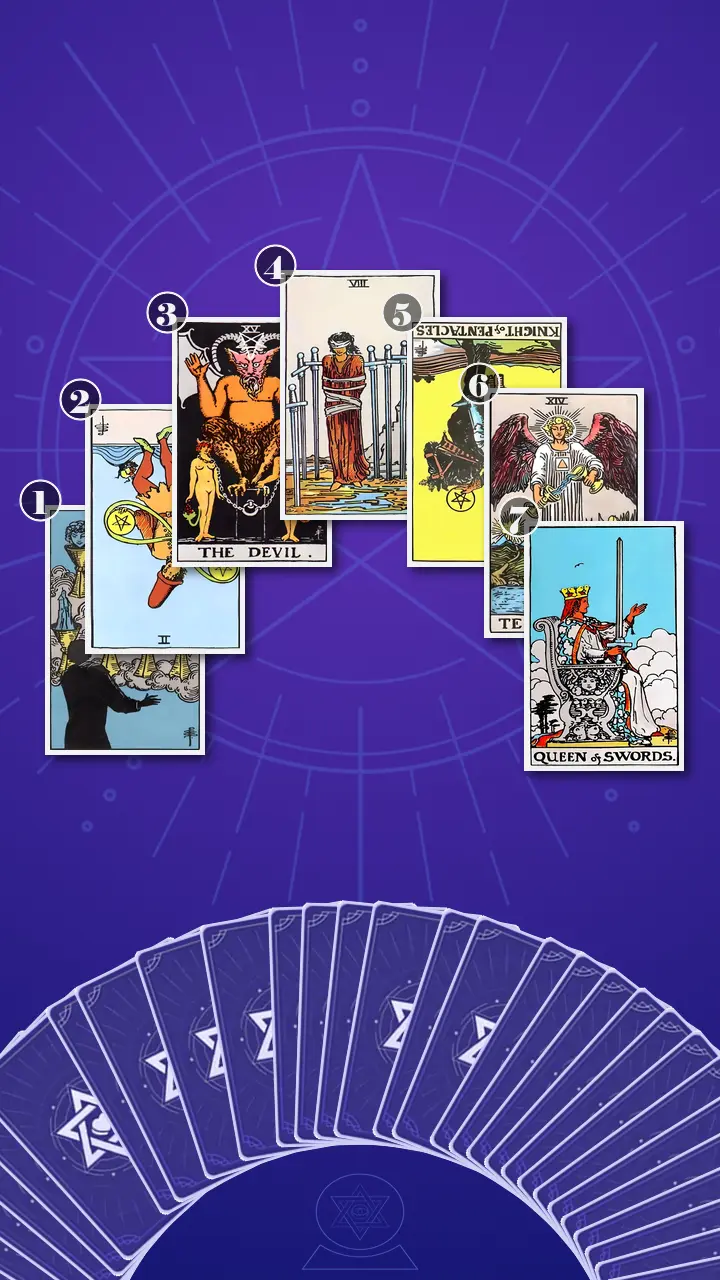
Reading the Map: From Option-Fog to a Better Default
Position 1 (Past influences): Seven of Cups, upright
“Now the card we turn is representing Past influences that normalized the current subscription pattern (how ‘options’ accumulated),” I said. “Seven of Cups, upright.”
The image always feels like a screen full of possibilities—beautiful, unreal, and strangely exhausting. “Here’s the lived translation,” I told Taylor, making it plain on purpose: “A year of busy seasons made ‘just try it’ feel harmless: a fitness trial for motivation, a productivity app for control, a streaming add-on for decompression, a meal-planning tool for the weeks you’re slammed. Now it’s Sunday night, and you’re staring at all these shiny options like they’re identities—‘organized me,’ ‘healthy me,’ ‘relaxed me’—and you can’t pick what’s real because every cup promises a different future.”
“That’s… brutal,” Taylor said, and then they let out a short laugh that had a bitter edge. “Like—yeah. I’m subscribed to potential.”
“Exactly,” I said gently. “In this position, the Seven of Cups isn’t calling you reckless. It’s naming the dreamy scroll montage: free trials, bundles, ‘upgrade to premium,’ each one offering a slightly better life. The energy here is excess—too many cups, too many futures. Not because you’re weak, but because modern systems are built to sell you a self.”
They stared at the card with something that looked like self-compassion arriving late, carrying groceries. Their shoulders dropped a millimeter.
Position 2 (Present imbalance): Two of Pentacles, reversed
“Now the card we turn is representing Present-day imbalance snapshot: what the renewals are showing you right now in behavior and bandwidth,” I said. “Two of Pentacles, reversed.”
I watched their mouth tighten before I even explained it. The body recognizes its own patterns faster than the mind does.
“This is the reality check,” I said, and I used the translation as promised: “You’re trying to keep everything in the air: renewals on different dates, a couple annual plans, one random ‘trial ends tomorrow.’ Your brain turns into a rolling spreadsheet while your life keeps moving. You tweak a tier here, chase a promo there, maybe shift a renewal date—yet nothing feels lighter. It’s not that you can’t do the math; it’s that the constant micro-decisions are draining your bandwidth.”
“Yep,” Taylor said immediately, and then—almost against their will—they did the move I see all the time: thumb mimed a scroll, then an invisible tap to close the app. Like hitting snooze on a fire alarm. The alarm still exists; you just bought ten minutes of pretend-silence.
“The energy is blocked,” I said. “Two of Pentacles wants flexible juggling. Reversed, the juggling tips into stress. You’re being responsible in the way that looks responsible—checking, tweaking, optimizing—but it’s not being effective because the total load doesn’t come down.”
Position 3 (Hidden driver): The Devil, upright
“Now the card we turn is representing Hidden driver: the attachment, comfort loop, or autopilot mechanism keeping renewals in place,” I said. “The Devil, upright.”
Taylor made a face—half amused, half caught. “Oh no.”
“Not ‘oh no’ as in doom,” I said, and I meant it. “More like: oh. Here’s the mechanism.” Then I grounded it in modern life the way I always do: “Auto-renew is the quiet contract: your card stays saved, the cancel path has extra steps, and convenience starts feeling like a personality trait you can’t give up. The real hook isn’t always the content—it’s the comfort of feeling ‘set up’ during demanding weeks. Cutting a subscription can feel like cutting a version of you that had it together.”
Taylor’s laugh this time was smaller. Uncomfortable. “Wait… it’s not even about the app.”
“If autopay is deciding for you, the stress makes sense,” I said. “The Devil is an autopilot contract—a little agreement you forgot you signed. In the Highlands we used to tell stories about bargains made at the wrong crossroads. Not because people were foolish, but because they were tired, cold, and promised relief.”
I tapped the chain in the image. “And notice something important: the chains are loose. The energy here is attachment, not imprisonment. Once you see what feeling you’re buying—ease, distraction, identity, ‘future-me insurance’—you can choose differently.”
Position 4 (Core obstacle): Eight of Swords, upright
“Now the card we turn is representing Core obstacle: the mindset or perception that makes rebalancing feel harder than it is,” I said. “Eight of Swords, upright.”
As I set it down, a shadow from the condo blinds fell across the table—thin stripes of darkness, like the card had reached up and pulled the room into its own image. Environment loves to collaborate with truth.
I used the translation, plain and practical: “You tell yourself the renewals are too tangled to fix, so you deal with them one-by-one when they pop up. But the ‘trap’ is partly the scattered visibility: when you never see the full list, your mind inflates the problem. The moment you put every subscription in one place, you realize you’re not locked in—you were just trying to navigate with your eyes closed.”
Then I linked it back to the Two of Pentacles reversed, because the loop matters: “Transaction scroll → close app,” I said, “is the Eight of Swords blindfold. And the ‘I just need to… check one more thing → and then I’ll… decide → but first…’ is the Two of Pentacles trying to juggle its way out.”
Taylor gave me exactly what this moment usually asks for: a quiet exhale, then a grim little nod. “I do that. I tell myself I can’t fix it right now, but… I’m literally holding the phone.”
“Responsible versus effective,” I said, not scolding—just naming. “Your mind is trying to avoid the discomfort of a final click by turning it into a research project.”
Position 5 (Your stance): Knight of Pentacles, reversed
“Now the card we turn is representing Your current stance: the habit of response you default to when you try to ‘be responsible’ about it,” I said. “Knight of Pentacles, reversed.”
“This is the ‘admin day someday’ fantasy,” I said, and again I anchored it in the provided scenario: “You keep promising a future you will handle it properly: an organized evening, a full spreadsheet, a ‘clean plan.’ In the meantime, you do small responsible-looking tasks—read the cancellation policy, compare tiers, move a renewal date—without ever making the final call. It’s maintenance mode disguised as diligence.”
The energy here is deficiency in motion—a steadiness that has tipped into inertia. “It’s not laziness,” I added. “It’s fear wearing a sensible blazer.”
Taylor’s eyes flicked to their laptop, where a Notion tab was open—an empty list titled “Subscriptions.” They winced, like the tab itself had called them out.
Position 6 (Stabilizing principle): Temperance, upright
“Now the card we turn is representing What rebalance looks like if you follow through: the stabilizing principle to aim for,” I said. “Temperance, upright.”
Temperance always feels like a quieter kind of competence—the kind you can actually live with. “Here’s the modern translation,” I said, letting it land: “Rebalance looks like a curated mix: a few subscriptions that genuinely support your real week, a cap you can live with, and a rhythm that stops surprise charges from hijacking your mood. You’re not trying to become a spreadsheet person—you’re building a steady flow where your money supports your life without constant friction.”
“A mix,” Taylor said softly. “Not a purge.”
“Yes,” I said. “The energy here is balance—ratio language, not punishment. Like meal prep that fits your actual schedule, not a fantasy week when you somehow have time to be a different person.”
Position 7 (Next step): Queen of Swords, upright
The room felt quieter as I reached for the final card, as if even the charger’s buzz decided to hush. “Now,” I said, “we turn the card that represents Next step: one concrete boundary-setting action that starts the shift this week.”
“Queen of Swords, upright.”
I gave Taylor the translation exactly where it belongs—in the body, not in a textbook: “You open the list, pick one renewal that’s coming up, and cancel it without negotiating with yourself. Then you write one rule—simple enough to follow when you’re tired—like: ‘If I didn’t use it in the last 14 days, it doesn’t auto-renew.’ You’re not proving discipline; you’re choosing a default that protects your future bandwidth.”
Taylor’s face tightened, and the unexpected reaction surfaced—sharp, defensive, real. “But if I do that,” they said, “doesn’t it mean I’ve been doing it wrong this whole time? Like… I should’ve been able to handle something this basic.”
I kept my voice calm. “No,” I said. “It means you’ve been navigating a system designed to keep you opted in, while you were tired. The Queen of Swords isn’t a punishment. She’s protection. Clarity isn’t harsh. Clarity is protective.”
And then—because this is where my Nature Empathy Technique becomes more than a pretty metaphor—I leaned in a little. “In late winter,” I said, “we prune. Not because we hate the plant. Because if we don’t cut what’s draining the tree, spring growth arrives thin and frantic. The Queen’s sword is winter pruning: one clean cut that lets your energy come back into the trunk.”
Setup: Taylor was stuck in the Sunday-night moment—bank app open, three ‘Manage Subscription’ tabs up, screenshotting prices like they were building a case—then closing everything because choosing one thing to cancel felt weirdly high-stakes. They wanted the perfect budget to save them from the discomfort of choosing.
Delivery:
Not more juggling—one clean cut, like the Queen of Swords raising the blade and ending the autopay loop.
Reinforcement: The sentence didn’t make Taylor instantly joyful. It made them still. First, their breathing stopped for half a second—like a browser freezing mid-scroll. Then their eyes unfocused, as if they were replaying every “I’ll cancel after I compare everything one more time” from the last six months. Finally, the air left their chest in a slow, shaky exhale. Their shoulders dropped, not dramatically, but with the unmistakable relief of a muscle that has been bracing for impact on repeat.
They swallowed. “Okay,” they said, and their voice sounded clearer than it had five minutes ago. “One thing. I can do one thing.”
“Good,” I said. “And we’ll make it small enough that your nervous system doesn’t revolt.” I offered a simple protective frame—one of my old family habits, modernized: “Before you click, take three slow breaths and listen. Not to your thoughts—just to the room. The fridge hum. The distant traffic. The tiny sounds that prove you’re safe while you choose.”
I paused, then asked the question that turns insight into lived memory: “Now, with this new lens—when did you feel this most last week? Was there a moment a renewal hit, and this one clean boundary would’ve changed how your body felt?”
Taylor didn’t answer immediately. They glanced at their phone, then back to me. “Tuesday on the TTC,” they said. “Bank alert. I did the mental math between stops. I opened ‘Manage Subscription’ and closed it. I remember my shoulders literally creeping up.”
“That’s the shift,” I said. “From braced stress and decision fatigue… toward calm self-trust built through one clear boundary. Not a perfect plan. A better default.”
The One Clean Cut Rule: Actionable Next Steps That Don’t Require a Perfect Budget
I gathered the arc of the reading into one simple story, because clarity is partly about hearing your own life spoken back without shame: “You said yes to options during high-stress seasons because each promised a better you (Seven of Cups). Now the renewals are landing like clustered raindrops and you’re trying to juggle them with constant micro-optimizing (Two of Pentacles reversed). Underneath, there’s an autopilot contract—comfort and identity—keeping you opted in (The Devil). The obstacle is the blindfold story that you can’t face the whole list without spiraling (Eight of Swords), and the attitude is ‘I’ll handle it on a future admin day’ (Knight of Pentacles reversed). Temperance says rebalance is a sustainable mix. And the Queen of Swords says the next step is one clean boundary that ends the loop.”
“Your cognitive blind spot,” I told Taylor, “is thinking you need more information before you can choose. But what you actually need is a boundary—a simple rule that protects you when you’re tired.”
“Transformation direction,” I said, “is moving from optimizing every subscription decision to making one clean cut, one decisive rule, and letting the system do the work.”
- Write the 14-Day Rule (your new default)Open your Notes app and write one line: “I only keep subscriptions I used in the last 14 days.” Screenshot it so it’s one swipe away when the bargaining voice shows up.Expect the “but what if I need it next month?” voice. It’s not a sign you’re wrong—it’s your brain protecting comfort. Read the screenshot once, then don’t renegotiate.
- Do the 10-minute “Queen of Swords Cut” (one subscription only)Open your banking app or subscription list. Pick ONE subscription that renews within the next 7 days. Set a 3-minute timer, cancel or switch to the free/paused plan, then close the tab when the timer ends.If anxiety spikes, take three slow breaths and do a 60-second walking pause while listening to environmental sounds (traffic, radiator, hallway footsteps). The win is the boundary—not finishing everything today.
- Create one calm review rhythm (15 minutes monthly)Put a recurring calendar event on the same day every month: “Subscriptions: 15-minute check.” This is visibility, not a full budget overhaul.Pair it with a 3-minute bedtime energy review on the night before: “What felt draining today? What felt supportive?” It makes the money admin feel like self-trust, not punishment.

A Week Later: Quiet Proof, Not Perfection
A week after our session, Taylor messaged me a screenshot. It wasn’t dramatic. Just a single confirmation screen: one subscription canceled, renewal avoided. “I did it on a timer,” they wrote. “My chest did the tight thing, and I still clicked.”
The bittersweet part was in the next line: “I didn’t even celebrate. I just sat at my kitchen counter for a minute, kind of… stunned. But the space in my head is real.”
I thought of Temperance pouring carefully between two cups, and of winter pruning—how a tree looks briefly barer after the cut, even though that bareness is what makes spring possible.
When renewals hit, it’s not just the money—it’s that tight, braced feeling of realizing your life is being decided by defaults you didn’t actively choose, and the fear that one wrong cut will prove you were never in control to begin with.
If you trusted that one small, clean boundary could be kinder than endless optimizing, what’s the single subscription you’d be willing to test-cancel for seven days—just to see how much space comes back?