From Late-Text Anxiety to Reciprocity: Leaving Backup-Friend Mode

The Friday-Night Ping That Tilted the Room
If a Friday-night 'you around?' text can tilt your whole evening before you even unlock the screen, I already know the shape of the wound. Jordan (name changed for privacy) came in from a wet Toronto night, rain still on her coat, her phone face-up on my table like it had already started the argument. The heater clicked, a streetcar hissed outside, and every time the screen lit up her thumb hovered over it before she even opened the message.
'I want friendships that feel mutual,' she said, 'but the second a late text lands, I turn into the easy yes.' Her anxiety felt like a seatbelt locking across her chest while the car was still parked — small, mechanical, and suddenly impossible to ignore. I told her I wanted to map the fog, because the point was not to blame the message; it was to see where the story began and where the facts actually ended. A fast reply is not a free yes.

Choosing the Relationship Spread
I asked Jordan to put the phone face down, take one slow breath, and let the question sit without performing for it. Then I shuffled until the room felt quieter, because for a one-sided friendship that keeps presenting itself as casual timing, I wanted a spread that could show the whole loop, not just the last text in isolation.
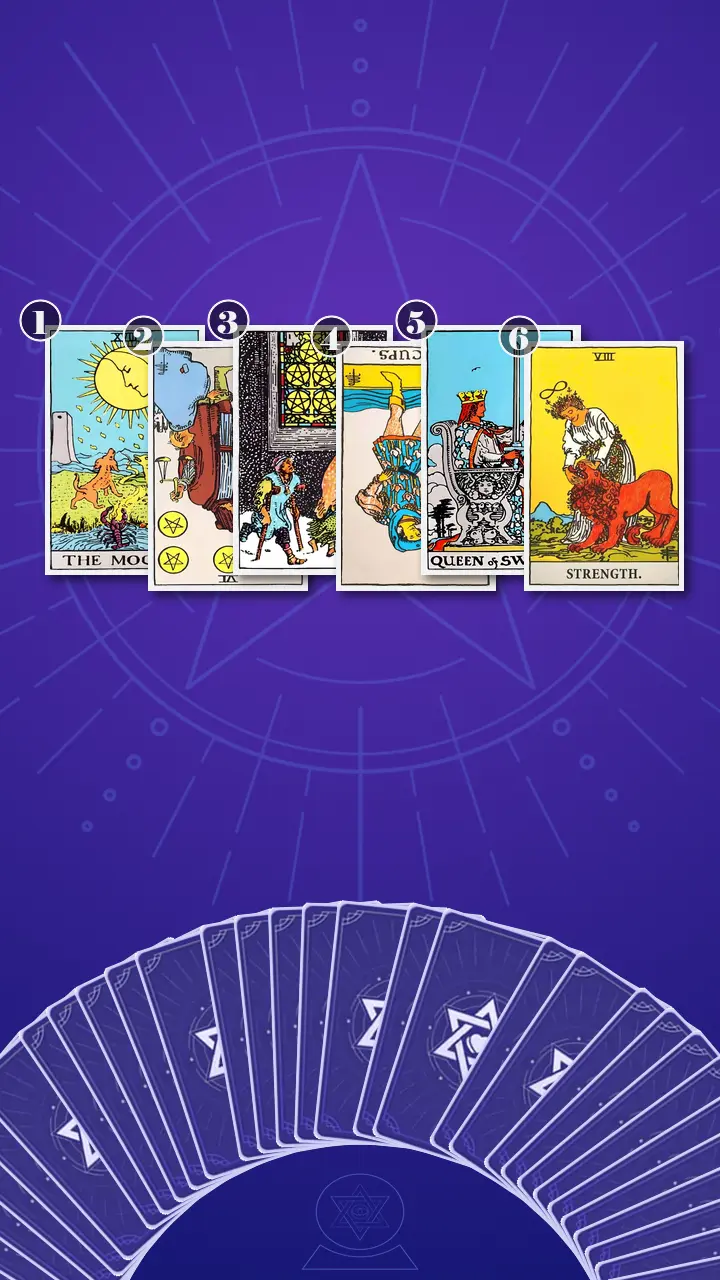
I used the Relationship Spread · Context Edition. This is how tarot works here: it turns a live pattern into visible steps, so the reply is no longer just a feeling in your chest. A six-card line is enough to show the trigger, the reflex, the belonging fear, the exchange pattern, the boundary pivot, and the new stance without drowning the issue in extra symbols.
The first three cards would show the fog and the old reflex. The fifth card would mark the turn in the road. And the sixth would show what steady, warm self-respect looks like once the dust settles.
The Moon on a Phone Screen
Position 1 — The Story Your Body Writes First
Now I turned over the card for the immediate trigger, and it was The Moon, upright. The modern-life image was almost too on the nose: a vague 'are you around?' text on a train ride home, the screen glowing in the dark while the mind starts filling in blanks before there are facts.
The Moon here is not saying the friend is hiding some dramatic secret. It is showing excess projection: the nervous system takes a small message and builds a whole movie around it. The path is half-lit, so the body starts scanning for danger, and then the scan becomes the story. In practice, that means timing, punctuation, and even the absence of an emoji start to feel loaded.
A fast reply is not a free yes, and The Moon is what makes it feel like one. My old market brain always notices this kind of thing. On a trading desk, a rumor can move faster than a report; in a nervous system, fear can do the same. The Moon is the rumor phase of the heart.
Jordan gave a short, bitter laugh and looked down at the card. 'That is... annoyingly accurate,' she said, and then went quiet, thumb rubbing the side of her phone as if she could smooth the message flat. I could almost hear the subway rhythm in the room.
The Social Tax That Keeps Coming Back
Position 2 — The Habit Loop
The second card, for the automatic response, was Six of Pentacles reversed. In everyday language, it is the friend who only makes time when their original plan falls through, the group chat where you are the one who keeps moving dinner, and the social tax that always seems to come out of your pocket first.
Reversed, the energy is an excess of giving that stops feeling like generosity and starts feeling like compliance. The scales are still there, but they are tipping in the same direction every time. In Jordan's pattern, the quick yes buys a tiny burst of relief, because it keeps the connection from feeling awkward for another night. The cost comes later, when she realizes her plans were the only ones that moved.
She tucked her chin slightly, and I saw the jaw set. 'Yeah,' she said. 'I hate how fast I become available when the message is casual.' That small, resentful laugh was the first sign that the pattern had started to name itself.
The Warm Cafe You Think You Might Be Locked Out Of
Position 3 — The Belonging Fear
Five of Pentacles upright is the deeper sting. It is the thought that if you do not answer fast, you will be the person standing outside the warm cafe, watching the door close while everyone else keeps talking under the lights.
That is why the boundary feels bigger than a boundary. It is not just 'Can I make it tonight?' It is 'If I say no, will they remember me less?' The fear is exclusion, scarcity, the old ache of being on the sidewalk while the life you want is happening just behind glass.
Jordan's shoulders rose a notch. She stared at the card for a long second, then exhaled through her nose. 'If I make it too hard, they will just stop asking,' she said, and for a moment the room felt colder, as if the window had opened a crack.
The Friendly Message That Still Leaves You On Call
Position 4 — The Shape of the Exchange
The fourth card was Page of Cups reversed, and it described the interaction itself: a voice note full of feeling and zero specifics, a heart emoji where an actual plan should be, a soft-launch friendship stuck in draft mode.
Reversed, the Page has softness without structure. The invitation feels sweet, but it is too vague to be solid. That is how someone can keep you emotionally available without offering enough clarity for you to feel safe. It is tender contact with no container.
I asked Jordan, 'Do you feel invited into real connection, or kept on standby?' She made a face that was half rueful, half offended, then said, 'That is exactly it. Pleasant, but weirdly load-bearing.' There it was: the tone was kind, but the shape was not.
When the Sword Cut Through the Fog
Position 5 — The Boundary Pivot
When I turned over the fifth card, the room went noticeably still. Jordan had been sitting in the kind of polite tension that tries to make itself small; her hands were folded, then unfolded, then folded again, like she was trying to decide whether a clear line would cost her the whole connection.
My Network ROI Analytics lens kicked in immediately. I do not mean that I reduce friendship to a spreadsheet; I mean I notice when a connection keeps asking for high output and returning low yield. If every late text pulls you into instant availability, rearranged plans, and quiet resentment, while the other person keeps offering only convenience, the ledger is already telling the truth.
You do not need to be instantly available to stay important; the Queen of Swords asks you to answer with clear limits and clean language instead of automatic yeses.
I let that line hang there for a beat.
You can care about someone without making yourself instantly available.
At first, she did not relax. She went still, then her eyes flicked to the sword, then to her phone, as if checking whether the screen had secretly changed shape. Her jaw held for a second, then released. I watched the shoulders that had been riding up near her ears drop one notch, then another, and the hand around the phone loosen its grip. The resistance came first — a quick flash of irritation, almost grief: 'So I have been teaching people I am always available?' she asked. Then the thought landed more cleanly, and the room seemed to make room for it. Her breath went deeper, slower; the next inhale reached the ribs instead of stopping at the throat. She looked a little dizzy, like someone setting down a heavy bag and realizing the floor is still there. That was the shift from hyper-alert, guilt-driven over-accommodation to calm, self-respecting reciprocity. Now, use this new lens to think back: was there a moment last week when this would have changed how you felt?
When Warmth Held Its Shape
Position 6 — The Steadier Body
Strength was the final card, and it did exactly what Strength does when it is working well: it made the boundary feel embodied instead of brittle. The woman and the lion in the image looked less like conquest and more like cooperation — instinct learning it does not have to drive every choice.
The modern-life version is simple: keep Do Not Disturb on for ten minutes, keep your shoulders down, and let the reply come from a body that has caught up with the decision. Warmth does not disappear here; it just stops leaking everywhere.
That is the end point of the reading: not a colder friend, not a harder mouth, but calm, self-respecting reciprocity. The connection no longer runs on urgency. It runs on choice.
The One-Page Reply That Keeps Your Evening Yours
The spread tells one clean story. The Moon shows the fog that lands before the facts; Six of Pentacles reversed shows how the quick yes keeps the exchange uneven; Five of Pentacles names the fear that a boundary will exile you; Page of Cups reversed shows a message that is sweet but unstructured; Queen of Swords gives you the turning point; Strength teaches you how to hold it without hardening.
The blind spot is assuming that flexibility is the same as belonging. It is not. Flexibility without reciprocity turns you into the backup friend, and backup-friend mode always costs more than it looks like it costs. The transformation is from hyper-alert, guilt-driven over-accommodation to calm, self-respecting reciprocity — and that is the beginning of finding clarity.
I gave Jordan three next steps, each small enough to try on a weeknight without turning it into a project.
- The 10-Minute Reply GapWhen a late text lands, put the phone face down for 10 minutes, check your calendar first, then decide whether the ask fits your actual evening.If 10 minutes feels impossible, start with 2. If your palm is buzzing over the screen, treat that as your handshake energy exchange cue to pause, not to rush.
- The Queen of Swords ReplyUse one clear sentence: 'I can't tonight, but I can do Thursday after 7.' If needed, make it a three-beat cocktail party algorithm: acknowledge, name your timing, offer one real option.Trim away apology padding until the line is kind but not slippery. Clear is kinder than slippery.
- The Reciprocity PauseOver the next week, notice who initiates twice in a row and whether the same friend respects a no the way they respect a yes.Do not turn it into surveillance. One or two data points is enough to see the pattern.

A Softer Kind of Proof
Three days later, Jordan sent me a message from a coffee shop near King and Bay: 'I waited ten minutes, checked my calendar, and sent the one-line version.' She added that the reply came back normal, not dramatic, which somehow felt more surprising than praise would have.
A week later she sent the clean reply and sat alone with a cortado while the thread stayed quiet; the relief arrived first, and the tiny ache of not being instantly needed arrived right beside it. That was enough. The phone was still in her hand, but it was no longer steering the night.
That was my read on the whole journey: the ping did not disappear, but it lost its power to rewrite her evening. When a late text lands, your chest tightens and your thumb starts bargaining with the notification, because saying no can feel like risking the one thing you were trying to protect: belonging.
If you gave yourself one extra breath before answering, what would you want that first honest sentence to be?