From Social Auditioning to Steady Self-Trust: Speaking Before You Shrink

Finding Clarity in the 8:47 p.m. Half-Step Back
You’re a 27-year-old NYC marketing/comms girlie who can do one-on-one just fine—until your friend rolls in with their ‘cool’ friends and your whole vibe becomes a tight smile + phone-checking (hello, social comparison spiral).
Taylor (name changed for privacy) said it like she was confessing to a crime she didn’t commit. She’d booked me after another night where she left early, texted “so fun!!” from an Uber, then spent the rest of the ride doing a full post-event replay like it was an internal performance review.
She described a Williamsburg rooftop at 8:47 p.m. on a Thursday: bass thumping up through the deck boards, air that smelled like vape + spilled beer, condensation slick on the plastic cup. Her friend hugged her, then turned and introduced her to two people with perfect posture and “creative” job titles. Taylor’s face went hot, her throat tightened, and she took that half-step toward the edge of the circle—wanting to join, terrified she’d say something that made her look irrelevant.
She looked at me with that particular NYC exhaustion—the kind that’s half sleep debt, half “I’m tired of monitoring myself.”
“I don’t want to compete for attention,” she said. “But I also don’t want to disappear.”
In her body, her insecurity wasn’t an abstract feeling. It was a tight throat and chest, a slightly frozen smile that had to stay “pleasant,” and restless hands that needed something to do—phone, cup, hair tie, anything—like props in a play she didn’t audition for.
I nodded, keeping my voice warm and plain. “We’re not here to make you cooler,” I said. “We’re here to figure out what’s feeding the imposter syndrome when your friend brings their cool friends—and to find one or two next steps you can actually try in real life. Let’s draw a map through the fog, so the night doesn’t keep turning into a trial in your head.”

Choosing the Compass: The Transformation Path Grid
I asked her to take one slow breath—nothing mystical, just a nervous system gear-shift. While I shuffled, I had her hold the question in a single sentence: “What feeds my imposter syndrome when my friend brings their cool friends, and how do I stop shrinking?”
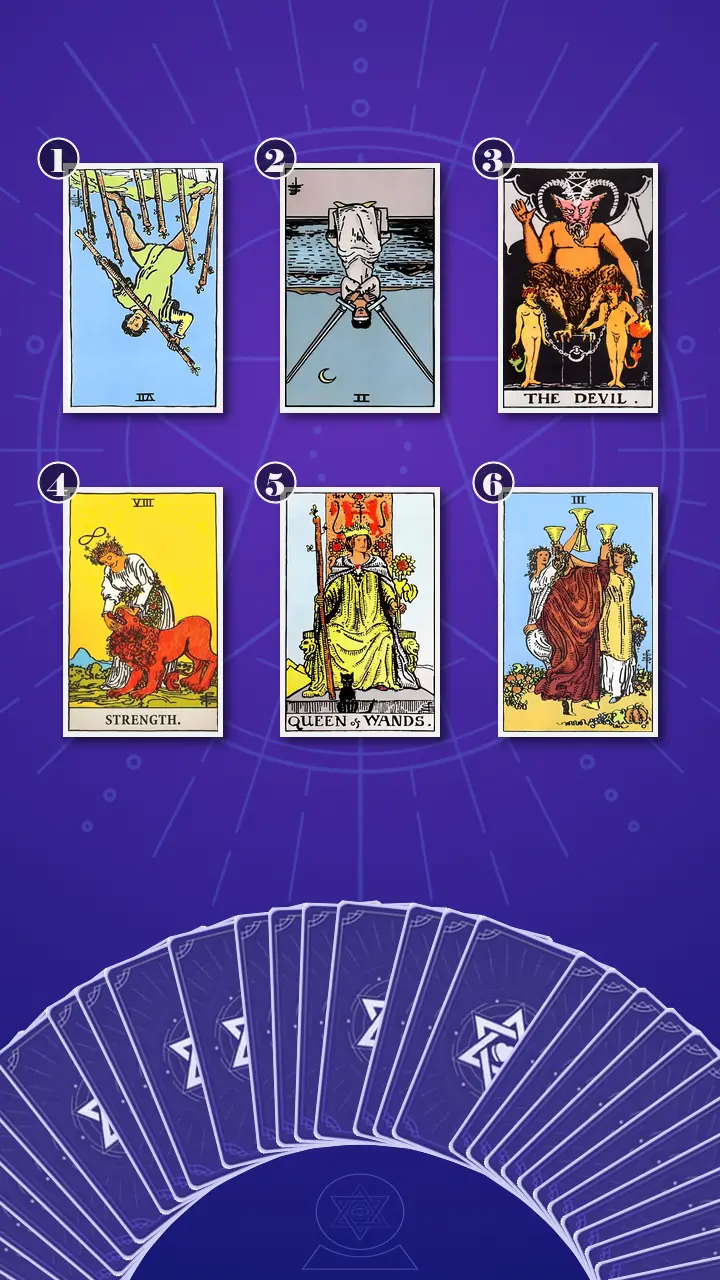
“Today,” I told her, “we’ll use a spread I built for moments like this: Transformation Path Grid (6) · Context Edition.”
For readers who wonder how tarot works in situations like this: this isn’t about predicting whether the party will go well. It’s about mapping an internal loop—trigger → reaction → hidden driver → pivot skill → new behavior → integration. A structured transformation spread is a better fit than a simple relationship mirror because the real problem isn’t the friend or the ‘cool’ people. It’s the pattern that turns their presence into an identity threat.
I traced the grid layout with my finger—two rows, three cards each. “Top row is the problem chain,” I said. “Bottom row is the resolution chain.”
“Card 1 will show your surface reaction in the moment—what you do with your voice and body when the cool friends arrive. Card 3 will reveal the deeper feed—the belief that makes comparison feel dangerous. And card 4 is our turning point—the inner skill that changes the whole system in real time.”
Reading the Map: Where the Spiral Starts
Position 1: The Moment You Step Off Your Own Hill
“Now flipping,” I said, “the card that represents: Surface reaction in the moment—the observable way you shrink, perform, or brace when the ‘cool friends’ arrive.”
Seven of Wands, reversed.
I let her look before I spoke. In the Rider–Waite deck, it’s a figure on uneven ground, holding position. Reversed, the story flips: you give up the high ground before anyone even pushes you.
“This is so specific it almost feels rude,” I said gently. “It’s like you’re at a rooftop birthday in NYC and you were chatting fine—until your friend arrives with their ‘cool’ friends. Your voice drops half an octave, you start talking in unfinished sentences, and you drift to the edge of the group like you’re making space for people who ‘belong’ more.”
Taylor gave a small laugh that had more bitterness than humor. “That’s… yeah. It’s accurate in a way that’s kind of cruel.”
“Reversed Seven of Wands is confidence collapsing under perceived pressure,” I continued. “The energy here is blocked. Fire wants to take up space; reversed Fire steps down. Not because you were defeated—because you pre-surrender. You edit yourself into a background character as a preventative strategy.”
She swallowed, eyes flicking to the side like she was replaying the half-step back. Her hands—without her noticing—tightened around her water glass.
Position 2: Over-Editing in Real Time
“Now flipping the card that represents: What immediately blocks connection—the mental move that keeps you stuck.”
Two of Swords, reversed.
“This is the brain split,” I said. “Someone says something witty and the group moves fast. You’re internally drafting three versions of a reply—smart, funny, effortless—while the conversation keeps going without you. When you finally land on a line, it’s too late, so you decide the safe move is silence.”
I watched her face—her eyes narrowed the way people do when something lands too close to the bone.
“Reversed, this is Air energy leaking everywhere,” I added. “The thinking doesn’t help you connect; it delays you until there’s no moment left. And here’s the line I want you to remember: Over-editing is just fear wearing a smart outfit. It looks like sophistication. It’s actually self-protection.”
She exhaled through her nose—one of those knowing exhales that says, I hate that this is me. Her shoulders softened by a millimeter, not much, but enough to prove her body was listening.
I gave her a clean reflection: “If I say nothing, I can’t be cringe. If I say something, it has to be perfect.”
“Exactly,” she said, voice quieter. “And then I leave with a highlight reel of everyone else and a blooper reel of me.”
Position 3: The Status Contract You Didn’t Mean to Sign
“Now flipping the card that represents: The deeper feed—the hidden belief or attachment that turns social comparison into an identity threat.”
The Devil, upright.
I didn’t dramatize it. I never want The Devil to sound like doom; it’s more like discovering fine print.
“The second you clock someone’s confidence, outfit, or connections, your brain turns it into a verdict: they’re higher-status, so you need to perform,” I said. “You start tracking reactions like metrics—who laughs, who follows up, who looks away. You’re not trying to have fun anymore; you’re trying to avoid being quietly deemed boring.”
Taylor’s mouth tightened as if she didn’t like being seen so clearly. Then she looked down at the card’s chains and said, almost annoyed, “I hate that I care.”
“I get it,” I said. “But caring isn’t the problem. The problem is when you turn caring into a survival plan.”
I tapped the image lightly. “The Devil’s chains are loose. That matters. This isn’t ‘you are trapped.’ This is ‘you keep consenting to a story that makes you act trapped.’ Like a subscription you forgot you signed up for: Premium Belonging—paid monthly in self-censorship and exhaustion.”
Then I let my old life slip in for one restrained second—my inner flashback. “On Wall Street, I used to read contracts for a living,” I said. “Not romantic ones—actual ones. And the thing about contracts is: most of the damage isn’t in the headline. It’s in what you silently accept as ‘standard terms.’ This card is showing me one term you’ve been accepting: If they’re impressed, I’m safe.”
She blinked slowly. The shame in her face shifted into curiosity, like the feeling of finding the exact tab that’s draining your phone battery.
“Can I use a framework I’m known for?” I asked. She nodded.
“I call it Influence Credit Scoring,” I said. “Five tiers, like relationship capital. The Devil shows up when you give strangers—or ‘cool gatekeepers’—an automatic Tier 5 score. You treat their approval like AAA-rated currency. And you treat your own presence like it’s risky stock. But most of those people haven’t earned that score with you. They’re just… well-lit.”
Taylor’s eyebrows lifted. It was a sharp, almost amused recognition. “They came with their own lighting,” she repeated, and this time her laugh had less pain in it.
“Exactly,” I said. “So the work isn’t to become ‘higher status.’ It’s to stop handing out top-tier influence credit to people who haven’t paid for it with real kindness.”
When Strength Spoke: The Inner Lion, the Breath, and the Mic
Position 4 (Key Card): The Turning Point That Changes the Whole System
I could feel the room go quieter, even through the city noise. This was the bridge card—the one that decides whether the story stays a spiral or becomes a path.
“Now flipping,” I said, “the card that represents: The turning point—the inner skill that begins to undo the imposter spiral in real time.”
Strength, upright.
Before I interpreted it, I watched Taylor’s posture. Her shoulders were still slightly lifted—bracing without realizing it, like her body was preparing for impact.
Here’s the setup, exactly as her life plays it: you’re at a rooftop birthday in Brooklyn, your friend hugs you, then turns and introduces you to three people who look like they came with their own lighting—suddenly your chest tightens and your smile turns into a careful mask. You’re trapped in one thought: Don’t mess this up. Don’t be irrelevant.
I let Strength be practical. “This card isn’t ‘be confident.’ It’s: regulate first,” I said. “Gentle hands on the lion. The lion is the hot face, tight throat, frozen smile. Not a personality flaw—just your body doing a protection job.”
Then I gave her permission in plain language. “You can be intimidated and still be present.”
You don’t need to become cooler—you need to become steadier with your own fear so you can show up without auditioning.
And then I placed the key sentence down like a weight that finally belonged on the floor.
Stop treating the room like a trial; start taming the inner lion with gentle courage, and your voice will come back.
There was a pause after I said it—an actual, clean pause. No rushing to make it easier.
Taylor’s reaction came in a three-beat chain. First: a tiny freeze—her breath caught, and her fingers stopped fidgeting mid-air as if someone had hit mute. Second: her eyes unfocused, not because she checked out, but because something inside her rewound recent memories: the window spot, the phone screen warming her palm, the “I’ll just be chill” disappearing act. Third: her face softened; her shoulders dropped in a slow, reluctant surrender, and she let out a shaky exhale that sounded like relief trying to become permission.
“But if I’m not… performing,” she said, and there was a brief edge of anger underneath, “doesn’t that mean I’ve been doing it wrong this whole time?”
I didn’t argue with her. I respected the grief in that question. “It means you did what worked to keep you safe,” I said. “And now you’re learning a better safety plan. Not a harsher one.”
“Strength is steady credibility,” I continued. “It’s jaw unclenched, shoulders down, breath lower in the ribs. It’s saying one true sentence—slowly—and letting that be enough.”
I folded in one of my own tools, because I know bodies need something to do when the fear spikes. “There’s a strategy I teach called Handshake Energy Exchange,” I said. “It’s basically palmar biofeedback. When your hands are restless, your nervous system is asking for a circuit breaker. At a party, you don’t have to ‘look calm.’ You can create calm.”
“Try this in the moment: thumb and index finger lightly press together for one breath—no one notices. Feel the warmth in your palm. Let that be your anchor. It’s the Strength card in your hand.”
Her eyes watered slightly, but she didn’t collapse. She looked steadier, like someone who just realized they have a lever they can actually pull.
I asked her, exactly as I always do when the insight lands: “Now, with this new lens—can you think of a moment last week when this would’ve changed the night? Even 5%?”
She nodded slowly. “Kitchen line,” she said. “Someone asked what I do. I started drafting… three versions.” She swallowed. “If I’d just breathed and said one real sentence, I wouldn’t have disappeared.”
That was the shift—the first step from freeze-and-compare social insecurity toward steady self-trust. Not hype. Not a makeover. Just a new internal setting.
Warmth With Edges: Practicing the Queen of Wands
Position 5: How to Show Up Differently Next Time
“Now flipping,” I said, “the card that represents: Actionable expression—how to show up differently in the next social moment in a concrete, embodied way.”
Queen of Wands, upright.
“This is ‘sunflower energy,’” I said, tapping the card’s open posture. “Warm, direct, not apologizing for taking up light. And the black cat at her feet is self-possession: you’re visible without begging for permission.”
I made it modern, because that’s where tarot becomes usable. “Instead of waiting on the edge for someone to pull you in, you take up a normal amount of space. You make eye contact, share one real opinion—not a résumé—and then ask a follow-up question because you’re actually curious.”
Her lips lifted into a half-smile, the first time her face looked like her own. “That sounds doable,” she said, cautious but not hopeless.
“And it’s not about being the loudest,” I added. “Queen of Wands is not ‘dominate the room.’ It’s: place one warm stake in the ground. Then stay human.”
Position 6: Belonging as Shared Rhythm (Not a Scoreboard)
“Now flipping,” I said, “the card that represents: Integration—what healthy belonging looks like when you stop auditioning and start participating.”
Three of Cups, upright.
“This is the ending your nervous system actually wants,” I said. “You leave the hangout remembering one real laugh, one moment someone lit up when you asked a genuine question, and one time you didn’t reach for your phone to disappear.”
I held her gaze. “Belonging shows up as shared rhythm, not perfect performance.”
And I gave her the after-action replay rewrite: “After the night, the new scoreboard isn’t ‘How did I rank?’ It’s: ‘Where did I feel 5% more relaxed?’ Picture walking to the subway with one genuine laugh still in your body. That’s measurable. That’s real.”
The One-Page Map: From Imposter Spiral to Actionable Advice
I leaned back and stitched the six cards into a single, coherent story—the kind my old finance brain loves because it explains the mechanism without blaming the person living inside it.
“Here’s what the spread shows,” I said. “When your friend brings ‘cool’ friends, you step off your own inner high ground first (Seven of Wands reversed). Your mind tries to regain control by drafting the perfect line and mind-reading the room (Two of Swords reversed). Underneath, The Devil is running a quiet contract: ‘approval equals safety,’ so the room becomes a jury. Strength breaks the contract by regulating your body—gentle courage—so you can speak from steadiness. Then Queen of Wands turns that steadiness into warmth and one clear contribution. Three of Cups is the result: connection that feels mutual, not earned.”
“Your cognitive blind spot,” I added, “is that you treat your bracing as evidence you’re not enough—when it’s actually just your body trying to protect you. The transformation direction is simple: from trying to earn coolness through performance to practicing one small, honest self-reveal that builds self-trust in real time.”
Then I gave her the next steps—small, concrete, low-drama. She actually flinched a little and said, “But I don’t even have five minutes before I go in. I’m always running late.”
I nodded. “Perfect. Then we do the five-minute version, or the sixty-second version. This is practice, not a test.”
- Steady First (the 60-second door version)Right before you walk in—outside the venue, in the stairwell, or in the elevator—do 3 slow exhales (longer out than in) and drop your shoulders on purpose. If your hands want a prop, use my Handshake Energy Exchange anchor: lightly press thumb and index finger together for one breath and feel your palm warm.If your brain calls it “cringe,” do it anyway for one minute. Your nervous system doesn’t care if it’s aesthetic; it cares if it’s safe.
- The One True Sentence PracticeWithin the first 5 minutes of arriving, say one plain, true sentence about your week with no punchline and no justification: “Honestly, my week has been ___.” Then let the pause exist.Lower the bar: your sentence can be neutral. You’re not confessing for approval—you’re placing one real detail into the room and letting it land.
- Queen of Wands Move: Warm Opinion + Follow-UpOffer one real opinion early (“I’m weirdly into ___ lately” / “Hot take: ___”), make eye contact with one person, and ask one follow-up you genuinely care about (not a résumé question). Stay in that conversation for 2 minutes.If you blank, use a stable line: “I’m blanking—tell me more about that,” said plainly. One clear contribution beats ten perfect lines you never say.
Before we ended, I gave her one optional add-on from my “dress code cryptography” toolkit—because sometimes the body needs an intention you can literally wear. “If you want a quiet cue,” I said, “choose one small item that signals ‘warmth + steadiness’ to you. A solid color top, minimal pattern, nothing that makes you tug at yourself all night. Not for the room. For your nervous system.”

A Week Later: Ownership, Not Certainty
A week later, Taylor messaged me after another friend-introduced hang—short, almost surprised: “Did the shoulder-drop thing. Said one true sentence. Didn’t die. Stayed for an extra drink.”
Her follow-up text came ten minutes later: “I still got that hot-face moment. But it didn’t hijack the whole night.”
Clear but vulnerable: she slept a full night, but the next morning her first thought was still, “What if I was awkward?”—only this time she caught it and wrote back to herself, “Maybe. And I stayed anyway.”
That’s what I mean by a Journey to Clarity. Not a personality transplant. Not a magical social glow-up. Just the quiet proof that you can interrupt the “approval = safety” contract in real time—and choose presence over auditioning.
When a room feels ‘cooler’ than you, it’s not that you suddenly have nothing to offer—it’s that your body goes into bracing mode, and your voice gets held hostage by the fear of being quietly deemed irrelevant.
If you didn’t have to earn your spot tonight, what’s one small, honest thing you’d let yourself say—even with a little shake in your voice?