A friend texts "Can I be honest?"—and you stop pre-apologizing

Finding Clarity in the WhatsApp That Makes Your Shoulders Jump
If someone texts “Can I be honest?” and your chest tightens like you just got a warning letter—even before you’ve read the next line—welcome to hypervigilance to feedback.
Jordan (name changed for privacy) sat down on my sofa in my London studio space with their phone face-down on their knee, like it might bite. Outside, the streetlight threw that familiar orange stripe through half-open blinds. Inside, the air had the faint, clean bite of bergamot from a diffuser I’d forgotten to turn off—bright, almost too bright for the hour.
“It’s stupid,” they said, but their jaw didn’t agree. “The second they say it, I feel guilty before I know what I did.”
They described the scene like it was on repeat: 11:23 p.m., in bed, the chat thread open, thumb hovering. The typing bubble appears… disappears… appears again. Their shoulders lift as if bracing for impact, throat tightening like a drawstring. And their brain—fast, efficient, cruel—starts writing the friendship breakup speech before the message even arrives.
“I want real friendships,” Jordan said. “But when someone says ‘Can I be honest?’ I instantly act like I’m about to be dumped. I start apologising before I even know what’s true.”
In my mind, it felt like watching someone try to taste a meal while flinching from the fork—closeness right there, but every bite translated as danger. Anticipatory dread has a particular texture: like swallowing air that’s too dry, like your body preparing for a fall that hasn’t happened.
I leaned in, gentle but direct. “Nothing about this is stupid. Your nervous system is reacting to that phrase like it’s a verdict. Today, let’s turn it back into information—so we can find some clarity and give you a next move that doesn’t require you to perform.”

Choosing the Compass: The Four-Layer Insight Ladder Spread
I asked Jordan to take one slow breath—not as a ritual for the universe, just as a clean handoff from spiralling to noticing. While they focused on the exact moment the phrase hits, I shuffled, steady and unhurried, like setting a table before a hard conversation.
“Today we’ll use a spread called the Four-Layer Insight Ladder · Context Edition,” I told them.
For you reading this: this is the smallest structure I know that can move cleanly from the observable reaction (what you do in that first second) to the trigger cue (what flips your system), down into the root belief (why it feels life-or-death), then back up into transformation, usable boundary language, and an integration practice. A simple ‘past-present-future’ wouldn’t catch the feedback-specific loop; this ladder does.
“We’ll start at the top,” I said, tapping the space for the first two cards, “with your surface reaction and the exact trigger. Then we’ll go down to the root belief. After that, we’ll cross into the key inner shift—what changes the moment in your body—and the resource: what to actually say. The last card is how to make it repeatable.”
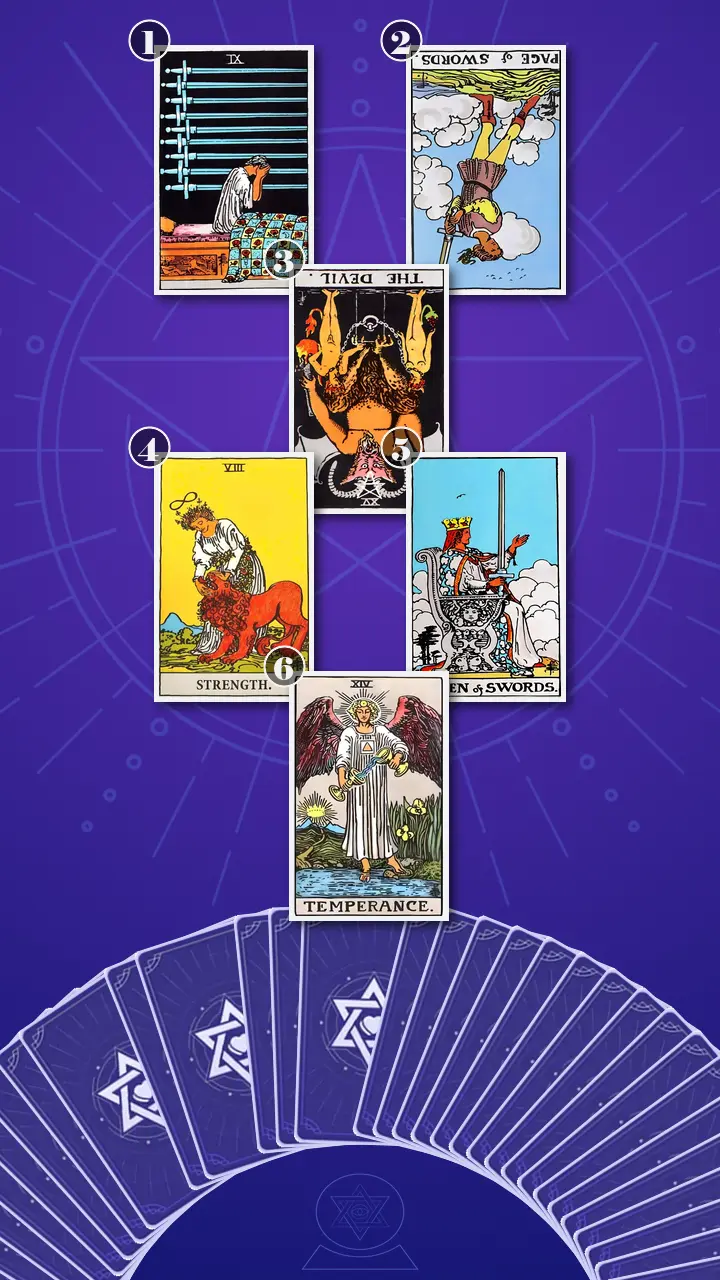
Reading the Map: How Tarot Works in a Feedback Spiral
Position 1 — The surface reaction: the specific bracing response you slip into the moment you hear “Can I be honest?”
Now turning over the card that represents the surface reaction, I revealed Nine of Swords, upright.
“This is like,” I said softly, “when you see ‘Can I be honest?’ come through on WhatsApp at night and instantly lose the present moment—heart racing, jaw clenched—replaying your last hangout like a highlight reel of mistakes. You start composing an apology before you even know what they’re upset about, because your brain treats ambiguity as proof you’re about to be rejected.”
In this position, the Nine of Swords is excess Air—thoughts with no brakes. Not insight, not reflection. A mental alarm system that keeps ringing even when the building isn’t on fire.
I watched Jordan’s fingers tighten around their phone. “Pre-apologising feels like control, but it quietly steals clarity,” I added, carefully. “Because you’re responding to a prediction, not to a message.”
They let out a short laugh that wasn’t amused. “Yeah,” they said. “That’s… brutally accurate.” Their shoulders stayed high, but their eyes softened—like part of them was relieved to have the pattern named.
Position 2 — The trigger mechanism: what exactly in the phrasing, tone, or uncertainty flips your system into self-protection
Now turning over the card that represents the trigger mechanism, I revealed Page of Swords, reversed.
“Here’s the cue,” I said. “A friend’s awkward opener reads like an attack, so you go into tone-detective mode: scrolling back for receipts, analysing punctuation, drafting the ‘perfect’ reply. Instead of curiosity, your communication becomes surveillance—trying to prevent being misunderstood before they’ve even said their point.”
Reversed, the Page is blockage: curiosity gets hijacked. It’s the Slack/WhatsApp ‘seen’ timestamp and typing dots becoming false evidence—like you’re building a case in your own head.
Jordan’s mouth twitched. “The typing bubble is my villain origin story,” they said, and this time the laugh had a little air in it.
“Exactly,” I replied. “You want clarity, but your system starts collecting proof you’re about to be rejected.”
I offered a single-line pivot—simple enough to use when your brain is loud: “Yes—I'm listening. Is this feedback, or something you’re feeling?”
Jordan nodded once, small and cautious, like testing a handrail on a steep staircase.
Position 3 — The root belief: the underlying fear about worth, belonging, or safety that keeps the reaction loop running
Now turning over the card that represents the root belief, I revealed The Devil, reversed.
“Under the panic,” I said, “is a quiet rule you’ve been living by: ‘If I’m easy enough, they won’t leave.’ So when someone signals honesty, you feel like your likability is being tested.”
Reversed, The Devil isn’t doom—it’s release beginning. The chains are loose. The energy here is a block that’s finally cracking: approval has been acting like oxygen, and your body panics at the thought of it being cut off.
I used the metaphor that always lands in real life: “It’s like an invisible subscription you don’t remember signing. ‘I’ll be low-maintenance if you don’t leave.’”
Jordan went still—breath shallow, eyes fixed on the card as if rereading terms and conditions. Then they swallowed. “If I don’t manage it perfectly,” they said, voice quieter, “they’ll decide I’m… difficult. And then I’m out.”
“That’s the bargain,” I said. “And it’s not a moral failing. It’s a strategy you learned. But it makes every honest moment feel like exile.”
I let the silence hold for a beat, the way you let a base note settle before you add anything else.
When Strength Spoke: Meeting the Lion with Calm Hands
Position 4 — The key inner shift: the quality that lets you stay present with honesty without collapsing or performing
Now turning over the card that represents the key inner shift, I said, “This is the bridge card—the one that changes the entire nervous-system response.” The room felt quieter, even the radiator clicking less loudly, like the environment had decided to listen too.
Strength, upright.
“This is like,” I told Jordan, “when you feel the dread hit—tight chest, shoulders up—but you don’t sprint into apologising. You exhale, soften your jaw, and say, ‘Okay, I’m listening.’ You let the message arrive before you interpret it. Safety comes from staying with yourself, not from performing agreeableness.”
In this position, Strength is balance: regulated courage. Not force. Not perfect calm. Just the ability to stay in the room with your own sensations.
As a perfumer, I can’t help but read patterns the way I read sillage—the invisible trail we leave in a room. So I brought in my signature lens, Social Pattern Analysis: “Notice what happens socially when you pre-apologise,” I said. “It changes the interaction before the other person has even spoken. You think you’re protecting closeness, but you’re also teaching people: ‘I can’t tolerate your honesty unless I shrink first.’ That’s the hidden barrier. Strength is you keeping your shape.”
Jordan blinked, like something in them had been named with uncomfortable precision.
Setup: I could see the familiar loop in their eyes—the moment they get the text, and before they even open it, their chest tightens and their brain starts drafting the ‘friendship breakup speech’ like it’s already decided.
Not “brace for impact,” but “soften your grip and meet the lion with calm hands”—that’s how Strength turns honesty into closeness.
I let that sentence sit between us.
Reinforcement: Jordan’s body did a whole three-step truth-telling sequence without their permission. First: a freeze—breath caught, shoulders held up around their ears, fingers locked on the edge of their sleeve. Second: the stare that goes slightly unfocused, like they were replaying every typing bubble they’ve ever watched on the Night Tube, every “We need to talk” that turned into a self-made trial. Third: a release—one long exhale that sounded almost surprised, their jaw unclenching as if it had been gripping a secret. Their eyes went shiny, but they didn’t look away.
“But if I don’t jump in and make it easy,” they said, a little shaky, “won’t I seem defensive?”
“That’s the lie the old contract tells you,” I replied. “And here’s the new frame—because it’s the turning point for finding clarity: Honesty isn’t a verdict on you—it’s data. You can stay steady, listen, and still choose what you accept.”
I leaned forward. “Now, with this new view—can you think of a moment last week where this would’ve changed how it felt in your body?”
Jordan nodded slowly. “My friend said, ‘Can I be honest?’ and I sent a whole apology paragraph. If I’d paused… I could’ve just… listened.” They looked almost dizzy with the simplicity of it—like stepping out of a loud room and realising the quiet is real.
“That’s the shift,” I said. “From anticipatory dread and pre-apologising to grounded self-trust. Not perfect. Just present.”
Position 5 — Your usable resource: how to communicate and set boundaries so honesty becomes specific, workable information
Now turning over the card that represents your usable resource, I revealed Queen of Swords, upright.
“This is your language tool,” I said. “Instead of sending a paragraph of pre-emptive repair, you respond with calm precision: ‘I want to hear you, and I do better with examples than general statements.’ You separate feedback about a moment from a verdict on your character, and you give the conversation a shape you can actually respond to.”
The Queen’s energy is balance again, but sharper: Air used skilfully. Boundaries without cruelty. Structure that protects dignity.
I showed it to Jordan in modern dialogue form, because this is where people actually change:
Before (people-pleasing essay): “Of course!! I’m so sorry if I was weird, I totally get it, I can change—tell me what I did, I didn’t mean to—”
After (Queen of Swords): “Yes, I’m listening. What do you mean specifically?”
Jordan pulled out Notes and, without ceremony, typed it in. Their shoulders stayed lower while they did.
Position 6 — Integration and next step: a grounded practice for responding in real time and rebuilding self-trust after feedback
Now turning over the card that represents integration and next step, I revealed Temperance, upright.
“Temperance is the volume knob,” I said. “Not on/off. You stop trying to fix the entire relationship in one text. You reflect what you heard, ask one clarifying question, and give yourself time to respond with nuance. Honesty and care can exist in the same room.”
This energy is balance and pacing. It’s the difference between flooding and flow—like pouring between two cups without spilling into extremes.
Jordan’s face did something subtle—less guarded, more practical. “So I’m allowed to slow it down,” they said. “Even if my brain screams that it’s urgent.”
“Especially then,” I replied. “Urgency is often just fear wearing a hi-vis jacket.”
The One-Note Shift That Changes the Whole Conversation
When I stitched the whole ladder together for Jordan, it formed a clean story: the Nine of Swords shows the immediate spike—your mind writing a worst-case script. The Page of Swords reversed shows the trigger—tone and ambiguity turning into ‘evidence.’ The Devil reversed reveals the hidden bargain—approval as oxygen: “I’ll be easy if you don’t leave.” Strength is the pivot—regulated courage that keeps you present with your body’s alarm without obeying it. Queen of Swords turns that steadiness into language. Temperance makes it repeatable, paced, and human.
The cognitive blind spot, gently: you’ve been treating your first bodily flinch as proof. But a flinch is a sensation, not a verdict. The transformation direction is clear: move from “honesty equals a verdict on my worth” to “honesty is data I can respond to with boundaries, questions, and self-respect.”
Then I gave Jordan next steps—small enough to do even when the typing bubble appears and your throat tightens.
- The 90-second Strength pauseBefore you reply to “Can I be honest?”, put one hand on your chest or jaw, exhale slowly, drop your shoulders once, then text one line: “Yes—I'm listening. Is this feedback, or something you’re feeling?” Then stop.If your body ramps up, you’re allowed to say, “I want to respond well—can I take 10 minutes?” Pausing isn’t punishing them; it’s making the conversation cleaner.
- The facts vs forecast checkOpen Notes and write two bullets: “What I know from their words:” and “What I’m predicting:”. Reply only to what you know, not to the forecast.If your brain insists it’s “too slow,” do the 30-second version: write just one fact and one prediction.
- A Queen of Swords specificity boundaryUse one sentence in your next honesty conversation: “I want to hear you, and I do better with examples than general statements.”If it feels intense, soften the tone—but keep the structure. Boundaries make honesty usable.
And because I’m Luca—perfumer brain always on—I offered a tiny, optional support from my professional presence enhancement with woody accords. “If you want a sensory anchor,” I said, “one dab of something woody—cedar, vetiver—on your wrist before a hard chat. Not to ‘fix’ you. Just to remind your body: you can be grounded while you listen.”

A Week Later: The Quiet Proof
A week later, Jordan messaged me a screenshot. Their friend had written: “Can I be honest?” And Jordan’s reply—two sentences, no essay—sat there like a small miracle: “Yes—I'm listening. Do you mean feedback, or something you’re feeling?”
Underneath, Jordan typed: “My hands were shaking. I still wanted to over-explain. But I didn’t. And it didn’t turn into a breakup speech. It turned into… a normal conversation.”
That’s the Journey to Clarity I trust most: not certainty, but steadiness. Not becoming bulletproof, but learning you don’t have to earn safety by being instantly agreeable.
When someone says “Can I be honest?” and your chest tightens before the message even arrives, it’s not that you hate honesty—you’re scared it’s about to become a verdict that costs you belonging.
If you didn’t have to earn safety by being agreeable for the next ten minutes, what would a calmer, more specific question sound like in your voice?