When ‘Tell Them the Story’ Starts, Set a Consent Boundary in Real Time

The “Tell Them the Story” Moment (and the cost of staying easygoing)
If your friend says, “Tell them the story,” and your face goes hot before your brain even catches up—then you spend the next two days replaying it like a mental highlight reel you didn’t ask for—I know that spot. I know the exact second your body decides for you.
Jordan (name changed for privacy) sat across from me on a video call from her Toronto condo, hair still damp like she’d showered to rinse off a night that wouldn’t quite leave her. She kept rotating her mug by the handle, over and over, like she could stir the feeling out of herself.
“It happened again,” she said. “Patio. New people. And then—” She did a tiny mimic of it, a hand wave like someone reeling strangers in. “Wait, tell them the story.”
In my mind I could see it, because she described it with the accuracy of someone who has rewatched the scene too many times: 8:47 p.m., heat lamps making everyone look a little nicer than they feel, sticky table, music too loud, air smelling like fries and spilled beer. She’s mid-sip of a gin soda—ice clinking—when her friend waves over someone new and drops her private moment into the conversation like a party trick.
Out loud, Jordan laughed. She even added a self-deprecating line first, to get ahead of the punchline. Quietly, her cheeks flared with heat, her chest tightened like she’d swallowed a zipper, and her stomach did that sinking thing—like an elevator cable went slack.
“I can take a joke,” she told me, eyes fixed on the lower corner of her screen. “But why is the joke always me?”
I didn’t rush to fix it. I watched the way her shoulders stayed lifted, like she was still bracing for the room to turn toward her.
“That reaction makes sense,” I said. “Your body is telling you this isn’t ‘just a funny story’—it’s a consent and respect issue. And you’re stuck in the exact contradiction that traps a lot of people at a career-and-friendship crossroads: you want respect and privacy, but you’re scared that setting a firm boundary will create social fallout.”
I leaned in a little, warm but direct—the way I used to speak to anxious travelers on transoceanic voyages when the ocean got rough and everyone pretended it wasn’t.
“Let’s make this practical,” I added. “We’re not here to craft a perfect speech. We’re here to find clarity—one line you can actually say in real time.”

Choosing the Compass: a Relationship Spread tarot reading for friendship boundaries
I asked Jordan to take one slow breath—not as a ritual for mystery, but as a gear shift. When our nervous system is in a freeze-response loop, it’s like trying to open a heavy app on 2% battery. You can do it, but everything lags.
I shuffled while she held her question in her mind: They keep retelling my embarrassing story to new people—what boundary do I set?
“Today I’m using a classic Relationship Spread,” I told her, and—because I always speak to the reader in the room, not just the client—I’ll tell you why it works so well for this kind of ‘friend keeps telling my embarrassing story’ situation.
This spread is designed for patterns with a clear you/them/dynamic structure. It doesn’t try to predict whether you’ll ‘win’ socially. It maps what’s actually happening: your in-the-moment response, their communication pattern, the shared dynamic it creates, the inner resource that helps you hold your ground, the mental block that keeps you stuck, and the cleanest next step.
In other words: it’s a way to stop mind-reading and start getting actionable advice.
“We’ll look at three key areas first,” I said. “Position 1 shows what you do in the first three seconds. Position 3 tells us what kind of relationship dynamic is being reinforced. And the last position—Position 6—will give us the clearest boundary and delivery style.”
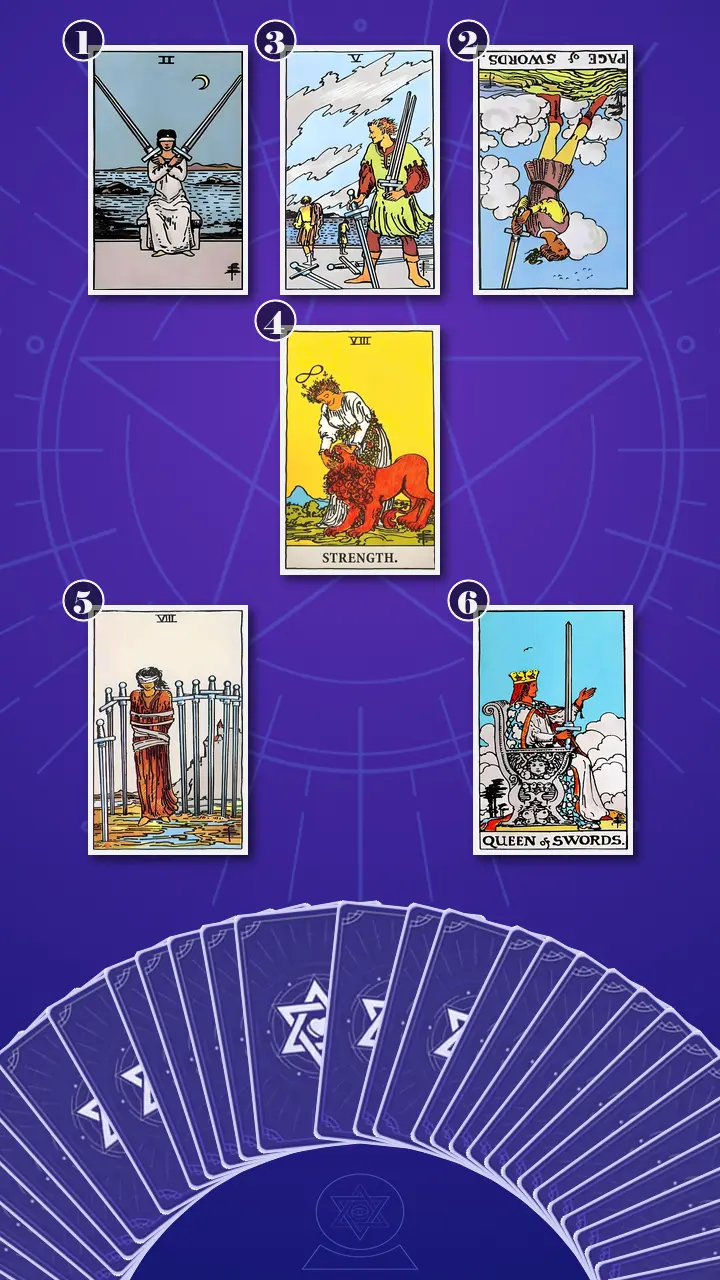
Reading the Map: six cards, one consent line
Position 1: Your in-the-moment response
“Now we’re turning over the card that represents your current in-the-moment response when the embarrassing story is retold,” I said.
Two of Swords, upright.
Immediately, I thought of the blindfold and those crossed swords across the chest—protection that looks calm on the outside and feels like a clamp on the inside.
“This is the patio moment,” I told her. “At a work-adjacent hangout, you hear the story starting and your brain instantly runs a cost-benefit analysis—‘If I interrupt, I’ll look uptight’ versus ‘If I let it happen, I’ll feel gross later.’ So you choose the polite smile. You nod. You try to steer the conversation elsewhere while your chest tightens like you’re holding your breath.”
“It’s not that you don’t know what you want,” I added. “It’s that your energy goes into a truce. You’re keeping the peace for the room.”
Jordan let out a small laugh—sharp, almost bitter. “That’s… too accurate,” she said. “Like, rude.”
I nodded. “It can feel cruel when a card shows you the exact mechanism. But it’s also a relief, because it means there’s nothing wrong with you. You have a pattern, and patterns can change.”
“Keeping the vibe shouldn’t require you to disappear,” I said, watching her shoulders drop a millimeter, like her body recognized itself in that sentence.
Position 2: Their pattern (without diagnosing intent)
“Now we’re turning over the card that represents their pattern and motivation in how they share the story—without us mind-reading,” I said.
Page of Swords, reversed.
“This is restless storyteller energy,” I said. “The windswept Page becomes ‘talk fast, stay interesting, keep the audience.’ In your life, it looks like your friend retelling your embarrassing story like it’s a reliable punchline they can drop into any introduction—same setup, same grin—aimed at getting quick laughs from strangers.”
“Like TikTok storytime energy,” Jordan muttered, and her eyes flicked up to meet mine for the first time.
“Exactly,” I said. “Fast laughs, low consent. And reversed, it’s not careful. It’s information used as social currency.”
I kept my language clean on purpose. “This doesn’t automatically mean they’re evil. But it does mean they’re in a mode where the room’s reaction matters more than your comfort.”
Position 3: The shared dynamic being created
“Now we’re turning over the card that represents the social dynamic being created between you,” I said.
Five of Swords, upright.
“This is scoreboard laughter,” I told her. “Someone gains social points while someone else pays with dignity.”
I translated it into her real week: “The story lands and the table laughs, but it doesn’t feel like shared closeness. It feels like you got made smaller for the vibe. You laugh because the room expects it, and then later you notice you’re less open with that friend—answering texts slower, sharing less—because trust took another hit.”
Jordan’s jaw tightened, then released. A flicker of anger crossed her face—clean anger, not the shamey kind. “I hate that it’s true,” she said. “I always tell myself I’m overreacting.”
“It’s not the story,” I said, letting the words land. “It’s the consent.”
She went still for a beat, like that sentence took something off her back.
Position 4: What supports you—tone, steadiness, self-respect
“Now we’re turning over the card that represents what supports you in setting a boundary with steadiness,” I said.
Strength, upright.
Even through a screen, I felt the temperature change. Strength is the opposite of performance. It’s power without the big speech.
“This card is a nervous-system bridge,” I told her. “It’s that moment when your face gets hot, but you take one breath anyway. Not to calm down perfectly—just to keep your voice from turning into an apology or an explosion.”
I let myself offer a single line, the way the card asks for: “I’m not okay with that story being shared.”
“No smile to soften it,” I added. “No explanation to justify it. Just steady.”
Jordan’s shoulders unclenched in a way that looked almost involuntary, like her body was trying on a new posture. She blinked a few times, slower now. The room’s brief pause—survivable. That’s what Strength teaches.
“Calm doesn’t mean compliant,” I said.
Position 5: The blocker—the mental cage that keeps you silent
“Now we’re turning over the card that represents what blocks the boundary from being stated or enforced,” I said.
Eight of Swords, upright.
“This is the ‘I technically can, but it feels unsafe’ card,” I said. “The bindings are loose. The space is there. But the blindfold makes the pressure feel absolute.”
I glanced at her and chose the analogy that fits her exact pattern. “This is what I call the Notes app courtroom.”
Jordan exhaled a quick laugh. “Oh no.”
“Yes,” I said gently. “You’re drafting and redrafting like you’re on trial. You write a message in Notes—empathetic opener, context, disclaimers, a joke so you don’t sound intense—and then you delete it because you can already hear the imaginary group chat verdict: ‘She’s being dramatic. She can’t take a joke.’”
I watched her micro-reaction chain unfold in real time: first her breath held (a tiny freeze), then her gaze unfocused like she was replaying the last hangout, and then a quiet sound—half ‘oh,’ half surrender—as her shoulders dropped on a slow exhale.
“Yeah,” she whispered. “That’s exactly it.”
“If they call you ‘too sensitive,’” I said, “that’s data—not a verdict.”
And because I’ve trained people in cross-cultural environments—where tone, status, and ‘keeping the vibe’ can become a social currency—I named the hidden mechanism: “Your mind is trying to pre-defend you against rejection. But it’s also keeping you stuck. Clarity doesn’t come from winning a future argument. It comes from choosing your role in the moment.”
When the Queen of Swords Cut Through the Noise
I took a breath before the final card. Not for drama—because the air in this spread was dense, all Swords, all reputation and wording and replay. Strength gave us a single warm note of courage. Now we needed the line.
“We’re turning over the most important card in this reading,” I said. “The one that answers: What boundary do you set, and how do you say it?”
Position 6: The clearest boundary and your next step
Queen of Swords, upright.
“One upright sword,” I said. “One clean sentence.”
I brought it straight into her life, because this is how tarot works when it’s used well: it becomes a mirror for a specific moment, not a vague vibe. “Next time you’re introduced to someone new and your friend starts the setup line, you cut in with a calm, clear boundary: ‘Don’t share that story about me with people I don’t know.’ If it happens again, you don’t argue—you follow through quietly by stepping away from the conversation. Your boundary isn’t a debate prompt. It’s a rule for access.”
Jordan swallowed. Her fingers tightened around her mug. I could see her about to bargain with the wording—about to put the Queen on the witness stand.
Setup: “Picture it,” I said softly. “You’re at a patio table, someone new gets introduced, and your friend goes, ‘Wait, tell them the story,’ and your face gets hot before you even decide what to do. Your brain tries to do the impossible: keep belonging and protect dignity and craft the perfect sentence in under two seconds.”
Delivery:
Stop negotiating your dignity in the moment and start using one clean, upright sword of language that draws a line without apologizing.
I let the silence sit for a beat—like the pause after a short Slack message lands, when you realize it says everything without a five-paragraph email.
Reinforcement: Jordan’s face shifted in layers. First her eyes widened a fraction, like she’d been startled by how simple it was. Then her mouth tightened—not in anger, but in that resisting way people get when they realize they’ve been carrying something heavy that they were told was “no big deal.” Her shoulders stayed lifted for one more second, then dropped, slowly, like she was setting down a bag she didn’t know she could put down. She blinked hard once; her eyes glossed, not into tears exactly, but into that watery edge of recognition.
“But if I say it,” she said, voice thin, “won’t everyone think I’m… dramatic?”
“That’s the Eight of Swords talking,” I replied, steady. “The predicted verdict. The imaginary jury.”
And then I used the tool that’s made me effective everywhere from Venetian canals to cruise ship gala nights: Social Role Switching. “You’re allowed to switch modes,” I told her. “You don’t have to become colder as a person. You just move from Supportive Mode—laughing along, smoothing, keeping the vibe—to Assertive Mode for ten seconds. On ships, we trained crew for this all the time: warm hospitality doesn’t mean unlimited access.”
I leaned closer to the camera and spoke like I would in a crowded room: slow, neutral tone. “The Queen of Swords is you choosing consistent wording over perfect wording. And Strength is you keeping your tone calm.”
“Now,” I asked her, “with this new lens—can you remember a moment from last week where you wish you’d had this sentence ready? The exact second the story started?”
Jordan went quiet. I watched her eyes move left, like she was replaying the scene. She inhaled, shallow at first, then deeper. “Yeah,” she said. “When they did the setup line. I could’ve just… cut in. One sentence.”
“Exactly,” I said. “This is the shift from shame-driven freeze-and-laughing-along to steady self-respect through clear, consent-based boundaries. Not louder. Cleaner.”
The One Clean Sentence Rule: actionable advice for your next hangout
I summarized what the spread had told us, as a single story, because integration is where finding clarity becomes usable.
“Here’s the arc,” I said. “Two of Swords shows you freezing to keep the peace. Page of Swords reversed shows someone using your personal story like social currency. Five of Swords reveals the win/lose vibe underneath—scoreboard laughter. Strength is the resource: calm courage, power without performance. Eight of Swords is the trap: the Notes app courtroom where you try to pre-defend yourself against being labeled ‘too sensitive.’ And Queen of Swords is the remedy: one repeatable sentence plus calm follow-through.”
“Your cognitive blind spot,” I added, “is thinking you need a perfect argument before you’re allowed to protect your dignity. But consent isn’t something you win. It’s something you state.”
Then I offered Jordan what I call a Maritime Social Protocol—a way to move through a potentially awkward social moment with minimal drama. On a ship, you don’t yell across the ballroom. You change the rules of access quietly and confidently.
- The One-Sentence Line (write it once)Open Notes and write: “Please don’t tell that story about me to people I don’t know.” Keep it exactly that short.If your brain wants to add “because” or “sorry,” that’s the Eight of Swords turning clarity into a debate. Don’t negotiate—keep the sentence.
- The Follow-Through Line (choose a calm consequence)Under it, write: “If it comes up, I’m going to step away from the convo.” Pick a consequence you will actually do: change seats, go get water, start a side conversation.This isn’t punishment. It’s a rule for access. Calm follow-through makes your boundary credible without starting a fight.
- Notes-App-to-Out-Loud Practice (7 minutes)Set a 7-minute timer. Read both lines out loud three times at a normal volume—standing in your kitchen, neutral voice, no explanation.You’re not trying to feel fearless—just familiar. If shame spikes, stop early. One read-through still counts.
- The 10-Second Reset (for freeze)At the next hangout: exhale, put your drink down, and look at the person telling the story—not the audience. Then say the line.If they push (“Relax, it’s funny”), use a broken record repeat once: “No—please don’t tell that story.” Then redirect: “Anyway—how do you two know each other?”

A Week Later: the quiet proof
Six days later, Jordan messaged me: “It started. I did the exhale thing. I said the line. It got quiet for like… two seconds. Then I changed the subject. I was shaking in the bathroom after, but I didn’t hate myself all night.”
It wasn’t a Hollywood moment. No group applause. Just a small, real reset—like deleting a tag you never approved. Clear, slightly shaky, and still a win.
That’s what this Journey to Clarity looked like: not becoming mean, not becoming perfect—just moving from “keeping the vibe” to naming consent and consequences in real time, with Strength in your tone and the Queen of Swords in your words.
When everyone’s laughing and you’re smiling too, but your chest is tight because you can feel your dignity getting traded for “good vibes,” it makes sense that you go quiet—and then feel furious at yourself later.
If you didn’t need the perfect wording—just one clean sentence—what would you want your future self to say the very first time the story starts?