From People-Pleasing to Self-Respect: Saying No to Co-Signing a Lease

Finding Clarity in the “Can You Co-Sign?” Text
If you’ve ever gotten a “Can you co-sign?” text right after they share a housing crisis story—and your chest tightens because you know you’re about to be guilt-managed—this is for you.
Jordan showed up in my café on a wet Toronto evening with that specific kind of exhaustion you can’t fix with sleep. Not “busy” tired—more like their nervous system had been left on a charging pad that never quite connects. They kept their phone face-down on the table like it might buzz again and ruin the little pocket of quiet they’d finally found.
They told me the scene like they were reading it off a receipt.
“11:42 p.m. on Tuesday,” Jordan said, eyes flicking to the window where streetlights smeared on the glass. “I’m on the couch with my laptop balanced on a throw blanket, blue light everywhere, and I’ve got the tabs open—credit score impact, co-signing liability, a Reddit thread titled ‘Never co-sign.’ My phone’s warm in my hand. And I keep flipping between a draft that says, ‘I can’t do this,’ and one that says, ‘I’m so sorry.’”
They pressed their tongue against the inside of their cheek. I watched their jaw work like they were chewing something tough.
“I still haven’t answered,” they admitted. “I keep saying ‘Let me think.’ Meanwhile they’re texting like it’s urgent, and… it is, I guess. Rent is insane. But I’m building my credit. I’m trying to actually have savings. And I don’t want to abandon them, but I also don’t want to be on the hook for this.”
The words came out clean, but their body didn’t match it. Their chest rose too shallowly, like they were holding their breath at the edge of a diving board while someone else counted down behind them.
Under the guilt, I heard something else—irritation, quiet but hot. The kind that shows up when a practical request gets turned into a loyalty test.
“I need a boundary that doesn’t turn into a breakup-level fight,” Jordan said. “I want to be supportive… versus I’m terrified of being financially trapped and held responsible for their choices.”
I set a cappuccino in front of them and didn’t rush the moment. The foam was still glossy, a soft white surface that calms people before they even take a sip.
“That tight chest and clenched jaw?” I said gently. “That’s your body clocking the stakes before your brain even finishes the sentence. We’re not here to make you colder or tougher. We’re here to find clarity—so you can be honest without handing over the keys to your financial life.”

Choosing the Compass: The Celtic Cross · Context Edition
I’ve owned this café for twenty years. I’ve watched first dates, breakups, roommate fallouts, new job celebrations—all of it—play out over espresso cups. Tarot, for me, has always belonged in that same world: not floating above real life, but sitting right beside it, like a spoon on a saucer.
I asked Jordan to take one slow breath and drop their shoulders on purpose, just an inch. “Let’s make your nervous system feel safe enough to tell the truth,” I said. While the espresso machine hissed behind the bar, I shuffled the deck in a steady rhythm—less ritual, more reset. A way of turning down the volume on the doomscrolling brain.
“Today we’ll use the Celtic Cross · Context Edition,” I told them.
For anyone reading who’s ever Googled how tarot works and gotten lost in the mystique: this spread is basically a decision map. It’s ideal for a co-sign question because the issue isn’t only “What should I say?” It’s the whole chain—your present paralysis, the deeper belief underneath it, the pressure field around money and housing, the 3 a.m. fear loop, and then the most aligned boundary posture you can actually embody.
In this edition, we read position 8 specifically as the external ask and the housing/financial pressure field, and position 10 as your chosen integration: not a fixed fate, but the clearest stance you can step into.
“Here’s what we’re going to listen for,” I said, keeping it simple. “The first card shows the exact loop you’re stuck in right now. The crossing card shows what’s making a clean answer feel impossible. And at the top of the ladder, the final card will show the boundary posture that protects you and keeps integrity—how to say no to co-signing a lease without turning it into a trial.”
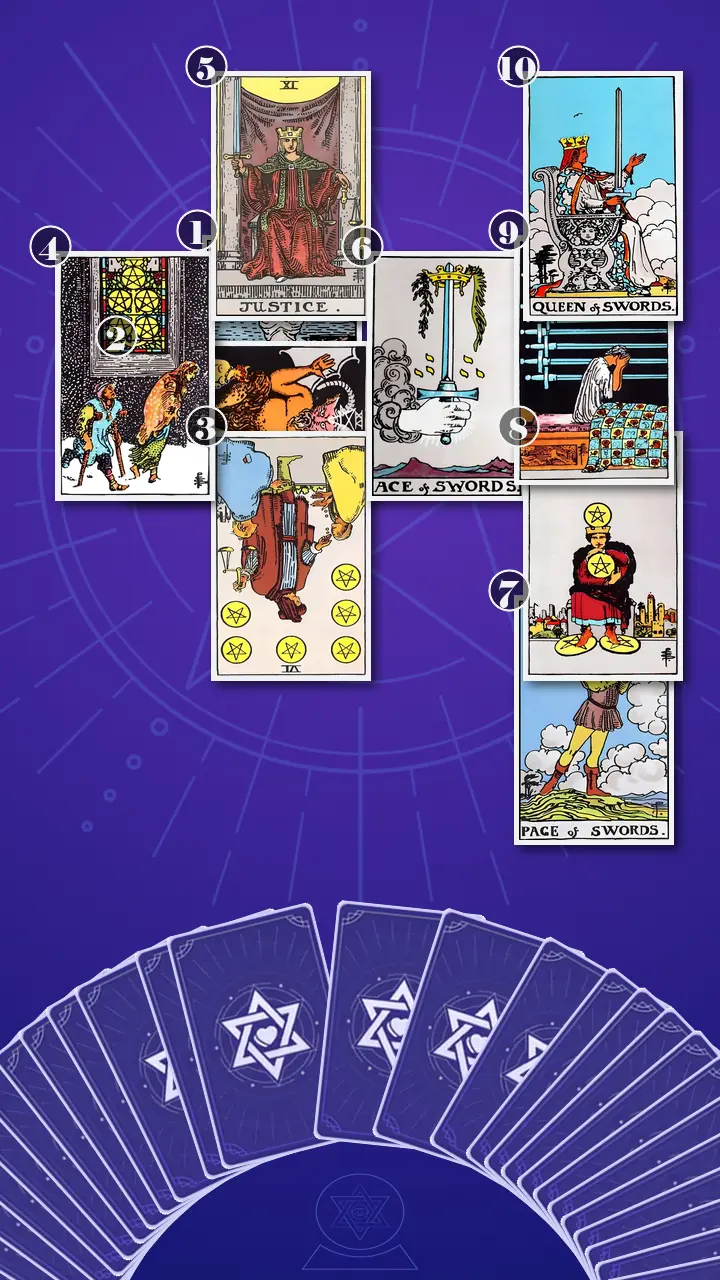
Reading the Map: From Draft-Text Purgatory to Clean Language
Position 1 — The immediate stuck point: your day-to-day freeze response
“Now we turn to the card that represents the immediate stuck point: how the co-sign request is currently affecting your behavior and nervous system in day-to-day life,” I said, and flipped the first card.
Two of Swords, reversed.
In the classic image, someone sits with a blindfold and two crossed swords over their heart. Reversed, that blindfold slips—not enough to fully see, but enough that the stalemate starts to ache.
“This is the draft-text purgatory,” I told Jordan, using the simplest modern translation. “It’s like keeping a message open and hoping the perfect wording will appear so you don’t have to feel the discomfort of a clear no.”
I watched Jordan’s mouth twitch. Then they let out a small laugh that wasn’t amusement—more like a bitter little puff of air.
“Okay,” they said. “That’s… kind of cruelly accurate.”
“I know,” I said, and kept my voice warm. “But it’s also kind. Because it names the real cost: silence feels polite, but it keeps you trapped between guilt and self-protection. That’s blocked Air energy—thoughts looping without action.”
I leaned in slightly. “And here’s the trap with the reversed Two: to escape the discomfort of deciding, you might send a long, apologetic message with multiple loopholes. That can sound ‘nice,’ but it invites negotiation. It makes your boundary easier to push.”
Jordan’s fingers tapped their mug, fast, then stopped—like they’d been caught doing it.
“You don’t need a courtroom-grade excuse to protect your credit,” I added, plain and direct. “You need one true sentence.”
Position 2 — The main challenge: the pressure that complicates a clean answer
“Now we turn to the card that represents the main challenge or pressure that complicates your ability to answer clearly,” I said, laying the next card across the first like a bar across a doorway.
The Devil, upright.
“This is the part that scares me the most in a co-sign reading,” I said, because honesty builds trust better than soft comfort. “The Devil isn’t ‘evil.’ It’s binding. It’s a contract that arrives wrapped in a friendship emoji.”
I let the contrast land in clean pairs, because that’s how this card speaks: “Support vs liability. Love vs leverage. Urgency vs consent.”
Jordan went still, like their body had recognized something before their mind wanted to admit it. Their eyes dropped to the card, and I heard a sharp, quiet exhale—almost a whispered “oh.”
“If I say no, I’m disloyal,” Jordan murmured, as if testing the sentence. “If I say yes, I’m trapped. Why does it feel like there’s no third option?”
“Because guilt collapses choices,” I said. “It makes a request feel pre-decided.”
I glanced at their phone, still face-down. “Co-signing is like adding your name as an admin on someone else’s account. You don’t just ‘help.’ You inherit risk and cleanup. And The Devil shows how fast that can become a tether.”
Position 3 — The underlying driver: the belief about loyalty and responsibility
“Now we turn to the card that represents the underlying driver: the deeper belief about support, loyalty, and responsibility that keeps you hooked,” I said.
Six of Pentacles, reversed.
This card is about giving and receiving—who holds the scale, who kneels, who decides what’s “fair.” Reversed, it’s imbalance. Invisible strings. Help that creates debt instead of stability.
“This is like you wanting to help, but not being able to shake the sense that co-signing would turn your relationship into a scoreboard,” I said. “Who owes what. Who’s pulling weight. Who gets to be disappointed.”
I wrote a tiny micro-scene out loud, because sometimes that’s the quickest way to truth. “You’re trying to sound chill while mentally calculating, ‘If they miss one payment, what happens to my credit? If I say no, what happens to my place in their life?’ That’s not generosity. That’s a power dynamic.”
Jordan nodded, slow. Their shoulders lifted like they wanted to protest, then dropped like they didn’t have the energy to lie about it.
“I hate that part,” they said. “I hate that I’m even… keeping score.”
“It doesn’t mean you’re petty,” I said. “It means your system recognizes structural unfairness. You take the bigger risk; they get the immediate benefit. The card is asking: what would ‘fair support’ look like if it protected both people?”
Position 4 — Recent past: the scarcity moment that set the emotional temperature
“Now we turn to the card that represents what recently shaped the emotional temperature of this situation,” I said.
Five of Pentacles, upright.
“This is the warm window you can see but can’t reach,” I said softly. “It’s scarcity—money, housing, belonging.”
I translated it into Jordan’s world immediately: “This is like hearing panic in someone’s voice and your brain going, ‘If I don’t fix this, they’ll be stuck,’ even though you didn’t set Toronto rent prices and you’re not the landlord.”
Jordan swallowed. Their eyes got shiny, just a little. “My friend was couch-surfing last year,” they said. “It was bad. I can’t get that image out of my head.”
“Of course you can’t,” I said. “Compassion is real. But this card is also a reminder: you can name what part is genuinely yours to help with—and what part is not yours to carry.”
Position 5 — Conscious aim: the integrity you want to protect
“Now we turn to the card that represents your conscious intention: what you want to be true about you and this relationship after you set a boundary,” I said.
Justice, upright.
Justice sits with scales and a sword. Balance and decision. Compassion and structure.
“This tells me you’re not trying to punish them,” I said. “You’re trying to make a decision you can stand behind without resentment or hidden costs.”
And because I’ve watched a thousand people try to negotiate their way out of guilt, I made it practical: “Justice is the terms-of-service moment. You don’t have to be dramatic. You just have to read what you’re agreeing to.”
Jordan let out a breath through their nose, like that framing finally gave their brain something solid to hold. “So it’s… not a personality test,” they said.
“Exactly,” I replied. “It’s a risk assessment.”
Position 6 — The next realistic opening: the conversation that becomes available
“Now we turn to the card that represents the next realistic opening: the kind of clarity or conversation that becomes available once you stop stalling,” I said.
Ace of Swords, upright.
Even before I spoke, Jordan’s shoulders dropped a fraction—like their body recognized the feeling of a clean sentence.
“This is the breakthrough,” I said. “This is the moment you stop writing paragraphs to manage someone else’s feelings and you say the true thing plainly.”
I gave them the tool in the simplest form: “Decision first. Explanation second. No negotiation hidden in the punctuation.”
“Ace of Swords is the ‘subject line first’ rule,” I added. “It’s the difference between a calendar invite and a vague ‘we should hang.’ Clarity makes it real.”
Jordan stared at the card, then at their hands, like they were noticing for the first time how tightly they’d been holding themselves. “I can feel how much energy I’ve been spending just… not sending it,” they said.
Position 7 — Self: your stance and agency while deciding
“Now we turn to the card that represents your stance and agency: how you show up when you’re trying to decide what boundary to set,” I said.
Page of Swords, upright.
“This is you in research mode,” I said with a small, knowing smile. “Alert. Curious. Ready to problem-solve. But also restless.”
I nodded toward the café’s corner table where people sometimes set up laptops like they’re building a second life in spreadsheets. “This Page loves information. But sometimes the research isn’t for clarity—it’s for delay.”
Jordan’s eyes widened a little, then they looked away. That was the tell. Not shame—recognition.
“You’re trying to gather enough data to be 100% safe before you speak,” I said. “But boundaries don’t require perfect certainty. They require a sustainable limit.”
Position 8 — Environment: the external pressure field around housing and money
“Now we turn to the card that represents the external pressure field: the other person’s ask, urgency, and the housing-money context around you,” I said.
Four of Pentacles, upright.
“This is the grip,” I said. “The ‘I need this locked down now’ energy.”
I kept it fair—no villainizing the person asking. “Their fear may be real. Housing can feel like a cliff edge. But this card also shows how fear can turn into control through someone else’s resources.”
“It’s like they’re not only asking for your signature,” I said, “they’re asking to borrow your sense of stability.”
Jordan winced, like the phrasing hit a bruise. “Yes,” they said quietly. “That’s… exactly it.”
Position 9 — Hopes and fears: the 3 a.m. spiral and imagined backlash
“Now we turn to the card that represents your hopes and fears: what you imagine will happen if you say yes or no,” I said.
Nine of Swords, upright.
“This is 3:07 a.m.,” I said immediately, and Jordan let out a startled laugh—half discomfort, half relief at being seen.
“Screen brightness low,” I continued. “Doomscrolling co-sign horror threads. Replaying a conversation that hasn’t happened. Imagining them saying, ‘Wow, okay,’ and feeling heat in your face like you’ve already been judged.”
Jordan nodded, eyes squeezed shut for a second, as if the scene was too accurate to watch.
“Here’s the reframe,” I said, careful not to promise it would feel good. “Discomfort isn’t danger. An awkward reaction is not the same thing as a catastrophic outcome.”
And I gave them the line I’ve watched save people from unnecessary emotional trials: “A boundary isn’t a breakup. It’s a definition.”
When the Queen of Swords Held the Line (Tarot for Boundaries)
Position 10 — Integration: the most aligned boundary posture to aim for
I let the room get a little quieter before I turned the last card. Even the café’s usual soundtrack—spoons clinking, low conversation, the espresso grinder—felt like it softened at the edges.
“We’re flipping the key card now,” I said. “This is the way you hold the line without becoming harsh.”
Queen of Swords, upright.
Her gaze is direct. Her sword is upright. Not swinging. Not threatening. Just present—like a fact.
Setup. Jordan had been trapped in that familiar loop: laptop open on credit-score FAQs, their text sitting there with “It’s urgent,” and them drafting a response that wouldn’t make them look selfish—while their chest tightened because they already knew their answer. They wanted a boundary that protected them and kept the relationship intact, and their brain kept insisting those two things couldn’t coexist.
Delivery.
Not “I need the perfect excuse,” but “I can tell the clear truth”—hold your boundary like the Queen of Swords holds her upright blade.
I let the sentence sit in the air for a beat, the way crema settles on a fresh pull.
Reinforcement. Jordan’s reaction came in layers, fast and honest. First: a tiny freeze—breath catching, fingers hovering near their phone like they might grab it and run. Then: their eyes unfocused, as if their mind replayed every draft they’d written, every “Let me think,” every attempt to soften reality into something that wouldn’t make anyone mad. Finally: a long, shaky exhale that dropped their shoulders and loosened their jaw. They blinked hard once. Their voice came out quieter, but steadier.
“But if I say it that clean,” they said, and there was a flicker of anger under the fear, “doesn’t that mean I was… wrong for all this time? Like I made it worse?”
I didn’t flinch. “It means you were trying to keep belonging,” I said. “You were trying to keep everyone safe at once. That’s not wrong. It’s just expensive.”
Then I brought in my own framework—the one I’ve learned from coffee and people, from watching what happens when you keep pouring past the point it tastes good.
“I call this Social Espresso Extraction,” I told them. “Every social situation has an optimal extraction time—the moment where what you say is potent, true, and clean. If you keep extracting past that, it gets bitter. In boundary conversations, over-extraction looks like over-explaining, adding loopholes, apologizing, stacking reasons. You think you’re making it kinder. But you’re actually pulling too long. The message turns harsh in a different way—because it becomes negotiable, and then you resent them for negotiating.”
I tapped the Queen’s sword lightly with my nail. “The Queen of Swords is the perfect shot: clean, contained, and strong enough to stand on its own.”
I slid a napkin toward Jordan. “Let’s do the 10-minute ‘Clean Sentence’ drill. Stop anytime if you feel yourself spiraling.”
“1) Open Notes and write one line: ‘I can’t co-sign a lease.’”
Jordan did it. I watched their jaw tighten, then—consciously—release, like they were practicing being someone who could live in truth.
“2) Add one supportive, non-binding offer you can actually sustain,” I continued. “Something time-boxed: ‘I can help you look for listings tonight for 30 minutes,’ or ‘I can be a reference.’”
Jordan’s thumbs hovered, then typed. Their shoulders rose, then fell.
“3) Read it out loud once, slowly,” I said. “Notice: jaw, chest, shoulders.”
Jordan read it. Their voice trembled on the first sentence. On the second sentence, it steadied—like the body understood the difference between care and liability.
“Boundary reminder,” I added, because this is where people slide back into old scripts. “You’re not required to justify your financial safety. If you start stacking explanations, delete everything after the first sentence and keep it clean.”
Then I asked the question that turns insight into real life: “Now, with this new lens—can you think of one moment last week when this would’ve changed how you felt?”
Jordan stared into their cup like it held a memory. “On the TTC,” they said. “8:17 a.m. Packed near the doors. I saw the text preview and my shoulders jumped like I’d been called into a surprise meeting. If I’d had this sentence then… I wouldn’t have spent the whole commute rehearsing a trial.”
“That’s the shift,” I said quietly. “From guilt-driven hesitation toward steady self-respect. You’re not trying to be ‘nice’ by absorbing risk. You’re trying to be trustworthy by stating a clear limit.”
The One-Clean-Sentence Toolkit: Support Without Liability
When I looked at the spread as a whole, it told a coherent story: your mind (Swords) is loud because the stakes (Pentacles) are real. Scarcity and housing fear (Five and Four of Pentacles) heated the emotional temperature. The Devil showed how urgency and guilt try to bind you before you consent. Six of Pentacles reversed explained why it hits so deep—because you don’t want love to become debt. And Justice, Ace of Swords, and the Queen of Swords offered the bridge: fairness plus clean language equals a boundary you can live with.
The cognitive blind spot here is sneaky: you’ve been treating a practical request like a moral exam. As if you need the perfect reason to earn the right to say no. The transformation direction is the opposite: move from “nice-as-risk” to “trustworthy-as-clarity.”
I gave Jordan a small, concrete plan—actionable advice they could actually do with a phone in their hand and their heart pounding, not a fantasy version of themselves who never feels guilt.
- Send the Two-Sentence Boundary TextText them within 24 hours: sentence one is the decision (“I can’t co-sign a lease.”). Sentence two is one sustainable, non-binding offer (“I can help you look for options tonight for 30 minutes if you want.”).If it feels “mean” because it’s short, remind yourself: clarity first, warmth second. Before you hit send, delete any line that tries to manage their feelings (“Please don’t be mad,” “I’m the worst”).
- Do the 5-Minute Justice CheckOpen Notes and answer three questions only: Is it reversible? Is responsibility shared? Is it in writing? If any answer is “no,” treat that as information—not a moral failing.Lower the bar: you’re not writing a thesis. You’re grounding yourself in reality. Fairness includes you.
- Set the Conversation Temperature (Social Thermometer)If they want to talk live, choose a “warm-not-boiling” format: suggest a 15-minute call at a set time. Start with one calm opener (“I care about you, and I want to be clear.”), then deliver the clean sentence. No debating clauses midstream.If your voice starts speeding up, pause and take one sip of water. Think: warm coffee—still drinkable, still steady, not scalding.
I added one last line, because it’s the thing people forget when guilt is loud: “Support is optional. Liability is not required.”

A Week Later: Ownership, Not Certainty
A week later, Jordan DM’d me a screenshot: two sentences in a clean iMessage bubble. No essay. No “maybe later.” Just the truth, and one offer they could actually sustain.
“They weren’t happy,” Jordan wrote. “It was awkward. But it didn’t explode. I slept through the night for the first time in days.”
They added a second message, almost like an afterthought: “I still woke up with the ‘what if I’m a bad person’ thought. But this time I noticed it… and it didn’t run my day.”
That’s what a real Journey to Clarity looks like in the wild. Not instant peace. More like your nervous system unclenching enough to let you act with self-respect.
When someone makes their housing emergency feel like your loyalty test, your chest tightens because you’re trying to stay close without handing over the keys to your financial life.
If you trusted that clarity is a form of care, what would your simplest, truest sentence be—and what kind of support could you offer that you wouldn’t resent later?