The Morning I Saw 'CC: Director'—And Stopped Over-Explaining

Finding Clarity in the CC Line
If you’re a 20-something project coordinator in Toronto who scans the CC line before you even read the email body, you already know this isn’t just “communication”—it’s workplace politics.
Jordan said that to me like it was a confession and a résumé bullet at the same time. She’d booked a session because she was tired of being smart all day and still feeling ambushed by Outlook/Gmail social weaponry.
She described 8:41 a.m. in the PATH on a Monday: one hand gripping coffee, the other thumb flicking through her inbox. The screen brightness was way too high against the beige hallway light, and the air smelled like cinnamon buns from a kiosk that was already doing a line. Then she saw it—CC: Director. Her shoulders climbed like they were trying to hide behind her ears. Her jaw set so hard she could feel it in her molars.
“Why are we performing for the director right now?” she muttered, not even asking me—just narrating her inner OS. “In emails, my coworker keeps CC’ing our director. What’s my next move?”
What she wanted was simple and human: protect her credibility and her boundaries. What she feared was also simple and human: being seen as “difficult” in front of the one person who could quietly decide she wasn’t worth trusting.
The unease in her voice wasn’t dramatic. It was specific—like walking around with a suit jacket that’s a half-size too small, tight across the shoulders, all day. You can still do your job, but every reach hurts.
I nodded. “That CC line can turn a normal email into a tiny stage light on your chest. Let’s make a map of what’s actually happening—and find the next move that’s calm, tactful, and still has your spine in it.”

Choosing the Compass: The Celtic Cross · Context Edition
I’m Lucas Voss. I used to live on trading floors where one sloppy sentence could move real money, and one missing detail could turn into a week of blame. Oxford for business school. Wall Street after. Tarot at 33—because, honestly, most “decision-making frameworks” ignore the part where your body locks up the second you feel watched.
I asked Jordan to take one slow breath and notice where the CC line landed in her body—jaw, shoulders, stomach. Not as a mystical thing. As data. Then I shuffled while she held the question: “When my coworker CCs our director, what’s my next move?”
“Today we’ll use a spread called the Celtic Cross · Context Edition,” I told her. “It’s built for situations that feel like a career crossroads: you’re not just choosing a sentence. You’re choosing a stance.”
For readers who’ve Googled how to respond when someone CCs your boss and ended up deep in Ask a Manager threads: this is how tarot works when it’s practical. The Celtic Cross gives a diagnosis-to-integration chain. It starts with what’s visible in the thread, drops down to the deeper fear driving the over-explaining, then climbs toward a clear mindset and actionable advice—real next steps you can take without escalating.
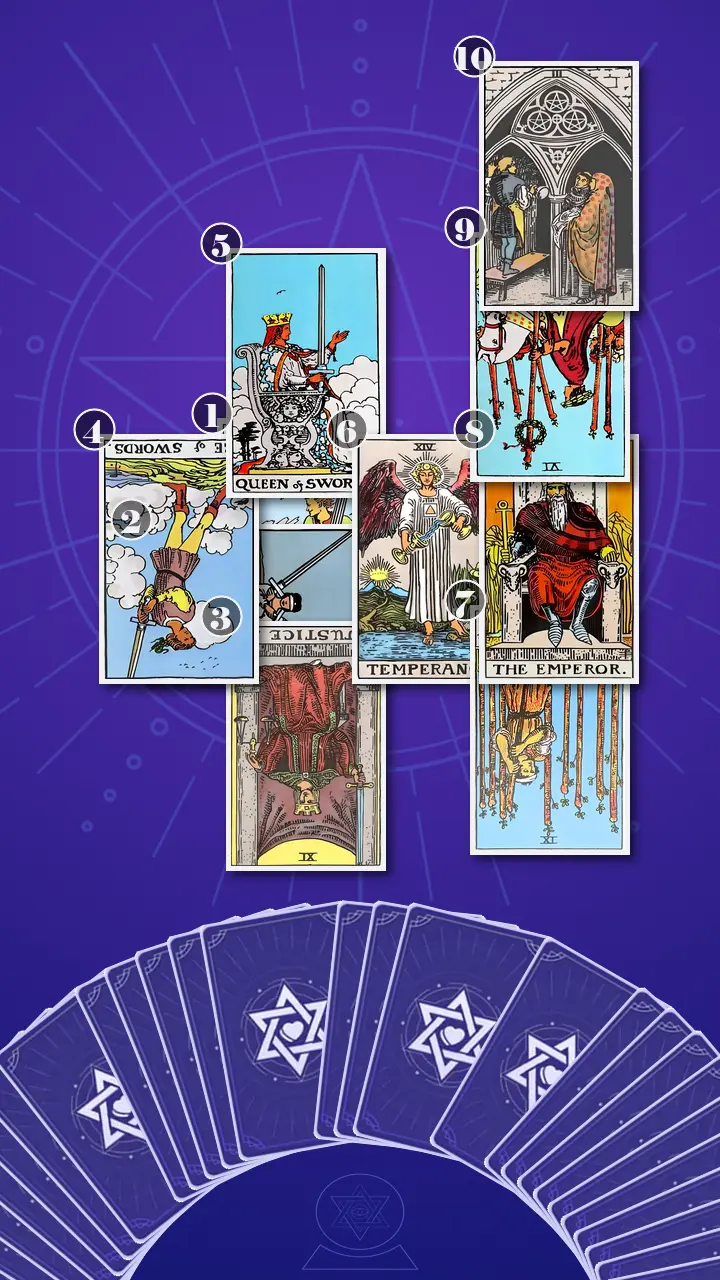
I previewed the key parts of the map: “Card 1 shows your lived reality in the thread—what it looks like right now. Card 3 goes underneath the email and touches the real driver—what fairness issue or old wound this is poking. Card 5 is the best near-term stance: the way to communicate with calm authority. And the last card points to the integration path—how you stop letting this pattern own you.”
Reading the Map: Card Meanings in Context
Position 1 — The Thread as a Battlefield
“Now turning over,” I said, “is the card that represents what the situation looks like right now in the email thread—your lived reality, not the story you tell yourself.”
Five of Swords, upright.
In modern terms, it’s this: you open a routine project email and instantly feel the vibe shift from team coordination to who looks right. The coworker’s CC to the director reads like a quiet flex. The thread becomes performative, and you start writing for optics instead of outcomes.
Energy-wise, Five of Swords is Air in excess—thinking used as a weapon. It turns communication into scoring points, collecting receipts, winning the narrative.
Jordan let out a short laugh that had no humor in it. “That’s… so accurate it’s kind of mean.” She looked down at the table and then back up, like she was checking if I was safe to be honest with. “It stops being about the work the second the director is there.”
Position 2 — The Blink of the Cursor
“Now turning over,” I continued, “is the card that represents the immediate challenge: what blocks your next move or makes you hesitate.”
Two of Swords, upright.
This is that moment you hover over Reply All and stall. Short feels careless. Long feels defensive. Direct feels “difficult.” So you pick the third option—delay and endless drafting—because it masquerades as neutrality while tension grows.
Two of Swords is Air as blockage: choice paralysis. The blindfold is the “I can’t safely choose” feeling. The crossed swords at the chest are you locking your voice down, trying not to get cut.
I described it the way her nervous system already knew it: “It’s like having ten browser tabs open for one email. Every tab is a possible misinterpretation. And you can’t click send because you’re trying to pre-live every reaction.”
Then I layered in the echo technique as a split-screen, because this is where decision fatigue becomes a loop:
Split-screen Voice A (Justice energy):If I can just be flawless, the record will protect me.
Split-screen Voice B (Two of Swords):If I don’t choose a stance, I can’t be wrong.
Jordan went very still. Her fingers tightened around her water glass—then loosened, like she’d caught herself bracing.
Position 3 — The Courtroom Under the Email
“Now turning over,” I said softly, “is the card that represents the root driver underneath the emails: the principle, wound, or fairness issue the situation touches.”
Justice, reversed.
Under the CC dynamic, you treat email like a permanent record that must prove you’re fair and competent. You start assembling a case—screenshots, timelines, extra context—because it feels like the only way to prevent an unfair narrative from sticking.
This is where the phrase from my own life flashes in: for the record. On Wall Street, “for the record” could be a shield, but it could also be a trap—because once you’re writing like you’re cross-examined, you stop building relationships and start building exhibits.
Justice reversed is not “you’re wrong.” It’s “your inner judge is running the meeting.” The scales tilt. Visibility becomes a verdict instead of alignment.
I told her, plain and calm: “When the thread becomes a courtroom, you start writing like evidence instead of collaboration.”
Jordan’s eyes flicked to the side, unfocusing for a second like she was replaying a specific email. She swallowed once. “I literally have a folder called ‘Receipts.’” She said it like she was embarrassed and proud. “It calms me down for ten minutes and then I feel… worse.”
Position 4 — The Over-Interpreter Cycle
“Now turning over is the card that represents recent past pattern: what has been happening that set this tone in motion,” I said.
Page of Swords, reversed.
Recently, you’ve been scanning for subtext in every line and reading neutral phrasing as critique. Refreshing the inbox. Re-checking the thread. Feeling watched—so you watch back. Your nervous system stays in threat-detection mode even when you’re technically off the clock.
This is Air in deficiency of maturity: curiosity turning into surveillance. The Page’s raised sword becomes hyper-vigilance—always ready to defend, even when nothing has actually happened yet.
Jordan exhaled through her nose, like she was annoyed at herself for being predictable. “I draft in Notes first,” she admitted. “Then I paste into email like it’s a high-stakes submission. And if I use ‘Schedule send,’ I can pretend I’m calm. I’m not.”
When the Queen of Swords Spoke
Position 5 — The Antidote Stance
I let the room quiet down before the next card—like you do before reading a contract clause you know will change the whole deal.
“Now turning over,” I said, “is the card that represents the best near-term stance: the clearest mindset or approach available to you in the next step.”
Queen of Swords, upright.
In modern life, she’s the part of you that replies like a calm operator, not a defendant: short status, one decision needed, one next step with ownership. No apologizing for clarity. No over-explaining to prove your worth. Neutral, factual, quietly unshakeable—even with the director on the thread.
Energy-wise, this is Air in balance: precise, boundaried, emotionally neutral without being cold. The Queen’s open hand is an invitation to align, not to fight. The upright sword is the boundary that keeps the email clean and un-gameable.
This is where I brought in my signature lens—because workplace dynamics are games whether we want them to be or not. “Let me put on my Corporate Game Theory hat for a second,” I said. “Right now, your coworker’s move—CC’ing the director—changes the payoff matrix. If you respond with paragraphs of defense, the CC tactic ‘works.’ It generates heat and performance and makes them look like the escalator. If you freeze, it also ‘works’ because they get to set the pace and the narrative.”
“The Queen of Swords changes the equilibrium,” I continued. “She doesn’t counter-escalate. She doesn’t over-explain. She makes the only rewarded currency in a director-visible lane: clarity, ownership, decisions.”
Jordan’s brow furrowed—then she shook her head once, sharp. “But if I’m concise, it’ll look like I’m hiding something.”
That was the key resistance, the one that keeps people stuck.
Setup: I pictured exactly what she’d described: staring at the CC line on the train, jaw tight, rewriting the same sentence in Notes like the right wording would keep her safe. Her mind wasn’t drafting an email. It was drafting a defense.
Delivery:
Not a trial brief but a clean blade of truth: choose one clear sentence and one clear boundary, and let the Queen’s steady gaze do the work.
I let the sentence hang there without rushing to soften it. No “just.” No “quickly.”
Reinforcement: Jordan’s body did a three-step reaction chain I’ve seen a hundred times in high-achievers who are tired of performing competence. First: a tiny freeze—her breath caught, and her fingers hovered mid-air like she was holding an invisible keyboard. Second: the cognitive seep-in—her eyes went slightly unfocused, like she was replaying last week’s thread and seeing it with new lighting. Third: the release—her shoulders dropped a fraction, and her mouth opened on a sound that was half laugh, half exhale.
“Wait,” she said, quieter. “So the director isn’t… my jury.”
“Exactly,” I said. “A director CC can mean ‘we need a clean decision’ more than ‘you’re on trial.’ And even if someone’s trying to make it political, you don’t need a perfect defense—you need a clear next step.”
I slid a blank notepad toward her. “Open a blank draft in your head and do a two-minute Clarity Pass. Write only: (1) current status, (2) decision needed, (3) next step + owner. If your jaw spikes, park the longer context in a private note—your safety net. You don’t have to force confrontation. You’re practicing clarity.”
Then I asked the question that makes the insight real: “Now, with this new lens—can you think of a moment last week where this would’ve changed how you felt?”
Jordan nodded slowly. “Friday. I wrote this huge thing. Like… exhibits. And if I’d just asked one clean question about timing, it would’ve been over.” Her eyes got a little shiny—not dramatic, just honest. “I’ve been trying to earn ‘not guilty.’”
That was the emotional shift in one line: from self-doubt to grounded authority. From courtroom thinking to process-building.
Turning Heat into Process
Position 6 — The Blend That Keeps You Safe
“Now turning over is the card that represents near future: what becomes possible once you shift how you respond,” I said.
Temperance, upright.
This is the near-future move that stops the thread from becoming a stage: you suggest a quick alignment chat, then send a brief recap email that documents decisions without heat. You blend direct conversation (less subtext) with clean documentation (less risk). You don’t have to choose between “take it offline” and “paper trail.” You can do both calmly.
Temperance is balance in action—one foot on land, one in water. Translation: you keep the work moving, and you keep yourself regulated.
Jordan’s shoulders loosened again. “A call feels scary,” she admitted, “but also… like it would end the weirdness.”
Position 7 — The Bracing You’re Tired Of
“Now turning over is the card that represents how you are showing up internally: your guard, fatigue, or resilience,” I said.
Nine of Wands, reversed.
Internally, you’re tired and braced. You draft like you’re expecting a hit—defensive qualifiers, pre-emptive soothing, trying to make yourself impossible to criticize. Part of you wants to stop engaging, but you also don’t want to look disengaged, so you over-function in writing.
This is Fire in depletion: not low motivation, but cumulative stress from repeated micro-defenses.
Jordan rubbed her jaw without realizing it. “I’m exhausted,” she said simply. “And I hate that I’m exhausted from… emails.”
“That makes sense,” I said. “Your body thinks this is reputational threat. It responds like it’s physical.”
Position 8 — The System, Not the Villain
“Now turning over is the card that represents the environment as email politics: how the director’s presence, hierarchy, and norms shape the thread,” I said.
The Emperor, upright.
This card is the reality check that often brings relief: the director CC is the system showing itself—hierarchy, decision lanes, accountability norms. In this lane, clarity and ownership matter more than emotional nuance.
It’s the difference between a casual group chat and a documented Jira/Asana update—same people, totally different rules.
“When you treat it as structure, not personal threat,” I told her, “you get your power back. The Emperor rewards a director-friendly update: short, accountable, decision-oriented.”
Jordan nodded, slower this time. “So I can respond to the lane,” she said, “instead of responding to the vibe.”
Position 9 — The Fear of Being the Weak Link
“Now turning over is the card that represents your hopes and fears about visibility: what you most want to protect and what you most dread being seen as,” I said.
Six of Wands, reversed.
This is the reputation pressure: attention that feels more like exposure than recognition. Even when you’ve done the work, you worry the “audience” will miss it—or worse, misread it.
Here’s the trap: the fear makes you write to earn approval instead of writing to coordinate. And that’s how a simple thread becomes a performance review in your head.
Jordan’s voice got tight again. “I’m afraid the director’s reading it like… ‘Why can’t Jordan handle this cleanly?’”
I asked her to name it in one sentence, because clarity starts there: “If the director reads this, I’m afraid they’ll think ______.”
She didn’t hesitate. “That I’m incompetent. Or… messy.”
“Good,” I said. “Now we can work with the real fear instead of letting it steer your wording.”
Position 10 — From Battlefield to Blueprint
“Now turning over is the card that represents the integration path: how to move forward with tact and self-respect so the pattern doesn’t own you,” I said.
Three of Pentacles, upright.
This is the clean ending: collaboration, clear roles, constructive review. The win isn’t a sharper reply. The win is a better container.
Three of Pentacles is Earth arriving after all that Air: we stop arguing in sentences and start building a process you can point to—approvals, owners, escalation rules, documentation norms.
Jordan leaned in. “So I’m not trying to out-email my coworker.”
“No,” I said. “You’re changing the structure so the CC can’t keep functioning as a power move.”
The One-Page “Queen of Swords” Plan (Actionable Advice)
I pulled the whole spread together in one short narrative—because that’s where tarot becomes a tool instead of a vibe.
“Here’s the story,” I said. “Right now the thread feels win–lose (Five of Swords). You freeze because every response feels like it could be used against you (Two of Swords). Underneath, there’s a fairness wound—this sense that visibility equals judgment, so you write like evidence to protect your integrity (Justice reversed). Recently, your nervous system has been stuck in subtext-scanning mode (Page of Swords reversed). The antidote is the Queen of Swords: concise, factual, boundaried. The near future is Temperance: blend a quick direct check-in with a clean recap. The environment is the Emperor: hierarchy is real, and it rewards structure. Your fear is Six of Wands reversed: being seen as the weak link. The path out is Three of Pentacles: turn this into roles and working agreements.”
“Your cognitive blind spot,” I added, “is thinking you have to earn safety with more words. But in a director-visible lane, safety often comes from structure and clarity. Transformation direction: shift from reactive self-defense in the thread to proactive clarity—name the working norm you want and invite a direct check-in before escalation.”
Then I gave her next steps that were small enough to start, but real enough to change the pattern:
- The 3-Part Queen Draft (7 minutes)Before you reply to any email with CC: Director, write exactly three sentences: (1) Status (one factual line), (2) Decision/ask (what you need confirmed), (3) Next step + owner + timing (who does what by when). Then stop. Don’t add defense paragraphs.If you feel exposed, keep your longer context in a private note titled “Receipts I actually need,” but only send the 3-part version unless someone explicitly asks for more. Concise isn’t cold. It’s accountable.
- The One-Sentence Boundary SwapBefore you hit send, delete one defensive line (anything starting with “Just to clarify…”, “For context…”, “As mentioned…”) and replace it with one clean process question: “Can you confirm whether you’re asking for X by EOD or for next week’s meeting?”If your hands start rewriting the email anyway, set a timer for 7 minutes. When it ends, you either send the clean version or you step away for 10 minutes—no infinite polishing.
- The 12-Minute Temperance Check-In + 4-Line RecapSend your coworker a neutral Slack/Teams message: “Could we do a quick 10–15 to align on what needs leadership visibility vs what’s working-level?” After the call, email a 4-line recap: goal, decision, next step + owner, timeline. No commentary on tone. No subtext.If a call feels too confrontational, start with the single question in writing: “When should we CC [Director] vs keep it between us?” Frame it as efficiency: “I’m trying to reduce thread noise.”
Jordan hesitated—an unexpected, practical snag surfacing right on cue. “But I literally don’t have 12 minutes,” she said. “My day is stacked, and if I propose a call, it could look like I’m making it a thing.”
I didn’t argue with her reality. I coached inside it. “Then make it a 6-minute version,” I said. “Or make it asynchronous: one Slack message that proposes the rule. The point isn’t a perfect conversation. The point is you stop letting the CC line decide your posture.”
I offered one of my personal tools—something I used to do before the market opened, repurposed for corporate life. “Try my trading floor opening simulation tomorrow morning,” I said. “Two minutes. Feet grounded. Shoulders down. One slow exhale. Then say out loud, once: ‘Status. Decision. Next step.’ You’re training your voice and body to show up like the Queen before you write a single word.”
She smiled, small but real. “That’s… annoyingly helpful.”

A Week Later: The Quiet Proof
A week later, Jordan emailed me a screenshot—not of a fight, not of a “gotcha,” just of something clean. Her coworker had CC’d the director again. Jordan’s reply was three sentences. Status. Decision needed. Next step + owner. Then one gentle boundary question about when they’d use CC for decisions versus working details.
The director’s response was a single line: “Thanks—clear. Proceed with the proposed next step.”
Jordan added her own note under the screenshot: “I didn’t write for the verdict. I wrote for clarity. My jaw didn’t lock up.”
She told me she celebrated in the most Toronto way possible: she finished work, walked to a coffee shop, and sat alone for an hour with her phone face-down—quiet, a little lonely, but proud that she’d changed something real.
That’s the Journey to Clarity I trust: not “everything is fixed,” but “your body loosens because your next move is yours again.”
When a director gets CC’d and your body tightens like you’re about to be judged, it makes sense that you’d try to defend yourself perfectly—because the real fear isn’t the email, it’s what it could ‘prove’ about you.
If you let yourself stop writing for the verdict and start writing for clarity, what’s the smallest boundary you’d want to try in your next reply—one sentence, not a whole speech?
Every reading at AceTarot is a Journey to connect with inner wisdom and empower next step.
Learn more about our Journey to Clarity.