When Co-Signing Becomes a Love Test: Choosing Safer Support

The Unread Thread That Felt Like a Verdict
If you are the late-20s city daughter with a client-facing job who can handle deadlines all day but still freeze when the family group chat asks you to co-sign, I recognize that family financial boundaries loop almost on sight.
When Maya (name changed for privacy) sat across from me, she did not start with the word money. She started with a time stamp. 12:37 p.m., Wednesday, downtown Toronto. Cold office lights. Slack open on one side of her screen, Apple Notes on the other, her banking app in between. In the break area behind her, someone had reheated pasta, her iced coffee had gone watery, and the family thread sat pinned at the top of her phone like it had its own pulse.
She kept flipping from the draft to her balance to the unread messages, jaw set so hard I could see it even in the way she held her mouth when she spoke. Her shoulders were almost touching her ears. She told me, not looking up at first, that every time the typing bubble appeared her stomach dropped as if the floor of the TTC had tilted under her.
Then she gave me the sentence that held the whole contradiction: she wanted to support her sibling and stay close to her family, and she was also afraid of the financial risk and the fallout of setting a boundary. She said that it was just one signature on paper, but it did not feel small in her body. The guilt around it had the texture of trying to swim through cold syrup — everything slowed, but nothing got lighter.
I nodded. I have heard that tone before: the sound of someone searching how to say no to co-signing without sounding cold, while half of her body already knows the answer. I told her gently that she was not confused about money. She was cornered by meaning. Then I said what I say when a reading needs to become a map, not a performance: let us draw the shape of this fog and find the kind of clarity that does not ask her to disappear.

Choosing the Compass: Energy Diagnostic Map (7) for a Family Money Decision
I set a small blotter strip between us and touched one drop of bergamot and cedar to the end of it. Not for theatre. I use scent the way some people use a deep breath: as a way to tell the nervous system that we are shifting from panic to attention. I asked her to breathe in once, place both feet on the floor, and hold the actual question in mind while I shuffled.
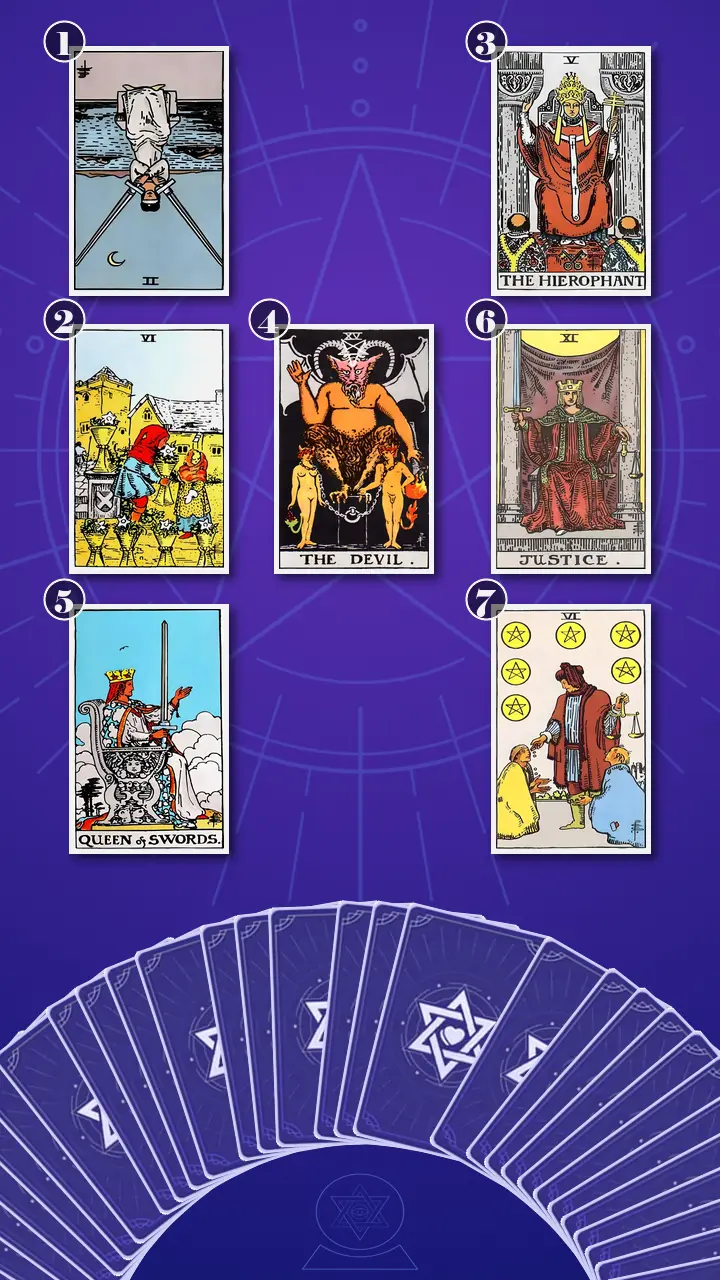
For this session, I chose my Energy Diagnostic Map (7) · Context Edition. When people ask me how tarot works in a situation like this, my answer is simple: it slows the problem down enough to show what is really making the decision feel impossible. A simple yes-or-no spread would have flattened Maya's dilemma into a single choice. A wider spread would have added detail without naming the family system clearly enough. This map is built for co-signing pressure from family because it tracks the visible freeze, the old loyalty reflex, the outside moral pressure, the core bind, the available resource, the reframe, and the next safe action.
I told her what mattered most in the layout before I turned a card. The first position would show her freeze-response the moment the request landed. The center card would reveal the knot that kept the loop repeating. The sixth would point to the transformation — the fairness-based shift that could separate care from liability. The seventh would show what support might look like if it stayed voluntary, clear, and financially safe.
Reading the Knot on the Left
Position 1: The Loop That Calls Itself Careful
Now turned over was the card that shows the visible freeze-response in the moment the co-sign request lands, including delayed replies and scenario-spinning. The Two of Swords, reversed.
I told Maya that this card could not have mirrored her lunch breaks more precisely. It was the Notes app, then the banking app, then the family text, then the lock screen, then back again — like having seventeen browser tabs open and none of them being the actual decision. The reversed energy told me the stalemate was no longer cleanly held; it was leaking into her body, her workday, her client emails, her evenings on the train home. This was blocked air under pressure: too much thinking, not enough naming.
I pointed to the blindfold and the crossed swords over the chest. She was not missing information anymore. She was selectively avoiding what she already knew because a clear answer felt emotionally expensive. Delay had started disguising itself as responsibility.
Maya let out a short laugh that had almost no humor in it. She rubbed her forehead and said that was accurate enough to be rude. She literally did that. In that moment, I watched the first layer of defense loosen — the tiny bitter smile, the inhale she did not mean to take, the way her fingers finally stopped gripping her phone.
Position 2: The Younger Sister Who Appears First
Next came the card for the inner tug — the sibling bond and the childhood caretaking reflex that makes no feel like disloyalty. The Six of Cups, upright.
This card always slows me down, because it is not cynical. It does not say the love is fake. It says the love may be arriving through an older role. I told Maya that the second her sibling sounded scared, part of her stopped being twenty-nine and slipped toward a younger, quicker version of herself — the easy helper, the peace-keeper, the one who soothed first and assessed later. In modern life, this is the part that hears stress in a sibling's text and starts rescuing before adult reality has even entered the room.
My perfumer's mind kicked in here. I told her I sometimes use what I call Family Energy Diagnosis, and one of the fastest ways I recognize it is by the scent trail of memory. Maya had already described Sunday morning: the kettle clicking off, the fridge humming, toast going a little too dark. That was not random detail. That was the nervous system reopening an old file — the smell of home, the smell of being useful, the smell of connection staying safe because she was the one who helped.
She went quiet after that. Her eyes softened first, then unfocused for a second, as if she were replaying a kitchen from years ago. When she finally nodded, it was small and almost embarrassed. She said she really did feel younger when it was them.
Position 3: When Family Helps Family Sounds Like Policy
The third position showed the external pressure — the system, message, or demand acting on her from outside. The Hierophant, upright.
I told her this was the moment her mother's phrase stopped sounding like an opinion and started sounding like policy. Family helps family. For Maya, that line landed like a Terms and Conditions page nobody remembers agreeing to but somehow still obeys. This was Hierophant energy in excess: inherited code, sanctioned rule, the authority of familiarity. It narrowed adult nuance until her body reacted before her mind could ask a single practical question.
I pointed to the formal posture, the blessing hand, and the kneeling figures. This was why her mother's text did not feel like input. It felt like a verdict. And once the verdict entered the room, Maya stopped treating the co-sign request as negotiable and started treating herself as if she were already on trial.
She pulled her lips inward and stared at the card for a long beat. Then she said something so many responsible daughters say in quieter words: when her mom said it, she stopped hearing it as a choice. Her shoulders rose again just as she said it, and that body truth mattered as much as the sentence.
Position 4: The Signature That Became Proof of Love
At the center of the spread sat the core blockage — the belief that love must be proven through financial risk and self-sacrifice. The Devil, upright.
I did not soften this card, because the situation did not need softness there. It needed accuracy. I told Maya this was the part where one signature stopped being paperwork and started feeling like proof of love. It was like an auto-renew contract you are scared to cancel because of the backlash fee. The chains on the card mattered to me more than the figure itself: loose chains, powerful pressure, a trap sustained as much by shame and obligation as by reality. She was not only scared of financial risk. She was scared of what refusing the risk would allegedly say about her love.
Her phone, sitting face down beside us, lit up briefly and went dark again. The timing was almost cruel. In the small silence after that flicker, the room felt heavier. I told her that co-signing, in this reading, was not just a legal detail. It had become an emotional contract she feared would decide whether she was the good sister or the cold one.
That hit hard. First her breathing stalled. Then her gaze slipped past the cards, not away from them but through them, the way people look when a sentence lands deeper than they wanted. Then came the smallest sound from the middle of her chest — not quite a sigh, more like unwilling recognition. She said that even before she chose, she already felt guilty. I told her yes. That was exactly the knot.
Position 5: The Clear Voice Already in the Room
The fifth position showed the resource she had not fully trusted yet — her capacity for clear language, financial reality-testing, and boundary-setting. The Queen of Swords, upright.
I loved seeing her here, especially after The Devil. I told Maya that her unused strength was not becoming colder. It was becoming cleaner. The Queen of Swords is the difference between a five-paragraph draft and a three-line message. She is kind without becoming compliant, brief without becoming cruel. In modern terms, she is the version of Maya who writes that she cannot co-sign, but she can help compare options this weekend — and then resists the urge to bury that boundary under six apologies.
The energy here was balanced air. Not detachment. Discernment. The sword and the open hand together said exactly what I needed her to hear: a clear limit can still be a loving answer.
I watched relief arrive in form, not sentiment. Her jaw unclenched a fraction. She leaned closer instead of away. Then she asked the question that told me the knot had started to open: did she really not need a perfect explanation? I shook my head. No courtroom defense of her finances. Just the truth, stated cleanly enough that guilt could not edit it on the way out.
When Justice Brought the Room Into Daylight
Position 6: The Scales, the Sword, and the Adult Question
When I turned the sixth card, the room changed in that quiet, unmistakable way it does when a reading stops circling and starts landing. Even the bergamot on the blotter had thinned enough for the cedar to come forward — drier, steadier, less persuasive and more true.
Now open was the card that points to the fairness-based reframe that separates care from liability and interrupts guilt-led decision making. Justice, upright.
I told Maya that this was the heart of the reading. After rent leaves your account and the family chat lights up again, the choice stops feeling like a financial question and starts feeling like a loyalty exam you never signed up to take.
This is not a love test you pass by chaining yourself to someone else's risk; hold the scales steady and let fairness, not guilt, decide what help looks like.
I let that sit between us for a beat. Then I translated it through the framework I use most often in family conflict: my Conflict Transformation System. I learned in perfumery that the first thing you smell is not always the thing that lasts, and family pressure works the same way. The top note here is the emergency in the group chat — the urgency, the stress, the typing bubbles, the part that says answer now. The heart note is the family rule — family helps family, good daughters do not hesitate, the responsible one absorbs the impact. The base note is what remains after the emotional flash burns off: the contract, the liability, the credit risk, next month's rent, future Maya still living with the decision. Justice asks which layer deserves the final vote.
Looking at that card, I had a quick flash of my training years in Paris. A fragrance could open beautifully and still fail if the structure underneath was unstable. Lovely intention did not rescue a composition that could not hold. Love is not exempt from structure either. That is why I said to her, more quietly this time, care is not the same as liability.
The reaction did not come as instant relief. First she froze, breath suspended halfway in. Then her eyes widened and lost focus, as if some internal replay had started — the Sunday kitchen, the rent withdrawal, her mother's text hitting like policy. Then the resistance rose. She looked back at me, almost angry, and asked whether doing this cleanly meant she should have known all along, whether she had been making it into something bigger than it was.
I told her no. It meant she had been carrying more meaning than the question deserved. I asked her, now, with this new lens, to go back to last week and find one moment when this insight would have changed the feeling in her body. She put a hand flat against her sternum. Her face shifted first from strain to surprise, then to a kind of grief, then finally to release. Her shoulders dropped. Her mouth trembled on an exhale. She said that if she had asked what was fair and sustainable, instead of what would make everyone least upset that night, she would have known the answer sooner.
That was the crossing point. Not from selfishness to generosity, but from guilt-driven hyper-analysis and fear of sounding selfish to calmer self-respect and fair adult support. Clarity did not make her invincible. It made her responsible to herself again, and I could see that land with both relief and a faint dizziness — the feeling people get when the fog lifts and the road is finally visible.
Position 7: A Defined Offer Instead of a Blank Check
The final card showed the next step — how to offer support in a measured, consent-based way without co-signing away safety or self-trust. The Six of Pentacles, upright.
I told her this card was beautifully practical. It was not a blank check. It was a defined offer. In modern life it looks like helping review documents, comparing lenders, researching tenant resources, sending a fixed amount she could truly afford, or sitting on the phone while her sibling made two hard calls. This is the difference between rescue and support, between handing over a whole debit card and making a clear, reality-based choice.
The energy here was grounded balance. Generosity with edges. The giver in the card holds scales for a reason: support works better when it is measured. I reminded her that she could be kind without becoming the collateral.
For the first time all session, Maya smiled without any bitterness in it. Not big. Just enough. Then she said that actually felt like help. And because it did, the room felt wider.
Care Without Collateral
When I looked at the whole spread, the visual architecture said everything. The left side was a knot: freeze, old sibling loyalty, maternal moral pressure. The center card tightened that knot into a false bind where a financial boundary looked like a moral failure. The right side opened into an exit lane: clear language, fair judgment, then practical generosity. This is why the family co-sign situation felt so stuck. The problem was never just the numbers. The problem was the meaning wrapped around the numbers.
Maya's blind spot was not that she lacked facts. It was that she kept using facts to postpone the decision instead of letting facts participate in it. She had been treating discomfort as evidence that she owed a yes. The transformation direction was simpler and harder: stop proving love by absorbing risk, and start defining help in forms that are clear, voluntary, and financially safe. That is how care grows up without going cold.
I told her one more thing before I gave her next steps: do not let guilt write a contract your future self has to live inside.
- The 20-Minute Facts WindowThis week, block one 20-minute slot in your calendar called co-sign facts only. Sit at your kitchen table or desk, put your real monthly non-negotiables in front of you — rent, transit, groceries, savings buffer — and review the actual risk once: credit impact, liability, and worst-case responsibility.If 20 minutes feels like too much, do 8. Write only three bullets: risk, limit, alternative support. Before you start, add a bright citrus note nearby — bergamot or grapefruit on a tissue is enough. I use this shared-space reset to help the body stay in the present adult moment instead of slipping back into the family emergency script.
- The Care vs Liability NoteOpen Notes and make two columns: Care and Liability. Under Care, list what you genuinely want to offer your sibling. Under Liability, write what you are not willing to sign for. Then say one sentence out loud in your apartment: I care, and I am not available for this specific risk.If saying it aloud feels intense, whisper it once or text it to yourself first. The moment guilt rises, remember that feeling cruel is not the same thing as being cruel.
- The Three-Line Clarity ScriptSend one direct text to your sibling, not five soft drafts to the whole family thread: I am not able to co-sign, but I can help by comparing options with you on Sunday for 30 minutes. If money support feels safe, make it capped and specific, like a fixed amount on a fixed date. After you send it, mute the group chat for one hour so you do not get pulled into instant damage control.Keep the limit and the help in the same message. Brief is not cold. If the conversation turns blame-heavy, you can pause it with: I am not discussing co-signing further tonight.

A Week Later, the Quiet Proof
Six days later, Maya sent me a screenshot. She had used almost exactly the sentence we built: she would not co-sign, but she could spend thirty minutes on Sunday comparing options and, if needed, send a small fixed amount on Friday. She told me she hit send, muted the thread, and then stood in her condo kitchen listening to the kettle as if it were the only sound in the world.
That night she slept straight through. In the morning, her first thought was still whether they would think she was cold — and then she smiled, because the thought no longer changed her answer.
This is what I mean by a Journey to Clarity. Tarot did not tell her to stop loving her family. It showed her where love had been getting confused with liability, and it gave her a next step she could actually live with. That is exactly why I reach for the Energy Diagnostic Map (7) when a family money decision feels morally loaded: it helps me guide someone back from fear, fusion, and people-pleasing with money into something steadier, more adult, and more self-respecting.
When the family thread lights up and your chest drops, it can feel as if one unread message is asking you to choose between belonging and your own safety. If that is where you are tonight, remember that noticing the false choice is already the beginning of finding clarity.
So when guilt tries to turn love into a contract, what kind of support would feel clear, voluntary, and safe enough that future-you could still breathe inside it?