From Splitwise Anxiety to Clear Trip Rules: A Family Money Reset

The 10:48 p.m. Splitwise Glow
You open the Splitwise request, do the math in your head, open your banking app, then close everything like it’s going to resolve itself—comparison fatigue’s cousin: accounting fatigue.
Jordan (name changed for privacy) said it like a confession, but their body had already said it first: the little jaw clench that happens before words, the chest tightening like a seatbelt locking when the car stops too fast.
They were in a downtown Toronto apartment, Wednesday night, under a duvet with the bedside lamp off. Their phone was on full brightness, warming their palm while the HVAC hum filled the silence too loudly. They opened the Splitwise notification, flicked to their banking app, back to Splitwise—trying to make the numbers and the family vibe line up at the same time.
“It’s a family trip,” they told me. “My mom just… sent it. No conversation. And it’s not that I’m mad about paying my share—I’m mad about not knowing what my share is.”
I watched their thumb hover over Settle up like it was a button that would lock in a version of them: either the easygoing one who absorbs the extras, or the difficult one who “makes it weird.”
The contradiction was clean, and it hurt: they wanted a fair, explicit split, but they were terrified that saying it out loud would sound ungrateful. The anxiety wasn’t an abstract feeling—it was like trying to whisper your way through a living room full of glassware, every step calculated, every breath too loud.
“We can make this practical,” I said, keeping my voice soft and level. “Not mystical. Just clear. Let’s draw a map for the part of you that freezes—so you can set one money boundary that keeps the trip fair and keeps you connected.”

Choosing the Compass: The Relationship Spread · Context Edition
I asked Jordan to take one slow breath in through the nose, then out through the mouth—not as a ritual for luck, but as a tiny nervous-system reset. While they breathed, I shuffled slowly, letting the sound be something steady and nonjudgmental in the background.
“For this,” I said, “I’m going to use a spread called the Relationship Spread · Context Edition.”
To you reading this: I choose this spread when the surface issue looks financial, but the real pressure is relational—when the numbers are doing double duty as a proxy for belonging, respect, or autonomy. It maps you, the other person, and the shared dynamic, then adds a spine for what’s hidden underneath, the principle that resolves it, and the practical next move. It’s how tarot works as a decision tool: not “predicting” your mom’s next text, but revealing what keeps repeating—and what changes the pattern.
Here are the anchors we’ll use: the first card shows your current avoidance workflow around the Splitwise link. The center card shows the actual giving/receiving dynamic between you and your mom. And the key card—up top—names the fairest boundary, the rule that keeps the trip from becoming an unspoken power contest.
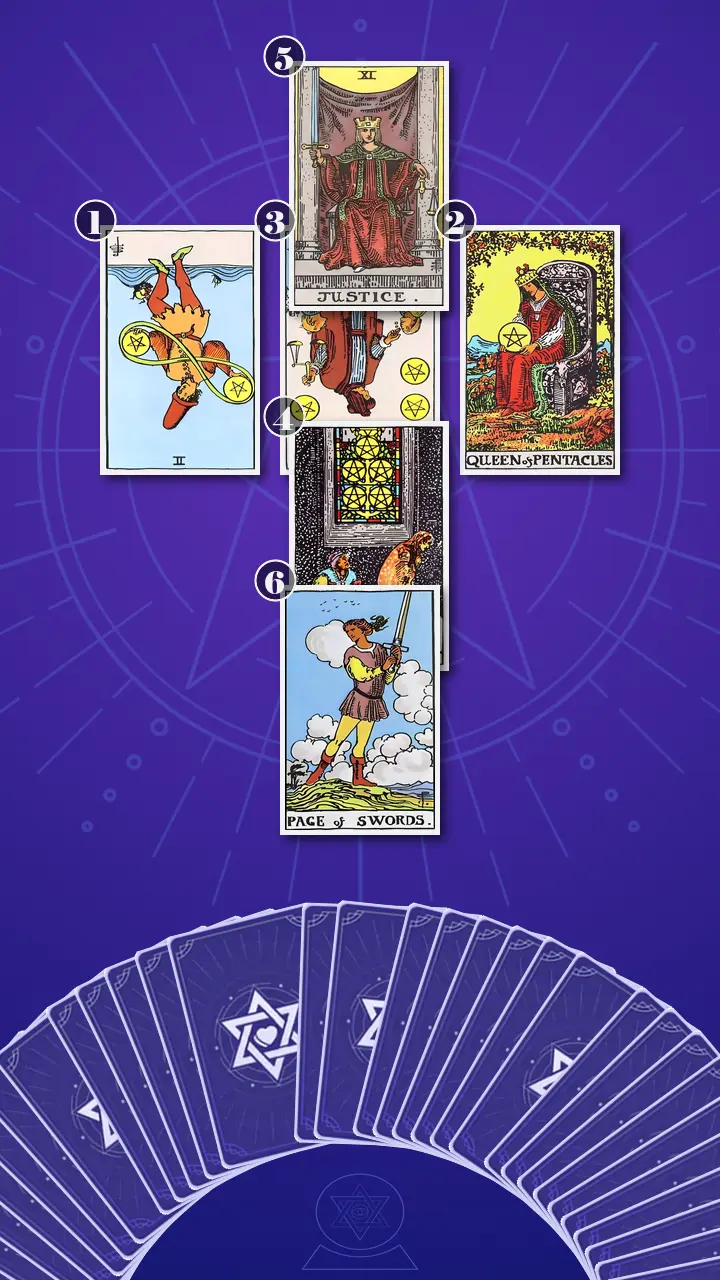
Reading the Map: When Money Feels Like Earth Weight
Position 1: Your current behavior pattern
“Now we’re turning over the card that represents your current behavior pattern with the Splitwise request—what you’re doing instead of addressing it directly.”
Two of Pentacles, reversed.
I didn’t have to reach far to translate it; Jordan was already living inside the image. “This is you toggling between Splitwise, your banking app, and Notes on your commute, redoing the same math and rewriting the same ‘polite’ text—because you’re trying to find a split that won’t upset anyone and won’t wreck your budget. The longer you loop, the more unstable you feel, so you stall instead of setting a rule.”
Reversed, this isn’t “you’re bad with money.” It’s Earth energy in distress: practicality overloaded, balance wobbling, the infinity loop becoming a doom-scroll. The coping behavior makes sense—stalling feels like control—but it quietly hands the steering wheel to the app.
Jordan let out a small, bitter laugh. Not agreement exactly—more like being caught. “Yep,” they said. “That’s exactly what I do. I open it late at night and… it’s like if I pay now, I’m agreeing. If I ask now, I’m rude. If I wait, I’m responsible… right?”
“Peace tonight versus clarity later,” I said, and saw their shoulders drop a millimeter at the simple naming of it.
Position 2: Mom’s likely mindset/approach
“Now we’re turning over the card that represents your mom’s likely mindset around trip expenses—how she frames responsibility and fairness.”
Queen of Pentacles, upright.
“Your mom sends Splitwise like it’s a casserole,” I said. “Practical, organized, meant to help. In her mind, she’s keeping the trip running smoothly—booking, paying, tracking—so nobody has to worry. But when it arrives with no conversation, it can feel like the terms were decided without you, and you’re supposed to be grateful and compliant.”
Upright, the Queen’s energy is care-through-structure. Balanced, it’s nurturing. Overdone, it becomes: ‘I handled it’ as a substitute for consent. I could feel Jordan’s resentment soften into something more precise: not “my mom is bad,” but “the framework landed on me without my input.”
Jordan stared at the card a second longer than the first. “She thinks she’s being responsible,” they said quietly. “And she is. That’s what makes it hard.”
Position 3: The money dynamic between you
“Now we’re turning over the card that represents the money dynamic between you two—how giving and receiving is actually operating.”
Six of Pentacles, reversed.
This is the one that stings because it names what everyone pretends isn’t happening. “Every Splitwise line item starts to feel like a referendum,” I said. “Who’s the generous one, who’s the taker, who’s ‘easygoing.’ You sense an uneven exchange—maybe someone books upgrades without checking, maybe someone assumes shared means everything—so you hesitate to participate at all, because you don’t trust the split is truly reciprocal.”
Reversed, the scales are still there—but the measurements are unclear. And when fairness is vague, power sneaks in. I told Jordan the line I’d been holding back, because it was true and clean: If the rule is ‘whatever got booked first,’ that’s not neutral—that’s just unspoken power.
Jordan went still in a three-beat chain: first a tiny pause in breathing, then their gaze unfocused like their brain was replaying old trips, then a slow exhale that sounded almost annoyed. “I hate that you’re right,” they said. “Because it makes me feel… dramatic.”
“You’re not too sensitive,” I said. “You’re sensitive to structure. And that’s adult.”
Position 4: What makes this so charged for you
“Now we’re turning over the card that represents what makes this so charged for you—the belonging fear under the surface.”
Five of Pentacles, upright.
“Under the money question is a deeper sting,” I said, letting the words land gently. “You don’t want to be the person who can’t keep up, who makes it awkward, who ends up outside the warm group moment. So you’d rather feel financially pinched in silence than risk sounding like you’re not grateful to be included.”
As I spoke, I thought of the stained-glass warmth in the card—warm window, cold sidewalk—and how perfectly it matched modern life: the family group chat banter glowing warm on the screen while you’re privately checking your balance like it’s a secret failing. That’s why a “simple” $60 charge can make the whole trip feel like a test.
Jordan’s shoulders softened, like they’d been bracing for impact and realized no one was going to hit them. “Wow,” they whispered. “It’s not just about the sixty bucks.”
When Justice Spoke: Finding Clarity in the Splitwise Spiral
Position 5: The fairest boundary to set (Key Card)
I let my hands rest on the deck for a beat before turning the next card. The video-call audio seemed to sharpen; even the HVAC hum in Jordan’s room felt like it lowered, as if the apartment itself was listening.
“Now we’re turning over the card that represents the fairest boundary to set—the principle that defines what gets split, what doesn’t, and how decisions are made.”
Justice, upright.
“Instead of guessing what ‘fair’ means and hoping the vibes stay good,” I said, “you put fairness into one agreed standard: what counts as shared, what’s optional, and how you all approve bigger costs before they hit Splitwise. This isn’t cold—this is what lets everyone relax, because nobody has to mind-read or quietly subsidize.”
Jordan nodded once, then immediately stiffened. “But if I do that,” they said, and there it was—an unexpected flash of anger under the guilt—“doesn’t it mean I should’ve done it earlier? Like I’ve been… letting this happen?”
I recognized that moment the way I recognize a planet as it clears the horizon. In my work at the planetarium, people think gravity is just weight. But gravity is also relationship—how bodies pull on each other until someone names an orbit.
“Can I put on my research hat for a second?” I asked. “This is where I use what I call Galactic Gravity Analysis. In families, the person who organizes—your Queen of Pentacles mom—often becomes the ‘mass’ everyone else orbits. Not because she’s a villain. Because she’s reliable. And if you’ve been the easygoing one, your orbit has been ‘absorb the extras so the system stays stable.’ Justice is you moving the family system from ‘whoever has the most gravity decides’ to ‘we all agree on the orbit.’ That’s not blame. That’s adulthood.”
Jordan’s mouth opened, then closed. They looked away from the camera, then back. They were right on the edge of their old rule—don’t make it weird—and their new one—clarity is care.
It’s 10:48 PM and you’re in bed, phone screen too bright. You open the Splitwise link again, flip to your banking app, then back to Notes—trying to find the one perfect number that won’t start a fight.
Stop trying to keep everyone happy by staying vague; choose a clear agreement and let Justice’s scales—not guilt—set the Splitwise rules.
I let silence do its job for two seconds.
Jordan’s reaction came in layers, not in a tidy movie moment. First: a visible freeze—breath caught high, eyes widening a fraction. Second: the thought landing—gaze drifting slightly off-screen, like they were watching a memory of themselves half-paying a charge just to stop the notification. Third: the release—jaw unclenching, shoulders lowering, a shaky exhale that sounded like relief and grief at the same time.
“Okay,” they said, voice smaller but steadier. “So… I don’t have to earn belonging by being quiet.”
“Exactly,” I said. “Clarity isn’t keeping score. It’s keeping consent.”
“Now,” I added, “use this new lens and look back at last week. Was there a moment—on the TTC, in the PATH food court, at 1 a.m. in bed—when this would’ve changed how you felt? When a simple rule would’ve saved you from doing customer service for everyone else?”
Jordan swallowed and nodded. “Tuesday,” they said. “The Line 1 ride home. I stared at ‘Settle up’ and my throat got tight. If I’d had a rule, I could’ve just asked. Not… spiraled.”
That was the shift: from tight, guilt-driven anxiety toward calm self-respect. Not perfect confidence—something more honest. A standard they could repeat.
Position 6: How to implement it
“Now we’re turning over the card that represents how to implement it—the next clear communication move.”
Page of Swords, upright.
“You send a short, direct, curious message—two sentences—then stop,” I said. “Not a speech, not a guilt-laced essay. Just: one question about what a charge includes, and one proposed rule going forward. You let clarity do the work instead of your anxiety doing customer service for everyone else.”
Upright, this is Air energy done well: clean, specific, brave. And it’s also permission. “You don’t need a perfect message,” I told them. “You need a repeatable rule.”
Jordan winced. “I don’t know if I can even find five minutes tonight,” they said, practical resistance kicking in. “The group chat is blowing up, and I’m already cooked.”
“Then we do the minimum viable version,” I said. “Two minutes. Notes app. You don’t have to send it tonight for it to count. We’re building the sentence so you can sleep.”
From Insight to Action: The One-Page ‘Justice Rule’ (No-Vibes Budget Agreement)
Here’s the story the cards told, in one line: you’ve been trying to stabilize the trip by doing silent math (Two of Pentacles reversed) while your mom expresses love through handling logistics (Queen of Pentacles). The shared dynamic has been “defaults become decisions” (Six of Pentacles reversed), and your nervous system reads that as a belonging threat (Five of Pentacles). Justice resolves it by replacing vibe-based fairness with explicit expectations—and Page of Swords makes it real with one clear text.
The blind spot wasn’t financial literacy. It was believing that silence keeps connection. In this spread, the transformation direction is the opposite: connection gets lighter when expectations get clearer. Shift from silently absorbing ambiguity to proactively naming a simple, shared rule for what gets split and what doesn’t.
To make this doable, I pulled one of my own tools off the shelf—my Solar Eclipse Mediation strategy. In an eclipse, alignment changes what you can see. This is a three-step alignment for a family money conversation: name the shared goal, name the rule, name the consent trigger. Short. Visible. Repeatable.
- Write the 140-character Trip Money RuleSet a 7-minute timer. Open Splitwise, but don’t pay yet. In Notes, write one line: “Shared = lodging + pre-agreed group meals; Extras = individual unless confirmed in the chat first.”Expect the inner cringe—your brain may call clarity “keeping score.” Keep it to one sentence. Clarity on paper still counts, even if you don’t send it tonight.
- Send the Two-Sentence Justice Text (one question + one proposal)In the family thread, paste: “Before I settle up—can we confirm what counts as shared for this trip? I’m good splitting lodging + pre-agreed group meals; extras I’ll handle individually unless we agree first.”No apology paragraph. If you’re worried about tone, add only: “Just so I can budget.” Then stop.
- Add a Big-Expense Consent CheckPick a number and name it: “If anything over $___ is going on Splitwise, can we check in first?” This turns momentum (“it’s already booked”) into consent (“are we all in?”).After you send, put your phone on Do Not Disturb for 20 minutes. Don’t live inside the reply.

Ownership, Not Certainty
A week later, Jordan emailed me a screenshot—not of a paid balance, but of a text they’d actually sent. Two sentences. No manifesto. They told me they hit send, put their phone on Do Not Disturb, and took a shower like they were rinsing off an old role.
“My mom replied ‘good idea’,” they wrote. “And my sibling asked what ‘extras’ meant, and I just… answered. I slept. I still feel a little shaky, but it’s not that 1 a.m. resentment spiral.”
That’s the Journey to Clarity I trust most: not dramatic confrontations, just one clean standard replacing a hundred silent calculations. In the Relationship Spread · Context Edition, the real win isn’t winning the thread—it’s letting money become logistics instead of a hidden emotional test.
When a Splitwise link lands and your chest tightens, it’s not because you can’t do math—it’s because you’re trying to buy belonging with silence while hoping fairness magically appears.
If you let “fair” be one simple rule you can actually repeat, what’s the smallest sentence you’d want your family to agree to before you pay anything else?