When Your Parents Vent Through You: Stepping Out of the Middle

The TTC Buzz That Turns You Into IT Support
If you’re a 20-something who can handle a chaotic work inbox, but one “Call me” text from a parent instantly spikes your heart rate—welcome to family triangulation.
Taylor sat across from me in my studio—26, Toronto, marketing coordinator energy still clinging to her like perfume on a scarf. She told me it always starts the same way: a vibration, a name on a lock screen, and her body reacting before her brain gets a vote.
“Last week,” she said, “8:47 p.m. on the TTC near Bloor-Yonge. The fluorescent lights were doing that hum. My phone buzzed—Mom. I answered even though my chest tightened, because if I don’t, I’ll spend the whole ride rehearsing what I should say later.”
She described the window glare reflecting her own face back at her, jaw already locking. Her mom vented, then slid in the line that always flips the switch: “Just tell your dad…”
Taylor’s thumb opened her Notes app like muscle memory. “And then I do it,” she said, voice small with annoyance at herself. “I translate. I soften. I do the emotional admin.”
What she wanted sounded so simple it almost hurt: “How do I stop being the messenger?”
But right under that was the real engine of the problem: wanting to step out of the middle—versus fearing she’ll upset one or both parents if she sets a boundary. She wasn’t worried about the boundary being rude. She was worried it would be interpreted as betrayal.
The tension in her didn’t look like a dramatic breakdown. It looked like a tight chest and a clenched jaw that didn’t even notice it was clenching. It looked like a buzzy, on-call feeling when her phone lit up—like her nervous system had been assigned pager duty for the family.
I nodded slowly. “You’re not overdramatic,” I told her. “And you’re not weak for reacting fast. Being the messenger isn’t a personality trait—it’s a role the system keeps rewarding.”
I let that land for a second, the way I let a top note settle before you chase the base. “Let’s make today practical,” I added. “We’re going to map the pattern, find the hook that keeps pulling you back in, and then get you to a boundary that’s clean enough to actually hold. A real Journey to Clarity, not a pep talk.”

Choosing the Compass: The Celtic Cross · Context Edition
I invited Taylor to take one slow breath with me—nothing mystical, just the kind of nervous-system handoff that tells your body, we’re not in an emergency right now. I shuffled while she held her question in mind: “How do I stop being the messenger without feeling like I’m choosing sides?”
“Today I’m using a spread called the Celtic Cross · Context Edition,” I said.
For readers who are curious about how tarot works in real life: a spread like this isn’t about predicting whether your parents will magically become emotionally fluent. It’s a structured way of tracking a system—what’s happening, what’s underneath it, what keeps it repeating, and what near-term move returns you to agency. It’s especially useful for family triangulation because the arc is clear: present pattern → underlying mechanism → boundary pivot → integration.
In Taylor’s case, we needed a map that could do two things at once: name the messenger loop without blaming her, and point to a boundary-and-communication pivot that restores role clarity without taking sides.
“A few positions matter most here,” I told her. “The first card will show your day-to-day messenger pattern. The crossing card will show what makes it hard to step out. The root card goes underneath—what’s really keeping the triangle glued together. And the near-future pivot card? That’s the move you can actually take the next time your phone lights up.”
Taylor exhaled like someone who’s been carrying decision fatigue in her jaw. “Okay,” she said. “I can do a map.”
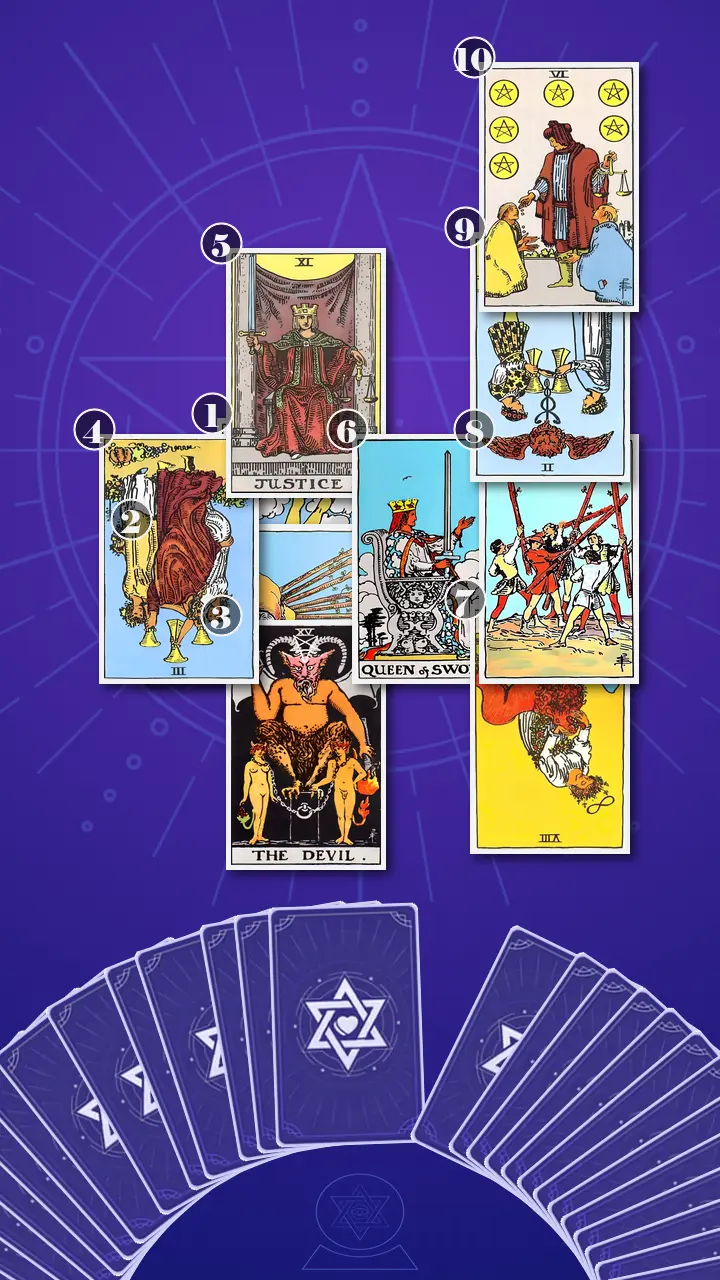
Reading the Map: When “Just Venting” Becomes a Job
Position 1: The current messenger pattern — Page of Swords (reversed)
I turned over the first card. “Now we’re looking at the position that represents the current messenger pattern: what you are doing and how it shows up day-to-day.”
Page of Swords, reversed.
“This is painfully literal,” I said, keeping my voice gentle. “In context, this card meaning isn’t ‘you’re bad at communication.’ It’s communication turned into surveillance. The Page becomes the family comms officer.”
I pointed to the restless posture in the image, the wind-whipped energy. “This is you answering mid-commute, then immediately opening Notes to draft a ‘neutral’ recap for the other parent. Screenshotting. Paraphrasing to soften. Rereading your own message until your eyes blur.”
Reversed, Page of Swords energy is a blockage: too much mental motion and not enough protection. It’s your nervous system treating every incoming message like it needs incident response.
Taylor let out a quick, bitter laugh—one sharp puff of air through her nose. “That’s… yeah. That’s exactly it. And it sounds kind of unhinged when you say it out loud.”
“It sounds like a system that learned to stay on guard,” I corrected. “Not unhinged. Trained.”
Position 2: The core challenge — Ten of Wands (upright)
I tapped the second position. “Now we’re looking at the core challenge: what makes it hard to step out of the middle.”
Ten of Wands, upright.
“This is emotional labor overload,” I said. “Your calendar and phone have become tools you use to carry everyone’s feelings: coordinating visits, smoothing tone, tracking who’s upset with whom. The load is so full you can’t see ahead—your own plans, rest, and focus get blocked by the bundle you’re carrying for them.”
Upright Ten of Wands is excess: responsibility that should be distributed, concentrated on one person because it’s easier that way.
“Let’s name three specific wands,” I suggested, because vagueness is how over-functioning stays slippery. “One: relaying messages. Two: scheduling logistics to prevent conflict. Three: tone-managing—editing so no one explodes.”
Taylor’s shoulders lifted toward her ears, then dropped. “And the worst part is I feel temporarily useful,” she admitted. “Like I’m preventing a blow-up. Then I feel quietly resentful and guilty for feeling resentful.”
“That’s the card,” I said. “Useful in the short term. Costly in the long term.”
Position 3: The root dynamic — The Devil (upright)
I slid my finger down to the base of the cross. “Now we’re looking at the root dynamic: the deeper mechanism that keeps the triangle in place.”
The Devil, upright.
“This is where I get very careful with language,” I told Taylor. “The Devil doesn’t mean your parents are villains. In a family-system reading, it usually means a binding rule—a guilt hook. Love-equals-compliance conditioning.”
In modern terms, it’s like a push notification that feels urgent but isn’t actually an emergency—except it’s in your chest.
“Even when you know you can say ‘I’m not doing this,’ your body reacts like you’re about to lose belonging,” I said. “Guilt and urgency pull you back into the middle—like an invisible chain tightening the second someone implies you’re ‘not caring’ enough.”
The Devil’s energy here is a compulsion: the automatic belief that if you don’t manage it, you’re a bad daughter and the family will implode.
Taylor stared at the card for a moment, eyes unfocusing the way they do when someone is replaying a memory. “My dad has literally said, ‘Wow, so you don’t care anymore,’ when I didn’t answer right away.”
“And your body learned that guilt equals danger,” I said. “Not because it’s true—because it’s effective.”
Position 4: The conditioning — Three of Cups (reversed)
I turned the next card. “Now we’re looking at the conditioning: how this pattern has been normalized over time.”
Three of Cups, reversed.
“This didn’t start as drama,” I said. “It started as closeness. Over time, being included became being responsible. You became the third point in a loop where their tension gets managed by pulling you in, not by them talking directly.”
Reversed Three of Cups is a distortion of support: the ‘group chat buffer’ dynamic. The triangle feels like connection, but it runs on spillover.
Taylor’s mouth tightened, then softened. “They both get nicer to me when they’re mad at each other,” she said, almost embarrassed. “Like I’m… the safe person.”
“That’s a real reward,” I said, not judging it. “And it’s also how the role keeps renewing itself.”
Position 5: Your conscious aim — Justice (upright)
“Now we’re looking at your conscious aim: what you think you ‘should’ do to make this fair or workable,” I said, and turned the card.
Justice, upright.
Justice in this position often shows up for people who have become their family’s neutral referee. “You try to be perfectly fair,” I told her. “Weighing both sides. Translating carefully. Making sure no one feels ignored.”
Justice is balance—but in this context, it becomes an inner rule: If I can just be fair enough, I can keep the peace.
I had a quick flash of my own training—Paris, evaluators in white coats, blotter strips lined up like evidence. In perfumery, ‘fair’ doesn’t mean ‘please every nose.’ It means structure: clear proportions, intentional choices. Trying to make every note equally loud makes a fragrance collapse into noise.
“Neutrality is not the same as responsibility,” I said, bringing us back. “Justice wants you to redefine what’s fair: it’s not fair for you to serve as the communication pipeline.”
Taylor nodded, slow and reluctant, like someone accepting a truth that’s been trying to land for years.
When the Queen of Swords Cut a Clean Lane
Position 6: The next pivot — Queen of Swords (upright)
I paused before turning the next card. The room felt quieter—not dramatic, just a subtle drop in background noise, like the city outside my window had taken one step back.
“We’re flipping the most important card for your near-term change,” I told her. “This is the next pivot: the most useful near-term approach to stop being the messenger.”
Queen of Swords, upright.
“This is direct communication, discernment, self-respect—without emotional over-explaining,” I said. “It’s the antidote.”
In modern life, the Queen of Swords looks like a short, consistent auto-reply that protects your inbox: polite, non-negotiable, repeatable. It’s you stopping the paragraph-writing and using one clean sentence: “I hear you, but I’m not going to relay messages—please tell them directly.”
I watched Taylor’s hands as I said that. Her fingers curled slightly, as if preparing to type. Her jaw tightened in anticipation of backlash.
Setup
In my mind I could see her on the TTC: phone lighting up, body reacting first—tight jaw, tight chest, that buzzy on-call feeling—while her brain tries to find the perfect wording that won’t upset anyone.
Delivery
Stop trying to phrase it perfectly for everyone; say it cleanly and let the Queen of Swords’ clarity do the separating work.
I let the sentence hang in the air for a beat.
Reinforcement
Taylor’s reaction came in a chain—three tiny movements that told me exactly where the work was. First: a brief freeze. Her breath stopped mid-inhale, and her eyes widened just a fraction, like the thought had startled her. Second: a cognitive drift—her gaze slid off the card and into the middle distance, like she was replaying every Notes-app draft, every “just to clarify,” every time she tried to edit her way out of conflict. Third: an emotional release that didn’t look like tears so much as gravity changing. Her shoulders dropped, and the muscles at the corners of her mouth softened into something almost relieved.
Then, unexpectedly, she got a little angry. “But if I say it cleanly,” she said, voice sharper, “and they get mad… doesn’t that mean I was wrong all this time? Like I’ve been enabling them?”
I didn’t rush past it. “It means you were surviving a system that rewarded you for carrying it,” I said. “And now you’re choosing something different. That isn’t you being wrong. That’s you growing.”
“Clear, kind boundaries aren’t a betrayal; they’re how you stop carrying conversations that were never yours to hold,” I added, more softly, because she needed permission as much as she needed strategy.
As a perfumer, I think in what the body recognizes instantly. Words are important, but so is state. “Can I show you a trick that makes this easier to do in real time?” I asked.
Taylor blinked. “Please.”
“This is where I use my Family Energy Diagnosis,” I said—my way of reading emotional flow through sensory preference, without pathologizing anyone. “Tell me: when your mom vents, if it had a smell, what is it?”
She surprised herself by answering immediately. “Something… sharp. Like vinegar? Or like… that cleaning spray.”
“And your dad?”
“Cologne. Too much. Like it’s trying to cover something up.”
I nodded. “So your nervous system has learned: sharp-cleaning-spray means ‘brace.’ Heavy-cologne means ‘manage.’”
“Here’s the lever,” I continued. “Before you send the Queen-of-Swords sentence, you need a scent cue that tells your body: I’m safe, and I’m not on call. Something calming, not sentimental. Lavender and bergamot are good—calm plus clarity. You keep a tiny rollerball by your keys or in your bag. Phone lights up. One inhale. Then one sentence.”
“This isn’t woo,” I said, because I could see her skepticism. “It’s sensory psychology. We’re building a clean lane in your nervous system so the clean lane in your communication can actually happen.”
Then I asked the question that anchors the shift. “Now, with this new lens—can you think of a moment last week when this would’ve changed your experience?”
Taylor swallowed. “Sunday night,” she said. “Two DMs after the group chat got weird. I stayed up another hour trying to write the perfect response.”
“That’s the move from your starting state to your desired state,” I said. “Not from ‘chaos’ to ‘perfect family.’ From tension-and-guilt to steadier self-trust. From being the router to being a person.”
And because she needed it said plainly: “A clear boundary isn’t you choosing a side. It’s you refusing a job you never applied for.”
The Ladder Out of the Triangle
Position 7: Your stance and agency — Strength (reversed)
“Now we’re climbing the right-hand staff,” I said. “This card represents your stance and agency: how you’re holding power, boundaries, and self-trust.”
Strength, reversed.
“This is the wobble,” I said. “Not because your boundary is wrong—because your nervous system is learning to tolerate disappointment without rushing to fix it.”
Strength reversed is a deficiency of steadiness in the moment after you set a limit. It’s the urge to send the follow-up text that softens, explains, apologizes—just to erase the discomfort.
Taylor nodded too fast. “I do that. I’ll set a boundary and then immediately walk it back because I can’t handle the… silence.”
“Exactly,” I said. “The silence feels like danger. But it’s just… space.”
Position 8: Family system pressure — Five of Wands (upright)
“Now we’re looking at family system pressure: how the environment reinforces the triangle,” I told her, turning the next card.
Five of Wands, upright.
“This is noisy conflict energy,” I said. “Pointed comments. Competing narratives. Overlapping arguments.”
It’s the group chat dynamic: one parent drops a comment, the other goes silent, then you get side DMs like you’re the moderator who didn’t ask for admin privileges.
Five of Wands is excess stimulation. And when the room is loud, the Page-of-Swords part of you wants to organize it. But the card’s truth is simple: the room isn’t yours to run.
Taylor let out a breath that sounded like she’d been holding it since childhood. “I always think if I could just explain it right…”
“One clean sentence beats five anxious paragraphs,” I said. “There is no perfect message that harmonizes a room that refuses direct communication.”
Position 9: Hope/fear — Two of Cups (reversed)
“Now we’re looking at hope/fear: what you’re afraid will happen if you stop translating,” I said.
Two of Cups, reversed.
“Your fear is that boundaries equal distance,” I said. “If you stop mediating, one parent will cool off, withdraw, or make love feel conditional. So you’re tempted to stay useful to stay close—even when that usefulness is the job that drains you.”
Reversed Two of Cups is a blockage in direct connection—not because you don’t love them, but because the channel keeps getting rerouted through you.
Taylor’s eyes shone, not crying, just wet in that way that happens when someone finally says the quiet fear out loud. “I hate that I think that,” she whispered. “Like love is… something I have to earn by being available.”
“It’s not weird that you think it,” I said. “It’s what the system taught you.”
Position 10: Integration — Six of Pentacles (upright)
“Now we’re at integration: what ‘success’ looks like when you return responsibility back to them,” I said, turning the final card.
Six of Pentacles, upright.
Two different cards in this spread show scales—Justice and Six of Pentacles—and that repetition matters. Justice is the abstract principle: fairness. Six of Pentacles is the lived practice: measured giving.
“This is the picture of success,” I told her. “You can offer empathy, a timed call, a check-in—while refusing to relay messages or contain their conflict. Support becomes intentional and measured, not automatic and endless.”
Six of Pentacles is balance grounded into behavior. It’s not a magically fixed family. It’s calmer contact with clearer roles.
“Their conflict can be real without becoming your responsibility,” I said, and Taylor’s whole face loosened like she’d been waiting for someone to say that in exactly that order.
From Fairness to Role Clarity: Actionable Next Steps That Actually Hold
I leaned back and summarized what the spread had said in plain language—because clarity isn’t the vibe, it’s the structure.
“Here’s the story your cards are telling,” I said. “You’re stuck in a family communication loop where you’ve become the easiest route between two adults who avoid direct contact. Page of Swords reversed shows the hyper-vigilant messaging: monitoring tone, drafting, rewriting. Ten of Wands shows the overload: you’re carrying emotional labor and logistics that were never assigned to you. Underneath, The Devil shows the binding hook: guilt that equates love with compliance. Justice shows your mind’s solution—try to be perfectly fair—while the Queen of Swords offers the real pivot: a clean boundary script that reroutes communication back to its rightful drivers. Strength reversed says the practice will be holding steady through discomfort. And Six of Pentacles says success is measured giving: care with limits.”
“Your cognitive blind spot,” I continued, “is thinking the solution lives in perfect wording. But the pattern is structural. The transformation direction is exactly this: shifting from ‘I must translate and carry their feelings’ to ‘I can set a boundary and return ownership of their communication back to them.’”
Then I gave her a small plan—because actionable advice is what turns insight into breath.
- Save the Queen of Swords ScriptIn your phone, create a Text Replacement snippet with: “I hear you. I’m not going to pass messages—please tell them directly.” Next time a parent vents and implies you should relay it, send only that sentence. No recap. No translation.Resistance plan: expect the guilt spike like a wave. If one sentence feels too sharp, add one softener that doesn’t reopen negotiation: “I care about you, and I’m not going to relay messages.”
- Hold-the-Line Timer (Strength Practice)After you send the script (or set any limit), put your phone on Do Not Disturb for 10 minutes. Don’t check read receipts, don’t send a follow-up, don’t “fix it.” Just let the discomfort exist without solving it.Lower-the-bar version: start with 2 minutes. Pair it with a physical reset: 5 slow breaths + unclench your jaw + loosen your tongue from the roof of your mouth. Repeat: “Discomfort isn’t danger.”
- Use Scent as a Boundary Anchor (Luca’s Practical Shortcut)Keep a tiny calming rollerball (bergamot + lavender, or any “clean calm” scent you like) by your keys. When your phone lights up with a parent’s name, take one inhale first, then send the one-sentence script. This trains your body out of “on-call” mode while your words reroute the conversation.Make it easy: leave it where your hand already goes (bag pocket, by your charger). This isn’t about fragrance aesthetics—it’s about building a repeatable nervous-system cue.
Taylor frowned, then gave me a look that was half laugh, half panic. “But I don’t have ten minutes,” she said. “I’ll be at work. Or on the TTC. Or they’ll keep texting.”
“That’s real,” I said. “So we adjust without abandoning the point. Make it two minutes. Make it one minute. Or make it ‘until the next stop.’ The goal isn’t to win a boundary Olympics. It’s to prove to your body that you can set a limit and survive the discomfort.”
“And if they escalate?” she asked.
“You exit,” I said simply. “A clean ending sentence is part of the Queen of Swords toolkit: ‘I’m going to hop off now—talk later.’ You’re allowed to stop.”

A Week Later: The Quiet Proof
A week later, Taylor sent me a message that was almost anticlimactic—in the best way.
“Mom tried the ‘just tell Dad’ thing,” she wrote. “I used the snippet. Then I put my phone on Focus for two minutes and stared out the streetcar window like it was a grounding exercise.”
She added: “I felt guilty. I didn’t die. Also… I slept.”
Her bittersweet detail came right after, as if she didn’t want to romanticize it: she slept a full night, but when she woke up her first thought was, What if I made it worse? Then she said she actually laughed a little—quietly—because for the first time, the fear wasn’t driving the car. It was just riding along.
That’s the kind of success Six of Pentacles promises: not a perfectly repaired family, but a measured exchange where you don’t donate your nervous system.
When I looked back on her reading, what stayed with me was how quickly clarity arrived once we stopped chasing perfect phrasing. Not certainty—clarity. The shift from being the family’s router to being a person with a boundary and a life.
When your phone lights up and your chest tightens, it’s not because you don’t love them—it’s because you’ve been trained to believe that belonging depends on staying in the middle.
If you didn’t have to carry their conversation for them, what would you want your next contact with each parent to feel like—just for you?