When Your Sister Asks Again: Turning Venmo Rescue Into Boundaries
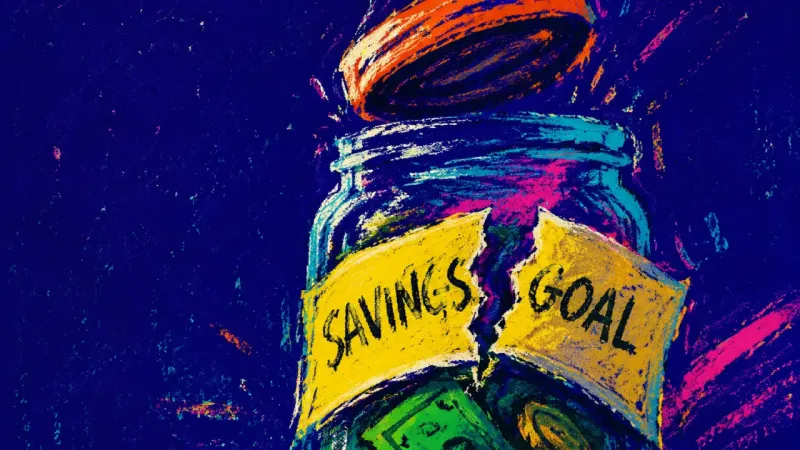
Finding Clarity in the 11 p.m. Venmo Spiral
You’re the NYC friend/sibling who can run a sprint planning meeting at 11 AM, but one “Can you help me just this once?” text at 11 PM sends you into a Venmo guilt spiral.
Casey (name changed for privacy) said it like she was confessing a petty crime, but her hands told the truth. She’d barely sat down before she checked her lock screen again—like her sister’s name might reappear if she blinked wrong.
“It was 11:26 last night,” she said. “Dark room, phone was basically the only light. The screen felt… hot? Like it was burning into my palm.”
I could almost hear the city behind her words: the distant siren, the radiator hiss, the tiny hum of a roommate’s Netflix through a wall. She described the body part first—tight chest, jaw set, that keyed-up, can’t-sit-still energy—and the money second. The amount wasn’t even huge. The urgency was.
“If I say no,” Casey said, voice small but firm, “I’m basically leaving her to drown.” Then, softer: “And I hate that I feel resentful, but I do.”
I nodded, slow. “That makes sense. And I want to normalize something right away: Sending money fast isn’t generosity—sometimes it’s how you stop the guilt from screaming.”
Her eyes flicked up, like that line landed in her ribs.
“So the question,” I said, keeping my tone steady, “isn’t just ‘Do I lend or not?’ It’s: Is this love, or is this my childhood role running the show? Let’s see if we can turn that fog into a map—something you can actually use the next time her text hits.”
Choosing the Compass: the Decision Cross for Money Boundaries
I asked Casey to take one breath that was noticeably longer than the last. Not as a ritual for the universe—just as a signal to her nervous system: we’re not in crisis, we’re in choice.
While I shuffled, I thought of my old life working with travelers at sea. On a ship, you don’t dock just because someone yells “Now!” You dock when you’ve checked the conditions—tide, weather, timing, capacity. Even generosity needs a docking plan.
“Today,” I told her, “we’ll use a spread called Decision Cross · Context Edition.”
For anyone reading along: this is a five-card decision spread for a yes-or-no crossroads, but it’s designed to do something more useful than predict the future. It compares two paths (lend again vs. stop rescuing) while also naming the hidden driver—the part that makes this feel morally loaded, like your entire identity is on trial. That’s exactly why this spread works for financial boundaries with family: the problem is rarely just the dollars; it’s the emotional charge that arrives with the request.
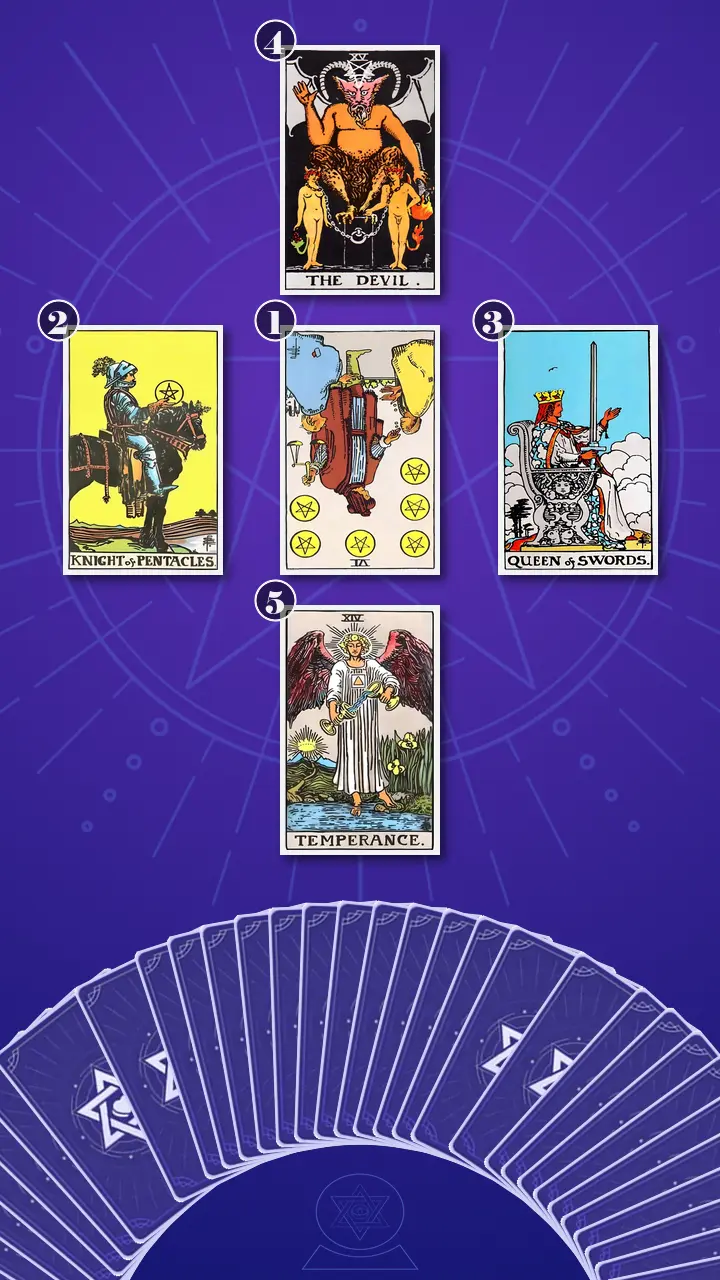
We’d read it like a compass: the center card shows the current dynamic; the left card shows what lending reinforces; the right card shows what a boundary activates and protects; the top card reveals what’s actually steering you beneath the surface; and the bottom card gives one grounded next step you can take—something actionable, not dramatic.
Reading the Map, One Card at a Time
Position 1: The current dynamic (what your body and behavior do)
“Now flipping over is the card that represents the current dynamic: what your body and behavior do when your sister asks for money, and what imbalance is being recreated in the relationship.”
Six of Pentacles, reversed.
I pointed to the image’s scales—balance, fairness, the invisible math. “This is the ‘human emergency fund’ pattern,” I said. “In modern life it looks like: you’re on the couch after work, Slack still pinging, you get her text, you send the money the same day because it instantly drops the tension in your chest… and then you spend the next three days rereading the thread, tallying fairness in your head.”
Reversed, the Six of Pentacles is rarely about being a bad person. It’s about imbalance. Generosity turned into a regulation strategy. An exchange that never fully reconciles—like a spreadsheet where the numbers add up, but it still doesn’t feel fair.
“Energy-wise,” I added, “this is blockage in Earth—money, stability, reciprocity. The giving happens fast, but the agreement is fuzzy, so your body keeps trying to ‘solve’ it later with rumination.”
Casey let out a short laugh that sounded like a cough. “That’s… too accurate,” she said, and the corners of her mouth tightened. “Like, kinda brutal.”
“I know,” I said gently. “But ‘accurate’ is what lets us fix it without shaming you. The card isn’t accusing you—it’s showing you the mechanism.”
Position 2: Path A (lend) — what lending again would reinforce
“Now flipping over is the card that represents Path A: what lending again would reinforce, and what it would temporarily relieve.”
Knight of Pentacles, upright.
“If you do lend,” I said, “this card only works in one mode: slow, explicit, and boring.” I tapped the pentacle. “It’s a contract energy. Capped amount, a date, and a clear statement that this is support—not an endless refill.”
The modern-life version is painfully specific: lending becomes a mini project plan. It can relieve your immediate guilt because you still get to be the dependable one. But it can also reinforce the role where you’re quietly managing her cash-flow like it’s another workstream—while your own goals (savings, moving, breathing room) take the hit.
“This is balance in Earth if you add terms,” I said. “But it flips to excess if it turns into you being her long-term maintenance plan.”
Casey’s shoulders rose like she was bracing for another sprint. “That’s what happens,” she admitted. “I start thinking about follow-ups and dates. Like… how did I become the finance department?”
Position 3: Path B (stop rescuing) — what changing the pattern would activate
“Now flipping over is the card that represents Path B: what saying no or changing the pattern would activate, and what it would protect.”
Queen of Swords, upright.
“This is the boundary card everyone thinks is ‘cold,’” I said, “but it’s actually clarity as kindness.” I nodded toward the raised sword. “One clean sentence. No loopholes.”
I gave Casey the modern translation: if you stop rescuing, the work is language. A short, clear “I can’t send money,” without the essay. Not because you don’t care—because you’re done trying to control how she feels about your limit.
“Think of it like an out-of-office message,” I said. “Clear, respectful, not a debate.”
Then I said the line I’ve watched people save to their Notes app like a lifeline: Care is one sentence. The limit is one sentence. The rest is you begging to be understood.
Casey swallowed. Her throat moved before she spoke. “I rewrite my texts like five times,” she said. “I’m basically… preemptively arguing my case.”
“That’s the Queen of Swords lesson,” I replied. “You can be warm without being porous.”
Position 4: The hidden driver (why this feels morally loaded)
“Now flipping over is the card that represents the hidden driver: the childhood role, fear, or attachment that makes this feel urgent and morally loaded.”
The Devil, upright.
The room got quieter in that specific way it does when someone finally names the thing under the thing. Outside the window, a passing car sent a brief sweep of light across the table—like a torch flare, gone in a second.
“This isn’t about your sister being ‘bad,’” I said. “This is about the moment your body decides you have no choice.”
I pointed to the loose chain around the figures’ necks. “The detail everyone misses: the chain is looser than it feels.”
And I described the split-second I hear in Casey’s story, in clipped internal dialogue—because that’s how compulsion sounds in real life:
No choice.
Just do it.
Fix it.
…and then, quieter: I can pause.
“The Devil is blockage in choice,” I continued. “The money request becomes an identity test: ‘If I don’t rescue, I’m not a good sibling. I lose belonging.’”
This is where my Jungian brain always goes: not to blame, but to pattern. “When you Venmo immediately,” I said, “you’re not just helping. You’re also avoiding the discomfort of a boundary conversation. That’s not a character flaw—that’s a nervous system strategy.”
Casey nodded without looking up. Her jaw worked like she was trying to unclench a truth. “Oof,” she said. “Yeah. It’s like… I pay so I don’t have to feel the guilt.”
“Exactly,” I told her. “And that means the first crack in the pattern isn’t a perfect speech. It’s a micro-choice: the pause.”
When Temperance Poured Between Two Cups
Position 5: Best next step (a grounded boundary that keeps you caring)
I held the last card for a beat before turning it, letting the reading’s center of gravity settle. “This one,” I said quietly, “is the bridge—where we stop swinging between ‘resentful yes’ and ‘panic no.’”
Temperance, upright.
In the setup, Casey was right back in that 11:26 PM scene—dark room, phone glow, chest tight—where her body moved before her mind caught up, and the fastest relief was a transfer. She’d been living inside a binary: save her or abandon her; be generous or be safe.
Stop treating every request like an emergency you must fix, and start blending care with structure—like Temperance pouring two cups into one steady, livable solution.
Casey’s reaction came in a chain—three small moments that told me the insight had found the exact tender spot.
First, a freeze: her breath paused, and her fingers hovered near her phone like she’d almost reached for it.
Then the cognitive shift: her gaze unfocused, like she was replaying the last request in her head with the volume turned down—seeing the “loose chain” detail for the first time.
Then the release: a slow exhale through her nose, shoulders dropping by a fraction. Not relief like a party. Relief like putting down a bag you didn’t realize you’d been gripping with your teeth.
“But,” she said, and there was a flicker of resistance—almost anger—“if I do that, doesn’t it mean I’ve been doing it wrong this whole time?”
I kept my voice soft and plain. “No. It means you’ve been doing what worked to survive the feeling. Temperance isn’t ‘you were wrong.’ Temperance is ‘you’re ready for a sustainable method.’”
This is where I used my Choice X-Ray—the lens I developed working with travelers making big, emotional decisions mid-voyage. “Let’s scan what each option really buys you,” I said. “Impulse transfer buys you tonight’s relief. The hidden cost is three days of resentment and a relationship built around emergencies. Temperance buys you discomfort now—a pause, a boundary—and the benefit is self-trust later.”
Then I anchored the reframe, because it matters: A boundary isn’t a wall. It’s the container that keeps your help from turning into resentment.
I leaned in. “Now, with this new lens—Temperance as pacing—think back to last week. Was there a moment where a pause, even two hours, would’ve changed how you felt?”
Casey nodded, eyes a little wet but steady. “Right after I hit send,” she whispered. “I felt sick. If I’d paused… I would’ve realized I didn’t even want to.”
“That,” I said, “is you moving from guilt-and-urgency rescue mode to steadier compassion with clear limits. Not abandoning her. Choosing a way to stay kind and stay whole.”
The One-Page Container: Actionable Next Steps for a Sister Money Request
Here’s the story the cards told, in one clean line: the Six of Pentacles reversed shows a pattern where money is used to regulate guilt and keep the peace; the Knight of Pentacles shows that if you lend, it needs terms or it becomes unpaid emotional labor; the Queen of Swords shows that language is the lever (short, clear, no essays); the Devil reveals the real engine—obligation confused with love—and Temperance resolves it by blending care with structure, turning crisis response into a repeatable system.
The cognitive blind spot was simple and painful: Casey had been treating speed as proof of love. The transformation direction was just as simple: move from automatic lending to a 24-hour pause where you choose one clear boundary-based response (no, structured loan, or non-cash support) and communicate it without over-explaining.
I framed it using one of my cruise-trained tools—the Port Decision Model. “You don’t dock in the dark just because someone’s waving from shore,” I told her. “You set a docking window. You check capacity. You enter on purpose.”
- The 24-hour pause textWithin 10 minutes of her request, send: “I hear you. I’m going to look at my budget and get back to you tomorrow.” Then close Venmo/Zelle and do not negotiate that night.If 24 hours feels impossible, start with 2 hours. Your goal is a quieter nervous system, not a perfect boundary.
- The Two-Cups Reply (care + limit)Write this in Notes, then send only two sentences: (1) Care: “I’m sorry you’re dealing with this.” (2) Limit + offer: “I can’t send cash, but I can help you make a plan / call the company / look for resources.”Allow yourself exactly one extra sentence if you must—no more. Over-explaining is the Devil’s chain disguised as kindness.
- The Family Help Cap (one line item)This week, choose a monthly number you can live with (even $0 or $25) and label it “Family Help.” When requests come in, you’re not deciding from scratch—you’re checking the container.Reframe the discomfort: systems aren’t cold. They’re how you keep generosity from turning into resentment.

A Week Later: Ownership, Not Certainty
A week later, Casey texted me a screenshot: her sister’s ask, and beneath it Casey’s new reply. Two sentences. No essay. No apology parade. Casey wrote, “My chest still did the thing, but I didn’t send money. I walked around the block, then came back and offered to help her call the billing office.”
That’s what a real Journey to Clarity looks like in the wild: not perfect peace, but a new kind of space—enough room to choose.
And if tonight, a request hits and your chest tightens, it can feel like you’re choosing between being loving and being safe—like one “no” would rewrite your whole identity as the ‘good sibling.’
If you gave yourself one pause—just long enough to breathe—what would a “care + limit” reply sound like in your own words?