From Over-Explaining to One Policy: A Home-Access Boundary With Mom

Finding Clarity in the 8:47 Hallway Buzz
“It’s normal,” Jordan told me their mom had said. “Just for safety.”
And Jordan—28, Toronto, paying a premium for a solo apartment that finally feels like quiet they can afford—felt the guilt hit before they even formed an opinion. The kind of guilt that arrives fast, like an auto-play ad you didn’t click.
They described a Tuesday at 8:47 PM: stepping out of the elevator into a condo hallway that smelled faintly like someone’s takeout. The overhead lights had that fluorescent buzz that makes everything feel slightly exposed. Jordan slid their key in, turned it, and then—without thinking—checked the deadbolt twice. Shoulders up near their ears. Stomach tight like it was holding its breath.
Then the ritual: Notes app open, phone screen warm against their palm, thumb hovering over an unsent draft. A five-paragraph explanation that tried to cover every angle—condo security, emergencies, landlord rules, love, trust—until it became a TED Talk no one asked for.
“I want to say no without it turning into a whole emotional event,” Jordan said, and there was that familiar split underneath: wanting closeness and peace with your mom vs fearing that saying no will trigger conflict, guilt, or emotional fallout.
I nodded slowly. “I hear how much you care about staying warm with her. And I hear how much your body wants your front door to be yours.” I paused, letting that land. “We’re not here to write the perfect justification. We’re here to find clarity—so you can set one simple access rule and keep your relationship intact.”
“Because,” I added, “it’s not the key. It’s the access.”
Choosing the Compass: Celtic Cross · Context Edition
I’m Alison Melody. Most people find me through my radio work—music therapy, sound psychology, the practical science of why certain rhythms calm a nervous system faster than a pep talk ever could. In readings, I use tarot the way I use sound: not as a verdict, but as a map.
I asked Jordan to take two slow breaths—not as a mystical thing, just a nervous-system reset. “Hold the question in your mind,” I said, “like you’re holding a single note in a song.” Then I shuffled. The soft rasp of the cards in my hands made the room feel more grounded, less like a courtroom in Jordan’s head.
“Today we’ll use the Celtic Cross · Context Edition,” I told them. “It’s based on the classic Celtic Cross, but phrased to focus on a boundary-setting process—what keeps it unresolved, what it symbolizes underneath, and what makes it sustainable.”
For you reading this: the reason this spread works so well for something like ‘my mom wants a spare key’ is that it separates logistics from meaning. It shows the present loop, the obstacle, the emotional root, the inherited family script, your conscious values, the near-term communication move, and then the inner/external dynamics that make the whole thing feel loaded.
“We’ll pay special attention to three points,” I said, pointing lightly as I laid the cross and the spine of cards: “What you’re doing right now that keeps this in motion. What’s underneath the request emotionally. And the integration card—how to hold the line without turning cold.”
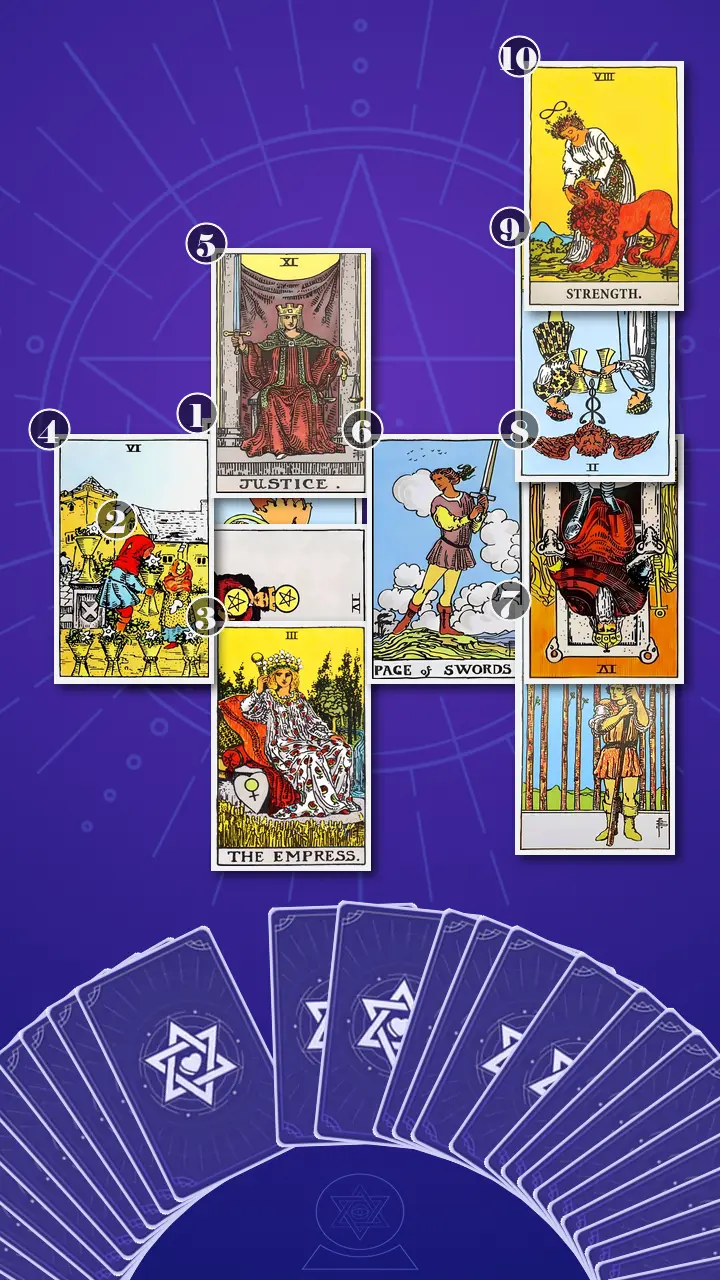
Reading the Map: The Doorway and the Backbone
Position 1: What you’re doing right now that keeps the boundary unresolved
“Now turning over,” I said, “is the card that represents what you’re doing right now that keeps the boundary unresolved—the observable juggling behavior.”
Two of Pentacles, reversed.
I traced the image with my fingertip in the air: the infinity loop, the juggler’s dancing stance, the rough waves behind him. “This is your Notes app spiral in card form,” I said. “Warm version. Firm version. Safety version. Apology stack. Then… nothing gets sent.”
I kept it concrete, because that’s where tarot becomes useful. “It looks like: you’re in your entryway, keys still in hand, double-checking the lock, drafting a perfectly balanced message that avoids conflict and protects your space. You keep switching versions until you’re drained. And the draining becomes the excuse to postpone.”
Energetically, reversed Two of Pentacles is overwhelm and instability—a blockage. Not because you can’t handle life, but because you’re using motion to avoid landing. It’s like moving tasks around in a Notion board instead of clicking the one scary task: Do the thing.
Jordan let out an unexpected sound: a tight, almost laugh-like exhale. Then their shoulders dropped a millimeter. “That’s… painfully accurate,” they said. “It’s like you read my drafts. Which is rude.”
I smiled gently. “Yeah. Tarot can be a little blunt. But it’s blunt in service of relief.”
Position 2: The main obstacle—what makes a simple “no” hard to deliver
“Now we’re looking at the main obstacle,” I said. “The thing that makes a basic boundary feel emotionally unsafe to deliver and maintain.”
Four of Pentacles, upright.
“This is the clench,” I said, keeping my voice calm. “Coins under the feet, one pressed to the chest. It’s your body saying: I finally have something that’s mine—please don’t take it.”
I translated it into Jordan’s real life. “You pay a premium to live alone. So the spare-key request hits like someone trying to put their hand on the steering wheel of the one area you finally control. Jaw tight. Shoulders up. Tone sharpening.”
Four of Pentacles isn’t wrong for wanting protection; it’s just fear-based protection. The energy is control as self-defense. “The risk,” I told them, “is that you protect your space so tightly it turns into a fortress. Then the conversation starts sounding like a standoff—even if you’re trying to be nice.”
Jordan’s fingers curled around their mug like they were testing how hard they were gripping. “I do get cold,” they admitted. “And then I hate myself for it.”
Position 3: The emotional root—what the spare key symbolizes
“Now we’re under the surface,” I said. “This card represents the emotional root—what the spare key symbolizes underneath the practical request.”
The Empress, upright.
“Okay,” I murmured, softer. “This is love.”
And here’s where I used one of my diagnostic tools—what I call Generational Echo. In music therapy, certain songs aren’t just songs; they’re memory containers. Families carry themes the way playlists carry moods.
“Tell me something weirdly specific,” I said. “When your mom is cooking or cleaning—what’s playing?”
Jordan blinked, surprised by the question. “Old-school R&B. Like… songs she knows every word to. It’s comforting.”
“Exactly,” I said. “So here are the two subtitles running at once.”
Mom’s language: ‘Safety. Care. Trust. Just in case.’
Your language: ‘Consent. Privacy. Adulthood. Predictability.’
“She says ‘just in case,’ and you hear ‘prove you’re still mine,’” I said—carefully, not accusing. “Not because she’s evil. Because in your family’s emotional playlist, closeness might have been measured by access. Being included meant being able to enter.”
Jordan’s eyes softened—then tightened again, like tenderness and resistance had to share the same face. “Yeah,” they whispered. “She’s loving. I just… don’t want love to mean keys.”
Position 4: The inherited pattern—past family norms about access
“Now we’re looking at the inherited pattern,” I said. “The old ‘normal’ that’s still running in the background.”
Six of Cups, upright.
“This is the card of old permissions,” I said. “The sweet, unspoken rule: doors were open, people dropped in, closeness was casual.”
In modern terms: if your childhood home had that vibe—family coming and going, no one knocking, privacy being ‘for later’—your nervous system learned that saying no to a caregiver equals danger. Not physical danger necessarily. Emotional danger: tension, distance, the chill in the air that lasts for days.
“This card explains why you can feel eight years old the moment she presses for a ‘simple’ sign of trust,” I said.
Jordan nodded once, slowly, like their body recognized the script before their brain wanted to admit it.
Position 5: Your conscious value—what you want this to be based on
“Now,” I said, “is your conscious value—what you want the relationship and the boundary to be built on.”
Justice, upright.
I felt my whole tone straighten—not harden, just align. “Justice is you wanting a clean agreement. Adult-to-adult. Fair.”
“This is where you stop trying to win an argument and instead propose a policy you can live with long-term,” I said. “Like Airbnb house rules: warm welcome message, firm access policy. Clarity is kindness.”
Justice is balance, but it’s also the sword—direct language. “A helpful prompt,” I told Jordan, “is: if this were a roommate asking for a key, what would your policy be without thinking?”
Jordan’s mouth twitched. “If it were a roommate, it’d be… an immediate no. No debate.”
“Right,” I said. “Justice doesn’t ask you to be mean. It asks you to be consistent.”
Position 6: The next conversation step—the message that actually gets sent
“Now we’re at the near future,” I said. “The next conversation step—the most constructive way to communicate.”
Page of Swords, upright.
“This is the card that says: send the one sentence,” I told them. “Not because you feel fearless. Because you’re willing to be precise.”
I held my phone up between us (screen dark) like a prop. “This is what Page of Swords looks like in 2026 Toronto,” I said. “One line. Then one loop-stopper line.”
Text (line one): “I’m not comfortable with anyone having a spare key to my place.”
Text (line two, if it loops): “I hear you—my answer is still no spare key.”
Jordan swallowed. Their phone was face-down on the table, but their hand drifted toward it anyway, like muscle memory.
“A boundary you can repeat beats an explanation you can’t finish,” I added, watching them absorb it.
Position 7: Your inner stance—how you’re bracing for pushback
“Now,” I said, “is you—your inner stance.”
Nine of Wands, upright.
“You’re already braced,” I said. “Bandaged head energy. Last-wand-as-guardrail energy.”
This card isn’t calling you dramatic—it’s calling you experienced. “Some part of you expects pushback because you’ve had to defend your needs before,” I said. “That’s resilience. But it can also make your voice sound guarded from the first syllable.”
Jordan exhaled through their nose. “I walk into the conversation like I’m pre-defending myself.”
“Exactly,” I said. “We’re going to keep the firmness, and lower the fight.”
Position 8: External pressure—where authority/control shows up
“Now we look at external pressure,” I said. “Where someone’s definition of ‘reasonable’ is being treated as the rule.”
The Emperor, reversed.
“This is the vibe of: ‘I’m your parent, so I should have access,’” I said plainly. “It turns a request into something that feels like entitlement.”
I gave a modern analogy Jordan would feel in their bones. “Think about condo fobs and building management. There’s a policy. Not a negotiation. You can be friendly with the concierge and still not get a master key.”
“When she says it like a given,” I continued, “your nervous system hears an order. And then you start scanning for an authority to justify yourself—landlord, neighbors, security desk, ‘lost key’ fees—so you don’t have to own the truth: I’m choosing this.”
Jordan’s eyes narrowed—not at their mom, at the dynamic. “So I’m not debating a key,” they said slowly. “I’m debating my adulthood.”
“Don’t argue your adulthood—state your access rule,” I said.
Position 9: Hopes and fears—“no key” heard as “no love”
“Now,” I said, “is hopes and fears—the emotional meaning your mind projects onto the boundary.”
Two of Cups, reversed.
“This is the rupture fear,” I said. “The fear that if you say no, it will be translated as rejection.”
“And it also contains a hope,” I added. “You want something more equal. You want mutual adult closeness. But your brain has been trying to buy that closeness with compliance.”
I watched Jordan’s throat bob as they swallowed. “If she gets quiet,” they said, “I interpret it as damage. And then I start offering compromises before she even speaks.”
“That’s the reversal,” I said gently. “Connection confusion. Closeness isn’t measured by permeability.”
When Strength Lowered the Volume: Tarot for Calm, Firm Boundaries
I let the room go quiet before turning the last card. Even the hum of the fridge felt louder, like the space itself was listening.
“We’re flipping the integration card now,” I said. “The healthiest energy to embody so this becomes sustainable and non-dramatic.”
Strength, upright.
In my head, I felt a familiar professional association—the way I do when I’m live on air and a caller is shaking in their voice. Sound isn’t just sound; it’s regulation. A boundary isn’t just words; it’s tone, pacing, breath. That’s why some conversations spiral: the content is fine, but the nervous system is at full volume.
Setup: Jordan had been trapped in a loop where every boundary had to come with a perfect explanation—because if it was perfect, maybe it could prevent discomfort. But their body was already acting like conflict was inevitable: tight stomach, tight shoulders, the bracing-before-anything-even-happens.
Delivery:
Stop gripping your privacy like a locked vault; hold it like the lion in Strength—gently, clearly, and without debate.
I didn’t rush past it. I let the sentence sit the way a low note sits in your chest when the speakers are good.
Reinforcement: Jordan froze first—breath paused, fingers hovering as if they were still about to type another paragraph. Then their eyes went a little unfocused, like their brain was replaying a dozen past calls with their mom: the careful explanations, the sudden guilt, the backpedaling. A moment later, their shoulders sank, not dramatically—just enough to change the line of their neck. They blinked hard. Their mouth opened, closed, and then they let out one long, shaky exhale that sounded like relief and grief mixed together.
“But if I don’t explain,” they said, and there it was—anger flickering under the guilt—“doesn’t that mean I’m the problem? Like I’m being… cold?”
I shook my head. “No. It means you’re switching from debate to policy. Strength isn’t a locked vault. It’s a steady hand. Kind tone. Same policy.”
Then I leaned in slightly. “Now—use this new lens and think back to last week. Was there a moment when your mom brought it up—text, call, casual comment—where holding it like Strength would’ve changed how you felt in your body?”
Jordan stared at the table for a beat, then nodded once. “Sunday,” they said quietly. “Doing dishes. She said she’d ‘just swing by’ sometime. My hands literally paused mid-scrub. I could’ve said the sentence. Instead I started explaining security.”
“That’s the shift,” I said. “This isn’t about becoming tougher. It’s about moving from guilt-driven tension to steadier self-respect—so the connection can be warmer because it’s built on consent and predictability.”
The One-Policy Access Rule (Plus a Kitchen Radio Plan)
I stitched the whole spread together out loud, so it became a single story Jordan could carry home: the present loop (Two of Pentacles reversed) keeps the decision moving so they never have to land on a sentence; the obstacle (Four of Pentacles) turns their need for privacy into a fearful clench; the root (The Empress) reveals that the key is a symbol of care and inclusion; the past (Six of Cups) shows inherited open-door scripts; the conscious goal (Justice) wants an adult agreement; the near future (Page of Swords) asks for one precise message; the self (Nine of Wands) is braced; the environment (Emperor reversed) injects authority; the hopes/fears (Two of Cups reversed) equate “no key” with “no love.” And Strength says: regulate, repeat, stay warm.
The cognitive blind spot was clear: Jordan believed they needed a perfect justification to “earn” privacy. But the transformation direction was simpler: move from “I need a perfect justification” to “I can state a simple access rule and repeat it calmly.”
Then I gave them a plan that didn’t require a personality transplant—just small, repeatable next steps.
- The 12-Word Boundary (Pinned Note)Set a 10-minute timer. In Notes, write one 12-word access rule you can live with (e.g., “I’m not comfortable with anyone having a spare key to my apartment.”). Save it as a pinned note.If you feel “rude” keeping it short, remind yourself: clarity is kindness. Stop before you add a paragraph.
- Doorway Practice (Strength in Your Body)Once a day for a week, stand by your front door, put one hand on the lock, take two slow breaths, and say your boundary sentence out loud in a neutral tone—like reading a calendar event.If your chest tightens and you start spiraling into “what if she says…,” pause, shake out your hands, and come back later. This is practice, not a performance.
- The Loop-Stopper Line (No Debate Policy)Prepare one follow-up sentence for when the conversation loops: “I’m not debating it—my answer is still no spare key.” Use it once, then change the subject or end the call politely.Repetition is the strategy. One follow-up response is enough. Don’t argue hypothetical emergencies—offer a separate emergency plan without default access.
- Access Policy + Connection Gesture (Kitchen Radio)In the same week you set the boundary, choose one predictable connection gesture: schedule a Sunday call, a coffee date, or invite your mom over when you’re home. If you cook together, put on a “Kitchen Radio” playlist—comforting, low-stakes, background music that keeps the vibe warm while the policy stays firm.This isn’t bribing. It’s separating warmth from access. Pick something sustainable, not something that keeps you “safe from guilt.”
I also offered a sound-based boundary tool from my practice—my Soundproof Barrier strategy. “If you know you’ll call her and you tend to escalate,” I said, “start the call after two minutes of a steady, low-tempo track—something around a relaxed walking pace. Not to manipulate her. To regulate you. Your tone is part of the boundary.”
A Week Later: Ownership, Not Certainty
Six days later, Jordan DM’d me a screenshot.
The text they’d sent was one sentence. No preamble. No apology stack. Then, when their mom pushed once, Jordan used the loop-stopper line—kindly—and changed the subject. “My heart was racing,” Jordan wrote, “and then there was this weird quiet. Like… my apartment got bigger.”
The bittersweet part was there too, because real change isn’t a movie montage: Jordan said they slept through the night for the first time in weeks, but when they woke up, their first thought was still, What if I messed everything up? “I just didn’t spiral for an hour,” they added. “I made coffee. I breathed. I held the line.”
That’s what this journey to clarity looked like: not a perfect outcome, but a sustainable one. Not hardness—Strength. A calm boundary you can repeat. A warmer relationship built on consent, not access.
When you want closeness with your mom but your stomach still knots at the thought of her having access, it can feel like your home has an invisible second occupant—present even when you’re alone.
If you didn’t need a perfect explanation, what would your calm one-sentence access rule be today?