From Frozen Guilt to Grounded Self-Trust: Choosing an Emergency Contact

The Emergency Contact Box That Felt Like a Verdict
You’re onboarding at a new job in London and the one field that makes your hands go cold isn’t your NI number—it’s the “Emergency Contact” box (adulting paperwork dread).
Jordan (name changed for privacy) didn’t say it like a dramatic confession. They said it like they were reporting an IT bug they’d tried to troubleshoot in private for too long.
“It’s literally a safety form,” they told me, voice low, like they were trying not to be overheard by the world. “And somehow it feels like a moral test.”
They described 8:41 a.m. on a Monday in a bright open-plan office near Liverpool Street: the HR onboarding portal open, Slack pings popping up like impatient knuckles on a door, printer whirring, the smell of burnt coffee trapped in the air. The cursor blinked inside the Emergency Contact field—blink, blink—like a dare. Jordan typed a parent’s name, deleted it, retyped it, and then just… hovered, hands suspended over the keyboard as the session timer quietly threatened to log them out.
What they called “guilt” wasn’t abstract. It lived in the tight rope of their throat, the clenched, sour knot under the ribs, the strange stiffening in their fingers right before “Submit”—like their hands were refusing to sign a contract they couldn’t fully read.
“I keep flipping between my family group chat and my partner’s texts like I’m checking the weather before leaving the house,” Jordan said. “Like if I pick the wrong name, I’ll get punished for it.”
I let that land, the way I do when someone is finally naming the real question underneath the practical one.
“Okay,” I said gently. “We’re not going to treat you like you’re ‘too much’ for reacting to a dropdown. We’re going to treat this like what it is: a family script getting triggered by admin. Let’s make a map through the fog—so you can choose what’s true, and still feel like you can breathe.”

Choosing the Compass: The Four-Layer Insight Ladder
In my office—small, calm, the sort of place where the radiator ticks softly and nobody is asking you to be “easygoing”—I invited Jordan to take one slow breath and hold the question in the most practical language possible: “What family script drives my guilt when I’m choosing an emergency contact?”
I shuffled the deck the way I used to watch anxious travelers grip a coffee cup during mid-Atlantic crossings: not as a mystical performance, but as a transition. A nervous system needs a threshold. A beginning.
“Today,” I said, “I’m using a spread I call Four-Layer Insight Ladder · Context Edition.”
For readers who wonder how tarot works in a situation this specific: this is exactly why I like a minimal spread here. A full Celtic Cross can sprawl into too many variables—who said what, who might react how—when the real issue is an internal mechanism: freeze → inherited rule → belonging fear → reframe → boundary action → integration. This ladder keeps the story tight enough that you can actually do something with it.
“We’ll look at six positions,” I told Jordan, tapping the table lightly as if I were outlining a plan on a whiteboard. “First: the exact freeze when the form appears. Second: the family rulebook behind it. Third: what you’re afraid you’ll lose. Fourth: the reframe that restores agency. Then we’ll get practical—clean communication, and what healing looks like after you hit submit.”
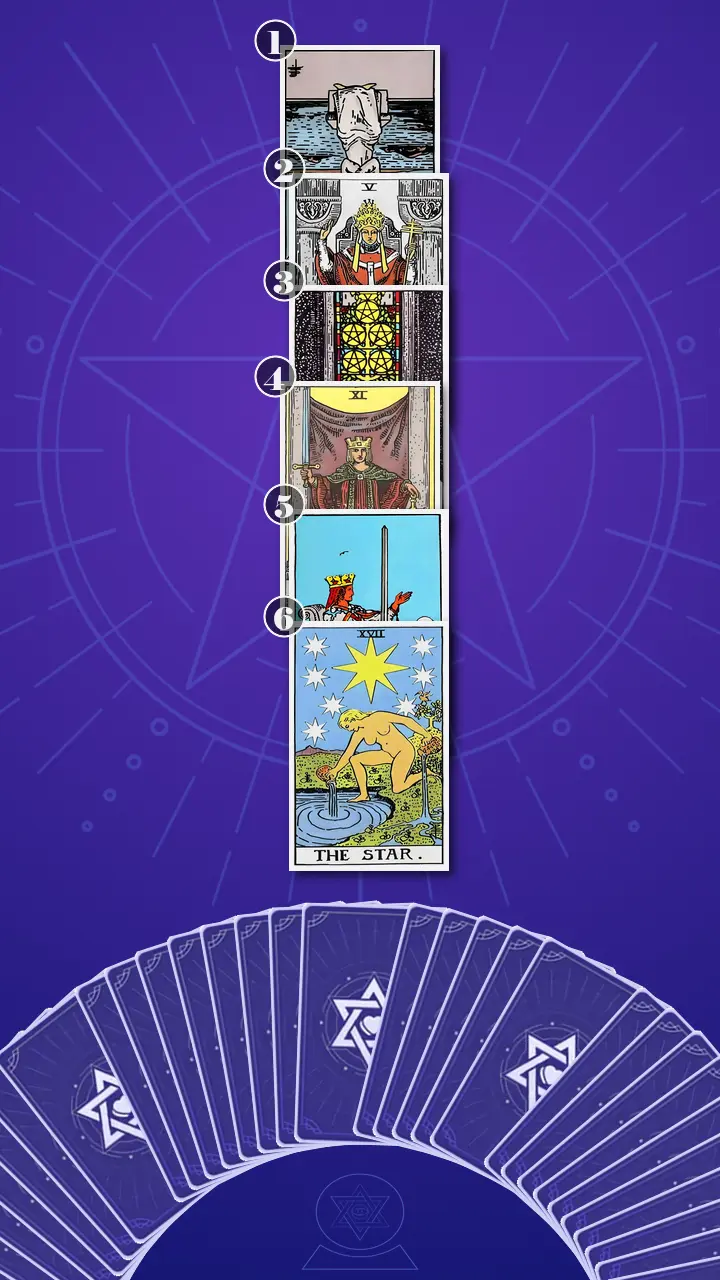
Reading the Ladder: The Trap in Real Time
Position 1: The surface freeze — what you do in the exact moment the field appears
“Now we open the card that represents the surface freeze,” I said. “The three seconds after you see ‘Emergency Contact.’”
Two of Swords, reversed.
I angled it so Jordan could see the blindfold, the crossed swords held tight to the chest, the still water behind the figure.
“This is that blink / delete / retype loop,” I said. “Cursor blinking. You type a parent’s name. Delete it. Open WhatsApp like you’re checking for a sign. Your brain runs five versions of the same argument—hoping delay can count as a decision.”
Reversed, the Two of Swords isn’t calm neutrality. It’s neutrality cracking under pressure—energy blocked for so long it turns into a pressure cooker.
Jordan gave a small, sharp laugh that surprised even them—half recognition, half bitterness. “Yeah,” they said, and their eyes flicked away from the card like it had been rude. “That’s… painfully accurate. Like, why is it that exact?”
“Because you’re not indecisive,” I replied. “You’re trying to stay ‘neutral’ so nobody can accuse you. But neutrality is still a choice—just one that keeps you trapped.”
Position 2: The family script — the inherited rule about loyalty and ‘goodness’
“Now we open the card that represents the family script—the rule you feel graded on.”
The Hierophant, upright.
“This is inherited authority,” I said, keeping my voice plain. “A policy you didn’t write. Terms & conditions you never agreed to, but your body still follows.”
I nodded at the formal posture, the pillars, the sense of a ‘correct’ way to belong. “The Hierophant turns a practical form into a ritual of compliance. It’s the internal voice that sounds like: Family first. Or: Good people don’t set boundaries. Or: Don’t embarrass us.”
Jordan’s shoulders rose toward their ears before they even realized it. Then they exhaled, slow and irritated, as if they’d just noticed they’d been clenching their jaw through a whole meeting.
“It’s so annoying,” they said. “Because I don’t even believe half of it. But my body acts like I’m about to get detention.”
“That irritation is healthy,” I told them. “It’s the part of you that knows you’ve been following a handbook from a job you don’t even work at anymore.”
Position 3: The belonging fear underneath the guilt — what you feel you might lose
“Now we open the card that represents the belonging fear underneath the guilt—the thing the script is protecting you from feeling.”
Five of Pentacles, upright.
Even before I spoke, Jordan’s face softened in a way I’ve learned to recognize. Not relief—something closer to grief finally being seen.
“This card is London drizzle in your sleeves,” I said quietly. “Cold that gets into the seams. And then the warm light of a screen—or a window—somewhere you’re afraid you won’t be allowed inside.”
“In real life,” I continued, “this is the bodily memory of being ‘out.’ You imagine choosing someone outside the family, and your stomach drops like you’ve just been left on read—only it’s scaled up into exile panic. You picture quiet punishment: a clipped phone call, a snide comment, being labeled difficult.”
Jordan’s hands—resting on the table—pulled inward, almost imperceptibly. Shoulders curved. Like their body was trying to make itself smaller.
“Yeah,” they whispered. “It’s like… if I don’t put them, I’m proving I don’t belong. Like I don’t deserve care.”
“That’s the heart of it,” I said. “The form isn’t the threat. The fear is: ‘If I choose based on reality, I lose my place.’”
When Justice Spoke: Reality Over Role
I let the silence sit for a beat. The radiator ticked. Somewhere outside, a car splashed through rain. The room felt unusually still—as if we’d reached the hinge of the whole reading.
Position 4: The reframe that restores agency — the principle that changes the narrative
“Now we open the card that represents the reframe that restores agency,” I said. “The principle that lets you choose based on reality and values—not approval and performance.”
Justice, upright.
I felt Jordan’s attention sharpen. Justice has that effect—like a clean line appearing on a page you’ve been smudging for years.
“First,” I said, “I want to name something directly: A safety form isn’t a referendum on whether you’re a good kid.”
Justice, in this context, is not punishment. It’s ethics as structure. The scales are criteria. The sword is a boundary that doesn’t require an essay.
And this is where my own background always flashes in: I used to train intuition for international cruise crews. In drills, we didn’t choose an emergency protocol based on who might feel offended by it. We chose what worked—because in a real emergency, reality is not interested in our family mythology.
Setup. Jordan was caught in that exact onboarding moment: portal open, emergency-contact field blinking, phone warm in their hand as they flipped between the family group chat and their partner’s last message—trying to pick the name that would hurt the least, not the one who would actually show up.
Delivery.
Stop treating the form like a loyalty oath, start weighing what’s true and workable, and let the scales of Justice—not inherited guilt—decide.
I didn’t rush past it. I let it hang in the air the way a bell note hangs over water.
Reinforcement. Jordan’s reaction came in layers—like their nervous system was reading the sentence before their mind could approve it. First: a tiny freeze, breath caught mid-inhale, fingers curling slightly as if they were about to protect their chest. Second: their gaze went unfocused for a second, like they were replaying a familiar family scene on fast-forward—some old moment where they’d learned that practicality equals selfishness. Third: a long exhale finally found its way out, and their shoulders dropped a fraction, not into confidence but into something truer: permission.
Then the complexity hit. Their brow tightened; their eyes shone with the beginning of anger.
“But if I do that,” they said, voice sharper, “doesn’t it mean I’ve been wrong this whole time? Like I’ve been… performing?”
I nodded. “That’s a real reaction. And no—this isn’t a trial where your past choices get sentenced. Justice isn’t here to shame you. It’s here to transfer authority. You did what you had to do to belong. Now you’re choosing what’s workable to stay safe.”
This is where I used one of my own tools without making it feel like a ‘tool’: in Venice, sound behaves strangely in canals. A voice can echo off stone and water until it sounds like it’s coming from everywhere. I call this Generational Echo Mapping—not to pathologize a family, but to notice which voice is echo and which voice is present-time reality.
“The guilt voice is an echo,” I told Jordan. “It’s loud because it bounces. But it’s not the only voice. Justice is the voice that doesn’t bounce—it stands still. It asks one boring question: Who is reachable, steady, and respects your wishes?”
I leaned forward slightly. “Now, with this new lens—tell me. Last week, was there a moment when this could have helped? When you could’ve picked for 2 a.m., not for appearances?”
Jordan blinked hard. “Tuesday night,” they said. “I timed out. Again.” A pause. “And the person who would actually answer is… not my family.” They said it like they were testing whether the ceiling would collapse.
“That,” I said softly, “is the shift from frozen guilt and loyalty-theatre decision paralysis to calm, reality-based clarity and grounded self-trust. Not perfect. Not loud. But real.”
Clean Words, No Courtroom Energy
Position 5: The boundary-in-action — communication that doesn’t spiral into over-explaining
“Now we open the card that represents the boundary-in-action,” I said. “How to implement the choice without turning it into a courtroom.”
Queen of Swords, upright.
“She’s not cruel,” I said, tracing the air near the card’s raised sword. “She’s precise. The boundary is fewer words, not harsher words.”
I asked Jordan to show me the draft text they kept deleting. They held their phone out, and I saw the familiar shape: a paragraph that started as a simple ask and quickly became a biography—context, apologies, preemptive self-defense.
“Here’s Queen of Swords in modern life,” I said. “Before: a TED Talk. After: one clean line.”
I watched Jordan’s thumb hover over the delete key. Their throat tightened—then they erased the entire paragraph like they were removing extra weights from a suitcase.
They read aloud, voice shaky but clear: “Hey—would you be willing to be my emergency contact for work/medical forms? No pressure if not.”
“Yes,” I said. “Clean words. No courtroom energy.”
Position 6: Integration — what healing looks like after you submit
“Now we open the card that represents integration,” I said. “Not a prediction. The stabilized state you can practice.”
The Star, upright.
“This is the opposite of the Hierophant’s tight room,” I said. “It’s open sky. Water that keeps pouring. You don’t ‘win’ against guilt—you outlast it with steadiness.”
The Star, here, is permission for quiet restoration: submit the form, drink water, step to a window, remind your nervous system that you’re allowed to choose what keeps you safe.
The Reality-First Policy: Next Steps You Can Actually Do
I took the whole ladder and braided it into a single story for Jordan: the emergency contact field triggers the surface freeze (Two of Swords reversed) because neutrality feels safer than being judged; underneath, an inherited rulebook (Hierophant) equates love with compliance; beneath that, a belonging panic (Five of Pentacles) warns that choosing reality means exile. Justice cuts through loyalty theatre with a reality-based principle, the Queen of Swords turns it into one clean sentence, and the Star offers a way to soothe the nervous system after the choice is made.
“Here’s the blind spot,” I said. “You’ve been treating your family’s feelings as a veto over your safety logistics. That’s why the form feels like a trial.”
“And here’s the transformation direction,” I continued. “We’re shifting from Who will this please? to Who is actually safe, reachable, and willing in a real emergency? Practicality leads. Not loyalty theater.”
Jordan swallowed. “I hear it,” they said. Then—honest, practical resistance—“But I can’t even find five minutes sometimes. Everything is deadlines. Even thinking about it makes my stomach flip.”
“Then we make it smaller,” I said. “Not ‘be brave.’ Not ‘fix your family.’ Just a protocol you can run.”
I also offered my dockside boundary tool—because boundaries, like moorings, only work if they’re placed where you can actually tie off. I call it the Bollard Marking Method: you decide where the boat stops, and you mark it with something solid and repeatable.
- Write the 3-line “Reality-First Emergency Contact Policy”Open Notes and write: “In an emergency, I choose: reachable, calm under stress, respects my wishes.” Keep it to three lines—no backstory, no moral footnotes.If you feel the urge to debate the criteria, that’s the script trying to take the wheel. Keep it boring on purpose.
- Do the 2 a.m. test and pick one namePicture a real call at 2 a.m. Who answers? Who stays calm? Who won’t override your wishes? Choose the one person who best fits, even if it isn’t family, and save them in your phone as “Emergency Contact — [Name]”.If guilt spikes, set a 90-second timer and only notice the body cues (tight throat, clenched stomach). You’re practicing clarity, not forcing bravery.
- Submit once, then place a 24-hour “no re-opening” bollardFill the form, hit submit, log out, close the tab. For 24 hours, you don’t reopen the portal “just to check.” That’s the boundary.If you feel the itch to re-open, tell yourself: “Guilt is loud. Reality is steady.” Then physically move—stand up, get water, look out a window.
“And if family ever asks?” Jordan said, cautious.
“You’re allowed not to announce it,” I replied. “But if you need a line, keep it non-debatable: ‘I sorted my emergency contact based on availability and location.’ Informing, not explaining.”

A Week Later: Quiet Proof
A week later, I got a message from Jordan while I was making tea—rain tapping the window, London being London.
“I did it,” they wrote. “I used the three criteria. I asked my partner with the one-sentence text. I submitted the form and didn’t re-open it. I felt sick for like ten minutes… and then it passed.”
They added, almost as an afterthought: “I slept through the night. Woke up and my first thought was still ‘what if I’m a bad person?’—but this time I just… noticed it. And kept making coffee.”
That’s the journey to clarity I trust the most: not fireworks, but a quiet loosening. A decision that matches real support, not a rehearsed role. A nervous system that learns—slowly—that practicality is allowed to outrank inherited guilt.
When a simple emergency-contact box makes your throat tighten and your hands freeze, it’s not because you’re dramatic—it’s because you’ve been taught that choosing your real support system is the same thing as failing a role you were assigned.
If you let “reachable, steady, respects my wishes” be your only standard for one tiny admin choice this week—what name would you type, just to see how it feels in your body?