From Bracing Shame to Steady Self-Respect at Family Reunions

The Hallway Question That Hits Like a Pop Quiz
You’re a 20-something in a high-cost city, and the second you walk into the reunion someone asks “So what are you doing now?” and your throat does that tight thing—classic imposter syndrome trigger.
Jordan said it like she was confessing a weird habit. “I swear I’m fine until someone asks me a normal question.”
In my studio in Toronto—mic arm folded back, tea steaming, a soft playlist barely above a whisper—I could practically see the scene she described. 6:12 p.m. on a Sunday, coat still on in her aunt’s entryway. The air smells like roast chicken and lemon dish soap. The overhead light is too bright in that unforgiving, kitchen-bulb way. Her phone buzzes once in her pocket like a tiny alarm bell. Someone calls her name, smiling, and drops it: “So, what are you doing now?”
Jordan’s body reacts before her brain finishes the sentence. Throat tight. Chest braced. Shoulders inching up like she’s getting ready to defend a thesis she didn’t write. She smiles—because she’s polite, because she’s practiced—and launches into her safe line. And even as she’s talking, her weight leans toward the kitchen like her nervous system already booked the exit.
That mix—wanting to feel relaxed and authentic with family, while fearing you’ll be “found out” as not impressive enough in small talk—creates a very specific kind of shame. Not the dramatic kind. The quiet kind that sits in your sternum like a paperweight and makes every answer feel like it has to be clean.
I told her, gently, “We’re not going to force confidence today. We’re going to map what happens—moment by moment—so you can find something steadier than a perfect script. Let’s aim for clarity: something you can actually do in real time, in a hallway, with your coat still on.”

Choosing the Compass: How the Celtic Cross Helps with Family Small Talk
I asked Jordan to take one slow breath in through the nose, out through the mouth—nothing mystical, just a clean signal to the body: we’re here now. While she held her question in mind, I shuffled. As always, I listened—not just to the cards, but to the pacing of her voice. In my world, emotion has tempo. Shame tends to rush or freeze.
“For this,” I said, “I want to use the Celtic Cross spread.”
For anyone reading who’s wondered how tarot works when the problem is modern—imposter syndrome, comparison culture, that LinkedIn-in-your-nervous-system feeling—the Celtic Cross is useful because it gives a chain. Not a prediction. A chain of cause-and-effect: what’s showing up on the surface, what intensifies it, what it’s really about underneath, and what resource you can access when it hits.
This is exactly what Jordan needed: a full-spectrum view of a career-and-identity trigger inside relationships. The spread lets us track the immediate social moment (the “So what do you do?” question), trace it back to the belonging wound it activates, and then name concrete, actionable next steps—so she leaves with actionable advice, not a vibe.
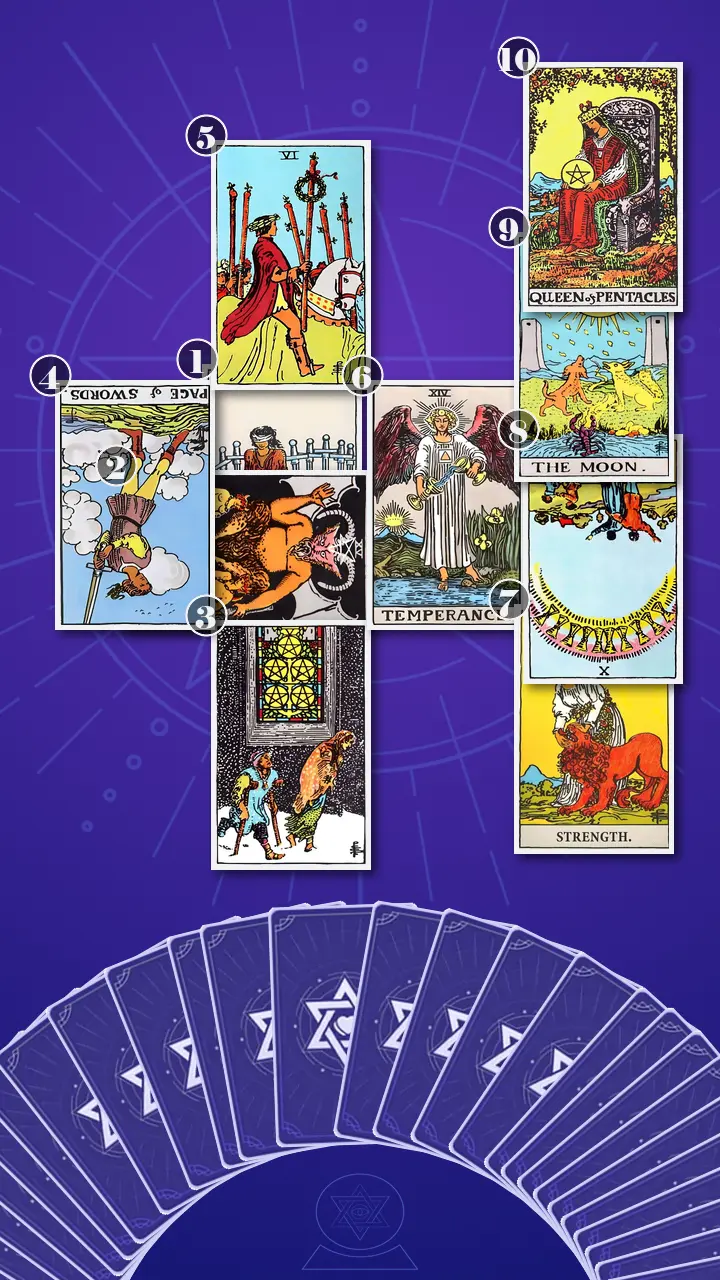
“We’ll start with the center,” I explained, laying the cross. “Card 1 is the behavioral snapshot—what imposter syndrome looks like in the first thirty seconds. Card 2 shows what locks you into performance mode. Card 3 goes underneath: the deeper belonging wound. And later, one card—your self-position—will show your most reliable grounding resource in the room.”
Reading the Map: When a Notes App Script Becomes a Cage
Position 1 — The visible way imposter syndrome shows up right now
“Now flipped over,” I told her, “is the card representing the visible way imposter syndrome shows up in family small talk right now.”
Eight of Swords, upright.
This is the card of the self-made conversational cage. And it lands exactly like the modern scenario: you arrive and start doing live self-editing. You answer “How’s work?” with a prewritten, résumé-safe sentence—then clamp down mid-thought so nothing messy slips out. Your eyes track the room for escape routes, and suddenly your hands are busy with plates, refills, chores, anything—because being useful feels safer than being seen.
Energetically, I read this as blocked Air: thoughts moving fast, but not moving you. The blindfold isn’t ignorance—it’s overcontrol. The ropes look tight, but they’re not. It’s a trap made of “Don’t pause. Don’t sound unsure.”
Jordan gave a small laugh that wasn’t funny. “That’s… brutal,” she said, eyes flicking down. “Like, accurate. But brutal.”
“I know,” I said. “And it’s not a character flaw. It’s a protection strategy.”
Position 2 — What intensifies the trigger and keeps you stuck performing
“Now we’re looking at what intensifies the trigger in the moment and keeps you stuck in performance mode.”
The Devil, upright.
This isn’t about you being “bad.” This is about the shame + comparison amplifier. The modern-life version is painfully simple: a casual question turns into a status check in your head. “So what are you doing now?” and your brain pulls up an invisible scoreboard—salary, title, relationship status, milestones. You feel chained to sounding impressive, so you overexplain, joke, deflect—anything to avoid the imagined moment where someone decides you’re not enough.
Energetically, this is excess attachment: your worth getting yanked toward external approval like a magnet. And the detail I always point out—because it matters—is that the chains are loose. The rule feels mandatory, but it isn’t.
I said one of my favorite truths out loud so it could exist outside her head: “You’re not failing small talk—you’re reacting to a scoreboard you didn’t agree to.”
Her shoulders dropped a millimeter, like her body understood that sentence before her mind did.
Position 3 — The deeper belonging wound underneath the reaction
“Now flipped over,” I said, “is the card representing the deeper belonging wound underneath the small-talk reaction.”
Five of Pentacles, upright.
Under the performance is an older fear: that warmth and inclusion are conditional. The modern-life scenario fits: being in a loud family room and still feeling like you’re outside looking in, like there’s a “successful adult” club inside the house and you missed the memo. So you try to earn your way in with competence and composure.
Energetically, this is deficiency—not of achievement, but of felt safety. The body can’t register the “glowing window” (the places support exists) when the belonging wound is lit up. You can be objectively okay and still feel like you’re walking through the party in winter boots.
Jordan went quiet. Her thumb started rubbing the side of her mug—one tiny, repetitive motion that said more than her words.
Position 4 — The recent mental habit-pattern you’re bringing in
“Now we’re looking at the recent mental habit-pattern you’re bringing into this reunion—what’s been building.”
Page of Swords, reversed.
This is the week-before spiral: LinkedIn checks, “career pivot anxiety” searches, drafting and redrafting answers in Notes until they stop sounding like you. You come in sharp and overprepared, which ironically makes casual conversation feel more high-stakes—like you’re ready to defend your life instead of share it.
Energetically, it’s excess Air without grounding: mental scanning, threat-hunting, imaginary dialogues. I’ve seen this a thousand times as a radio host, too—when someone’s nervous on-air, they try to talk faster to regain control. But speed doesn’t create safety. It just creates more places to trip.
Jordan exhaled through her nose. “I literally have a Notes doc called ‘Family answers lol.’”
“Of course you do,” I said, smiling in a way that wasn’t teasing. “That’s you trying to build a handrail.”
Position 5 — The conscious ‘should’ standard you feel you must meet
“Now flipped over,” I said, “is the conscious ideal you feel you must live up to in front of family—the ‘should.’”
Six of Wands, upright.
This is the pressure to deliver a highlight reel: a one-liner that gets approving nods and stops follow-up questions. You’re not craving bragging—you’re craving safety. But here’s the trap: in this room, being seen as winning starts to feel like the price of belonging.
Energetically, this is Fire seeking applause. Not bad. Human. But in a family system with an unspoken scoreboard, that fire gets hijacked into performance.
Position 6 — A near-term stabilizer you can use during the event
“Now we’re looking at a near-term stabilizer: what can help you stay regulated and grounded during the event.”
Temperance, upright.
Temperance is pacing, measured disclosure, balance. The modern-life scenario is incredibly practical: you answer slowly, share one real detail, then stop. Take a sip of water. Feel your feet. Let the conversation breathe. Instead of swinging between oversharing and disappearing, you blend honesty with timing—enough to be real, not so much you feel exposed.
Energetically, this is balance: Water and Earth re-entering the system. And I want to underline a phrase I teach clients like it’s a chorus you can return to: “Connection, not audition.”
Jordan nodded, small and cautious. “Okay,” she said. “I can try that without making it a whole thing.”
When Strength Held the Lion—And the Room Got Quiet
Position 7 — Your most reliable inner resource for grounding
I told her, “We’re turning to the staff now. This next card is big. It’s the one that answers your actual question: what grounds you when the small talk trigger hits.”
“Now flipped over,” I said, “is the card representing your most reliable inner resource for grounding—who you can be instead of who you perform.”
Strength, upright.
The modern-life translation is exactly what Jordan has been trying to do the hard way: your grounding is quiet courage. You notice the urge to perform, then lead yourself gently. Soften your jaw. Exhale. Give a simple, truthful update without apologizing for it. Let a pause exist. You don’t wrestle the lion of judgment-fear—you hold it steady with patience and self-respect.
And because sound is my native language, this is where I used my signature diagnostic lens—what I call a Generational Echo. I asked Jordan, “At your family gatherings, what’s usually playing? Like… what’s the background soundtrack of ‘togetherness’ in your family?”
She blinked. “Uh. Classic rock. Always. My uncle basically DJs. Loud.”
“That’s not random,” I said. “Your nervous system learned that loud equals perform. Not because your family is evil—because in a loud room, you have to fight to be heard, and whoever sounds the most certain wins airtime. Strength isn’t about being louder. Strength is your internal volume knob. It’s you deciding, ‘I can speak at my pace. I can breathe first. I can be a person in a room, not a press release.’”
Stop trying to prove you’re untouchable; practice calm, steady self-respect—like Strength holding the lion with patience instead of force.
For a moment, Jordan’s whole face went still—like someone hit pause. That’s the freeze. Then her eyes unfocused, not dissociating, more like replaying a hundred hallway questions at once. I watched her swallow. Her hand stopped rubbing the mug. Her shoulders, which had been perched high all session, sank down as if they’d finally gotten permission to be heavy.
And then the unexpected reaction arrived: not relief first—anger. “But if that’s true,” she said, voice tight, “does that mean I’ve been doing it wrong? Like… all this time?”
I kept my voice steady. “It means you’ve been doing what worked in the short term. Eight of Swords and Devil strategies keep you from getting follow-up questions. They do their job. Strength is just a different job description: self-respect in real time.”
Her breath hitched, then lengthened. That was the release. She looked down at the Strength card again, and her voice got smaller. “I want to practice that,” she said. “Being steady instead of impressive.”
I let the silence sit—two beats, on purpose—so her body could register that nothing collapsed.
“Now,” I asked, “use this new lens and tell me: now, with this new perspective, can you think back to last week—was there a moment when this insight would have let you feel different?”
Jordan’s mouth twisted, half-smile, half-wince. “Wednesday. On Line 1. I was literally writing bullet points like it was a pitch deck. I could’ve… just practiced one normal sentence. And breathed.”
That was the shift in real time: from bracing shame toward embodied self-trust. Not a personality makeover. A different steering wheel.
The Upstairs Cards: Family Atmosphere, Moon-Stories, and the Direction Forward
Position 8 — The family-system atmosphere shaping your response
“Now flipped over,” I said, “is the card representing the family-system atmosphere: the cues and expectations that shape your nervous system response.”
Ten of Cups, reversed.
This is the unspoken “nice family” script: keep it pleasant, keep it impressive, keep it surface-level. When the vibe isn’t warm, you assume you did something wrong and try to fix it—over-laughing, over-helping, over-agreeing. The environment subtly rewards polish, even if nobody is consciously trying to harm you.
Energetically, it’s a context mismatch: the picture-perfect expectation versus the complicated human reality. You can’t use the room’s mood as your measure of worth.
I added, softly, “A room can be loud and loving and still not be emotionally safe for your specific tender spots.”
Position 9 — What you hope to prove and what you fear will be revealed
“Now we’re looking at hopes and fears—what you hope to prove, and what you fear will be exposed.”
The Moon, upright.
This is projection under ambiguity. The modern-life version is that tiny moment: someone says “Oh… cool,” neutrally, and your brain turns it into a full narrative—They think I’m behind. They’re being polite. Everyone noticed. You start responding to what you imagine people mean, not what they actually said, and you chase certainty in a situation that can’t give it.
Energetically, this is excess imagination without data. I offered her a reality-check phrase I use like a tuning fork: “Neutral isn’t rejection—sometimes it’s just neutral.”
Jordan nodded once, like she was filing it somewhere she could reach quickly.
Position 10 — Integration: the most grounded way forward
“Now flipped over,” I said, “is the card representing integration: the most grounded way forward if you practice the shift.”
Queen of Pentacles, upright.
This is where the reading lands: embodied self-worth and practical support. Not winning the reunion—supporting yourself through it. The modern-life scenario is unglamorous and solid: you take care of your body before and after, set small boundaries, define success as self-respect, and leave steady because your worth wasn’t up for negotiation.
Energetically, this is Earth-led stability. After all that Air (overthinking) and shadow (shame), Queen of Pentacles says: build emotional infrastructure. Boring. Reliable. Like transit you can count on.
From Insight to Action: Next Steps for Feeling Grounded at the Reunion
Here’s the story the whole spread told, in plain language.
You walk into a family gathering already braced (Eight of Swords), because an invisible scoreboard gets activated (Devil). Under that is a deeper fear that belonging is conditional (Five of Pentacles). In the days leading up, your mind tries to solve it with more scanning and scripting (Page of Swords reversed), because part of you believes you must deliver a highlight reel to be safe (Six of Wands). The turning point is pacing and regulation (Temperance), which opens the bridge to your real resource: gentle self-command (Strength). From there, you stop depending on the room to feel perfect (Ten of Cups reversed), stop treating ambiguity as danger (Moon), and build steadiness through tangible care and clear limits (Queen of Pentacles).
Your cognitive blind spot is subtle: you’ve been treating polish as the price of connection. But the transformation direction is different: shift from performing a “proof of success” to practicing grounded self-trust through small, honest, boundaried answers in real time.
And I want to give you permission in one sentence, because it’s a Temperance-and-Strength truth: A complete sentence is not a complete confession.
- The 30-Second Strength Breath (before you walk in)In the car or hallway, inhale for 4 and exhale for 6, twice. Feel both feet in your shoes. Name one body sensation out loud—“tight throat,” “hot face,” “jaw clenched”—then relax your jaw one notch.If your brain says “cringe,” shrink it: one slower exhale is still success. Make the goal “regulated,” not “impressive.”
- Write One Script-Lite Update (once, not ten times)Open Notes and write a single 15-second line: “Work’s been busy. I’m learning a lot, and I’m keeping the next step simple right now.” That’s it. Save it as one line, not a paragraph. Practice it out loud once, then stop.If it feels too exposed, do the 7-second version and end with a real question back—curiosity, not escape: “How’s your week been?”
- Build a 2-Minute Reset Spot (Temperance, not avoidance)Before the event, choose one reset location (front porch, bathroom, stairwell). Put a timer on your phone labeled “Reset, not escape.” When your chest tightens, step there for two minutes and do the Temperance pacing move: slow your speech rate by 10% and shift weight from one foot to the other.If you can’t leave the room, do the zero-drama version: look at one physical object (a plant, framed photo) and press your feet into the floor for 10 seconds.
- Use a “Soundproof Barrier” (my music-therapy add-on)Make a 2-song “Reset Playlist” at ~60–70 BPM (steady, not sleepy). Use one earbud only in your reset spot for 90 seconds—just enough to give your nervous system a boundary without checking out of the gathering.Pick songs you don’t associate with achievement. No “hype.” Think “steady.” Your body should feel like it’s coming back online.
Those are small steps on purpose. This isn’t about becoming a different person by next Sunday. It’s about having next steps that work when your throat tightens and your brain starts auditioning.

A Week Later: The Quiet Proof
Five days later, Jordan texted me a screenshot: her Notes app, one line only. Under it, she wrote, “I didn’t rewrite it. I practiced once. I’m weirdly proud of that.”
Then, after the reunion, another message: “I did the breath in the hallway. My aunt asked. I said the sentence. I took a sip of water and let the pause happen. Nobody died. I still got a little shaky, but I didn’t run to the kitchen.”
That’s what a real Journey to Clarity looks like in the wild: not perfection—proof. A softer jaw. A slower exhale. One honest sentence that doesn’t try to buy approval.
When a ‘normal’ family question hits and your throat tightens, it can feel like you’re being measured in real time—like if your life isn’t perfectly explainable, your worth might slip through the cracks.
If you didn’t have to win the room, what’s one small, honest, boundaried sentence you’d be willing to try the next time someone asks, “So, what are you doing now?”
Every reading at AceTarot is a Journey to connect with inner wisdom and empower next step.
Learn more about our Journey to Clarity.