The Sunday Night Ping That Rewrote the Week—And the One-Line Reply

The Sunday Night Ping That Rewrote the Week
It was 8:47 PM on a Sunday, and Alex (name changed for privacy) was sitting in a Toronto one-bedroom with Notion open on one side of the laptop and their banking app open on the other. The family group chat pinged, the laptop fan hummed, the fridge gave its low electric buzz, and I watched their shoulders rise before they even opened the message. It had that Severance feeling: work self still at the desk, private self already on call, and the body doing the admin in between.
They gave me the line I hear so often from the dependable one: “I can handle it, I just do not want the whole week to disappear again.” Under the joke, their jaw was tight and their chest looked braced, like too many pinned tabs open at once. That was the contradiction in plain sight—wanting to stay responsive and helpful to family, while fearing that any boundary would make them look selfish or unreliable.
I told them that was enough to start with. The goal of this reading was not to make them love the chat less; it was to turn the blur into a map and find the place where finding clarity actually starts.

Choosing the Map Instead of Chasing the Ping
I asked Alex to put the phone face down and take one slow breath before I touched the cards. I also set a thin bergamot blotter on the table—not as theatre, just as a small scent cue to change the atmosphere before the conversation got sharper. Fifteen years in perfumery taught me that the room itself can either keep a panic loop alive or help it loosen.
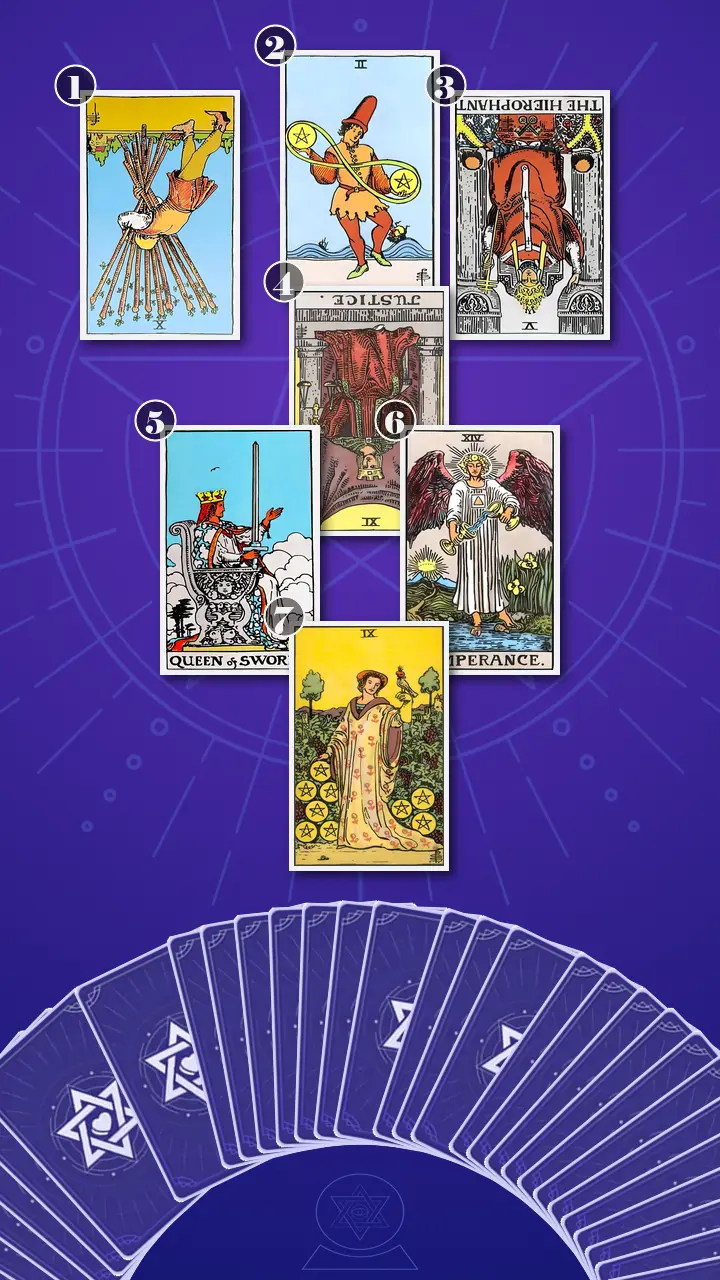
Then I explained the spread: Energy Diagnostic Map · Context Edition, my family boundary tarot spread for the exact kind of problem where one request spills into the calendar, the budget, and the rest of the week. A linear spread would have flattened the story. This one lets me read the surface overload, the inner juggling act, the inherited family script, the fairness distortion, the interrupting resource, the key shift, and the grounded next step in one coherent path.
I pointed out the most important positions up front. Position 1 would show what the overload looks like in daily life. Position 4 would name the belief underneath the loop. Position 5 would reveal the clean line that can interrupt it. Position 7 would show what stability looks like once the pattern stops hijacking the week.
The Cards Begin to Speak
The Load That Would Not Stay on One Back
Now I turned to position 1, the visible overload and how the loop shows up day to day. Ten of Wands, reversed, is the card of a load that has slipped out of the neat bundle and started pressing on the whole week. In real life, it looked like one family request landing while Alex was midweek and instantly forcing meetings, dinner, and spending to be rearranged so nothing looked like a hard no.
Reversed, the energy is not laziness; it is overcorrection. The body tries to prove it can carry more by saying yes faster, moving faster, and shrinking rest to make room. I told Alex that the scene reminded me of a perfume accord with too much base note—rich, heavy, and impossible to lift. They gave a short laugh that had a bruise in it and said, “That is embarrassingly accurate.”
Three Tabs, One Breath
Now I turned to position 2, the inner juggling between competing priorities. Two of Pentacles, upright, is the live spreadsheet energy: calendar on one side, bank balance on the other, family chat in the middle, all of it changing while you are still entering the numbers.
This card said Alex was not frozen; they were actively balancing, but only by reacting to the loudest thing in the room. That is why the body never fully settles. The juggling itself becomes the job. Alex let out a slow breath and said, “I keep thinking it is just a quick yes, and then I am doing the math for the rest of the night.”
The Old Rule in the Blue Bubble
Now I turned to position 3, family expectation and external demand. The Hierophant, reversed, is the old rule in a new blue bubble: the chat lights up and, before capacity has even been checked, the dependable role has already been assigned.
This is where my Family Energy Diagnosis work kicked in. I was decoding the intergenerational language of the family system, and the emotional scent of the exchange was duty at the base, guilt in the middle, and a metallic edge of obligation at the top. In other words, the message was not just a request; it was an inherited script speaking through a notification. The older family language said urgency. Alex’s nervous system heard danger. That mismatch was the real pressure.
They stared at the table, then gave the tiniest nod. Their shoulders dropped a fraction and they said, almost quietly, “It feels like I am being cast before I have even read the line.”
The Fairness Spreadsheet That Never Settled
Now I turned to position 4, the core belief that keeps the loop alive. Justice, reversed, points straight at the fairness spreadsheet that never settles. Alex keeps redoing the math of who deserves what, how much time is fair, how much money is too much, and how many explanations are needed before a boundary feels allowed.
Reversed Justice is a distorted ledger: if it is not perfect, it feels forbidden. That is why the yes comes out faster than the truth and why guilt hangs around even after the request is handled. Alex’s face tightened as if I had named a private rule they had never wanted out loud, then they admitted, “If I am not perfectly fair, I feel like I am being bad.”
When Queen of Swords Made the Room Bigger
Setup
Alex was stuck in the familiar trap: if they waited, they feared they would look unreliable; if they said yes, the week and the budget would shrink again. They were not really asking how to help. They were asking how to stop feeling wrong either way.
Delivery
Stop treating every message as an emergency, and let the upright sword show you that one clean line can protect both care and capacity.
Reinforcement
For a second, Alex did not speak. First came the freeze—their eyes held on the card, unblinking. Then the thought replayed across their face as if they were watching every overexplained text they had ever sent. Then the release arrived, not as a victory cheer but as a small stunned laugh that caught in the throat. Their shoulders dropped, the jaw unclenched, and the hand that had been gripping the phone finally loosened enough to rest on the table. I could see the recognition land: not “I am rude if I set a limit,” but “I do not need to justify my capacity for ten paragraphs.”
I told them, “A fast yes is not always a real yes. Clarity can be kinder than over-explaining.” Then I asked them to take the feeling back to last week and notice whether there had been a moment when one short sentence would have protected the evening better than the long, anxious reply. They went quiet for a beat, then said, “So I was not wrong. I was just overexplaining.”
That was the hinge. It was the first visible move from reactive overwhelm and guilt-driven overcommitment toward calm self-trust and deliberate coordination.
The Pace That Let Care Breathe
Now I turned to position 6, the key shift that makes a different response possible. Temperance, upright, did not ask Alex to stop caring; it asked them to stop compressing care into panic.
The practical reframe was simple: let a request sit overnight when it touches both time and money. Check the calendar after the pause, not during the first ping. Mix care with limits until the answer can actually live in the week instead of crashing into it.
Alex nodded slowly, and for the first time their shoulders dropped all the way down instead of hovering near their ears. That was the difference between patching a week in panic and spacing a week in a way the body could survive.
The Week That Belonged to One Person Again
Now I turned to position 7, the grounded next step for follow-through. Nine of Pentacles, upright, is quiet self-sufficiency rather than withdrawal. It is knowing your own schedule and budget well enough that a family request does not instantly rearrange your life.
The modern image was not dramatic. It was one fixed weekly block on the calendar that stayed put, a small money buffer that did not get raided by reflex, and a private routine that belonged only to Alex before they reopened the chat. They did not look triumphant when I said that. They looked steadier, which is better.
By the time I laid the cards back in order, the loop was no longer a mystery. It was a pattern with a shape, and shapes can be interrupted.
One Clean Line, No Extra Sparkle
When I put the spread together, the story was unmistakable. Ten of Wands reversed showed the visible overload. Two of Pentacles showed the live juggling. The Hierophant reversed named the inherited role. Justice reversed exposed the fairness distortion. Queen of Swords was the resource that could cut the rope without cutting the person. Temperance made the pacing sustainable. Nine of Pentacles showed the grounded result: a week that is still caring, but no longer crowd-controlled by every ping.
The blind spot was treating every family request as proof of belonging. The transformation direction was simpler and harder at the same time: stop treating each request like an emergency, and let it be reviewed against the calendar and the budget instead of against the reflex. Your calendar is not a family emergency room. If it needs your time and your money, it deserves a pause.
I used my Conflict Transformation System here the way I use it when two scents refuse to blend: do not keep forcing them together at full strength. Thin the pressure, name the ingredients, and let one clear sentence carry the conversation further than a paragraph of apology ever will. The goal is not less love. The goal is a cleaner way of telling the truth.
So I gave Alex three small moves instead of one dramatic overhaul.
- The Clear-Reply PauseDraft the next family reply in Notes before you send it. Keep it to two sentences: one acknowledgement, one limit.If it feels sharp, add one kind phrase and stop there. Wait two minutes before sending so the fast yes does not speak for you.
- The 15-Minute BufferFor any request that touches both time and money, close the chat for 15 minutes before you answer. During that pause, check your calendar and budget only once.If the request still fits after the pause, answer from the calmer version of you. If it does not, let it sit overnight.
- Boundary-First SchedulingProtect one fixed weekly block on your calendar and one small money buffer that does not move for family requests.If you want a cue, use a citrus scent before you open the chat—one clean breath, one clean line, one week that does not collapse.
That is the part people usually miss when they search for how to set boundaries with family without sounding rude: the first win is not a perfect no, it is a pause that stops the week from being rearranged on autopilot.

The Quiet Proof
Three days later, Alex sent me a screenshot of their Notes app. They had drafted the reply, waited ten minutes, and answered with one short line that moved the request to Saturday. Their Wednesday block stayed on the calendar, and they went back to dinner without reopening the bank app.
That is what finding clarity looked like here: not a magical ending, just a nervous system learning that a clear line can be kind, and that self-trust does not have to arrive loud to be real.
What I keep hearing in readings like this is that when the chat pings and your chest tightens before you even read it, it is not just about the request; it is about the fear that one clear limit could make you seem less dependable, less included, less safe. If you are standing in that same place tonight, what would you want one beat of pause to protect first: your time, your money, or your peace?