I Found My Dad's 'Toughen Up' Note—And Started Practicing Staying Present

Finding Clarity in the Elevator Mirror
If you’re the kind of Toronto project coordinator who can sound calm in any meeting—but the second someone’s upset with you, your throat closes and you go silent (hello, conflict shutdown).
Jordan (name changed for privacy) said it like she was reporting a bug she’d been quietly patching for years. Her camera showed the corner of a condo kitchen—neutral countertops, a dish rack, the kind of overhead light that makes everything look a little too honest. She kept her shoulders pulled inward, like she was trying to take up less space on her own screen.
“I found this note,” she told me, and held up a folded scrap of paper. “It’s from my dad. It literally says… ‘toughen up.’ And now I can’t stop seeing it everywhere. Like… that’s the reason I go blank when people are mad.”
As she talked, I watched the pattern arrive in her body before it arrived in her words: a held breath that made the silence feel pressurized, a jaw that tightened the way people do when they’re trying not to cry in public, a throat working around a sentence that wanted to come out and couldn’t find the door.
Her question wasn’t dramatic or vague. It was specific and lived-in: “Why do I shut down in conflict now? I don’t want to win an argument. I just want to not disappear.”
Shame has a particular texture in moments like this. It’s not loud; it’s fluorescent. It feels like standing in a condo elevator at 8:47 p.m., staring at your own reflection under a humming light—face totally blank—while your insides shake as if one honest word would make the glass crack.
I softened my voice on purpose, the way I used to on transoceanic voyages when someone would come to me on a deck at night, carrying a private worry like contraband. “I’m really glad you brought this here,” I told her. “We’re not going to treat your shutdown like a personality flaw. We’re going to treat it like a protection strategy—and figure out what it’s protecting, and how to update it. Let’s make a map through the fog. This is a Journey to Clarity.”
Choosing the Compass: How Tarot Works for Conflict Shutdown
I asked Jordan to set the note down beside her keyboard, just within reach, and take one slow breath she could actually feel—not a performance breath, a real one. Then I shuffled while she held the question in mind: “I found Dad’s ‘toughen up’ note—why do I shut down in conflict now?”
I’m a Jungian psychologist by training, so I don’t use tarot to “predict” your next fight like weather. I use it the way I’ve watched thousands of travelers use a map on open water: to understand the system you’re in, so you can steer differently.
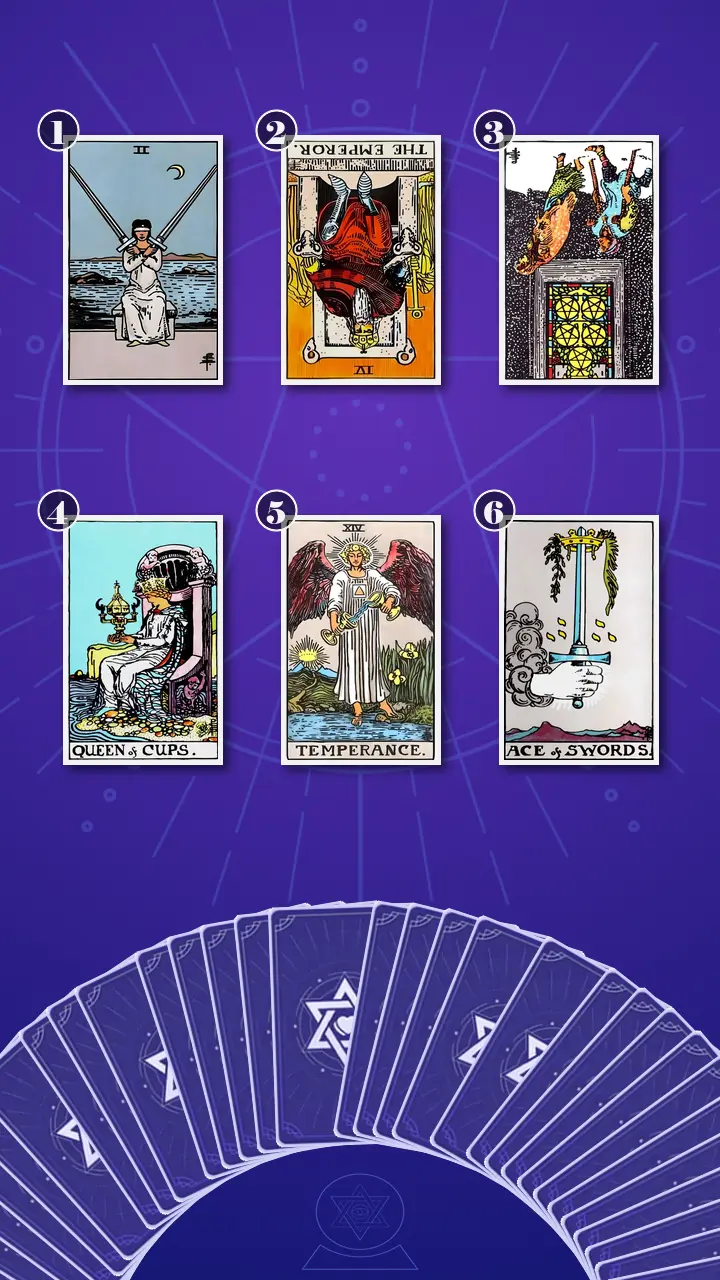
For Jordan, I chose an original six-card layout I call the Four-Layer Insight Ladder · Context Edition. It’s a 2x3 grid—simple, compact, and brutal in the best way. Because her issue wasn’t lack of relationship advice; it was a mechanism: trigger → rule → protection → then what.
To you, reading along: this spread is perfect when you’re asking questions like “Why do I go silent during arguments?” or “Is this stonewalling or shutting down?” It lets us see the shutdown system on the top row (what you do, the inner authority behind it, the deeper root), and then the repair pathway on the bottom row (resource, practice, integration). It’s the smallest spread I know that still gives actionable advice—not just insight.
Before we turned any card, I previewed the three positions that matter most for “I can’t talk when conflict rises” questions:
Position 1 shows your real-time shutdown move—the observable thing you do first when tension spikes.
Position 2 names the internalized rule—that “toughen up” voice that starts running the conversation from behind the scenes.
Position 5 is the hinge: the in-the-moment practice that turns disappearing into staying present—without forcing you to power through.
Reading the Map: Card Meanings in Context
Jordan watched me lay the cards into the grid. The screen made a neat little universe: my hands, the worn edges of the deck, and her face holding stillness like a shield.
Position 1 — Current conflict response pattern: the specific shutdown behavior
“Now we turn over the card that represents your current conflict response pattern—the specific, observable shutdown behavior that shows up in real-time disagreement,” I said.
Two of Swords, upright.
I didn’t even have to reach for a poetic explanation; the card met her exactly where she lives. “It’s the exact second a disagreement gets real,” I told her, using the card’s modern translation. “You stop making eye contact, your answers shrink to one-word neutral replies, and you try to ‘out-wait’ the discomfort until it passes. You’re not choosing a side—you’re choosing numbness, because speaking feels like it could cost you respect.”
In this card, the energy is blocked Air: mental control used as a barricade. Not balance—containment so tight it becomes a lock. The blindfold isn’t ignorance; it’s self-protection. The crossed swords aren’t clarity; they’re a “no-feeling, no-speaking” mode you can activate in milliseconds.
Jordan let out a small laugh that wasn’t amused. It was the kind of laugh people make when the truth is accurate enough to sting. “That’s… harsh,” she said, and her eyes flicked down toward the counter instead of the camera. “Like, yeah. That’s me. I literally stare at the floor. I can hear myself say, ‘It’s fine, don’t worry about it,’ and I’m screaming in my head.”
I nodded. “Shutting down isn’t a character flaw—it’s a protection strategy that got promoted to default.”
And because she lives in a world of Slack pings and tone anxiety, I named the modern mechanism out loud: “It’s like your nervous system hits Airplane Mode the second the conversation gets tense. No calls, no data—just a blank screen and a tight chest.”
Her throat worked again, swallowing something back. A tiny exhale left her nose, like her body finally got permission to admit it.
Position 2 — The internalized “toughen up” rule: the inner authority voice
“Now we turn over the card that represents the internalized ‘toughen up’ rule—the inner authority voice shaping how you interpret conflict and vulnerability,” I said.
The Emperor, reversed.
Jordan’s shoulders rose almost imperceptibly, the way they do when someone says your full name. I felt my own inner flashback: the cruise ship training room where I taught staff how to read emotional micro-shifts in travelers—how a stiff jaw is often “I’m bracing,” not “I’m fine.” The body never lies; it just gets trained to speak in code.
“This is like hearing your dad’s ‘toughen up’ note as an invisible rulebook in conflict,” I said, again pulling directly from the modern scenario. “Be controlled, be factual, don’t show it. So when someone’s tone sharpens, you default to a stiff, professional cadence—like you’re defending your competence rather than staying in a relationship.”
Reversed, the Emperor’s energy is excess control—authority turned inward as harsh supervision. In real life it sounds like clipped fragments in your mind: Don’t cry. Don’t react. Be normal. Be an adult. It’s the internal manager who writes you a performance review every time you have a feeling.
Jordan’s mouth pressed into a line. “I hate how true that is,” she said. “It’s like… I’m in HR with my boyfriend.”
“Yes,” I said gently. “And that’s exhausting.”
Then I named it, because naming it is how you stop obeying it automatically: “That ‘toughen up’ note didn’t just hurt—your system treated it like a rule update.”
She blinked fast and looked away again, eyes briefly unfocused—memory moving behind the screen. Her fingers pinched the edge of the note, then released it, then pinched it again. A three-beat rhythm of freeze, process, try to regain control.
Position 3 — The deeper root of the pattern: what shutdown originally protected you from
“Now we turn over the card that represents the deeper root of the pattern—what this shutdown originally protected you from feeling or risking,” I said.
Five of Pentacles, reversed.
“This is the part people miss,” I told her. “Your shutdown didn’t start because you’re weak—it started because you learned comfort was conditional. So now, after conflict, you isolate and self-manage: scrolling alone, drafting texts alone, convincing yourself you ‘shouldn’t need anything’—even though a simple ask for reassurance or pacing would change everything.”
Reversed, the Five of Pentacles isn’t “everything is fine.” It’s the possibility of turning toward warmth when your reflex is to brace in the cold. The energy here is a shift from scarcity (“I’m on my own”) to a tentative re-entry into support (“maybe I don’t have to be”).
Jordan swallowed. “The Notes app thing… it’s embarrassing,” she admitted. “I draft five versions. Delete four. Send one painfully polite line. And I’m still mad afterward.”
“That’s not embarrassing,” I said. “It’s intelligent adaptation. If real-time speaking felt unsafe, your system found another channel. The cost is that you end up outside the warm room looking in.”
Position 4 — Your stabilizing resource: what helps you stay present
“Now we turn over the card that represents your stabilizing resource—the emotional capacity you can access to stay present during conflict,” I said.
Queen of Cups, upright.
The atmosphere shifted in a way I could feel even through Wi‑Fi. The Queen of Cups has that effect: she doesn’t demand change; she makes room for it.
“This is the version of you who can feel a lot without being taken hostage by it,” I told Jordan, using the modern translation. “You notice the tight throat, place a hand on your chest, breathe slower, and silently validate the feeling—‘I’m allowed to feel this’—before you choose your next sentence. You stop treating emotion as evidence you’re failing.”
Her energy is balanced Water: emotional depth with containment. Not shutting feelings down. Not dumping them everywhere. Holding the cup steady.
Jordan tried it without announcing it—her hand moved off-screen for a moment, then returned, and her breathing visibly slowed. She gave the smallest nod, like she’d just found a stair where she’d been expecting a wall.
“That feels… doable,” she said quietly. “Like I don’t have to pretend I’m chill. I just have to… stay with myself.”
“Exactly,” I said. “Not ‘be softer.’ Just be with yourself.”
When Temperance Became a Practice, Not a Vibe
I glanced at the center-bottom position—the hinge of the whole Ladder. “We’re turning over the key card now,” I said. “This is the one that changes the pattern in the moment.”
Temperance, upright.
“In the moment of conflict,” I said, again anchoring it in real life, “you don’t force yourself to push through or vanish—you use a timed pause like a safety rail: ‘I want to stay in this with you, and I need ten minutes to reset so I can speak clearly.’ You step away, drink water, set a timer, and actually come back—turning shutdown into paced engagement.”
Temperance is integration. Measured mixing. The angel doesn’t dump one cup into the other; she pours carefully, back and forth, until the system can hold what it couldn’t hold before.
As a woman raised near the Venetian canals, I can’t help but see Temperance like a craftsperson at Murano: molten glass can become a vessel only if you respect the timing—too fast and it cracks, too rigid and it shatters, too forceful and it collapses. This is where my Glass Workshop Metaphor becomes diagnostic: Jordan’s “toughen up” rule is like skipping the annealing stage. The glass looks intact in the moment—cool, controlled—but the stress lines are already inside it. Temperance is the annealing oven: the paced cooling that lets the structure become truly strong.
Jordan’s eyes narrowed a fraction. “But… if I take a break, won’t they think I’m being dramatic? Or like… abandoning them?”
Her question was the exact knot: wanting to speak up honestly vs fearing she’ll be judged as weak or “too much” for having feelings.
I let the silence hold for a second, then moved into the three-part aha moment—because her system needed a sentence it could use when it couldn’t think.
Setup: You know that moment when the tone shifts, your throat tightens, and you suddenly start sounding like you’re in a performance review—while you’re actually hurting? That’s the moment your body starts protecting you faster than your mind can explain what’s happening.
Delivery:
Stop treating shutdown as proof you’re weak; start practicing measured mixing like Temperance—one breath, one boundary, one honest sentence at a time.
I stopped talking on purpose. Even through her laptop mic, I could hear the room around her go quieter—no clink of dishes, no scrolling thumb, just breath.
Reinforcement: Jordan’s body reacted in layers. First: a micro-freeze—her lips parted, then held, and her breath paused at the top like her lungs were waiting for permission. Second: cognition seeped in—her gaze drifted off-camera, unfocused, like she was replaying a specific argument on the TTC, the typing bubble that appeared and disappeared, the moment she went silent and then wrote a text she didn’t mean. Third: the emotion landed—her shoulders dropped two centimeters, and a shaky exhale came out, half relief and half grief. She rubbed her thumb against the side of her index finger like she was trying to keep herself contained.
“I always thought… if I can’t just handle it, I’m failing,” she said. Her voice wobbled on the last word, and she looked almost annoyed at herself for wobbling. “Like the only acceptable version of me is unbothered.”
I kept my tone steady, the way I do when someone is right at the edge of changing an old story. “This isn’t about being unbothered,” I said. “This is about building a repeatable way back to your voice. Temperance is regulation, not repression.”
Then I asked the question that turns insight into ownership: “Now, with this new lens, can you think of one moment from last week—one specific moment—where a measured pause could have protected you from disappearing?”
Jordan didn’t answer immediately. She swallowed, blinked, and then nodded. “Tuesday. In the kitchen. He said, ‘Can we not do this right now?’ And I just… shut off. If I’d said I needed ten minutes and I’d come back… I wouldn’t have spent the whole night drafting texts.”
And that right there is the emotional transformation we were tracking: from shame-driven conflict freeze and self-editing to paced presence, clear boundaries, and steadier self-trust.
Position 6 — Integration and next step: clear self-expression that doesn’t vanish
“Now we turn over the card that represents integration and next step—what clear self-expression looks like when the new pattern is applied consistently,” I said.
Ace of Swords, upright.
“After you regulate, you say one clean sentence,” I told her, using the modern scenario. “Simple, specific, present-tense—without burying it in apologies. ‘When your tone gets sharp, I shut down. I need us to slow down.’ Then you stay with the silence instead of retracting, over-explaining, or turning it into a joke.”
In the Two of Swords, Air is blocked—crossed blades over the chest. In the Ace of Swords, Air becomes a tool: one upright line of truth. The energy here is balanced clarity, not sharpness for its own sake. It’s a boundary that doesn’t require a speech.
Jordan inhaled, then laughed softly—less bitter this time. “I can literally feel my brain trying to add disclaimers,” she said. “Like, ‘Sorry, I might be wrong, but—’”
“Of course,” I said. “Your inner Emperor wants to stay safe by staying impeccable.”
“I hate that,” she admitted.
“We’re not going to hate it,” I replied. “We’re going to thank it for keeping you safe before you had better tools. And then we’re going to give it a better job.”
The One-Page Plan: A Pause That Isn’t Disappearing
When I looked back over the whole Four-Layer Insight Ladder · Context Edition, the story was clear in a way Jordan could actually use.
“Here’s the chain,” I said. “When conflict starts, your system goes into Two of Swords: you freeze, go quiet, try to out-wait the discomfort. That’s propped up by the Emperor reversed: an internalized ‘toughen up’ authority that equates strength with emotional hardness. Under that is the old Five of Pentacles story: comfort was conditional, so you learned to self-manage alone—especially after conflict. Then the repair path appears: Queen of Cups gives you containment and self-compassion, Temperance gives you a repeatable pause-and-return process, and the Ace of Swords gives you one clean sentence.”
I named the blind spot gently, because it’s common and it’s painful: “Your cognitive blind spot is thinking the only options are power through or go offline. That’s the ‘toughen up’ rule talking. The real shift is moving from trying to look unbothered to staying present with one honest sentence and one clear boundary—including a timed pause—when conflict rises.”
Jordan frowned, practical brain online. “But I can’t always get ten minutes,” she said. “Like, what if he follows me? Or what if we’re in public? Or what if it just escalates?”
I loved that question, because it was real. “Then we scale it,” I said. “Temperance is not a rigid rule. It’s pacing. Two minutes. Thirty seconds. A text first. The point is: you don’t need the perfect wording—you need a repeatable way back to your voice.”
Then I gave her the smallest, most actionable next steps I could—skills she could practice in low-stakes moments, not just in “the big fight.” And I folded in one of my strategies from the Venetian docks, because boundaries work best when they’re structural, not emotional.
In Venice, a gondola doesn’t stay steady because the water is calm. It stays steady because it’s tied to a bollard—a fixed post that holds the line even when the current moves. That’s my Bollard Marking Method: decide your “fixed posts” in advance, so you’re not negotiating your boundaries while you’re flooded.
- Pin the Pause-and-Return ScriptOpen Notes and pin this one line: “I want to stay in this with you. I need 10 minutes to reset so I can speak clearly. I’m coming back at __:__.” Fill in the return time in real time.If 10 minutes feels impossible, do the 2-minute version. The ‘bollard’ isn’t the length—it’s naming the return time so the pause isn’t disappearance.
- Use the Private Body Cue (Hand-on-Chest Reset)When you feel the throat-tightening start, put one hand on your chest under the table or by your side and take three slower breaths before you answer. Don’t announce it. Just do it.Your goal is 5% more presence, not instant calm. Think “turn the volume down, not off.”
- Say One Clean Sentence—Then StopChoose one present-tense sentence you can stand behind: “When your tone gets sharp, I shut down. I need us to slow down.” Say only that, and let the silence exist without rushing to patch it.Your inner ‘toughen up’ voice may call this “dramatic.” Treat that as data, not a command. One breath. One boundary. One true sentence.

A Week Later: Quiet Proof, Not a Perfect Personality
Six days later, Jordan messaged me: “I used the script. My voice shook. I still did it.”
She described a minor argument about plans—low stakes, exactly the right training ground. She felt the throat clamp and the familiar urge to go “It’s fine.” Instead, she placed her hand on her chest, took three slower breaths, and said the line: “I want to stay in this with you. I need ten minutes. I’m coming back at 9:30.” Then she actually came back at 9:30.
Not a cinematic transformation. Just a small, structural win.
She added one sentence that made me think of Temperance’s path to the rising sun: “I slept through the night. In the morning I still thought, ‘What if I did it wrong?’—but I didn’t spiral. I just… made coffee.”
That’s what a Journey to Clarity often looks like in real relationships: not certainty, but ownership. A system that used to go emotionally offline learns a paced way to stay present—slow, simple, and repeatable.
When tension hits and your throat locks, it can feel like you’re choosing between being honest and being safe—because some part of you still believes being emotional is the same as being weak.
If you didn’t have to look unbothered to be respected, what’s one honest sentence you’d want to stay present for the next time conflict rises?