From Family Guilt Spirals to Calm Boundaries That Protect Work & Love

Finding Clarity in the 12:07 a.m. Notes App Spiral
If you keep saying “I’m not asking permission” while secretly refreshing your phone for a ‘safe’ reply before you can focus on work or be present on a date… you’re not dramatic, you’re stuck in an explanation loop.
Jordan (name changed for privacy) sat across from me with her hoodie sleeves pulled over her hands like she could hide inside them. She’s 29, a product designer in Toronto, and she’d already done the “bold” thing: booked the one-way ticket. But her body hadn’t gotten the memo.
She described a night I could see without trying—12:07 a.m. in her downtown condo bedroom, thin duvet, phone-blue light washing the wall, radiator clicking like a metronome. Notes app open. Delete. Retype. Add one more “I’m sorry.” Her chest tightened the way it does when a sports bra is one size too small, and her stomach sank every time the family group chat’s typing bubble appeared… then disappeared.
“I bought the ticket to feel free,” she said, voice low and careful. “But the second family is… not okay, I can’t work. I can’t date like a normal person. I’m there physically, but my brain is in the group chat.”
I watched her swallow on the word family, like it had edges. Guilt wasn’t an abstract emotion in her; it was a physical event—tight sternum, hollow dip in the belly, a nervous system pulling the fire alarm because someone might be disappointed.
“Okay,” I said, gentle and direct, the way I’d speak to someone who’d been carrying an invisible backpack for too long. “Let’s make today about finding clarity. Not the kind that erases guilt overnight—more like a map that tells you where you are, why you keep looping, and what your next steady step is—so your work and your love stop being collateral damage.”

Choosing the Compass: The Celtic Cross · Context Edition
I asked Jordan to take one slow breath—not as a ritual, not as a performance, just a clean transition from spiraling to observing. While I shuffled, I kept my voice practical. “Hold the question exactly as it is: One-way ticket booked—what stops family guilt derailing work & love?”
As the cards warmed under my hands, I did what I always do as a Paris-trained perfumer: I listened for the invisible structure. In fragrance, you can’t fix a formula by adding more of everything. You have to find what’s loud, what’s missing, and what keeps hijacking the blend. Emotions work the same way.
“Today we’ll use the Celtic Cross · Context Edition,” I told her. “It’s one of the most efficient spreads for a situation where one emotional driver—family guilt—is spilling into multiple life domains: your focus at work and your availability in dating.”
For you reading this: this spread isn’t about prediction. It’s a full-spectrum diagnostic. The arc moves from the visible stuck loop (the present situation + what crosses it), down into what conditioned the pattern (the root + the emotional backstory), then forward into how it’ll be tested in real life (near future + environment + hopes/fears), and finally into integration guidance—how to relate to guilt so it stops running the schedule.
“We’ll pay special attention to three spots,” I said, tapping the table lightly like I was marking a map. “The center shows how guilt tangles your attention right now. The root reveals the learned rule that keeps it alive. And the final card—our integration guidance—will give us the most empowering next steps.”
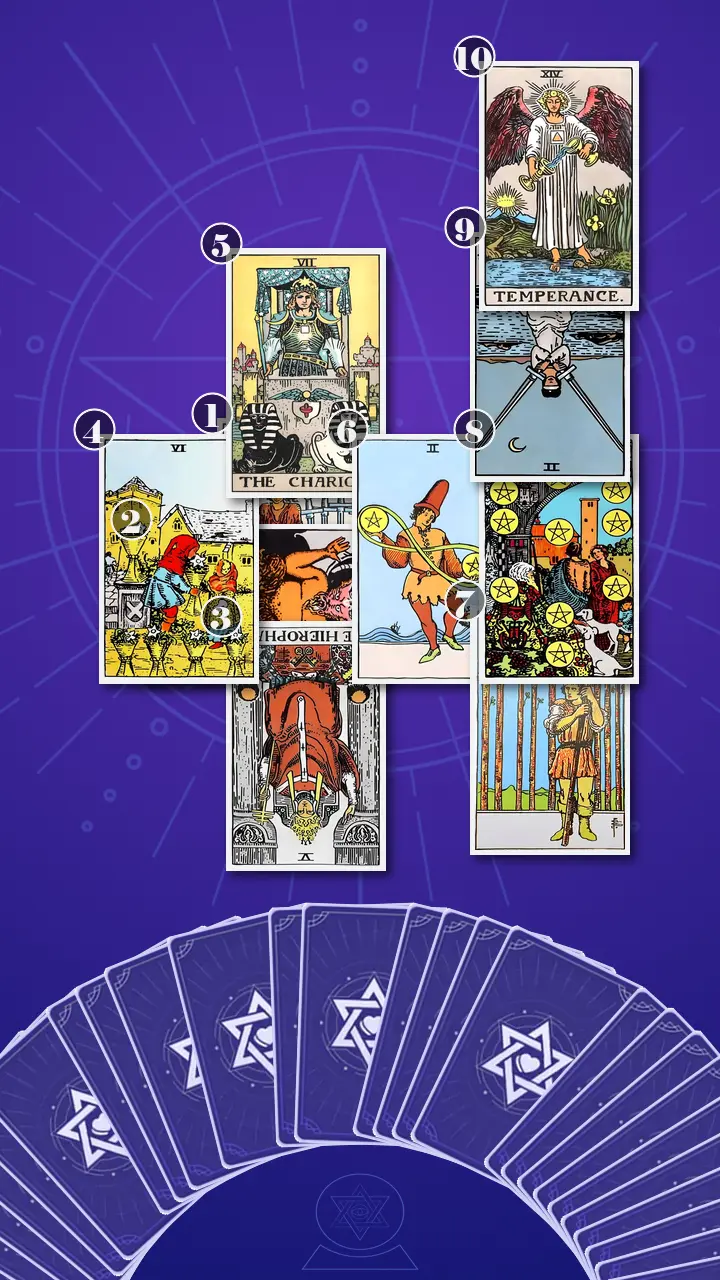
Reading the Map: How Tarot Works When You’re Stuck at a Career Crossroads
Position 1: The current stuck point — Eight of Swords (upright)
“Now we’re turning over the card that represents the current stuck point: how guilt is tangling your attention right now.”
Eight of Swords, upright.
I didn’t need to dramatize it; the image did that on its own—blindfold, loose ropes, a narrow corridor of swords that looks tighter than it is.
“This is 12:13 a.m. in Toronto,” I said, keeping it specific, “and you’re in your Notes app rewriting the same ‘respectful, mature’ explanation about the one-way ticket. The move is already booked, but your nervous system is acting like your real life can’t start until the family group chat gives a ‘safe’ response. So the phone stays within reach the next day—at work, on dates—because part of you is still waiting for permission to exhale.”
Energetically, the Eight of Swords is a blockage of agency. Not a lack of options—more like a mind-loop that narrows the hallway. The blindfold is important: it’s not “you’re naive.” It’s “you don’t want to look directly at the pain of disapproval.”
Jordan let out a small laugh that had bitterness in it. “That’s… too accurate,” she said. “Like, kind of brutal.”
“I know,” I said softly. “But also—notice the ropes. They’re not tight. This card always asks: what’s one single step that proves you still have agency, even while guilt is loud?”
And because the Eight of Swords pairs with a later card in this reading, I added the split-screen. “At night: phone glow, essay-texts, refreshing. By day: ‘I’m fine, I’m fine’ in meetings while a hidden tab in your brain plays the group chat audio.”
Position 2: The immediate blocker — The Devil (upright)
“Now we’re turning over the card that represents the immediate blocker or amplifier: what most strongly complicates this—the hook guilt uses.”
The Devil, upright.
“This isn’t about you being ‘bad,’” I said, because I never let that misunderstanding land. “This is about attachment and binding agreements.”
I translated it into her actual life: “You treat guilt like a binding contract. If family is upset, you must pay—extra explanations, extra calls, extra proof you’re still a good daughter. You pick up inconvenient calls, you apologize pre-emptively, you overfunction to keep the peace—and then you show up depleted at work and emotionally guarded in love because you’ve been chained to managing everyone’s feelings.”
Energetically, the Devil is excess obligation: love gets confused with compliance, reassurance gets confused with safety. It’s like a subscription you forgot you agreed to—every time you try to cancel, it offers you a “free month” of relief if you just explain a little more.
Jordan’s shoulders rose toward her ears without her noticing. She nodded once, sharp. “The relief when someone says ‘Okay, fine’—it’s like oxygen.”
“Exactly,” I said. “And here’s the trust-building part: needing boundaries doesn’t mean you love them less—it means you’re finally counting your own capacity.”
Then I added the line I knew she needed, because her work and love were paying rent for a family conversation they didn’t start. “Don’t let the family conversation rent space in every room of your life.”
Position 3: The deep root — The Hierophant (reversed)
“Now we’re turning over the card that represents the deep root: the learned rule about family, love, and duty that keeps the pattern running.”
The Hierophant, reversed.
At the root, this isn’t just about a few tense calls. It’s about a rulebook.
“You have an internal respectability checklist,” I told her. “The second family reacts, your mind starts translating your move into their language—practical, safe, approved—like you have to submit an application for adulthood.”
Energetically, the Hierophant reversed is a deficiency of self-authored values. Not because you don’t have values—but because you don’t let them be the authority when pressure arrives. You still hand the keys over.
I pointed to the card’s keys—then let my perfumer brain speak for a second, an “inner flashback” to Paris labs and strict briefs. “In perfumery, there’s a moment where you realize you’ve been composing for a judge you’ll never meet. The formula becomes ‘acceptable’ instead of alive. That’s what this rulebook does to your decisions.”
Jordan stared at the keys like they were a real object on the table. “I hate how much I still… want to be ‘the sensible one.’”
“That makes sense,” I said. “But we’re going to separate value from justification. One sentence can be enough.”
Position 4: The emotional backstory — Six of Cups (upright)
“Now we’re turning over the card that represents the emotional backstory: what you’re carrying forward from earlier family dynamics.”
Six of Cups, upright.
This card softened the room. Not because it made things easy—because it made them human.
“This is the tenderness,” I said. “You aren’t only dealing with pressure—you’re dealing with real warmth and history. You remember being close, being the one who kept things warm. So boundaries feel like betrayal.”
Energetically, the Six of Cups is balance in memory—until it slides into a younger role. “On calls, you slip into a version of yourself that seeks reassurance instead of relating as an adult. And then guilt hits harder, because it’s not just ‘they’re mad’—it’s ‘am I still safe here?’”
Jordan’s mouth tightened, then relaxed. Her eyes went glassy for half a second. “Yeah,” she whispered. “It’s not that they’re monsters. It’s that I… miss the old version.”
“That grief belongs in the story,” I said. “We don’t fix guilt by pretending you don’t love them. We fix it by updating the relationship so love doesn’t require self-erasure.”
Position 5: The conscious aim — The Chariot (upright)
“Now we’re turning over the card that represents the conscious aim: what you’re trying to do with the one-way ticket—values, direction, self-definition.”
The Chariot, upright.
This card has posture. It’s the moment your spine remembers itself.
“This is the moment you remember: you already chose,” I said. “The one-way ticket is your steering wheel—values first, reactions second.”
And I used the echo technique we planned, shifting from phone to body: “I picture you on a morning walk to grab coffee—cold air waking your face up, fingers wrapped around a hot cup. You feel the ticket in your inbox and your spine straightens. Two truths: I can care AND I can go.”
Energetically, the Chariot is balance through will: not emotional shutdown, not dramatic declarations—just direction. The two sphinxes are the modern conflict: loyalty and autonomy pulling in different directions. The Chariot doesn’t kill either sphinx. It holds the reins.
Jordan exhaled in a way that sounded like her ribs had been locked for weeks. “That,” she said. “That’s what I want. Not to burn bridges. Just to… drive.”
Position 6: The near-term reality check — Two of Pentacles (upright)
“Now we’re turning over the card that represents the near-term reality check: how the work-and-love balance will be tested as the move becomes real.”
Two of Pentacles, upright.
“This is a bandwidth problem,” I said, plain and kind. “Deadlines, packing, dating, family contact—competing for the same limited attention.”
I pointed to the infinity loop. “If you try to keep everyone continuously updated, you’ll give work and love the leftover version of you. This card isn’t a warning that you’ll fail. It’s a warning that juggling without named priorities becomes a never-ending loop.”
Energetically, the Two of Pentacles is excess responsiveness—competence under pressure that becomes unsustainable without limits.
Jordan’s jaw clenched. “I literally rewrote a Slack update yesterday because I didn’t want to sound… irresponsible.”
“That’s the Hierophant root talking,” I said. “Your autonomy shouldn’t need a courtroom-level defense in Slack or in love.”
Position 7: Jordan’s stance — Nine of Wands (upright)
“Now we’re turning over the card that represents your stance: how you’re showing up and coping—your self-protection and effort.”
Nine of Wands, upright.
“You’re braced,” I said. “Bandaged head energy. You enter family calls already tense, rehearsing arguments, and later you’re too depleted to be affectionate with your partner—or to be creative at work.”
Energetically, the Nine of Wands is balance tipping into blockage: resilience that becomes guardedness. The fence is protection, but it’s also isolation.
Jordan gave me a look that was half apology, half confession. “I’m tired of being on defense. Even when no one is actively attacking.”
“That’s the body remembering old rounds,” I said. “We’re going to teach it a new pattern: firmness without adrenaline.”
Position 8: The family system field — Ten of Pentacles (upright)
“Now we’re turning over the card that represents the family system field: what the environment is asking of you—expectations, legacy, pressure.”
Ten of Pentacles, upright.
“This is legacy gravity,” I said. “It’s not just one person’s opinion. It’s the feeling that you’re being measured against a stability rubric you never agreed to.”
I traced the archway on the card with my finger. “An invisible keycard door. Everything is fine until you try to access a new floor.”
Energetically, the Ten of Pentacles is excess system-weight: security, reputation, continuity—offered with an unspoken price tag. It’s why your family conversations can feel like Succession-lite, but without the suits—just the pressure.
Jordan’s lips pressed together. “It’s like there’s a family brand guideline,” she said, almost laughing. “And I’m… off-brand.”
“Exactly,” I said. “And adulthood is deciding you’re allowed to evolve the brand without being exiled from the building.”
Position 9: The push-pull — Two of Swords (reversed)
“Now we’re turning over the card that represents the push-pull: what you secretly want and what you fear it will cost—belonging versus autonomy.”
Two of Swords, reversed.
“Here’s the other blindfold,” I said, and I felt Jordan go still. “This is what happens in daylight.”
I used the split-screen echo fully: “At night, the Eight of Swords is you under the duvet, Notes app glowing, rewriting. By day, this Two of Swords reversed is you in a glass meeting room near King Street, marker smell sharp in your nose, nodding while your brain replays one line—‘Must be nice to just leave.’ Your leg bounces under the table. You’re hoping for one magical text that makes everything clean, so you keep reopening a decision you already made.”
Energetically, this is blockage dissolving into overwhelm: indecision used as pain control, until indecision becomes its own pain. It’s decision fatigue with an emotional edge.
Jordan swallowed. “I hate that my partner can tell,” she said. “Like I’m there, but I’m not.”
“You’re not choosing between family and love,” I said. “You’re choosing whether guilt gets to be the manager of your attention.”
When Temperance Spoke: Turning Guilt into a Thermostat
Position 10: Integration guidance — Temperance (upright)
I let the room quiet before I touched the final card. Even the city sounds outside—distant streetcar, a faint siren—felt like they stepped back to listen.
“Now we’re turning over the card that represents integration guidance: the most empowering way to relate to guilt so it doesn’t derail work and love.”
Temperance, upright.
Setup—because this is where Jordan lived most days: “You know that moment when the group chat goes quiet after you share your plan, and you feel your chest tighten like you just did something wrong—so you start drafting a longer explanation to fix the feeling?”
Stop treating family guilt like a verdict, and start treating it like a temperature you can regulate—Temperance turns the messy mix into something livable.
I let the sentence sit there. No extra coaching. No extra paragraphs. One sentence is still communication.
Reinforcement came in layers—the way a fragrance reveals itself from top note to base. Jordan’s reaction had a sequence I see often when someone finally stops arguing with gravity.
First: physiological freeze. Her breathing stalled mid-inhale, and her fingers tightened around her water glass like it was an anchor. Her shoulders stayed high, waiting for impact.
Second: cognitive seep-in. Her gaze unfocused, sliding slightly past the cards as if her brain was replaying every midnight Notes app essay, every “quick call” that turned into interrogation, every date where she smiled on autopilot and didn’t hear the last three sentences.
Third: emotional release. A shaky exhale escaped her, and her shoulders dropped—not dramatically, just enough to be real. Her eyes went wet with that specific look that says, Oh. I’ve been living like I’m on trial.
And then—an unexpected reaction, because clarity can sting before it soothes. Her eyebrows pulled together and her voice sharpened. “But if that’s true,” she said, “doesn’t it mean I’ve been doing it wrong? Like… I’ve been feeding it.”
I didn’t flinch. “It means you’ve been doing what worked in the old system,” I said. “And you’re outgrowing it. That’s not a moral failure. That’s an update.”
Here’s where my perfumer’s brain and my signature work as an intuitive consultant snapped into place—my Conflict Transformation System, the way I convert tension into a constructive dialogue rather than a shutdown or a blow-up.
“Temperance is emotional moderation,” I continued. “And in my world, moderation isn’t ‘muted.’ It’s measured. This angel is blending two cups—compassion and firmness—into a wearable shade. Not the color that pleases everyone. The color you can actually live in.”
I leaned in slightly. “And I want you to borrow the line that matters most: Guilt is a signal to set a boundary, not a command to surrender your life.”
She blinked fast. Her chin trembled once, then steadied. “Okay,” she whispered, like she was trying on the words for size.
“Now,” I said, gently coaching. “Use this new frame and look back at last week. Was there a moment where guilt spiked—tight chest, sinking stomach—and you started bargaining? What would Temperance have done in that moment?”
Jordan pressed her palm to her sternum, exactly where she’d described the tightness living. “I would’ve… not written the essay,” she said, almost surprised. “I would’ve sent two sentences. And then I would’ve gone to bed.”
“Yes,” I said. “That’s the emotional transformation right there: from guilt-driven tightening and over-explaining to steadier self-respect through consistency. Not perfect certainty. Consistent regulation.”
The One-Page Boundary Plan: Actionable Advice That Protects Work and Love
I took a breath and threaded the whole reading into one coherent story, because that’s what integration is: not ten separate insights, but a single, believable narrative.
“Here’s why it’s been happening,” I said. “Right now, you’re stuck in a mental trap (Eight of Swords) and the hook is guilt-as-control (Devil). Underneath, there’s an inherited rulebook that equates respectability with belonging (Hierophant reversed), powered by real tenderness and nostalgia (Six of Cups). You’re trying to drive your adult life with values (Chariot), but the logistics are getting swallowed by constant juggling (Two of Pentacles). You’re resilient but braced (Nine of Wands), and the family system carries legacy weight (Ten of Pentacles), which makes you keep reopening the decision for relief (Two of Swords reversed). Temperance says: stop trying to win permission. Regulate the intensity, set a boring boundary, and keep living.”
“The blind spot,” I added, “is thinking that if you explain enough, everyone will feel okay—and then you’ll be allowed to relax into work and love. That keeps you in a loop: family discomfort → your guilt spike → you pay with emotional labor → short relief → long-term resentment and distance.”
“The transformation direction is simpler and harder,” I said, meeting her eyes. “Shift from earning permission through explanations to practicing clear boundaries plus self-compassion when guilt shows up.”
Then I gave Jordan—and you—something you can actually do. Not a personality transplant. Tiny experiments that teach the nervous system a new rule.
- Pin the 2-Sentence ScriptOpen your Notes app and write a two-sentence boundary you can reuse: “I love you. I’ve made my decision and I’m not debating it. I can update you on logistics on Sunday at 5.” Pin it. Use it the next time you feel tempted to write an essay.Expect it to feel “mean” the first time. Discomfort isn’t proof you’re wrong; it’s proof you’re changing the pattern. If you freeze, send only the first sentence. One sentence is still communication.
- Schedule One Predictable Family WindowChoose one contact window for the week (example: Sunday 5:00–5:30 p.m.) and put it on your calendar like a meeting. If someone calls outside it, let it go to voicemail and text: “I’m not free to talk right now—let’s do Sunday.”Make your boundary boring. Repetition is what makes it real. If you worry about emergencies, set a rule: two calls in a row = step out; otherwise you respond during the scheduled window.
- Do a 10-Minute “Agency Step” After Any Guilt TriggerRight after a guilt spike—tight chest, sinking stomach—set a timer for 10 minutes and do one forward-motion task: pack one box, update one moving document, draft one work deliverable, or confirm one appointment. The point is to teach your body: guilt can be present and you still move.If 10 minutes feels like too much, do the 2-minute version. Momentum matters more than intensity.
Because I’m Luca, and scent is one of my most reliable tools for nervous-system regulation, I offered one more layer—optional, but powerful—using my Dialogue atmosphere enhancement with calming scents strategy.
“Temperance is a thermostat,” I reminded her. “So let’s give your body a physical cue that says ‘we’re safe while we hold a boundary.’ Before the Sunday call, choose one calming scent you genuinely like—something soft and clean, maybe neroli, lavender, or sandalwood. Put it on your wrist or on a tissue nearby. Not to ‘control’ anyone—just to signal your own system: steady voice, firm limit.”
Then I used my Family Energy Diagnosis lens, the way I read emotional flow through sensory preference. “Notice which family interactions make you reach for something ‘sharp’—peppermint gum, extra coffee, scrolling. That’s your body asking for regulation. Temperance is you meeting that need without paying for approval.”

A Week Later: Ownership, Not Permission
A week later, Jordan messaged me a screenshot—not of a long explanation, but of her pinned note. Two sentences. That was it. Under it, she’d typed: “Used this. Felt like my chest was doing The Bear kitchen panic for 30 seconds. Didn’t add a paragraph. Went on my date anyway.”
She told me the Sunday call still had an edge. Nobody threw confetti. But she didn’t bargain. She didn’t offer coupons—timelines, extra visits, extra proof. She repeated the boundary once, calmly, and ended the call without turning it into a trial.
Her bittersweet proof was small and real: she slept through the night, then woke up and her first thought was, “What if I’m wrong?”—and this time she just lay there for a beat, hand on her sternum, and whispered, “I’m allowed to choose.” Then she got up and made coffee.
That’s the Journey to Clarity I trust: not dramatic rupture, not perfect peace—just ownership. A life where you can love your family without negotiating your future, and where your work and your love get the present version of you.
When the group chat goes quiet and your chest tightens, it can feel like belonging is something you have to keep paying for—right as you’re trying to build a life that’s finally yours.
If you didn’t need anyone’s permission to exhale, what would your next tiny boundary look like—one sentence, one schedule choice, one ‘not tonight’—that protects your work and your love?