Stuck in the Cancel-Guilt Loop—And a Cleaner Way to RSVP Early

Finding Clarity in the Warm Glow of the Family Group Chat
If you’ve ever typed “Yes!!!” in the family group chat before checking your calendar—then reopened Google Calendar three times a day like you’re renegotiating a contract you didn’t mean to sign—this is for you.
Taylor showed up on my screen from their Toronto condo, shoulders slightly hunched the way people get when they’ve been bracing all week. Behind them, a kitchen light cast that flat, end-of-day glow; you could almost hear the microwave hum through the silence. Their phone kept lighting up on the table—little iMessage reactions, the kind that look harmless (❤️/👍) but somehow raise the stakes instantly.
“I don’t want to disappoint anyone,” they said, voice careful like they were choosing each word with tweezers, “but I also can’t keep doing this to myself. I say yes because it’s easier than explaining a boundary… and then I cancel, and I feel like I have to write an essay to prove I’m not a bad person.”
I watched their hand drift to their jaw without them noticing. A small press, like they were trying to hold their face together. The guilt wasn’t abstract—it sat in their body like a stone in the stomach, then climbed into the chest as pressure, then tightened the jaw into that restless clench that makes you grind through the night.
“Okay,” I said, keeping my voice warm and steady. “Let’s treat this like a pattern—not a personality flaw. We’re going to make a map of the loop, find where it steals your agency, and build a clean next step. A real Journey to Clarity, but in the language of your actual life: group chats, calendars, and the thumb hovering over ‘Send.’”

Choosing the Compass: The Celtic Cross · Context Edition
I asked Taylor to take one slow breath—not as a mystical thing, but as a nervous-system handbrake. Then I shuffled, letting the sound of the cards create a tiny buffer between the ping of obligation and the moment of choice.
“For this,” I told them, “I’m using the Celtic Cross · Context Edition.”
For anyone reading along who’s ever wondered how tarot works in a practical way: this spread is perfect for a repeating behavioral loop. It doesn’t just say ‘do this’—it shows (1) what you’re doing on a normal week, (2) what’s blocking you, (3) the deeper ‘should’ underneath the schedule, and then it climbs toward what to do next. It’s structure, not fortune-telling.
“Card 1,” I said, “will name the loop as it actually plays out in your day-to-day—your RSVP/cancel pattern.”
“Card 2 crosses it,” I continued, “as the immediate block—the thing that makes a clean RSVP feel weirdly impossible.”
“And card 10,” I added, tapping the top of the layout, “is integration: the healthiest communication pattern. Not a fixed outcome—more like the voice you can practice until this stops costing you sleep.”
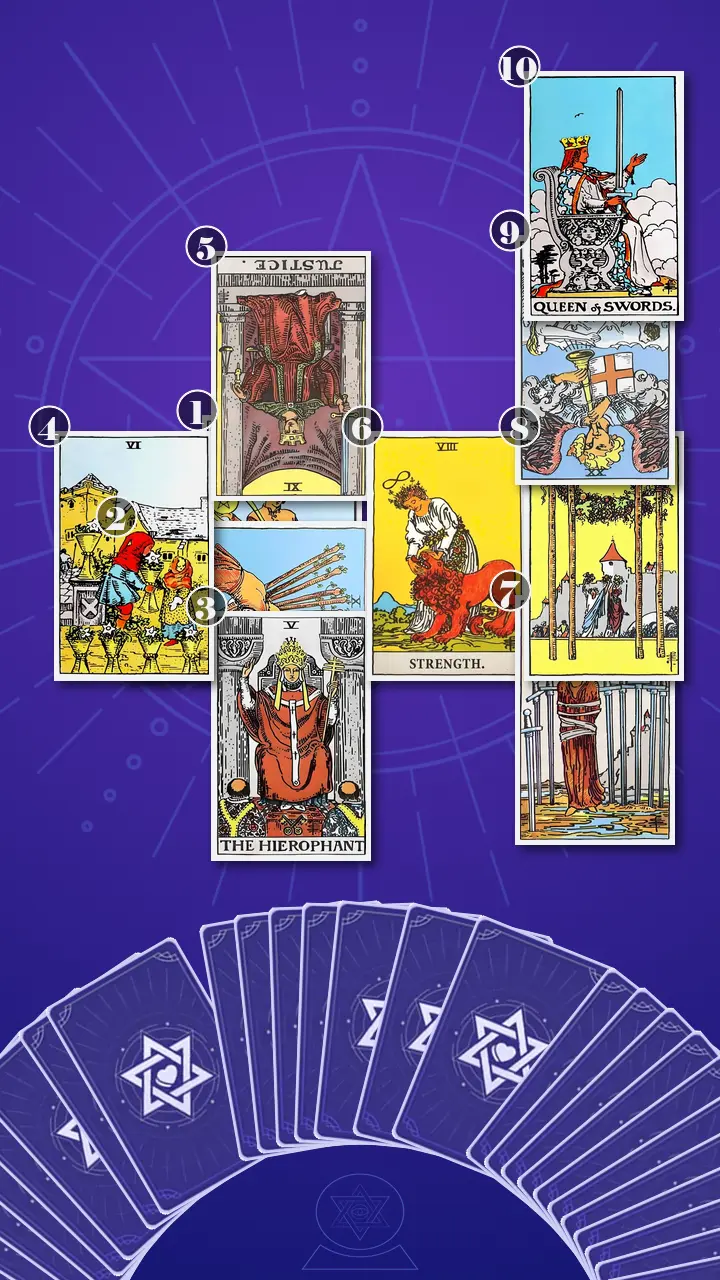
Reading the Map: Card Meanings in Context
Position 1 — The current RSVP/cancel pattern as a concrete, day-to-day behavior loop
“Now turning over,” I said, “is the card that represents the current RSVP/cancel pattern as a concrete, day-to-day behavior loop.”
Two of Pentacles, upright.
The first thing I noticed was the infinity loop ribbon linking the coins—motion without rest. “This is the juggling,” I told Taylor. “Not even dramatic juggling. The quiet kind: keeping everything ‘technically yes’ while constantly recalculating.”
I grounded it in their real life: “This is like when you keep multiple tabs open—calendar, messages, transit times—and you call it ‘being flexible,’ but it’s actually constant background stress.”
Energetically, the Two of Pentacles is balance under movement. In Taylor’s case, it’s balance tipping into excess: too much adjustment, not enough decision. The relief of the instant ‘yes’ lasts five minutes; then the recalculations start.
Taylor let out a small laugh—quick, a little bitter. “That’s… weirdly accurate. Like, it’s almost rude,” they said, but their eyes softened the moment after, like they were relieved someone finally called it what it is.
“Not rude,” I said. “Just honest. And here’s a question this card asks: what would change if ‘I’m not sure yet’ were a valid RSVP instead of a failure?”
Position 2 — The immediate block that makes it hard to give a clean RSVP and follow through
“Now,” I said, “we’re looking at the immediate block that makes it hard to give a clean RSVP and follow through.”
Ten of Wands, upright.
The image is someone carrying too much, their view blocked by the load. “This is over-commitment,” I told them. “The RSVP happens when you’re still imagining the plan as light. Then the week arrives and every responsibility climbs into the same tote bag until you’re mad at the dinner invite like it personally did this to you.”
And then I used the scene-contrast that always lands with people stuck in this pattern: “In the group chat, it’s a light ‘Yes!’—two taps and a heart reaction. Two days later, you’re staring at your calendar like it’s a Tetris game by Thursday, and you’re thinking, ‘I can carry this… I can carry this… why am I suddenly angry at a dinner invite?’”
Energetically, Ten of Wands is excess—carrying obligations past your actual limit. And when a yes is made from duty instead of capacity, it doesn’t stay a yes. It turns into a burden you resent. Resentment makes avoidance more likely. Avoidance makes late cancellation more likely. Late cancellation makes guilt feel “proven.”
I watched Taylor’s throat move as they swallowed. Their head dipped in a tight nod, and when they exhaled it sounded like someone putting down a heavy grocery bag. “Yeah,” they said quietly. “I can literally remember the last text I wrote. It was… so long.”
Position 3 — The hidden driver behind the guilt response (the ‘should’ beneath the schedule)
“This card,” I said, “represents the hidden driver behind the guilt response—the ‘should’ beneath the schedule.”
The Hierophant, upright.
“This is the rulebook energy,” I told Taylor. “Family plans aren’t just plans in your nervous system. They’re moral. They’re tradition. They’re ‘how things are done.’”
In modern terms: “It’s like you hear ‘It’s family’ as a rule that overrides your capacity, so a simple RSVP becomes a test of loyalty instead of a scheduling choice.”
Energetically, the Hierophant is structure. In balance, structure gives belonging. In excess, structure becomes a script you don’t remember agreeing to. That’s when hesitation feels like being ‘difficult,’ and a boundary feels like betrayal.
“When you feel that pressure to say yes,” I asked gently, “what unspoken rule shows up first—‘family comes first,’ ‘don’t make it weird,’ ‘showing up proves love’?”
Taylor’s eyes flicked away from the camera—memory-searching. “It’s… ‘don’t be difficult.’ Like, just be easy. Be the easy one.”
Position 4 — The recent emotional history with family plans that still colors your reactions
“Now we’re looking at the recent emotional history that still colors your reactions,” I said.
Six of Cups, upright.
“This is emotionally old,” I told them. “Not in a dramatic, blame-your-childhood way. In a simple way: you learned early that ‘nice’ keeps things smooth.”
Modern translation: “This is like when you feel a surge of ‘I should be easy to be around’ and you say yes to preserve the familiar good vibe, even if your adult life can’t support it.”
Energetically, Six of Cups is sweetness—but it can become pull. It pulls you toward a younger version of yourself answering the invite: the one who wants approval and peace, not the adult with a calendar and a body.
“When you RSVP,” I asked, “which ‘you’ is texting? The adult with the week ahead—or the younger part that wants everything to stay uncomplicated?”
Taylor didn’t answer right away. Their shoulders lifted, then dropped—like they’d been holding that question in their body for years.
Position 5 — Your conscious story about what being ‘a good family member’ requires
“This card,” I said, “shows your conscious story about what being ‘a good family member’ requires—and how that story shapes guilt.”
Justice, reversed.
Justice reversed is one of the clearest cards for the inner courtroom. “You want to be fair,” I told Taylor. “You want to be accountable. But the scorekeeping has gotten distorted.”
Modern translation: “This is like treating an RSVP like a binding contract and a cancellation like a character flaw—so you try to ‘pay back’ the discomfort with long explanations.”
Energetically, Justice reversed is blockage: fairness gets stuck, then turns inward as self-prosecution. Instead of ‘I changed plans,’ it becomes ‘I did something wrong.’
I layered the earlier scene contrast here, because this is where the loop locks in: “Ten of Wands is the load. Justice reversed is the trial. First you carry too much… then you reread the thread like it’s evidence. You become judge, jury, and defendant in a case called ‘Taylor vs. Being Unreliable.’ And your jaw clench? That’s your internal gavel.”
Taylor’s mouth tightened, then they winced like I’d caught them mid-habit. “I literally edit the cancellation text ten times,” they admitted. “I add context every time. Like I’m… building a defense brief.”
“Exactly,” I said. “And here’s the practical reframe: clarity early is kinder than guilt late.”
Position 6 — The most supportive next step for breaking the loop
“Now we’re turning to the most supportive next step—not a prediction, but a direction for practice,” I said.
Strength, upright.
Strength isn’t loud. It’s not a mic-drop boundary. It’s the steady hand that holds the moment before it turns into a spiral.
Modern translation: “This is like when you reply, ‘I can’t make Saturday, but I can do a short coffee next week,’ and you let that be enough instead of spiraling into apologetic over-functioning.”
Energetically, Strength is balance: firm without being mean, clear without being cold. It’s the opposite of scrambling.
I guided Taylor into the micro-moment: “Picture the group chat ping. Your thumb is hovering over ‘Send.’ You feel your stomach tighten—the first warning sign you usually bulldoze past. Strength says: wait ten minutes. Open Google Calendar. Notice the body cue. Then answer from calm.”
I watched it land the way it often does: a small softening. Taylor’s shoulders dropped a fraction, like their body recognized a door that wasn’t locked. “I could try that,” they said, almost surprised.
“You can,” I agreed. “And here’s the inner script swap: from ‘I need to make this okay’ to ‘I can be firm without being mean.’”
Position 7 — How you are positioning yourself internally (self-talk, perceived options, and confidence)
“This card,” I said, “represents how you position yourself internally—your self-talk and perceived options.”
Eight of Swords, upright.
Eight of Swords is the ‘no safe wording’ story. “You’re blindfolded by imagined consequences,” I told Taylor, “and your bindings are looser than they feel.”
Modern translation: “This is like staring at the keyboard with a drafted message, convinced there’s no safe way to respond, even though a simple, honest sentence would work.”
Energetically, this is blockage—not because you have no options, but because your mind narrows them until you only see two: perform a perfect yes, or later beg forgiveness for a no.
“Which part is real constraint,” I asked, “and which part is a story you’ve repeated so often it feels like fact?”
Taylor blinked slowly. “The ‘they’ll think I’m difficult’ part,” they said. “That’s… a story. It’s loud, but it’s a story.”
Position 8 — The family/group dynamic around plans: the emotional ‘weather’ you’re responding to
“Now,” I said, “we’re looking at the environment—the emotional weather your family plans create.”
Four of Wands, upright.
Four of Wands is the ‘it’s supposed to be happy’ pressure. “Your family plans carry celebration energy,” I told them. “Milestones. Togetherness. The vibe is ‘can’t wait!!!’ which can make negotiation feel like you’re raining on the party.”
Modern translation: “This is like when you know it’s ‘just dinner,’ but the vibe is ‘we’re all together,’ so declining feels like rejecting the family rather than managing a schedule.”
Energetically, it’s fire in balance—warmth, welcome. But when you’re already overloaded, that fire can turn into performance: you feel you must be upbeat and available.
I nodded at Taylor’s phone on the table. “Those heart reactions? That’s Four of Wands energy in an iMessage costume.”
Taylor gave a tiny, reluctant smile. “It’s so true. A heart reaction shouldn’t feel like a contract.”
Position 9 — What you secretly hope will happen and what you fear will happen
“This card,” I said, “shows your hopes and fears—the secret hope for ease and the fear of judgment.”
Judgement, reversed.
Judgement reversed is the fear of the verdict. “This isn’t about the plan,” I told Taylor. “It’s about what you think the plan says about you.”
Modern translation: “This is like refreshing your DMs like you’re waiting for a performance review—checking ‘seen’ receipts and reading silence like a negative Yelp review about your character.”
Energetically, it’s blockage again—because you’re seeking absolution instead of practicing straightforward boundaries.
I went full phone-screen realism, because shame dissolves when we name the mundane details: “You cancel. Then you open the chat. Then you check timestamps. Then you re-open it. Then you imagine what everyone’s saying in their kitchens. And your nervous system starts begging for a verdict: ‘Am I still okay? Are we still okay?’”
Taylor laughed—nervous, a wince inside it. “I do that. I hate that I do that.”
“We don’t shame it,” I said. “We just reframe it: Silence isn’t always a sentence. And also—belonging shouldn’t have an RSVP penalty fee.”
When the Queen of Swords Lifted Her Upright Sword
When I reached for the final card, the room felt quieter—like even the city noise outside Taylor’s cracked window had lowered its volume. “This,” I said, “is the integration card. The voice you grow into.”
Position 10 — Integration: the healthiest communication pattern to adopt so the loop loses its fuel
“Now turning over,” I said, “is the card that represents integration: the healthiest communication pattern to adopt so the loop loses its fuel.”
Queen of Swords, upright.
Her gaze is direct. Her sword is clean. Her open hand says, ‘I’m not here to punish you. I’m here to tell the truth.’
Modern translation: “This is like when you text, ‘I can’t make it. I’m keeping this weekend for rest. I’d love to see you next Saturday for lunch,’ and then you stop rewriting it to manage everyone’s feelings.”
Energetically, the Queen of Swords is balance—clarity with kindness. Not coldness. Not over-explaining. Just respectful, adult information.
Setup. I could see Taylor’s usual moment in my mind as I spoke: the family group chat pinging, everyone reacting fast, their fingers typing “I’m in!” before Google Calendar even opened—because hesitation feels like being the difficult one.
Stop trying to earn forgiveness with apology essays; start offering clean, timely truth with the Queen’s upright sword.
Reinforcement. The sentence hung in the air like a bell. Taylor’s breath stopped for half a beat—physiological freeze. Their eyes unfocused slightly, like their brain was replaying a hundred message drafts at once—cognitive seep. Then their shoulders dropped, slowly, like a tight coat finally sliding off—emotional release.
Their lips parted and they made a sound that wasn’t quite a laugh, not quite a sigh. “But… if I do that,” they said, and there was a flash of heat in their voice, “doesn’t it mean I’ve been doing it wrong? Like I’m the problem?”
There it was: the unexpected reaction that’s actually part of the healing logic. People often meet clarity with grief or anger first, because clarity implies responsibility.
I kept my tone soft but precise. “It doesn’t mean you were bad,” I said. “It means you were buying safety the only way you knew: with extra effort. The Queen isn’t here to shame you. She’s here to stop the interest payments.”
And because I’m Luca—Paris-trained perfumer before I ever read cards—I added the lens that lives in my bones. “I use something I call Family Energy Diagnosis,” I explained. “It’s not woo. It’s sensory psychology. Families have an emotional ‘scent’—a pattern of how closeness is signaled.”
“Think about your family gatherings,” I continued. “Are they ‘sweet’—dessert, nostalgia, jokes, no hard conversations? Or are they ‘bright’—lots of plans, lots of hype? When a family system is built on sweetness, directness can feel like vinegar at first. It doesn’t mean it’s wrong. It means the system is used to comfort notes, not truth notes.”
Taylor’s eyes widened slightly—then they nodded, slower this time. “It’s sweet,” they said. “It’s like… everything is ‘can’t wait!!!’ and if you’re not excited it’s weird.”
“Exactly,” I said. “So your apology essays are you trying to keep the sweetness while changing the plan. The Queen of Swords offers a new kind of belonging: belonging that can hold honesty.”
I leaned in, just a bit. “Now—with this new lens—think back to last week. Was there a moment where a clean, early sentence would’ve changed how you felt in your body?”
Taylor stared at the corner of their screen, replaying. “Wednesday,” they said. “The invite came in and I said yes in like two seconds. My stomach did that tight thing immediately. If I’d paused… I could’ve said ‘not sure yet’ and it wouldn’t have become a whole thing.”
“That,” I said, “is a real step—from self-doubt and apology-spirals to grounded, adult clarity. Not perfect. Just cleaner.”
The Burden-to-Boundary Reset: Next Steps You Can Actually Do
I summarized the story the spread had told us, so Taylor could feel it as one coherent thread instead of ten separate insights.
“Here’s the loop,” I said. “Two of Pentacles is you juggling in real time—answering fast to stay connected. Ten of Wands shows the cost: you’re already carrying more than your week can hold, so the ‘yes’ becomes heavy. The Hierophant and Six of Cups explain why it feels moral and nostalgic—like you’re breaking a rule and a role. Justice reversed and Judgement reversed are the internal courts: you prosecute yourself, then wait for a verdict in the chat. Strength is the hinge: the pause, the self-respect, the early clarity. And Queen of Swords is the integration: fewer words, earlier answers, calm tone. Stop writing apology essays. Start stating plans.”
“The cognitive blind spot,” I added, “is thinking that more explanation creates more safety. But in this system, more explanation usually just keeps you trapped in verdict mode. The transformation direction is simpler: pause before you RSVP, choose a bounded answer, and let your language be clean enough that you can stand behind it without days of repair.”
Then I gave Taylor actions—small, specific, low-drama. Actionable advice, not a personality makeover.
- Build your “RSVP Scripts” Note (2 minutes)Open your Notes app and create a pinned note titled “RSVP Scripts.” Add three copy/paste options: (1) “I can’t make it this time, but I hope you all have a great night.” (2) “I’m not sure yet—can I confirm by Wednesday at 6?” (3) “Yes, but I can only stay until 8:30.” Use it the next time the family group chat pings.Your brain will say two sentences is rude. That’s guilt trying to buy safety with extra labor. Paste it anyway—especially with a ‘safer’ family member first.
- Do the 10-minute “calendar + body check” before you replyBefore you type anything in the chat, open Google Calendar for the day of the plan and the day before. Set a 2-minute timer and ask: “If I say yes, what am I giving up—rest, errands, time with friends, or recovery?” Write ONE cost. If your stomach tightens or your jaw clenches, choose “not sure yet” or a bounded yes.Make it easier: set a personal rule that you don’t send RSVP messages after 10 PM when you’re depleted. If you break it, you’re allowed to revise in the morning without self-punishment.
- Use a scent-anchor to exit the courtroom (30 seconds)Keep one calming scent by your phone—lavender, neroli, or a simple bergamot rollerball. Before you reply or cancel, inhale once and let it mark the shift from “verdict mode” to “plan mode.” Then send the clean script. (This is my “dialogue atmosphere enhancement” strategy, but for your nervous system.)If you start spiraling, step away for 5 minutes and come back. No one needs an immediate essay reply. You can always add context later only if you genuinely want to—not to earn forgiveness.

A Week Later: The Quiet Proof
Eight days later, Taylor sent me a screenshot—cropped tightly, like they didn’t want to make a big deal out of it.
It was a family invite. And below it, their reply: “I’m not sure yet—can I confirm by Wednesday at 6?” No essay. No extra paragraphs. Just a plan.
They added one line: “My stomach did the tight thing, and I used the bergamot. I still felt awkward… but I didn’t spiral. I slept through the night. This morning my first thought was ‘what if they’re annoyed?’ and then I laughed a little because… I stated a plan. That’s allowed.”
That’s what I want people to understand about finding clarity: it’s rarely fireworks. It’s often a small unclenching in the jaw, a calmer thumb over ‘Send,’ a sentence that doesn’t cost you three days.
When a simple family RSVP makes your stomach tighten, your jaw lock, and your brain start drafting a defense—what you’re really carrying isn’t the plan, it’s the fear that belonging has a price tag.
If you didn’t have to earn understanding with an apology essay, what would your clean, early RSVP sound like—just one sentence, in your own voice?
Every reading at AceTarot is a journey to connect with inner wisdom and empower your next step. The stories shared here are psychological mirrors, not private records—crafted to reflect universal emotional loops and help you find your own clarity. Learn more about our Journey to Clarity.