From Nickname Freeze to Calm Self-Respect: A Family Boundary Practice

The 8:47 p.m. Silence in the Hallway
If the nickname hits and your throat goes tight, you do a quick polite laugh, and then you spend the next hour drafting the perfect boundary text in Notes that never gets sent—yep.
When Taylor showed up on my screen, they were sitting in a small Toronto apartment that looked exactly like a life you built yourself: a coat rack crowded by the door, a narrow hallway, and that particular winter-dark reflection in the window that makes everything feel a half-step more private. They ended a family call while we were still settling in—almost by accident, like it had been on their mental to-do list for days and finally happened because the banner popped up and they couldn’t ignore it.
The screen went dark. The silence felt loud. A radiator clicked like it was keeping time. Taylor’s phone was warm in their palm, and their jaw was tight in that way that doesn’t feel like anger so much as it feels like you’ve been chewing on words you never got to swallow.
“They did it again,” Taylor said. Not yelling. Not dramatic. Just… flat. “The old nickname. And I laughed. I literally laughed. And now I’m going to pace and write twelve versions of a text I won’t send.”
I watched them stand, drift into the hallway by the coat rack, and start that familiar loop: two steps forward, two steps back, like their body was trying to walk the sentence out of their throat. They opened Notes. Typed. Deleted. Typed again.
What landed between us wasn’t just irritation. It was hurt—sharp and clean—followed immediately by guilt for having it at all. Like a tiny internal courtroom had convened in their chest: Are you overreacting? Are you being ungrateful? Are you hard to love?
Taylor looked at me and said, “It’s not just a word, it’s a whole version of me getting dragged into the room. I want to be seen as who I am now. But I’m scared that correcting them is going to make me seem ungrateful or… difficult.”
Their throat worked like it was trying to push something past a locked gate.
“Okay,” I said, keeping my voice peer-level and steady. “We’re not here to write the perfect paragraph. We’re here to find clarity—what boundary actually helps in the moment, and how to say it without abandoning yourself or turning it into a fight.”

Choosing the Compass: The Celtic Cross · Context Edition
I asked Taylor to take one slow breath with me—not as a ritual, not as anything mystical, just as a nervous-system gear shift. While they exhaled, I shuffled. On my desk, a blotter strip held a soft, clean scent—something I use when conversations carry old family electricity. It’s not magic. It’s sensory psychology: a small, consistent cue that tells the body, we’re safe enough to be honest.
“For this,” I said, “I’m using a spread called the Celtic Cross · Context Edition.”
And because people always deserve the ‘why,’ I explained it plainly: “This issue isn’t just what should I say. It’s a whole chain—what happens in your body when the nickname lands, what blocks you from speaking, the family rule underneath it, and then a workable way to practice a repeatable boundary. The Celtic Cross is good for mapping a pattern, not just predicting an outcome.”
I pointed to three anchors in the layout, the way I’d talk someone through a map app before a long walk: “Card one will show the lived moment—your immediate reaction. Card two is the block—the pattern that keeps the correction stuck behind your teeth. And later, card seven is your stance: the version of you that can actually deliver the boundary with dignity. Then the final card shows an integrated direction—something you can cultivate through practice, not a fixed fate.”
Taylor nodded once, small. Their shoulders were still high, like they were bracing for impact.
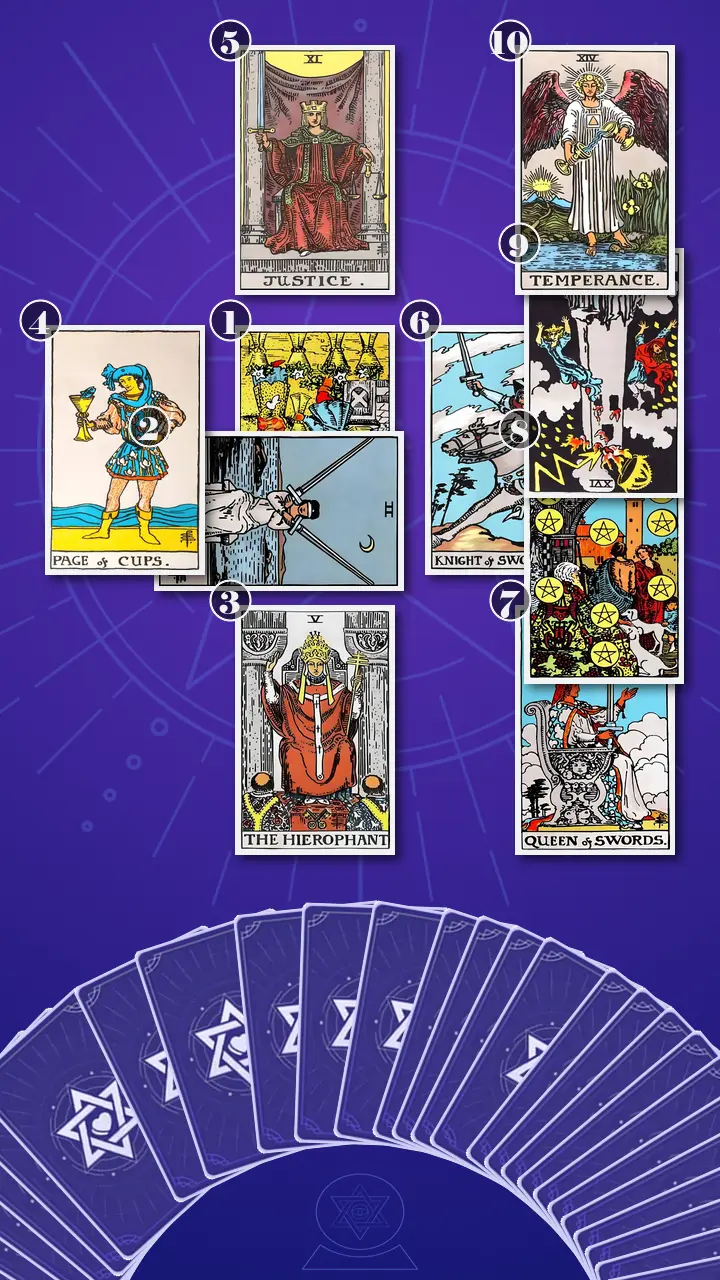
Reading the Map: Card Meanings in Context
Position 1: The Moment the Nickname Lands
“Now we’re turning over the card that represents the lived moment when the old nickname lands: the immediate identity and nervous-system reaction you experience.”
Six of Cups, reversed.
“This is the time-travel card,” I told Taylor. “Reversed, it’s nostalgia as autopilot—the past trying to define the present.”
I used the translation that fits modern life because it matters that tarot lands in real context: “It’s like your family keeps tagging you in an old Facebook photo-album version of you, and you’re trying to update the tag without starting a comment war.”
Taylor let out a short laugh that didn’t carry any humor. More like a recognition flinch. “That’s… actually brutal,” they said. “But yeah.”
“Not brutal,” I said gently. “Accurate. The energy here is a blockage in present-day identity. The nickname may be ‘sweet’ to them, but it assigns you a role: easy, cute, low-maintenance. And your body does what it learned to do back when you needed that role.”
I watched Taylor’s fingers press into their phone case, then release, then press again—like a metronome of restraint.
Position 2: The Block—Peacekeeping Through Silence
“Now we’re turning over the card that represents what blocks the boundary from being stated simply: the in-the-moment conflict-avoidance pattern.”
Two of Swords, upright.
I didn’t rush this one. The room felt quieter, even through video—like Toronto winter had leaned a shoulder against the window.
“This,” I said, “is tone-monitoring as a blindfold.” I tapped the image lightly. “Two swords crossed at the chest—this is the locked jaw. The held breath. The body going, don’t move, don’t make it weird.”
And I gave the inner monologue out loud, because sometimes hearing it externalized is what releases shame: “If I say it wrong, I’ll make it weird… so I’ll just not say it.”
Taylor’s throat bobbed like they’d swallowed a word. Their jaw flexed, and then they caught themselves doing it—like they’d just noticed their hand on a hot stove.
“Yeah,” they said quietly. “And then afterward I’m mad at myself for, like, choosing silence.”
“It’s not a moral failure,” I said. “It’s a strategy that used to keep you safe. But it comes with a trade: short comfort now versus long discomfort later—stewing, drafting, distancing, feeling less real around them.”
Taylor nodded once. A small exhale. The kind that says, Oh. It’s a pattern.
Position 3: The Root—The Family Rule Underneath
“Now we’re turning over the card that represents the family-rule underneath the nickname: the inherited role expectation that keeps repeating.”
The Hierophant, upright.
“This is ‘the way we’ve always done it’ energy,” I said. “Naming conventions in families can become a ritual. Not conscious. Not malicious. Just… institutional.”
Here’s where my own mind flashed to my training—perfume school in Paris, where tradition is both beautiful and stubborn. You can respect a classic formula and still update it for the person who’s going to wear it in 2026, not 1996. The Hierophant always reminds me: legacy isn’t the enemy, but it is heavy.
“In your family system,” I continued, “there’s an unspoken rule: parents name, kids accept. Even when the ‘kid’ is 28 with a corporate job and a fully adult life.”
Taylor stared at the card, then looked away, like it was too direct. “It’s like… I’m not allowed to correct them.”
“Exactly,” I said. “That rule is old. And it’s running the conversation in the present.”
Position 4: The Emotional History You Don’t Want to Damage
“Now we’re turning over the card that represents what the nickname originally represented in your relationship: the emotional history you’re trying not to damage.”
Page of Cups, upright.
“This card is tenderness,” I said. “Playful connection. The nickname probably started as affection, not control.”
I let that land because nuance is often what stops guilt from hijacking clarity. “A nickname can be affectionate and still be inaccurate,” I said, using the phrase the way I’d use a calming ingredient in a blend—small but stabilizing.
Taylor’s eyes softened for a second. “Yeah. Like… I don’t think they’re trying to hurt me.”
“Right,” I said. “And that’s why your boundary needs to update the connection, not punish it.”
Position 5: Your Conscious Aim—Fairness and Accuracy
“Now we’re turning over the card that represents what you’re actually asking for at a values level: respect, accuracy, and adult-to-adult language.”
Justice, upright.
“This is the catalyst,” I said. “Justice is HR-policy-level clarity. Facts, not feelings. Like correcting your name on a file: not drama, just accuracy.”
I watched Taylor’s shoulders drop a fraction—the smallest physical evidence that the request could be simple.
“Here’s the script energy Justice likes,” I said, and I spoke it the way you’d read a clean line in a handbook: “I go by Taylor now—please don’t use that nickname.” One sentence. Then stop.”
Taylor blinked. “That sounds… too simple. Like I should add something so they don’t get defensive.”
“That’s the Two of Swords talking,” I said. “Keeping the vibe isn’t worth losing yourself in the room.”
Then, very gently: “Accuracy is not cruelty.”
Position 6: The Near-Future Energy—Speed and Sharpness
“Now we’re turning over the card that represents the next conversational energy: how the correction is likely to come out if you speak without preparation.”
Knight of Swords, upright.
“This is momentum,” I said. “After enough silence, your truth wants to come out fast.”
I connected it to the exact modern pattern: “It’s like the next time they say it in front of relatives, your brain goes, now or never, and you want to say it all at once—every reason, every feeling, every example.”
“Yeah,” Taylor said, and their mouth tightened. “And then I’m scared I’ll sound sharp.”
“That’s the watch-out,” I agreed. “The Knight’s energy can be excess—truth delivered like a sprint. We want mature air, not storm air.”
Position 7 (Key): The Boundary Posture That Serves You Best
“Now,” I said, slowing down, “we’re turning over the card that represents the boundary posture that serves you best: the self you need to embody while speaking. This is the key card.”
Even through a screen, the atmosphere shifted. The radiator seemed to pause between clicks. Taylor stopped pacing and sat down—like their body knew something important was coming.
Queen of Swords, upright.
“This is the adult you,” I said. “Clear, calm, and boundaried without cruelty. One sentence. Neutral tone. Steady repeat.”
Then I brought in the lens that’s uniquely mine—because I’m not only reading cards; I’m reading systems. “Taylor, I’m going to use something I call Intergenerational Communication Decoding. It’s a way of translating ‘what they mean’ into ‘what lands.’ Your parents’ language is probably coded for closeness—like a familiar family scent they’ve worn forever. Your language is coded for accuracy and respect—like a clean, modern formula. They’re not speaking the same dialect of love.”
“And,” I added, “this is where my perfumer brain gets very practical: you can’t fix a blend by yelling at the top note. You fix it by changing the default—what goes on the skin every time.”
Taylor’s eyes narrowed slightly, focused. The first time I’d seen them look forward instead of inward.
Setup (the stuck loop): Taylor was mid-call after a long week, and the nickname dropped like it always does. Their throat tightened, they laughed on autopilot, and later they were pacing their apartment rewriting a ‘perfect’ text they never sent—trying to buy safety with extra words.
Delivery (the line that cuts clean):
Stop trying to keep the peace by staying silent; claim your words with a steady blade and an open hand.
I let the sentence sit there. No extra commentary. Like a pause after a clear note in a perfume evaluation—so you can actually smell what changed.
Reinforcement (the body learns it’s allowed): Taylor’s reaction came in layers. First, a micro-freeze—their breath held, and their fingers hovered above their phone as if they were about to type and couldn’t. Second, the thought landed: their gaze went slightly unfocused, like they were replaying every dinner table moment where they’d swallowed the correction. Third, emotion moved: their jaw unclenched in a visible release, and their shoulders sank, not dramatically, but like a backpack being set down after a long commute.
“But… if I do that,” Taylor said, and their voice sharpened for a second—more fear than anger—“doesn’t that mean I was wrong for not saying anything all these years?”
I didn’t flinch from that. “No,” I said. “It means you were surviving with the tools you had. The Queen isn’t here to shame you. She’s here to give you a new tool—one that doesn’t require a courtroom-level explanation. Firm line, open door.”
I leaned in slightly. “Now—use this new lens and look back at last week. Was there a moment when the nickname happened and you could’ve said, just once, ‘I go by Taylor now,’ and then continued the conversation like normal? No apology tour. No essay. Just one clean update.”
Taylor swallowed, but this time it looked like they were making space rather than blocking. “Yeah,” they said. “Tuesday. They did it in front of my aunt. And I went small for the rest of dinner.”
“That,” I said softly, “is the shift. This isn’t just about a nickname. It’s you moving from sting-and-freeze into grounded self-respect—choosing to be accurately seen without making it a referendum on love.”
Position 8: The Family System’s Gravitational Pull
“Now we’re turning over the card that represents the family system’s gravitational pull: why the nickname persists and what it ‘means’ on their side.”
Ten of Pentacles, upright.
“This is legacy,” I said. “Family culture. Shared language that repeats like holiday stories. They may hear the nickname as belonging.”
Then I brought in my other diagnostic tool: “In my Family Energy Diagnosis, I often look at what people associate with ‘home.’ For some families it’s sweet, nostalgic notes—vanilla, caramel, laundry-clean musk. Comfort. Familiarity. Your boundary isn’t you rejecting the whole scent of home. It’s you saying: ‘The label on the bottle needs updating.’ Same love. New name.”
Taylor’s expression shifted—less defensive, more… strategic. “That feels kinder,” they admitted. “Like I can acknowledge what they mean without giving up what I need.”
Position 9: Hopes and Fears—The Catastrophe Forecast
“Now we’re turning over the card that represents what you fear will happen if you correct them, and what part of you hopes it can change.”
The Tower, reversed.
“This is the fear that one sentence will cause an explosion,” I said. “And reversed, it’s also the impulse to prevent any shake-up by swallowing yourself.”
I named the pattern without shaming it: “Pre-emptive soothing. Compliment-padding. Voice-softening. Topic-switching. Or disappearing after the visit.”
Taylor made a tight-lipped smile—recognition with a little ‘yikes’ in it. “I do all of that,” they said.
“It’s like you’re trying to defuse a bomb that might just be a smoke alarm,” I said. “We’re not aiming for lightning. We’re aiming for a micro-shift.”
Position 10: Integrated Direction—The Slow Pour That Changes the Default
“Now we’re turning over the card that represents the best-integrated direction if you practice the boundary consistently.”
Temperance, upright.
“This is my favorite kind of boundary card,” I said. “Because it’s not performative. It’s sustainable.”
“Temperance is the slow pour between two cups,” I continued. “You’re translating ‘family affection’ into ‘adult respect’ without throwing either cup away. This is how you stop waiting for the perfect moment and start building a new normal: same line, same tone, repeated over time.”
Taylor’s face softened again, but this time it wasn’t just tenderness—it was relief with a thread of nerves. Like, I can do that… but wow, it’s real.
From Insight to Action: The One-Line Correction (and the Calm Repeat Protocol)
Here’s the story the whole spread told, in one coherent line: the Six of Cups reversed showed the identity snapback—being pulled into an old role. The Two of Swords showed how you protect the vibe by freezing. The Hierophant and Ten of Pentacles explained why it’s sticky: inherited family rules and legacy language. Justice clarified your true aim—accuracy and respect. The Knight of Swords warned that when you finally speak, it might come out fast. The Queen of Swords taught the posture: firm line, open door. The Tower reversed admitted the fear of rupture. And Temperance offered the path: micro-shifts that change the default.
Your cognitive blind spot—because it’s such a common one for people-pleasers—is this: you keep treating your boundary like a debate you must win, so you try to craft a perfect explanation that prevents any reaction. But a boundary doesn’t work because it convinces someone. It works because it’s clear, repeatable, and calmly enforced.
Now, the next steps—small, specific, doable this week. And because I’m Luca, I’m going to make this not only verbal, but sensory. When we’re dysregulated, the body doesn’t follow logic; it follows cues. So we’ll pair your script with a scent anchor that tells your jaw and throat, we’re safe enough to speak. That’s my Dialogue atmosphere enhancement with calming scents strategy—practical, not precious.
- The One-Line CorrectionOpen Notes and write one sentence you can live with: “I go by Taylor now—please don’t use that nickname.” Read it out loud once in a neutral tone.If your brain screams “That’s mean,” label it: “This is guilt, not proof I’m wrong.” Then stop. Don’t add a second sentence.
- Low-Stakes 1:1 Soft LaunchPick one low-stakes 1:1 moment this week (a quick call, not a group dinner). Before you dial, inhale a calming scent (even your hand soap is fine—lavender, clean musk, or a soft woody note) for one slow breath. Then deliver the line once, and continue the conversation like normal: “How was your week?”If you freeze live, text it 10 minutes before the call. It counts. The goal is “boring consistent,” not “brave in public.”
- The Second-Time Repeat LineDecide your second-time repeat in advance: “Yep—just Taylor.” If they say, “But we’ve always called you that,” respond: “I know. And I’m asking you to call me Taylor.” Then pause. Let one beat of silence happen without filling it.Calm repetition is a boundary, not a debate invitation. If escalation starts, exit cleanly: “I’m going to hop off the call now—talk later.”
If you want a scent-specific upgrade that’s still low-effort: keep something citrus-light (bergamot, grapefruit, lemon) near the door for visits or before calls. Citrus doesn’t erase hard feelings; it simply brings the nervous system into a slightly more open, less braced state. In perfumery we use it to lift a blend’s top notes—your first two seconds matter.

A Week Later: Ownership, Not Certainty
Five days later, Taylor sent me a message that was almost aggressively simple: “Did it. One sentence. Didn’t explain.”
They told me it happened on a quick 1:1 call. Their parent used the nickname. Taylor felt the familiar jaw-lock start—then they took one breath, delivered the line, and asked about their parent’s week. No speech. No apology. No ‘just so you know…’ paragraph. Just a clean update.
“It was awkward for like… two seconds,” Taylor wrote. “And then it wasn’t. I didn’t feel amazing. But I didn’t feel invisible either.”
That’s what a real Journey to Clarity looks like in relationships: not a movie-scene confrontation, but one tiny proof that you can stay in the room as yourself.
When a parent says the old nickname, it can feel like your throat locks—like you have to choose between being loved and being accurately seen in the same sentence.
If you didn’t have to earn the right to be addressed correctly, what would your simplest ‘just call me ___’ line sound like this week?
Every reading at AceTarot is a Journey to connect with inner wisdom and empower next step.
Learn more about our Journey to Clarity.