Stuck in On-Call Mode After a Sibling Crisis Text—Learning to Pace

The 11:47 p.m. Text That Turned a Phone into a Smoke Alarm
If you’re a late-20s/early-30s Toronto office worker who can run a product roadmap—but one “I can’t do this anymore” text turns your phone into a ticking device, welcome to crisis spillover.
Jordan (name changed for privacy) came in looking like she’d been trying to sleep in an airport: technically horizontal, never actually landing. She kept her phone face-down on her thigh like it was hot. The kind of “I’m fine” posture that’s basically a lie your shoulders are telling the room.
She described 11:47 p.m. the night before—Sunday, in her condo bedroom—phone glow skating across the ceiling while the streetcar squeal drifted up from the street. She’d reread her sibling’s crisis text until the words went fuzzy. Thumb hovered, typed, deleted. Typed again. Her eyes had that wired-tired heaviness behind them, like she’d been staring into bright snow. Every tiny notification sound made her flinch.
“I’m trying to be there for them,” she said, voice flat in the way people get when they’ve been too ‘on’ for too long, “but my whole life is wobbling. Work. Money. Sleep. Like… all of it.”
I nodded slowly, letting her hear that I believed her without making her perform for it. “Your phone didn’t just get a text—your nervous system got a job.”
Her laugh came out sharp and small. “That’s… horrifyingly accurate.”
She told me about Monday morning—TTC Line 1, fluorescent buzz, winter coats pressed too close—Slack open in one hand and her sibling’s message thread in the other. She’d opened her banking app at a subway platform and moved money between accounts like it could rewrite the outcome. By bedtime, she was exhausted but staring at the ceiling, replaying the crisis text and drafting the ‘right’ response like sleep would be irresponsible.
Under it all was a specific kind of alarm: not a movie panic, but a constant internal siren that said, if I stop scanning for danger, everything will fall apart and it’ll be on me.
That feeling—alarm with guilt braided into it—can be like trying to swim through gray syrup while someone keeps turning the lights on and off. You’re moving, but you’re not going anywhere.
“We don’t have to solve your sibling’s entire situation today,” I said gently. “But we can map what this text did to your system, and find a way to support them without collapsing your baseline. Let’s aim for clarity—something you can actually do this week.”

Choosing the Compass: How Tarot Works When Life Becomes On-Call Mode
I’m Luca Moreau—Paris-trained perfumer and intuitive consultant—and when someone sits across from me with crisis spillover, I think in systems and senses. What’s flooding? What’s constricting? What needs a container?
I asked Jordan to take one slower breath—not as a mystical ritual, but as a clean transition. Then I began shuffling. In my studio I keep the air simple on purpose: no heavy incense, no performance. Just a faint citrus-and-cedar mist I blend for focus, the way you’d clear your palate between courses. It’s my version of making space in the nervous system.
“Today, we’ll use a spread I call the Energy Diagnostic Map (7) · Context Edition,” I told her.
For you reading this: this situation isn’t a single-choice problem or a neat timeline. It’s a system-wide wobble after a relational shock—one alarming text spilling into work focus, money decisions, and sleep. This spread is designed to scan the surface symptoms, identify the inner split and the external load, find the core mental bind, and then route the whole reading toward one usable resource, one integration lesson, and one realistic next step.
The layout is circular on purpose. We spiral into the center—where the real bottleneck lives—then we take the exit with a plan. It keeps the reading anchored in self-regulation and boundaries rather than pretending tarot is here to predict what your sibling will do next.
“A few positions matter most today,” I said, tapping the table lightly as if I was outlining a product flow. “We’ll start with the visible wobble. Then we’ll look at the inner tug-of-war. Card Four sits in the center—your core blockage, the rule your brain is enforcing. Then we move out: resource, integration, and a grounded next step.”
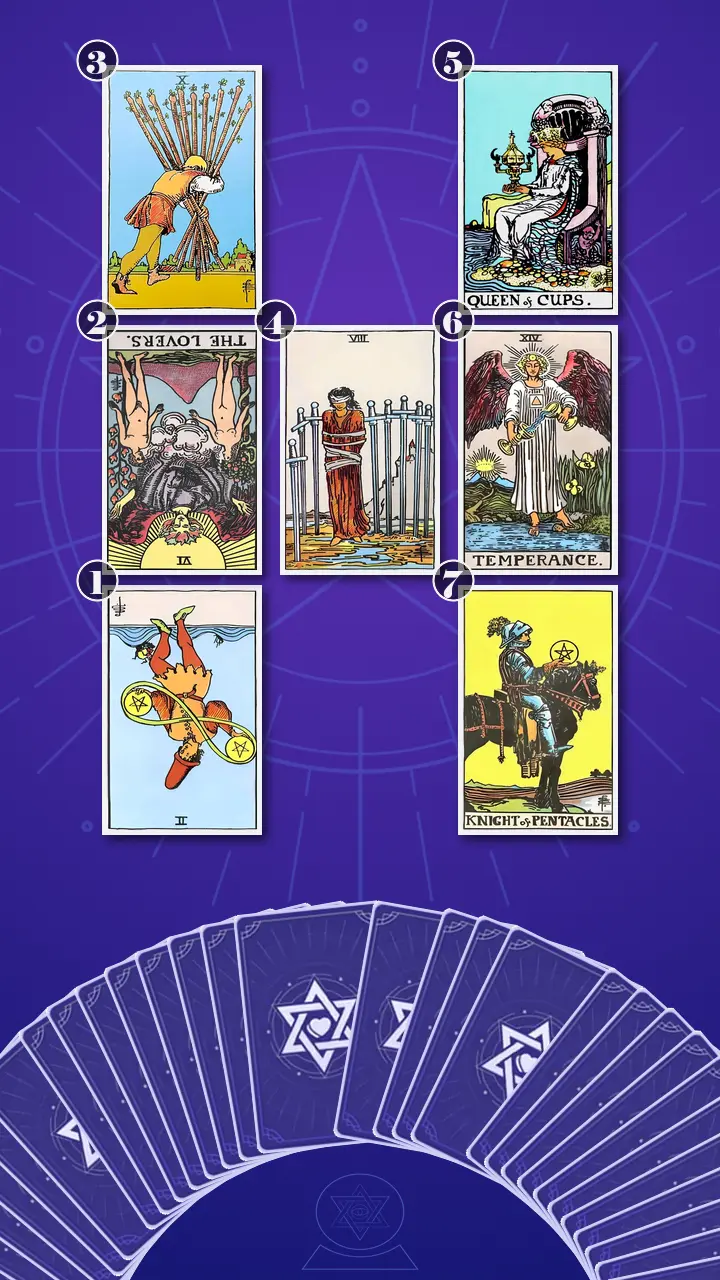
Reading the Roundabout: From Wobble to the Rule Sentence
Position 1 — Surface wobble: what’s visibly unstable this week
“Now we’re turning over the card that represents surface wobble—the most visible way instability shows up across work, money, and sleep this week,” I said.
Two of Pentacles, reversed.
In the image, the juggler is trying to keep two coins moving inside an infinity loop while the sea behind them stays choppy. Reversed, the whole rhythm turns into overload—like the beat drops out and everything becomes frantic switching.
I pointed to it. “This is the day after the crisis text. Jira ticket open. Budget app open. Your sibling’s chat thread pinned. You bounce between them every two minutes—‘just to make sure.’ By noon you’ve been ‘busy’ for hours, but you’ve finished nothing.”
Her mouth pulled sideways. Then that unexpected reaction landed: a half-laugh with a bitter edge. “That’s literally my tabs. It’s… rude how accurate that is.”
“It’s not rude,” I said. “It’s diagnostic. Reversed here reads like blocked Earth energy: your practical life—work, money, sleep routines—can’t find a stable tempo because your attention is being yanked. The more you try to keep everything in motion, the more you drop the thread.”
She nodded, but her fingers were still twitching toward her phone like a reflex. I noticed it the way I notice a note that keeps cutting through an otherwise calm fragrance—one sharp thing dominating the blend.
Position 2 — Inner tug-of-war: the values split that turns choices into guilt-tests
“Now we’re turning over the card that represents inner tug-of-war—the conflicting values, loyalties, or self-expectations activated by the crisis text,” I said.
The Lovers, reversed.
“This isn’t about romance,” I told her, keeping my voice plain. “It’s about choice and alignment. Reversed, it’s misalignment—making decisions from fear and guilt instead of values.”
I used the exact modern translation the card was asking for: “You stare at your sibling’s message and it feels like every response is a referendum on your character. If you don’t reply instantly, you’re ‘cold.’ If you do, you risk committing to being available all night. You draft a perfect paragraph, delete it, draft again—because you’re trying to choose in a way that makes you guilt-proof.”
“Yes,” she said, like the word cost energy. “If I don’t respond right, I’ll make it worse.”
“That’s the contradiction,” I said softly. “You want to be steady and dependable support. But your brain is treating ‘stop scanning’ as ‘cause harm.’ And boundaries start feeling like betrayal.”
I let it land, then added a sentence I’ve watched people need like water: “Boundaries aren’t a lack of love; they’re how love stays sustainable.”
Her eyes went shiny for a second, then she blinked hard, as if her body was trying to choose between crying and staying operational.
Position 3 — External pressure: the weight that didn’t pause for your crisis
“Now we’re turning over the card that represents external pressure—what demands, roles, or obligations are adding weight beyond the emotional impact,” I said.
Ten of Wands, upright.
“This is the ‘invisible extra load’ card,” I said. “Your workload doesn’t pause. Product reviews, deadlines, rent, groceries—plus being emotionally on-call for someone in another city.”
I traced the bundle of wands with my finger. “You keep saying yes to one more thing—one more late work hour, one more message, one more money adjustment—until your day has zero open space for sleep to land.”
Energetically, this is excess Fire: pressure and pushing. Not evil, not wrong—just unsustainable when it’s stacked on top of fear.
Jordan exhaled through her nose, like she’d been holding herself upright by sheer jaw tension. “I didn’t even realize how much I’ve been… hauling.”
“That’s the Ten of Wands,” I said. “It doesn’t let you look up. It blocks your view.”
Position 4 — Core blockage: the rule that keeps you trapped in on-call mode
“Now we’re turning over the card at the center,” I said, and even I felt the room tighten a little. “This represents the core blockage—the key belief-rule that keeps your nervous system stuck in ‘on-call’ mode.”
Eight of Swords, upright.
I didn’t rush it. The blindfold. The loose bindings. The space beyond the swords that exists… but doesn’t feel accessible.
“This is a mental bind,” I said. “Options exist, but your mind treats them as forbidden. Not impossible—morally unsafe.”
Then I used the inner-monologue frame, exactly as it shows up in real life: “I can’t sleep until they reply. I can’t focus until it’s resolved. I can’t spend money unless it’s ‘responsible.’ I can’t put my phone down because if something happens while I’m not looking, it’ll be on me.”
I watched her as I said it. A three-part reaction chain moved through her in real time: first a tiny freeze—her breath hitched and her fingers stopped moving. Then her gaze went slightly unfocused, like she was replaying last night’s ceiling glow. Then the release: a quiet, almost embarrassed, “Oh…” as her shoulders dropped a fraction.
“That’s the rule sentence,” I said. “It’s not just anxiety—it’s the feeling that boundaries equal betrayal.”
To make it practical, I offered a quick reality-check scene: “Imagine you put the phone face-down and walk away for twenty minutes. Nothing catastrophic happens in those twenty minutes. But your body still expects punishment—like the smoke alarm will go off because you dared to blink.”
Jordan swallowed. “Yeah. Exactly. My brain acts like I’m… signing a waiver.”
“This card doesn’t shame you,” I said. “It names the trap so we can stop treating it like truth.”
And because I’m also a perfumer, I added the kind of sensory truth that bypasses shame: “Your system is acting like it’s in a high-alert scent environment—like the air is full of acrid smoke. Even if there’s no smoke in the room, your body is still scanning for it.”
Position 5 — Available resource: caring without merging
“Now we’re turning over the card that represents your available resource—the inner capacity that helps you stay caring without losing your baseline,” I said.
Queen of Cups, upright.
The Queen sits near the water, but she’s not drowning in it. Her cup is ornate and lidded: the symbol of contained empathy.
“This is you at your best,” I told Jordan. “Not the version of you who overfunctions out of guilt. The version who can listen deeply—and still have edges.”
I brought it into a scene: “Before you reply, you pause. One hand on your sternum. Warm mug, dim kitchen light, fridge hum. One slow breath. Then a message that is warm and simple—one concrete support, one clear limit. And you don’t stay in the thread waiting for the next hit of uncertainty.”
Her posture softened the way people soften when permission reaches them before advice does. “That sounds… kinder. But also—cold?”
“It feels cold only because your nervous system has been using urgency as a love language,” I said. “But urgency is a feeling, not a plan.”
This is where my Family Energy Diagnosis shows up naturally. I asked, “When you think about being there for your sibling, what kind of scent does your body crave—something sharp and bright, or something warm and grounding?”
She blinked. “Uh. Bright. Like… I’ve been chewing mint gum nonstop.”
“That’s your system reaching for ‘alertness’ notes,” I said, like I was naming ingredients. “Mint, citrus, anything that says stay awake, stay ready. Queen of Cups is a different accord: warmth, soft edges, containment. Not sedation—holding.”
I slid a blotter strip toward her—light neroli with a little cedar underneath. “Smell this when you’re about to open the thread. It’s not magic. It’s a cue. We’re training your body to associate ‘I can care’ with ‘I can be steady,’ not with ‘I must be on-call forever.’”
Her shoulders loosened another millimeter. “Okay. I can do that.”
When Temperance Spoke: The Pace That Changes Everything
I held the next card for half a beat before turning it, because I could feel we were right at the hinge. The studio felt quieter—like even the traffic outside had lowered its voice.
Position 6 — Key transformation lever: the process that restores balance
“Now we’re turning over the card that represents the key transformation lever—the mindset or process that restores balance and reduces spillover into work, money, and sleep,” I said. “This is the pivot.”
Temperance, upright.
Temperance is an angel pouring between two cups. One foot on land, one in water. A path leading to sunrise. It’s the opposite of frantic juggling: it’s deliberate blending.
And because I blend for a living, this card always hits me like truth you can smell. In perfumery, you don’t fix a harsh note by adding more harshness. You add a bridge note. You pace the evaporation. You build structure so the scent can breathe. That’s Temperance.
Setup (the moment before the reframe): Jordan was still caught in that familiar split-screen panic—Slack on one side, banking app on the other, and her thumb drifting back to the chat thread like gravity. That fear loop was whispering: If I stop monitoring, the worst thing will happen in the one minute I look away.
Delivery (the sentence that needed to be said):
Stop treating constant urgency as proof of love; start blending care and limits like Temperance’s poured cups, so support becomes steady instead of consuming.
I let the silence do its work.
Reinforcement (the reaction and the new map): First her face went still—like she’d been caught mid-scroll. Her pupils widened just slightly. Then her jaw unclenched in tiny stages, as if it had been holding a secret. Her hands, which had been gripping her phone, loosened; the device slid to the table with a soft, surprisingly loud tap. She inhaled, but it wobbled—half breath, half sob she didn’t fully let happen. A flush crept up her neck. Then the exhale finally arrived, shaky at first, then longer. Shoulders dropped. Not relief like a movie, more like the moment your body realizes it can put a heavy bag down—but feels a little dizzy without the weight.
And then the unexpected reaction: she frowned, a flash of anger aimed inward. “But if I do that… doesn’t that mean I was doing it wrong? Like all this time I’ve been—”
I interrupted gently, because this is where people turn self-awareness into self-punishment. “No. It means you were doing what your brain does when it’s trying to prevent regret by never clocking out. That’s not ‘wrong.’ It’s protective. Temperance is just showing you a smarter protection plan.”
I leaned in slightly, voice warm but blunt. “If you care about them for a week, a month—your only sustainable option is pace. Intensity burns out. Steadiness holds.”
Then I asked the question that turns insight into lived memory: “Now—with this new lens—can you think of one moment last week when you could have acted from pace instead of urgency? Even just for twenty minutes?”
She stared at the edge of the table, eyes glassy, like she was watching a playback. “Last night. I kept refreshing because they hadn’t replied. I could’ve… set a check-in time. Put the phone somewhere else.”
“Exactly,” I said. “This isn’t about becoming less loving. It’s about moving from alarm-driven hypervigilance to paced compassion with clear limits. That’s the first step back to sleeping like a human.”
And because my signature tools include a Conflict Transformation System, I named the hidden conflict precisely: “Right now you’re in a dialogue with two voices—Care and Fear. Fear is loud and absolute. Temperance doesn’t silence Care. It lowers Fear’s volume by giving Care structure.”
Position 7 — Next grounded step: stability through repeatable routines
“Now we’re turning over the card that represents your next grounded step—one practical, repeatable action pattern that stabilizes your week without denying what happened,” I said.
Knight of Pentacles, upright.
The Knight’s horse is still. The pentacle is held at chest level. The field is cultivated. This is single-tasking energy. It’s not flashy. It’s reliable.
“After a crisis, your nervous system trusts routines more than promises,” I said. “So we rebuild with modest, repeatable anchors. One brick at a time.”
I gave her the modern translation: “You pick one anchor for each wobble area and keep it comically small: a 60-minute deep work block, a 10-minute money action, and a phone-off cue before bed. You do them even when your emotions surge—not perfectly, just repeatedly—until your body starts believing stability again.”
Jordan stared at the Knight for a second, then whispered, “That sounds… possible.”
“It’s supposed to,” I said. “Consistency is the apology your sleep has been waiting for.”
From Insight to Action: The Temperance Pace Plan for Work, Money, and Sleep
I pulled the whole circle together for her in one clean storyline, the way I’d explain a scent’s structure from top notes to base.
“Here’s what I see,” I said. “The crisis text shook your Earth—your routines and practical stability—so you tried to fix it by moving faster (Two of Pentacles reversed). Inside, your values split: care versus self-preservation, and every choice became a guilt-test (The Lovers reversed). Outside, nothing paused—your deadlines and bills kept stacking (Ten of Wands). At the center is the rule that keeps you trapped: ‘If I’m not vigilant, I’m bad, and something terrible will happen’ (Eight of Swords).”
“Then the recovery path begins: Queen of Cups gives you contained compassion—care with edges—and Temperance gives you the method: integration, pacing, two cups poured on purpose. Finally, the Knight of Pentacles translates that into a week you can actually live: steady anchors, not frantic heroics.”
I named the blind spot directly, because clarity needs honesty: “Your cognitive blind spot is believing that urgency is the only moral way to love someone in crisis. That’s why you feel guilty resting, why your money choices swing, and why your work focus fractures. The transformation direction is the opposite: from 24/7 vigilance and perfect rescuing to paced support with clear limits and repeatable routines that protect your baseline.”
“Okay,” Jordan said, and then her practical brain showed up with the real-world obstacle. “But I can’t just… not respond. What if they message something worse? And I’m in a meeting?”
I appreciated the honesty. “We’re not building a rigid system. We’re reducing accidental urgency. If something is actively urgent, you can break the plan. The plan is for the 95% of moments where your body feels emergency but the situation isn’t changing minute-to-minute.”
Then I offered the next steps—small, specific, and calendar-friendly. And because scent is part of how I help people follow through, I also folded in one of my exclusive strategies: dialogue atmosphere enhancement with calming scents. Not as a cure-all—just as a cue that says, “I’m entering the paced version of care.”
- Two Daily Check-In WindowsPut two 10-minute blocks in Google Calendar (for example, 12:30 PM and 7:30 PM) labeled “Family check-in.” Outside those windows, keep the message thread closed while you work or wind down.Expect the thought “If I’m not instantly available, I’m failing them.” Treat it as a stress-thought, not a command. Start with one day, not forever.
- The 45-Minute Phone-Out-of-Reach Work SprintOnce this week, put your phone in another room for 45 minutes. During that sprint, do only two “must-do” tasks for the next 24 hours (write them on a sticky note and keep it visible). After the sprint, check messages once, then close the app again.If the timer spikes anxiety, shorten it to 15 minutes. This is about reducing compulsive checking, not ignoring real urgency.
- The 10-Minute “Temperance Pour” + Scent CueSet a 10-minute timer. Write two headings: “Care I can offer” and “Limits that keep me functional.” Under each, write one small item you can do today. Choose ONE from each list and put them into your calendar as two separate blocks. Before you do it, take one slow breath while smelling something calming (a dab of hand cream, a citrus peel, or a light neroli/cedar scent) to signal ‘pace, not panic.’If your body spikes (tight chest, shaky hands), do only the headings and one “Care” item. You can stop anytime—this is a pacing tool, not a test of love.

A Week Later: Ownership, Not Urgency
A week after our session, I got a message from Jordan. Not a long paragraph. Not an apology. Just a screenshot: her Google Calendar with two neat blocks—“Family check-in”—and one block titled “One Brick.”
Underneath she wrote, “I did the 45-minute phone-in-the-kitchen sprint. I hated the first five minutes. Then I finished an actual ticket. Like… fully finished. And when I checked my phone after, nothing was on fire.”
She added one more line: “I still woke up at 6 a.m. thinking ‘what if I’m missing something?’ But I turned over, did the scent thing, and went back to sleep. I didn’t think that was possible.”
That’s what I mean by a Journey to Clarity. Not certainty. Not control. Just the quiet proof that your life can stop wobbling when you stop proving love with chaos and start proving it with pace.
When someone you love is in crisis, it can feel like the only way to be a ‘good’ person is to stay on-call forever—so your body never stops scanning, and your work, money, and sleep become the collateral.
If you didn’t have to prove your love with urgency tonight, what’s one tiny, repeatable way you’d want to show up—without abandoning your own baseline?