From Wired-Tired Nights to Steadier Focus: Loosening Midnight Fix-It Loops

Finding Clarity in the 11:38 p.m. Buzz
You get an Apple Watch stress alert during a late-night study block and immediately open your bank app like the number will explain your nervous system.
Maya (name changed for privacy) said it like she was trying to make it funny—like if she laughed first, it wouldn’t sting. But when she settled into her chair on our video call, I watched her shoulders hover a little too high, like they didn’t trust gravity.
She described a small Toronto apartment kind of night I know by heart even from across the ocean: 11:38 p.m. on a Sunday, the lamp half-on, radiator clicking like it’s keeping time, the phone screen throwing that cold blue glare onto her hands. She was sitting on the edge of her bed—not under the covers, not fully “in” bedtime—just perched there, halfway between responsibility and collapse.
“I’m not even doing anything dramatic,” she told me. “And my watch is yelling at me.”
When she said the word yelling, her jaw tightened so visibly it was like her molars were holding up the whole week. The stress in her body wasn’t a concept—it was a restless chest that wouldn’t settle, a wired-tired hum in her limbs, the kind that makes you feel both exhausted and strangely alert, like your brain is running on caffeine and fear.
“I can’t tell if I’m stressed about school or money or just… being tired,” she said. “And if I sleep now, I’m basically choosing to fall behind.”
I nodded, slow. “Okay,” I said, keeping my voice soft and plain. “We’re going to treat this like a system that’s sending signals—not like a moral failure. Let’s try to draw a map through the fog, so you can see what’s linked to what, and what your next step actually is.”

Choosing the Compass: How Tarot Works as a Stress Map
I asked Maya to take one breath with me—nothing mystical, just a clean transition. Inhale like you’re opening a window. Exhale like you’re letting the room temperature change. While she breathed, I shuffled slowly, the way I do after the planetarium doors close and the crowd noise fades: steady, rhythmic, like orbit.
“Today,” I said, “we’re using a spread I designed for situations exactly like this—an Energy Diagnostic Map (7) · Context Edition.”
For readers who are new to tarot or skeptical in a healthy way: this isn’t about predicting whether Maya will magically become stress-free, or whether money will stop being real. The reason I use this spread is simple: her issue is cyclical. School pressure, money anxiety, and sleep disruption aren’t separate problems lined up in a row. They’re a loop that keeps feeding itself.
The Energy Diagnostic Map gives a clean arc: we start with what’s showing up on the surface (the Apple Watch stress alert and the nighttime spirals), then we look at the internal coping pattern linking school and money, then the external pressure amplifying it. From there, we go straight to the core blockage—and then we pivot into usable resources, the key transformation, and one low-risk next step for the next seven days.
“Think of it like tracing a roundabout,” I told her. “Not to blame you for being in it—just to find the exit ramp.”
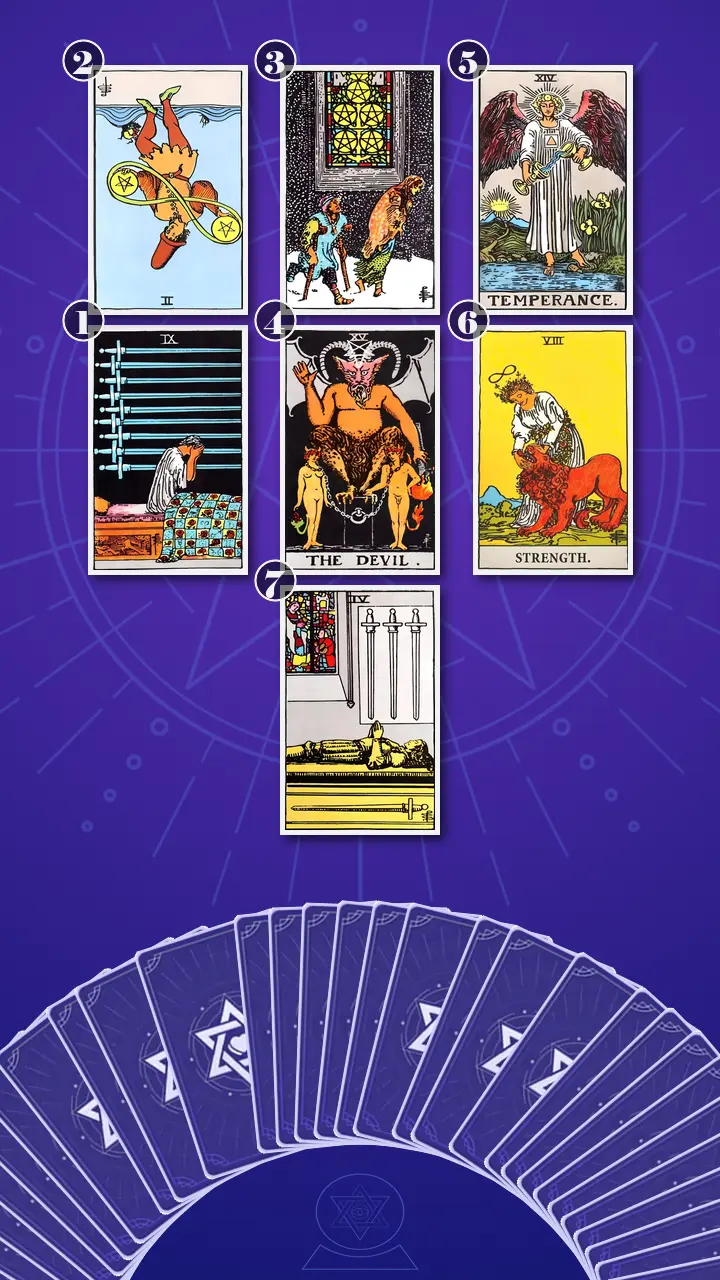
Tracing the Loop: Card Meanings in Context
Position 1 — Surface signal: what the Apple Watch alert is reflecting
“Now turning over,” I said, “is the card that represents the surface signal—what the stress alert is reflecting in day-to-day life, especially around sleep.”
Nine of Swords, upright.
I angled the card toward the camera. The image is classic: a person sitting up in bed, head in hands, nine swords lined up like mounted thoughts on a wall.
“Here’s the modern-life translation,” I said. “You’re in bed in Toronto at 12:40 a.m., and the day looked fine on paper—yet your brain turns into a courtroom. You replay tuition numbers, deadlines, and every moment you felt ‘behind,’ while your jaw clenches and your Apple Watch buzzes like it’s tattling.”
Her eyes flicked down—like she could feel the watch buzz again just from the description.
“This card isn’t ‘you’re dramatic,’” I continued. “It’s involuntary. It’s the mind turning nighttime into a prosecution. Energy-wise, this is a blockage in Air: too much mental motion with nowhere to land. Your body is flagging what your mind has started calling normal.”
I added, carefully, because shame loves silence: “Your watch isn’t judging you. It’s reporting on your nervous system.”
Maya let out a small laugh that had a rough edge to it. “That’s… accurate,” she said. “And honestly, a little mean.”
“Yeah,” I said gently. “Sometimes the first card is honest in a way that feels like it read your browser history.”
I asked, “What are the last three thoughts you have in bed right before you try to sleep—the exact sentences?”
She didn’t answer right away. Her fingers pinched at the sleeve of her hoodie, then released. “It’s always some version of: ‘I shouldn’t have spent that.’ ‘I’m behind.’ ‘If I don’t fix this now, I’ll regret it.’”
Position 2 — Inner tug-of-war: the juggling pattern linking school and money
“Now turning over,” I said, “is the card that represents the inner tug-of-war—the pattern that links school responsibilities and money management.”
Two of Pentacles, reversed.
“This is you toggling,” I said. “Work text. Course portal. Bank app. Back to notes. Reversed, it’s not ‘busy but fine’—it’s when the rhythm breaks. You can’t keep the bounce without dropping something, so your nervous system reads it as nonstop demand.”
Energy-wise, I described it as excess and scatter: too many micro-switches, not enough completion signals. “It’s the Notion-trap,” I said, “where reorganizing the dashboard feels like progress, but it’s really just motion.”
Maya’s gaze shifted to the side, like she was picturing her actual screen layout. “I do that between class and work,” she said. “Like I’m standing still, but my brain is sprinting.”
“Exactly,” I said. “And when your day is built on alt-tabbing, your night stays on-call.”
I asked her the position question: “In the last 24 hours, when did you switch from school to money to school again without ever feeling finished—what was the exact sequence?”
She exhaled through her nose. “Canvas notification, then I checked my hours for next week, then I checked my balance, then I went back to reading, but I didn’t actually read.”
Position 3 — External pressure: the real-world factor amplifying stress
“Now turning over,” I said, “is the card that represents external pressure—the environment factor that amplifies stress.”
Five of Pentacles, upright.
The snowy street. The two figures. The warm stained-glass window with pentacles above them, close enough to see, far enough to feel excluded from.
“This is the rent day / tuition reminder card,” I said simply. “You check your balance after rent or tuition and it’s like the room gets colder. Even a small surprise fee feels existential: you can’t afford a slow week, a sick day, or a low-energy morning.”
Energy-wise, this is scarcity pressure. Not imaginary. Not something you can ‘manifest’ away. And because it’s real, it makes every school decision feel higher stakes—so sleep starts to feel expensive.
Maya’s lips pressed together, then loosened. “It makes me feel… alone,” she admitted. “Like everyone else has a cushion and I don’t.”
“That feeling matters,” I said. “And this card always includes a detail people miss: the warm window exists. Support exists. The stress loop gets tighter when you believe you have to brute-force it alone.”
Position 4 — Core blockage: the belief that turns pressure into a loop
“Now turning over,” I said, “is the card that represents the core blockage—the belief or attachment that turns pressure into a self-reinforcing loop and disrupts rest.”
The Devil, upright.
I didn’t dramatize it. I never do. The Devil is dramatic enough in real life.
“Here’s the scene,” I said, and I could feel the pace of the reading tighten the way a throat does before you say something true. “Your watch buzzes a stress alert and you treat it like proof you need to tighten the grip. You open the laptop at midnight to ‘fix tomorrow’—rework the budget, rewrite the plan, recheck deadlines—because stopping feels like risking failure.”
Then I did what I promised: I wrote it like a chain reaction montage, quick cuts that felt like her actual nights.
“Tuition email. Bank balance. Mental math. ‘I should be studying.’ Laptop opens. Spreadsheet. Canvas. Notion. Google: ‘how to fix sleep schedule fast.’ And underneath all of it, rules that sound like laws:
‘If I stop, I’ll slip.’
‘If I sleep, I’m irresponsible.’
‘If I’m not optimizing, I’m failing.’”
I leaned in a little. “And here’s the twist The Devil always brings: these aren’t laws. They’re habits dressed up as laws.”
Maya made a tense sound—half laugh, half choke—then went quiet. Her hand rose to her throat, stayed there a second, then fell.
“I keep trying to fix my life at midnight,” she said, voice low. “And calling it responsibility.”
“Yes,” I said. “And it makes sense that you do it. It gives you short-term relief. But the card is blunt: control can start controlling you.”
I asked her the core question: “If you chose rest tonight, what are you afraid it would mean about you—lazy, behind, irresponsible, not in control?”
She swallowed. “That I’m not… capable,” she said. “Like I can’t do adulthood.”
Position 5 — Usable resource: what can regulate the system this week
“Now turning over,” I said, letting my own shoulders drop to signal a shift, “is the card that represents a usable resource—what can realistically help regulate your system this week without a life overhaul.”
Temperance, upright.
In my planetarium work, there’s a moment right before a show starts where the audience stops rustling. The lights dim. The room cools a fraction. People remember, without being told, that they have lungs. Temperance feels like that moment—the pacing change that makes everything else possible.
I slowed my words on purpose. “This is an evening handoff,” I said. “One foot in water, one on land. Not all work mode. Not all collapse mode. A bridge routine that tells your nervous system: ‘We’re transitioning now.’”
“Instead of swinging between overwork and crash,” I continued, “you build a small nightly blend: a short admin closeout, a light reset of your space, then a predictable wind-down cue. You stop chasing the perfect schedule and choose something repeatable—because your nervous system trusts consistency more than intensity.”
Maya’s face softened in a way I could almost measure. Not joy. Not relief. More like… less fight.
“That sounds… doable,” she said, surprised.
“That’s the point,” I told her. “Temperance isn’t inspirational. It’s sustainable.”
When Strength Put a Hand on the Lion
When I reached for the sixth card, the air in my little reading room felt different—like the second before a star projector clicks on and the whole ceiling changes. I knew this was the pivot.
Position 6 — Key transformation: the inner quality that breaks the loop
“Now turning over,” I said, “is the card that represents the key transformation—the inner quality that breaks the school–money–sleep stress loop and restores self-trust.”
Strength, upright.
I showed her the card: the calm figure, the lion, the infinity symbol hovering like a quiet promise of continuity. No violence. No domination. Just steady hands.
“Here’s the modern-life scenario,” I said. “The Apple Watch stress alert shows up and—this is the difference—you don’t argue with it or try to overpower it. You pause, exhale longer than you inhale, unclench your jaw, and choose one steady boundary: ‘Not tonight.’ It’s not weakness; it’s leadership.”
I named the energy dynamic: balance. Not intensity. Not punishment. “Strength is soft power,” I said. “And soft power is still power—especially at 1 a.m.”
Then—because this is where my own lens lives—I brought in my signature diagnostic tool, the one I use when people mistake force for safety.
“In astrophysics,” I said, “a black hole isn’t just ‘a lot.’ It’s a boundary problem. The event horizon is the line where, past a certain point, the pull becomes so strong that the usual rules stop helping you.”
“I call this Black Hole Focus,” I continued, watching her expression to make sure it landed as useful, not cosmic fluff. “Your midnight ‘quick check’ has an event horizon. Bank app in bed. Course portal in bed. Notion in bed. Once you cross that line, it’s not about willpower anymore—you get pulled into a gravity well of tabs, math, and self-prosecution.”
“Strength isn’t you ‘trying harder’ inside the black hole,” I said. “Strength is you noticing you’re near the horizon and choosing the steady hand: fewer inputs, calmer breath, one boundary. You don’t wrestle the lion. You stop feeding it.”
For a beat, Maya’s face tightened. She leaned back, and I saw the unexpected reaction I was waiting for—the resistance that protects the old story.
“But…,” she said, sharpness flashing. “If I’m not pushing, doesn’t that mean I was doing it wrong? Like… all this time?”
I didn’t rush to soothe. “It means you were surviving,” I said. “And now you’re upgrading the strategy.”
Stop trying to overpower your stress; start building calm strength, like a steady hand on the lion, and let that be what protects your sleep and your choices.
She froze for half a second—breath paused, eyes wide like the sentence had turned the lights on in a room she’d been navigating by touch. Then her gaze went unfocused, not dissociating—more like rewinding. I watched her replay a dozen nights: the watch buzz, the jaw clench, the laptop open like a reflex.
Her shoulders, which had been holding themselves up like armor, dropped a fraction. Then another fraction. Her hand moved to her jaw, and she realized she was clenching; her fingers pressed gently, like she was meeting her own body for the first time that week. She exhaled—small, shaky, but real.
“Oh,” she said. Not dramatic. Just… recognition. “So the alert isn’t… it’s not a failing grade.”
“Exactly,” I said. “It’s feedback. An error log, not a performance review.”
Then I offered the reinforcement practice—because insight without a next movement can turn into another tab.
“Try this once today,” I said. “A 7-minute Soft Power Reset. You can stop anytime if it feels irritating.”
“Sit on the edge of your bed or on the couch, feet on the floor. Put your phone face-down—not across the room, just face-down. Inhale for 4, exhale for 6, five rounds. Whisper or write one sentence: ‘Tonight, I’m not solving my life. I’m setting it down.’ Then pick one tiny boundary for the next hour: no bank app until tomorrow, no course portal after 11:30, or one tab open at a time.”
She nodded slowly, and I could see the vulnerability that comes right after clarity: the slight dizziness of realizing you actually have a choice. Her eyes watered, not with sadness exactly—more like the release of pressure from a too-tight lid.
“Now,” I asked her, “with this new perspective, think back over the last week. Was there a moment—maybe small—where this would’ve changed how you felt?”
Maya blinked hard once. “Tuesday,” she said. “At like 12:37. The watch buzzed and I opened the spreadsheet like it was a weapon.” She shook her head. “If I’d just… closed tabs. If I’d treated it like feedback. I might’ve slept.”
I let that sit. This was the emotional transformation in motion: from wired vigilance toward steadier self-trust. Not perfect. Not instant. But a real shift from “I have to earn rest” to “rest makes tomorrow workable.”
Position 7 — Next step: one concrete action for the next 7 days
“Now turning over,” I said, “is the card that represents the next step—one concrete, low-risk action that protects sleep and reduces stress reactivity over the next week.”
Four of Swords, upright.
“This is the closing mirror to your first card,” I said. “Same theme—bed, quiet, night. But a different relationship to it.”
I gave her the scenario in her language: “You stop treating sleep as the prize you get after you fix everything. You schedule rest like an appointment. A protected ‘rest container’ where finances and school portals are off-limits. Rest isn’t the reward. It’s the infrastructure.”
Maya’s eyes narrowed slightly—not in disagreement, but in calculation. “But what if I need to check something?”
There it was: the practical obstacle. The loop always defends itself with ‘realistic exceptions.’
“Then we build an exception that doesn’t become a wormhole,” I said. “Three minutes. Timer. One purpose. Stop when it ends. Imperfect is allowed.”
Rest as Infrastructure: Actionable Advice for the Next 7 Days
I leaned back and stitched the whole map together for her, like drawing a constellation from scattered points.
“Here’s the story the spread tells,” I said. “The Nine of Swords shows your nights turning into a courtroom—your mind prosecuting you when the world finally goes quiet. The Two of Pentacles reversed shows how your days are built on micro-switching—so your brain never gets a ‘task complete’ signal, and it stays on-call. The Five of Pentacles confirms the external truth: money stress is real and it makes everything feel higher stakes, like sleep is a luxury you can’t afford. The Devil is the bind: you’ve accidentally promoted survival habits into laws, so rest feels like breaking a rule. Temperance offers the workable bridge—small transitions and repeatable blends. Strength is the antidote: leadership over force. And the Four of Swords gives the next step: a protected container for rest.”
“Your cognitive blind spot,” I added, “is thinking that more late-night thinking equals more stability. But the transformation direction is the opposite: stability comes from building a rhythm your nervous system can trust. Sleep and recovery aren’t what you earn after fixing everything—they’re what makes school and money decisions workable.”
Then I gave her the smallest possible off-ramp—clear, measurable, and designed for a grad student life that doesn’t have extra hours lying around.
- The 12-Minute Bridge Routine (7 days)Each night, do 4 minutes tidy-reset (desk/backpack), 4 minutes admin note (write tomorrow’s ONE school task + ONE money/admin task), 4 minutes wind-down cue (tea, shower, stretch). Do it before you sit in bed.If your brain says “too small to matter,” that’s the Devil talking. Keep it tiny so your nervous system believes it.
- The Lion-Tamer Pause (60 seconds, whenever the alert hits)Feet on the floor. Unclench jaw. Exhale longer than you inhale three times. Then choose your next action from calm: close tabs, stand up, or do one single task—no switching.If breathwork annoys you, swap it for a physical cue: hand on chest + feel your feet. Consent-first—if it spikes you, stop and ground.
- One Rest Container Rule (start tonight)Pick one simple boundary for 7 days: Focus mode at 11:45 p.m., or bank app blocked after 11 p.m., or no course portal in bed. Put a 10-minute “tomorrow check-in” on your calendar at 10:30 a.m. for money/schedule so your brain stops trying to do it at 1 a.m.If you need to check something for real, set a 3-minute timer. When it ends, stop—even if it’s messy.
Before we ended, I offered one more tool—quietly, like sliding a bookmark into a book she actually wants to finish.
“If your brain throws a scary thought at you in bed,” I said, “try my Shooting Star Notes method: 30 seconds to capture it on paper exactly as it sounds, no fixing. The point is to get it out of orbit around your nervous system. Just ‘write it down and let it burn out.’”

A Week Later, the Night Felt Different
Six days later, Maya sent me a message at 12:18 a.m. It was short—almost shy.
“Watch buzzed,” she wrote. “I did the lion-tamer pause. Closed tabs. Didn’t open the bank app. I still felt anxious, but it didn’t turn into a two-hour spiral. Slept.”
The bittersweet part came in the next line: “Woke up and my first thought was still ‘what if I’m behind?’—but this time I didn’t panic. I just made coffee and did the one school task.”
That’s what I mean when I talk about a journey to clarity. Not a perfect life. A steadier rhythm. A nervous system that starts to believe you when you say, “We’re safe enough to rest.”
And if you recognized yourself here—if your body is exhausted but your brain keeps trying to earn safety by fixing school and money at midnight, so rest starts to feel like breaking a rule—even though it’s the one thing that would actually make tomorrow workable—then I want to leave you with one gentle experiment:
If you treated tonight’s rest as part of your plan (not the prize for finishing it), what’s the smallest boundary you’d be willing to try for just one week?