Instant-Reply Loop at Work—how to Keep Reliability Without 24/7

The 10:45 p.m. Slack Glow: always-on Slack and DM responsiveness
If you’ve ever been in bed in NYC, phone literally warm in your hand, telling yourself “I’ll just check Slack,” and then suddenly it’s midnight—welcome to the always-on loop.
Jordan (name changed for privacy) sat down across from me with the kind of careful posture you get after too many nights of half-sleep—shoulders slightly lifted, jaw set like they were holding a pencil between their teeth.
They described a Wednesday, 10:45 p.m., in their Brooklyn walk-up: slipping under the duvet, the room finally quiet except for distant sirens and an AC hum that never quite resolves into silence. Then the cold Slack-glow on the sheets. One ping. Their thumb moving before they decided. A two-sentence reply turning into a paragraph because tone suddenly felt like a high-stakes presentation.
“I’m not even working that late,” they said, staring at their own hands like they didn’t fully trust them. “I’m just never fully off.”
I could hear the contradiction right away: being seen as responsive and on top of things versus protecting sleep and mental bandwidth to avoid burnout. And I could see it in the body—wired-tired energy, shallow breathing, fingers that kept wanting to reach for a phone that wasn’t there.
The overwhelm wasn’t abstract. It was like keeping 30 browser tabs open and pretending your laptop isn’t overheating—each tab is “just one thread,” until your whole system lags.
“Okay,” I told them, keeping my voice steady. “We’re not here to shame the habit. We’re here to understand what it’s protecting—and then redesign the system so you can keep your reputation and your sleep. Let’s try to find clarity in this.”

Choosing the Compass: the Transformation Path Grid (6) spread for burnout triage
I asked Jordan to take one slow breath in through the nose, longer breath out—nothing mystical, just a nervous-system downshift. While they held their question in mind (“Slack pings, sleep warning, DMs—what do I drop to avoid burnout?”), I shuffled at a pace that made it impossible to rush.
“Today we’ll use a spread I built for questions exactly like this,” I said. “It’s called the Transformation Path Grid (6) · Context Edition.”
For you, the reader: this spread works because always-on messaging isn’t just a feelings-problem—it’s a pattern with mechanics. A tiny three-card pull can name the vibe, but it usually under-serves the behavioral specifics (notifications, reply windows, bedroom habits). And something huge like the Celtic Cross can turn burnout triage into an overwhelming audit. This grid is compact but complete: it diagnoses what’s happening, what blocks change, what’s underneath, and then it pivots into a one-week experiment and the “what it looks like when it’s working.”
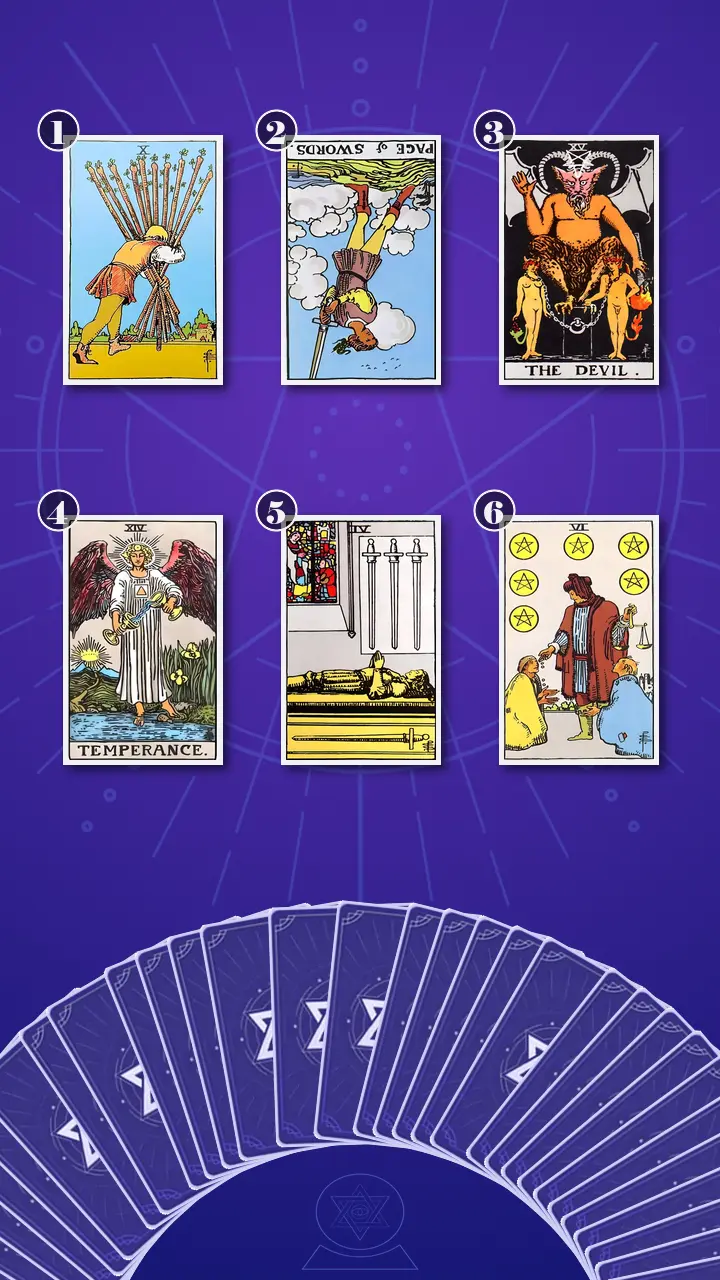
I pointed at the layout as I dealt the cards into a clean 2×3: “Card 1 is the observable pattern—what’s happening right now. Card 3 is the root hook—the fear under the habit. And Card 5 is where we get very practical: the one boundary you can test within a week.”
Reading the Dashboard: feeling stuck in an instant-reply loop
Position 1: The current burnout pattern you can actually observe
“Now we turn over the card representing the current burnout pattern as a concrete, observable workload/availability behavior,” I said.
Ten of Wands, upright.
I tapped the image gently, the figure bent forward under a bundle that blocks his view. “This card doesn’t scream ‘one big crisis.’ It’s the pile-up.” Then I grounded it in exactly what this card is saying in modern life:
“It’s not one massive crisis—it’s the pile-up: you carry every thread in your head like it’s your job to hold the entire team together. You’re replying after hours, tracking who’s waiting on you, preempting questions, and keeping Slack half-open like a second heartbeat. You’re technically “done,” but your brain isn’t allowed to put anything down.”
In energy terms, this is Fire in excess—responsibility and effort turned up so high it becomes weight. “The destination is still there,” I said, “rest, focus, sleep. But it stays far away because the bundle keeps you staring at the next step instead of the actual priority.”
Jordan let out a small laugh that didn’t reach their eyes. “That’s… brutal,” they said. “Like, accurate. But brutal.” Their fingers curled and uncurled on the armrest, like their hands were still trying to carry something.
Position 2: The immediate blocker—the reflex that forces your hand
“Now we turn over the card representing the specific habit or mindset that keeps the always-on cycle running,” I said.
Page of Swords, reversed.
“This is the scout archetype—messages, alerts, mental vigilance,” I told them. “Reversed, it becomes jittery monitoring. Not strategy. Surveillance.” Then I used the lived translation of the card:
“You refresh Slack like it’s weather radar—watching for incoming ‘storms.’ Even when you don’t need to respond, you check because not knowing feels dangerous. You fire off quick replies, add extra context, and then keep monitoring the channel to see how it lands. Your attention is fragmented into dozens of tiny ‘defend competence’ moments.”
I framed it as an Air-channel blockage: attention is there, intelligence is there, but the energy is scattered—too reactive to choose. And then I gave Jordan the split-screen that usually makes people feel painfully, specifically seen:
(A) You, trying to wind down: duvet pulled up, one last scroll, telling yourself you’re allowed to be a person.
(B) You, suddenly back in performance mode: thumb hovering, breath shallow—What if it’s urgent. What if they think I’m MIA. I’ll just answer.
Jordan winced, then laughed again—this time tired, almost relieved to have it named. Their shoulders lifted like a flinch and then dropped a millimeter. “It’s literally ‘refresh, refresh, refresh,’” they said. “Like doomscrolling, but for work.”
Position 3: The root hook—the fear that makes logging off feel risky
“Now we turn over the card representing the deeper attachment or fear beneath the habit,” I said.
The Devil, upright.
I didn’t dramatize it. I didn’t need to. In a Slack-first workplace, this card shows up like an unspoken contract.
“Your phone isn’t just a tool—it’s a leash you keep within reach because being unreachable feels like being exposed. No one explicitly said you have to answer at 11 p.m., but your body acts like you do. The real drop isn’t “caring” or “trying.” It’s the belief that your worth is proven by immediate availability.”
Jordan went still—heavier pause, eyes fixed on the loose chain in the image as if they could feel it around their own neck. I watched their breathing slow, then catch, like their body didn’t want to admit the truth but also couldn’t argue with it.
“It’s like… I’m holding my own leash,” they said quietly. “No one is yanking it, but I don’t put it down.”
I nodded. “And I want you to hear this as a reframe, not a verdict: This isn’t laziness. It’s fear trying to keep you safe. The belief is: ‘If I don’t respond fast, I’ll be judged as not committed.’ The behavior buys you short-term relief. The cost is sleep disruption and resentment. That’s not a moral failing. That’s a system with a brutal interest rate.”
When Temperance Spoke: pouring attention in measured doses
Position 4 (Key Card): The turning point—the internal switch that makes a new pattern possible
“Now we turn over the card representing the turning point energy that makes a new pattern possible,” I said. “This is the bridge.”
The room felt quieter for a second—like even the radiator decided to listen.
Temperance, upright.
“This is moderation and rhythm,” I told Jordan. “Not caring less. Not disappearing. Building a workflow your nervous system can survive.” Then I gave them the modern, workplace-native translation:
“You stop treating every message like a fire drill and start building a cadence people can count on: a final check at a set time, a clear status, a consistent response window. You’re still dependable—just in a way that doesn’t steal from your sleep. Your attention becomes dosed, not dumped.”
Setup (what you’ve been living inside): It’s 10:45 p.m. in NYC and you’re already in bed. You open Slack “just to check,” one ping lights up the screen, and suddenly your jaw tightens like you’ve been called on in class—so you reply fast, then reread the thread to make sure you didn’t sound weird.
Delivery (the sentence that changes the frame):
Not “answer everything to stay safe,” but “pour your attention in measured doses,” like Temperance mixing two cups into one workable routine.
I let the line hang there for a beat.
Jordan’s reaction came in a sequence I’ve learned to trust as the body’s version of truth. First: a tiny freeze—breath caught, eyes wider, like they’d just heard their own secret read out loud. Second: their gaze drifted off the card and into the middle distance, as if replaying the last week’s nights in fast-forward. Third: a visible exhale that softened their mouth and unclenched their jaw; their hands stopped “hunting” for something to do. Then the vulnerability: they blinked hard once, like they were surprised by the relief and a little scared of it.
“But if I do that,” they said, voice edged with sudden defensiveness, “doesn’t it mean I was… doing it wrong the whole time?”
I met that moment gently, but I didn’t let it drag us back into shame. “No. It means you were using speed as safety because it worked—until it didn’t. Temperance doesn’t judge your past. It gives you a lever.”
This is where my old life kicks in. On a trading floor, you don’t survive by reacting to every flicker on a screen. You survive by having rules—what counts as a real move, what’s noise, what’s your risk limit. So I offered Jordan my Risk-Reward Matrix, a modified 3-scenario forecast I use when life choices feel like they’re happening at notification-speed:
“Scenario A: stay instantly responsive. Reward: you feel ‘safe’ for five minutes. Risk: your sleep keeps bleeding out, and your best work gets worse.”
“Scenario B: hard cut-off, total silence. Reward: immediate rest. Risk: if your team isn’t prepared, it can create friction and spike your anxiety.”
“Scenario C—Temperance: measured doses. Reward: predictability people can rely on, including the part where you’re offline. Risk: discomfort for a week while your nervous system retrains.”
I watched Jordan nod, slowly, like they were recognizing the difference between rebellion and design. “Okay,” I said. “Now, using this new lens: can you think of one moment last week where a paced reply—ten minutes later, or tomorrow morning—would have been fine, but your body treated it like a fire?”
They didn’t answer right away. But their shoulders dropped again, and that was enough. This was the pivot from hypervigilant overwhelm and guilt-driven instant replying toward paced self-trust, protected rest, and sustainable reciprocity with work—not as a personality makeover, but as a new cadence.
Position 5: The one-week boundary—the drop-worthy commitment
“Now we turn over the card representing a practical boundary you can test within a week,” I said.
Four of Swords, upright.
“This is deliberate recovery,” I told them. “A container. Not a collapse.” And then the lived translation:
“You create a ‘quiet room’ in your life where work messages don’t get access—especially the bedroom. Rest becomes scheduled containment: phone out of reach, notifications off, and a hard stop that doesn’t require you to be fully caught up first. You’re not collapsing—you’re recovering on purpose.”
I used the protected-room image because it makes the boundary feel physical, not theoretical: “The bedroom is your quiet car on the train. It’s not anti-social. It’s protected space.”
Then I gave them a micro-script that doesn’t sound like a corporate essay: “I’m offline now—back at 9:30am.” And I anchored it in sensory reality: phone face-down, charger in the hallway, the steady hum of the AC becoming the loudest thing again.
Jordan’s face tightened—resistance—then softened—relief. They swallowed once. “I hate how hard that sounds,” they admitted. “And also… I want it.”
Position 6: Integration—what fair exchange looks like when it’s working
“Now we turn over the card representing how a healthier exchange with work looks when boundaries are in place,” I said.
Six of Pentacles, upright.
“This is reciprocity with a spine,” I told them, pointing at the scales. “It’s the moment you stop over-giving privately and start making expectations visible.” Then the modern translation:
“Your team learns what to expect from you because you make it visible and consistent: response windows, fewer private DMs, clearer ownership, and less emotional labor in messages. You don’t drop reliability—you drop over-giving. The exchange becomes fair enough that your evenings can belong to you again.”
In my head, I flashed back to contracts—actual, boring, protective paperwork. Fairness isn’t a vibe; it’s structure. The Six of Pentacles is that structure: Fair exchange: clear windows, fewer emergencies, more actual off-hours.
The Decision Ledger: actionable advice and next steps that don’t require willpower
I leaned back and stitched the whole story together for Jordan in plain language: the Ten of Wands showed the overload isn’t one project—it’s the constant carrying of everyone’s threads. The Page of Swords reversed showed the immediate friction point: hair-trigger monitoring that turns every ping into a performance. The Devil named the hidden engine: the belief that availability equals worth. Temperance offered the bridge—measured doses and a repeatable reply rhythm. Four of Swords made rest non-negotiable by giving it a container. And Six of Pentacles grounded it all into fair exchange, where your team adapts because your norms are consistent, not heroic.
The cognitive blind spot I saw most clearly was this: Jordan was treating speed as the only proof of commitment. But speed is a shaky metric—it creates more threads, more follow-ups, and more anxiety. The transformation direction is cleaner: shift from “instant responsiveness proves my value” to “clear expectations and paced replies protect my value and my capacity.”
To make this real, I used my boardroom approach—what I call a Decision Ledger. Not because your life is a spreadsheet, but because anxiety loves ambiguity. Structure gives your brain something solid to stand on.
- Set your “Final Pour” + StatusTonight, pick one nightly final check time (example: 9:30 p.m.). Do one last Slack scan, then set a clear Slack status like: “Offline—back at 9:30am ET.” After that, no replying—your availability becomes predictable on purpose.Expect the first few nights to feel weird. Start with one rule, not a full overhaul—consistency is kinder than heroic availability.
- Run the 10-minute “Measured Dose” Draft DelayWhen a ping hits after hours, draft your reply but don’t send for 10 minutes unless it’s truly time-sensitive (deadline tonight, blocked teammate). At minute 10, send only the real fire, then turn on Do Not Disturb.If anxiety spikes, stop early. Your job is to notice the reflex—“My body thinks this is urgent”—not to force yourself through it.
- Make the Bedroom a No-Messaging Zone (7-day pilot)For one week, remove Slack/work email from your bedroom routine: log out, move the apps off your home screen, or use iPhone Focus/Android DND to block them after your final pour. Charge your phone outside the bedroom (or at least across the room) and use a basic alarm clock.If “no phone in the bedroom” is too big, downgrade it: Slack logged out only, or notifications off for one app. The point is a protected pocket of stillness, not perfection.

A Week Later: the quiet proof of finding clarity
A few days later, Jordan messaged me: “Did the 9:30 final pour. First night felt like I was forgetting something in the oven. Third night… I didn’t wake up at 3 a.m. to replay threads. I woke up annoyed at my alarm instead of my job, which feels weirdly like a win.”
In their follow-up, there was a bittersweet honesty I trusted: they slept a full night, but the next morning their first thought was still, What if I missed something? Then they wrote, “I set my status. If it’s urgent, they can tag me. And… I went back to making coffee.”
That’s the Journey to Clarity in real life. Not a sudden personality transplant—just a small, steady looseness. The moment your evenings start to belong to you again because you built a rhythm people can rely on, including the part where you’re offline.
When your phone can pull you back into “prove you’re reliable” mode in one buzz, it starts to feel like your evenings don’t belong to you—like rest is something you have to justify instead of something you’re allowed to protect.
If you treated your availability like something you choose (not something you owe), what’s one tiny rhythm you’d want people to be able to rely on this week—when you’re on, and when you’re genuinely off?