From Trophy-Shelf Pressure to Self-Trust: Learning to Ship a v1

The Trophy Shelf Glare on a Sunday in the GTA
If seeing your parents’ trophy shelf makes your standards spike so hard you start rewriting a simple message like it’s a performance review, you’re not alone.
Jordan (they/them) booked a session with me from Toronto, the kind of city where the rent is a constant background hum in your nervous system—like a low bass note you can’t turn off. They’re an early-career product designer, reliable, talented, and exhausted in a very specific way: not the “I worked hard” tired, but the “my body can’t unclench until I earn permission” tired.
They told me about a Sunday dinner in the GTA—7:18 PM, in that familiar hallway where the air smells faintly like laundry detergent and old winter coats. Warm lamp light. A glass shelf catching glare like a camera flash. They said they smiled and went, “It’s cute.” But their jaw went tight. Their chest narrowed. Their phone buzzed with a LinkedIn notification, thumb hovering over it like a reflex test.
“The second I see it,” Jordan said, “it’s like… I need receipts too.”
They weren’t asking me how to stop caring. They were asking something more honest and more difficult: How do I loosen perfectionism when family symbols of success make me feel instantly not enough?
And I could hear it underneath their words—the core contradiction playing like two tracks fighting for the same speaker: wanting to feel proud and free in their own life, versus fearing that “good enough” will prove they’re not worthy of respect.
The pressure didn’t look dramatic on the outside. It looked like them getting home after the visit, opening their laptop like it was a reset, then spending an hour nudging pixels and rewriting the same paragraph—fonts, spacing, the smallest controllable things—while the actual story stayed unfinished. The sensation, they said, was like a clamp tightening around their sternum while their mind kept whispering, fix it, fix it, fix it.
I let that land for a beat, then I said, “Okay. We’re not going to bully you into ‘confidence.’ We’re going to map the loop. And then we’re going to find a form of strength that doesn’t require you to be flawless to be safe. Let’s aim for clarity—real, usable clarity—so your nervous system doesn’t treat a trophy shelf like a tribunal.”

Choosing the Compass: The Celtic Cross Spread
I’m Alison Melody. Most weeks I’m behind a microphone as a radio host, talking music therapy and why certain sounds calm us while others tighten us up. In readings, I use tarot the way I use audio engineering: not to “predict,” but to isolate the track that’s distorting the whole mix.
I asked Jordan to take one slow breath and hold the question in plain language—“When I see the trophy shelf, what helps me loosen perfectionism?”—while I shuffled. Not as a mystical ritual. As a clean transition: from spiraling to observing.
“Today I’m going to use the Celtic Cross,” I told them, angling my camera so they could see the cloth and the space where the cards would land.
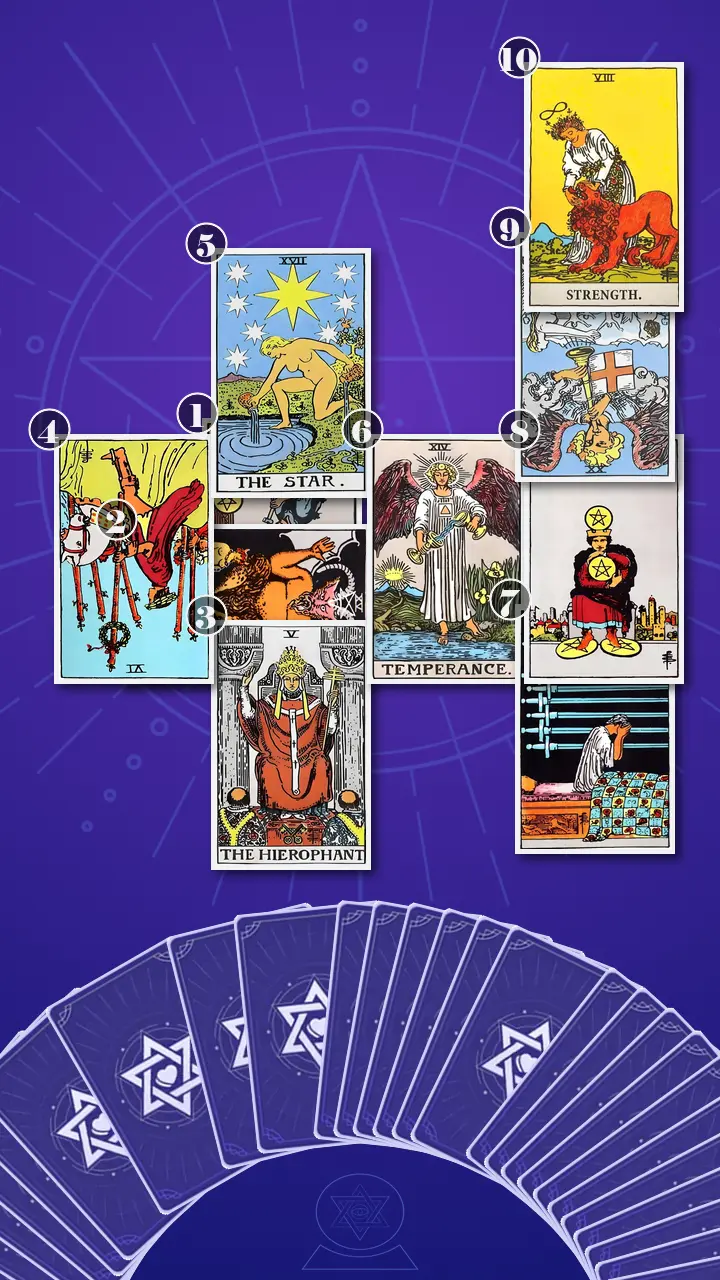
For readers who like to know how tarot works in real life: the Celtic Cross is useful here because it shows a full inner mechanism. It doesn’t just say “you’re stressed.” It tracks (1) what you do when triggered, (2) what locks the loop in place, (3) the deeper conditioning underneath it, and (4) how past experiences with recognition still echo. Then it shows your conscious intention, your next realistic lever for change, what’s happening inside you versus around you, and finally the most empowering direction forward.
I also like it for perfectionism procrastination because it separates “the task” from “the nervous system.” One card will talk about behavior (the endless edits). Another will talk about belief (the bargain you keep making). Another will talk about environment (why a family hallway can hit harder than a performance review).
“We’ll start in the center,” I said. “Card one is the present pattern—what perfectionism looks like in daily behavior when the trophy-shelf trigger is active. Card two crosses it—what keeps the loop locked. Card three goes underneath—root conditioning. And at the top of the staff, the final card is outcome guidance: not a fate, but a direction you can practice.”
Reading the Map: Card Meanings in Context
Position 1: Present pattern — Eight of Pentacles (reversed)
“Now we turn over the card for Present pattern: how perfectionism shows up in daily behavior when the trophy shelf trigger is active,” I said.
Eight of Pentacles, reversed.
In the Rider-Waite-Smith image, there’s a craftsperson bent over a bench, repeating the same motion. Upright, it’s practice and mastery. Reversed, it’s when “practice” gets hijacked into nitpicking—effort that fragments instead of builds.
“This is the Figma auto-layout rabbit hole card,” I told Jordan, keeping my tone light but precise. “It’s the moment you open the file to ‘make it better’ and suddenly you’ve spent 62 minutes on micro-details. Improvement becomes a trap when it’s driven by fear.”
Energetically, this is blocked Earth: productivity that should ground you instead turns into a treadmill. More editing, less completion. Your body gets short-term relief—at least I’m trying hard—but the long-term cost is fewer finished outputs, which then “proves” the fear again.
Jordan gave a small, sharp laugh—half recognition, half irritation. “That’s… brutal,” they said. “Like, yes. That’s exactly what I do.” Their shoulders lifted toward their ears as they said it, as if the word exactly came with a tax.
“Before we even touch the trophies,” I said, “this card asks: when the trigger hits, what’s the first tiny thing you start fixing—fonts, wording, spacing—instead of finishing the real deliverable?”
They didn’t hesitate. “Copy,” they said. “I’ll rewrite one sentence until it stops sounding like me.”
“That’s the loop,” I said gently. “And it’s not a personality flaw. It’s a coping strategy.”
Position 2: Primary challenge — The Devil (upright)
“Now we turn over the card for Primary challenge: what keeps the perfectionism loop locked in place,” I said.
The Devil, upright.
I felt Jordan go still on the other side of the screen. Even through video, The Devil has a way of changing the room temperature—not with superstition, but with accuracy. It’s the card of compulsion and the illusion of bondage. In the image, the chains are loose. The figures could step away. But they don’t.
“Here’s the phrase I want to offer you,” I said. “Perfection is just fear wearing a productivity outfit.”
Jordan’s eyes flicked down and back up, like that sentence had hit a nerve.
“The Devil is the silent contract,” I continued. “It’s the deal your brain offers you: ‘If I perform perfectly, I’ll be safe.’ The trophy shelf isn’t just decor; it becomes a symbol that tightens the chain. Like your body hears terms and conditions.”
I narrated the scene the way it actually happens: you’re in the hallway, trophy shelf catching glare, your phone buzzes with a LinkedIn “I’m excited to announce…,” and your brain auto-generates a contract in milliseconds—Be impressive or be at risk.
Then I said the contrast line, slow and plain: “No one said it out loud, but your body heard it anyway.”
Jordan’s reaction came in a three-beat chain I’ve seen a hundred times in my studio when a caller suddenly recognizes their own pattern: (1) their breath paused, like a tiny freeze; (2) their gaze went unfocused for a second, as if replaying a memory; (3) then a tense laugh slipped out and turned into a long exhale.
“Oh,” they said quietly. “That’s the deal. That’s literally the deal I keep making with myself.”
“And because the chain is loose,” I added, “we’re not talking about rebelling against your family or burning your ambition down. We’re talking about noticing the choice-point—where you can step back without having to make it dramatic.”
Position 3: Root cause — The Hierophant (upright)
“Now we turn over the card for Root cause: the deeper conditioning linked to achievement, authority, and belonging,” I said.
The Hierophant, upright.
“This is the inherited rubric,” I told Jordan. “Like grading criteria from a class you already graduated from—but your body still thinks the teacher is watching.”
The Hierophant is tradition, sanctioned ‘right ways,’ and internalized authority. In this context, it’s the voice that says: There is a correct way to succeed. There is a correct timeline. There is a correct level of polish. And approval belongs to the people who do it right.
Jordan nodded, but it wasn’t the satisfying kind of nod. It was the kind that looks like swallowing something you didn’t realize you were still carrying.
“When you’re near that trophy shelf,” I said, “it’s not just comparison. It’s a system. It’s the feeling that failing isn’t merely inconvenient—it’s wrong.”
I asked, “Whose rubric are you still trying to pass?”
Jordan’s mouth tightened, then softened. “My dad’s, maybe,” they said. “But also… my own. Like a version of me from high school who always had the ‘right’ answers.”
That was important. Because it meant the shelf wasn’t only about parents. It was about identity maintenance—keeping the “high achiever” badge valid.
Position 4: Recent past — Six of Wands (reversed)
“Now we turn over the card for Recent past: how recognition and comparison have shaped the current pressure response,” I said.
Six of Wands, reversed.
Upright, it’s the victory parade. Reversed, it’s the complicated aftertaste: praise that doesn’t land, wins that instantly become the next expectation, visibility that feels conditional.
“This looks like getting positive feedback and immediately thinking, ‘Now I have to keep that up,’” I said. “So the next project becomes even harder to start.”
Energetically, it’s recognition as unstable fuel. If applause doesn’t translate into safety, you try to control the outcome by being flawless. Not for ego—for protection.
Jordan’s eyes went a little glassy, the way they do when someone names the shape of an old reflex. “Even when I do well,” they admitted, “it doesn’t feel like it counts.”
“That’s the reversal,” I said. “It’s not that you didn’t achieve. It’s that achievement didn’t reliably soothe.”
Position 5: Conscious desire — The Star (upright)
“Now we turn over the card for Conscious desire: what you’re hoping will replace perfectionism,” I said.
The Star, upright.
“You want healing,” I said simply. “Not the Instagram version. The nervous-system version.”
The Star is unarmored. Open sky. Steady pouring. It’s renewal after strain—hope that doesn’t require proof.
“This tells me you’re not trying to stop caring,” I told Jordan. “You’re trying to care without fear and comparison driving the steering wheel. You want gentle consistency.”
Jordan exhaled and looked down at their hands. “I do,” they said. “I’m tired of turning everything into a test.”
In my head, I heard it the way I hear a mix that’s been over-compressed: the song is still there, but it can’t breathe. The Star is what happens when you let the track have dynamics again.
Position 6: Near future — Temperance (upright)
“Now we turn over the card for Near future: the most likely next opening for change,” I said.
Temperance, upright.
This is the catalyst card—the release valve. Temperance is integration, moderation, and the middle way between “all-in panic” and “shutdown avoidance.” It’s the skill of mixing opposites into a sustainable process.
I described it as a montage, because that’s how it lives in a product designer’s life: opening Figma or Notion and setting a calm constraint—two focused sprints + one revision pass. Scheduling a real break like it’s part of the deliverable. Hearing an inner monologue that sounds like a gentle PM: We’re shipping a v1, not proving our worth.
Jordan’s shoulders dropped a fraction—small, but visible. They nodded once, slow. Relief, not excitement. Like they’d been bracing for me to say either “try harder” or “stop caring,” and instead I offered a third option: redesign the process.
“Temperance protects energy before it protects image,” I said. “And that’s the opening.”
Position 7: Self-position — Nine of Swords (upright)
“Now we turn over the card for Self-position: the inner experience and mindset that amplifies or softens the trigger,” I said.
Nine of Swords, upright.
“This is the 1:24 AM card,” I said, and Jordan’s eyes widened like I’d just read their calendar.
I painted the scene the way they’d described it without even realizing it was a scene: blue phone light on the ceiling, the sheet twisted at the knees, streetcar noise muffled through the window. The laptop fan’s ghost-hum from earlier. And their mind replaying Slack messages and imagined feedback like it’s running a private trial—Jordan as both defendant and judge.
Energetically, it’s Air in excess: thoughts so sharp they become weapons pointed inward. Not “work ethic.” An echo chamber.
“Here’s a simple tool,” I said. “Split it into Predictions vs Facts. The Nine of Swords loves predictions that dress up as realism.”
Jordan’s voice dropped. “The harshest sentence?” they repeated, thinking. “It’s… ‘If I’m only fine, they’ll realize I’m not that good.’”
I nodded. “Okay. That’s a prediction. Not a fact. We’re going to treat it like audio feedback—loud and annoying, but not truth.”
Position 8: Environment — Four of Pentacles (upright)
“Now we turn over the card for Environment: the external cues that intensify perfectionism,” I said.
Four of Pentacles, upright.
This is “keeping receipts” energy. Holding on tight for security. Proof treated like safety. In the image, the figure grips the pentacle to their chest; another sits on their crown; two pin down the feet. Thoughts, feelings, choices—all guarded.
“This doesn’t make your parents villains,” I said immediately, because I could see Jordan tense at the possibility. “It just shows a culture. Value is held tightly—through possessions, proof, visible markers. A trophy shelf is a Four of Pentacles object.”
I added a sentence I’ve learned can soften shame without softening the truth: “The environment can be intense even when the people are loving.”
Then I offered the pivot Jordan needed to hear: “Treat the trophy shelf as information about their values, not a verdict about your worth.”
And I said it in the exact language that wants to become a new mental shortcut: Trophies are a chapter of your story, not a contract you have to keep renewing.
Jordan’s face shifted—like something unclasped behind the eyes. “A contract,” they whispered. “That’s what it feels like.”
Position 9: Hopes and fears — Judgement (reversed)
“Now we turn over the card for Hopes and fears: what you secretly want from achievement, and what you fear will happen if you loosen your grip,” I said.
Judgement, reversed.
“This is ‘draft mode’,” I told them. “Waiting for an approval notification that never arrives.”
Reversed Judgement is fear of evaluation and self-sentencing—reviewing whether you’ve earned your life, replaying achievements and “misses” like evidence. Part of you hopes for release, forgiveness, and a new identity. Part of you fears that if you stop judging yourself, you’ll lose motivation.
Jordan frowned, a protective reflex. “But what if it’s true?” they asked. “What if I do need the pressure to be good?”
That question was the whole reading in one line.
“That’s the fear,” I said. “Not laziness. Not lack of ambition. The fear that without a whip, nothing happens.”
When Strength Rewrote the Silent Contract
Position 10: Outcome guidance — Strength (upright)
I took a breath before turning the final card. The room felt quieter—not dramatic, just focused, like when you pull all the faders down in a studio and you’re left with one clean vocal line.
“We’re turning over the card for Outcome guidance: the most empowering direction for loosening perfectionism as an ongoing practice,” I said.
Strength, upright.
In the image, the figure isn’t overpowering the lion. They’re close. Calm. Steady hands. This is inner authority that doesn’t use violence. It’s leadership, not control.
This is where my own lens—my actual lived work—clicked in. I told Jordan, “In music therapy, we don’t calm a nervous system by yelling at it to relax. We change the tone. We slow the tempo. We give the body something steady to entrain to. Strength is that, psychologically.”
Then I brought in my signature framework in the most natural way I know: “I want to use something I call Generational Echo. It’s the idea that certain ‘music memories’ get passed down—three generations, sometimes—about what love sounds like. In some families, love sounds like applause. In others, it sounds like quiet approval after you nail it. In others, it sounds like, ‘We don’t talk about feelings, but we display proof.’ A trophy shelf is a kind of family playlist on a wall.”
Jordan’s eyes sharpened. “That’s… weirdly accurate,” they said.
“And the work,” I said, “is updating your internal soundtrack—so your worth isn’t only played on the ‘achievement’ station.”
Setup (the moment we all know): You know that moment: you’re back at your parents’ place, you catch the trophy shelf out of the corner of your eye, and suddenly your chest tightens like you just got assigned a grade for your entire life. Your mind tries to solve it by controlling output—one more edit, one more polish pass—because being seen feels like being judged.
Delivery (the sentence that changes the frame):
Stop treating the trophy shelf like a verdict; start meeting your inner ‘lion’ with steady hands—because Strength is about calm courage, not flawless performance.
I let it hang there for a second, the way I let a resonant note fade before I speak again.
Reinforcement (the body learns it first): Jordan’s reaction was immediate and layered. First their face went still—eyes wider, mouth slightly open, like their brain had to stop and re-buffer. Then their hand, which had been gripping their water bottle too tightly, loosened without them noticing. Their jaw shifted, a tiny release at the hinge. They swallowed once, hard, and their eyes went wet—not a breakdown, more like the body recognizing a new option.
“But…,” they started, and there was a flash of resistance—anger, almost—“doesn’t that mean I’ve been doing it wrong? Like I’ve wasted so much time?”
I didn’t rush to comfort them. I stayed steady. “It doesn’t mean you were wrong,” I said. “It means you were trying to be safe with the tools you had. Strength isn’t an indictment. It’s an upgrade.”
Then I guided them through a 7-minute Strength move right there, because insight without an embodied experience can evaporate by Tuesday: (1) one hand on chest, one on jaw—notice tension without fixing it; (2) say, out loud if possible, ‘Pressure is here because I care—and I’m still safe to be human’; (3) choose the next smallest shareable step and do it before you feel ready. And if anxiety spiked, we downshifted: three slow breaths, smaller version, v0.
As they breathed, Jordan’s shoulders lowered, not like defeat—like finally putting a heavy backpack down. They stared at the card and whispered, “I don’t need to bully myself into excellence.”
“Exactly,” I said. “This is the emotional shift: from ‘I must prove I’m worthy’ to ‘I can practice worthiness by finishing, sharing, and learning in public.’ Not overnight. But starting today.”
I asked, “Now, using this new view—can you think of one moment last week when this would’ve changed how you felt?”
Jordan blinked, searching. Then: “A Slack message,” they said, almost laughing at how small it was. “I rewrote it ten times.”
“Perfect,” I said. “Small is where Strength lives.”
The One-Page Plan: From Verdict to Practice (With a Little Soundproofing)
I pulled the whole spread together for Jordan in one coherent story—because the point isn’t ten separate meanings; it’s the mechanism.
“Here’s what the cards say happened,” I told them. “You have an inherited rulebook about success (Hierophant). When you enter an environment that displays proof tightly (Four of Pentacles), the old contract activates (Devil): ‘Be impressive or be at risk.’ That contract turns your craft into a polish loop (Eight of Pentacles reversed), and at night it becomes a private courtroom in your head (Nine of Swords). Because even recognition hasn’t felt stable (Six of Wands reversed), your system tries to control outcomes with perfection. But you consciously want healing and steadiness (Star). Your next lever is process redesign and moderation (Temperance). And the integrated direction is Strength: calm, compassionate self-leadership.”
Then I named the blind spot cleanly, the way I would in a sound check: “Your cognitive blind spot is believing that fear is the only manager who can keep you producing. It’s not. Fear is loud, not wise.”
“So what do I do?” Jordan asked. And there it was—an actual, practical obstacle tucked behind the question: “I can’t take a whole day to fix this. I have deadlines. And I’m going back to my parents’ place next weekend.”
“Good,” I said. “We’re not doing a whole day. We’re doing tiny, repeatable experiments. Think of this as a week of A/B testing, not a new personality.”
- The Done Definition + One-Revision RuleBefore you start one task this week, write a one-line ‘Done Definition’ at the top of your doc or in your Figma file name (example: ‘Portfolio v1 — send Friday’). Then allow yourself one revision pass only and hit send.If your brain says, ‘This is too small to matter,’ treat it as Devil data (all-or-nothing loves that line). Set a 12-minute timer for the revision pass and stop when it rings. One revision pass. Then done. Not because it’s flawless—because you’re practicing being seen.
- Temperance Sprints (Energy Before Image)For one deliverable, run a two-sprint workflow: 25 minutes build + 5 minutes off, twice. After the second sprint, assess and stop. Schedule one real reset during work hours (walk, tea, outside air) like it’s a meeting.If breaks feel “undeserved,” label them as part of the deliverable. If you can’t take a full break, take a micro one: stand, drink water, look out a window. This is Temperance: mixing effort + care on purpose.
- The Strength Move + Soundproof BarrierWhen you feel the trophy-shelf spike (or the post-visit crash), do a 3-minute decompression before opening your laptop. Then read a two-line ‘coach voice’ script from a phone note and take one “seen while learning” action (share a rough draft with one trusted person, ask for one specific feedback type, stop there).Use a Soundproof Barrier: headphones with a steady, low-lyric playlist (think 60–80 BPM, soft electronic, lo-fi, or instrumental). You’re not “escaping”—you’re giving your nervous system a clean signal so it can lead instead of react. Ship a v1. Let reality answer the question your anxiety keeps trying to solve.
Because I can’t help being who I am, I also offered Jordan one optional, gentle family-facing reframe using my “Memory Vinyl” strategy—no confrontation, no speech. “Next time you’re near the shelf,” I said, “ask one curious question: ‘What song does this trophy remind you of?’ Let it become a story request, not a scoreboard. It subtly changes the energy from verdict to narrative.”

A Week Later: The Quiet Proof
Six days later, Jordan sent me a message that was only two sentences long—like they were trying not to jinx it. “I did the Done Definition,” they wrote. “One revision pass. I sent the case study draft to my manager even though one headline is kind of awkward.”
Then: “Nothing collapsed. They said it was strong and asked one question. I slept.”
I pictured them in that Toronto condo bedroom, the same streetcar noise, the same dim light—but with a different body. Not magically healed. Just less braced. Clarity doesn’t always look like fireworks. Sometimes it looks like a jaw unclenching at 11:30 PM instead of 2:07 AM.
When Jordan went back to their parents’ place the next weekend, they told me later, they still noticed the shelf. Their chest still tightened for a second. But they put one earbud in anyway, let a steady playlist hold the baseline, and reminded themselves—quietly, firmly—that trophies were a chapter, not a contract. They left without starting a polishing spiral that night. They celebrated by sitting alone in a coffee shop for an hour, not euphoric—just steady, a little tender, and strangely proud.
This is what I mean by a Journey to Clarity: not certainty, but ownership. Not lower standards, but a different source of leadership. The reading didn’t erase Jordan’s ambition. It helped them stop using fear as their manager.
And if you’re standing in front of that trophy shelf, it can feel like your chest and jaw tighten into a silent promise: “If I’m not exceptional, I don’t get to relax—maybe I don’t even get to belong.”
If you stopped treating “good enough” like a verdict and started treating it like a practice, what’s one small thing you’d be willing to finish and share this week—just to see what’s true?