From On-Call Hypervigilance to Planned Responsiveness: A 7-Day Rhythm

Finding Clarity in the 1:32 a.m. Buzz
You’re the kind of city professional who can run a project plan in your sleep—except since your mom’s SOS call, your phone buzz feels like a fire alarm and your nervous system won’t stand down. Taylor said that to me in different words, but her body said it first.
It was 1:32 a.m. in her Toronto condo bedroom when she described it—city glow leaking through the blinds, HVAC humming like a distant engine. She’d started placing her phone face-up on the pillow beside her like it was a heart monitor. The screen warmed her fingertips. Her shoulders stayed lifted, not because she was moving, but because part of her was listening for the next vibration that might rewrite the night.
“I’m not even sure what rest means when my phone could ring,” she told me. And then, quieter: “I’m functioning, but I’m not okay.”
The core tension wasn’t complicated, but it was brutal: she wanted to respond to her mom’s SOS and be dependable, and she was terrified that if she loosened her grip she’d lose control of work, sleep, and her dating life. Hypervigilance doesn’t feel like a choice in the moment—it feels like love with a stopwatch.
I watched her swallow as if she was trying to push down a whole week. The feeling she carried wasn’t just worry. It was like living with a constant internal siren: tight chest, tense shoulders, wired at night, and then heavy, foggy mornings where coffee became a life support system.
“We’re not going to shame the part of you that wants to be there,” I said. “We’re going to give that part a plan—so the rest of you can sleep, work, and still remember you’re allowed to want connection. Let’s make a map through the fog. This is a Journey to Clarity, not a test you have to pass.”

Choosing the Compass: How the Celtic Cross Works for Caregiver Overload
I began the way I always do—nothing theatrical, just functional. I asked Taylor to take one slow breath, and then another, and to hold the question in her mind as if she were holding a mug between her palms: not squeezing, just steadying. I shuffled until the rhythm settled.
“Today, we’ll use the Celtic Cross,” I told her.
For you reading this: the Celtic Cross is ideal when the problem isn’t a single decision but a whole-system recalibration after a destabilizing event. It tracks the chain from the visible symptom (sleep disruption, overload, dating withdrawal) to the deeper driver underneath (“If I’m not instantly available, it’ll be my fault”), and then it points toward actionable next steps. It’s less about predicting outcomes and more about showing how a pattern works—so you can change the pattern.
I also named a few positions so she—and you—could feel the structure: the first card is the heart of her current reality; the crossing card shows the main obstacle; the root card reveals what belief is keeping her nervous system on-call; and the “crowning” card—our key card—shows what her conscious self is reaching for, even if she hasn’t built it yet.
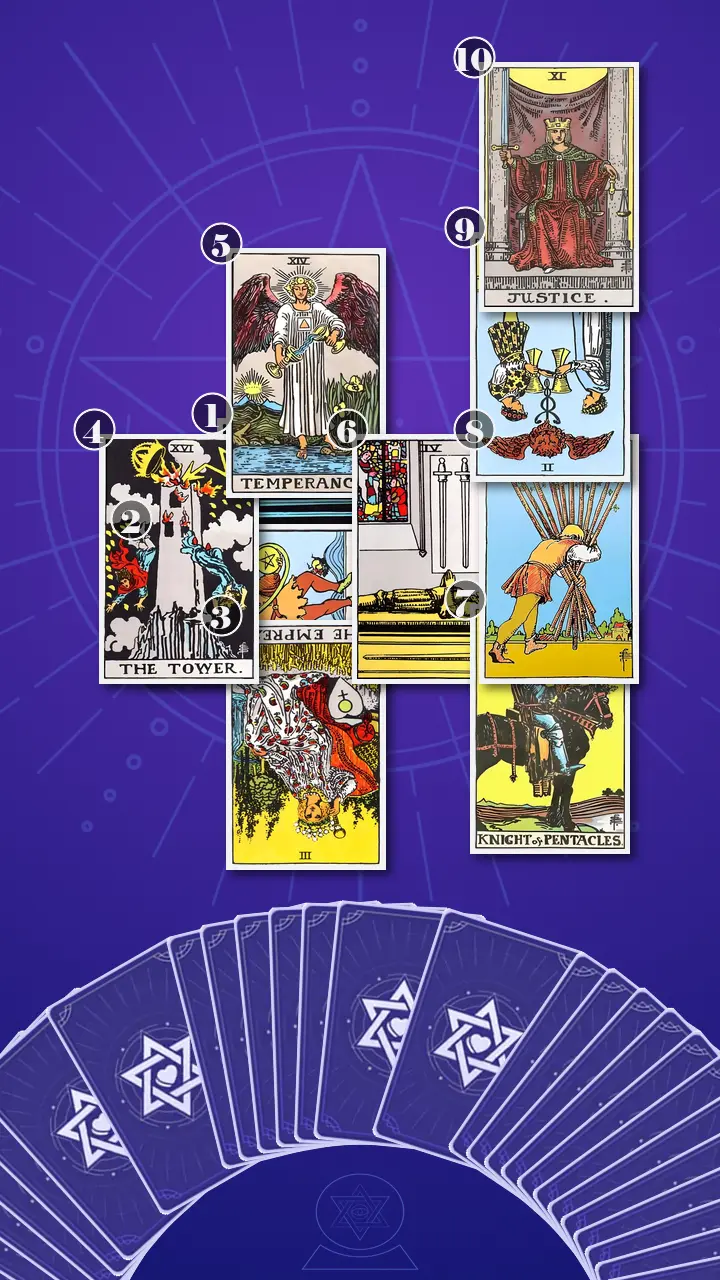
Reading the Map: The On‑Call Loop in Real Life
Position 1 — What your day-to-day reality looks like right now
“Now we turn over the card that represents what your day-to-day reality looks like right now—the most visible pattern disrupting work focus, sleep, and dating availability.”
Nine of Swords, upright.
On the card, someone sits bolt upright in bed, hands covering their face, nine swords lined up like thoughts you can’t un-think. I told Taylor, “This is your ‘night mind’ taking the shift.”
And the modern version was almost too exact: it’s like when you finally get into bed, but your brain runs a crisis slideshow—missed calls, worst outcomes, tomorrow’s work, the message you didn’t answer—until sleep feels impossible. This is phone anxiety at night after a family emergency in tarot form.
Energy-wise, this is Air overload: not “thinking” as a useful tool, but thinking as an alarm system that doesn’t know when to stand down. It’s care turning into self-punishment. It’s your brain acting like you’re the only person holding the pager.
I asked, “When you check your phone at 1:30 a.m., what are you hoping the check will give you—information, control, reassurance, or relief?”
Taylor let out a small laugh that had no joy in it. “That’s… kind of mean,” she said, half-smiling. “But yes. My night brain does that.” Her fingers kept tracing the edge of her mug like it was a worry stone.
Position 2 — The primary obstacle
“Now we turn over the card that represents the primary obstacle—the specific way your attempt to manage everything creates instability or overload.”
Two of Pentacles, reversed.
This is the juggler card, but reversed the infinity loop isn’t elegant anymore—it’s a loading spinner. I described it as a rapid-cut montage: laptop → phone → calendar → dating app → back to laptop. The inner monologue that comes with it is relentless: “If I just… then I can…” followed by “Why can’t I finish anything?”
In real life, it’s the night where you’re not doom-scrolling for fun—you’re scanning for control: Slack, texts, calendar, news, dating app, back to Slack… and suddenly it’s 2 a.m. Flexibility becomes fragmentation.
The energy here is blockage through constant switching. You’re moving all the time, but you’re not arriving anywhere. And I said the sentence I’ve learned people need to hear without judgment: “Tab-switching isn’t the same as being present.”
She exhaled sharply—one clean breath like she’d been holding it for a week. Then a quiet nod. “That’s exactly it,” she said. “It’s like I’m ‘handling it,’ but I’m not actually doing anything.”
Position 3 — The deep driver underneath the on-call posture
“Now we turn over the card that represents the deep driver—the caregiving belief activated by your mom’s SOS that keeps your nervous system on-call.”
The Empress, reversed.
In the Empress, care is supposed to be fertile: nourishment, receiving, warmth that refills itself. Reversed, the lushness looks drained—giving becomes depletion, and being needed starts replacing rest and pleasure.
I translated it plainly: “This is like when your identity narrows into ‘the reliable daughter,’ and your body’s basic needs—sleep, meals, touch, pleasure—get treated as optional.”
The energy is deficiency in receiving and excess in giving. And here, my own method naturally surfaced—what my family calls Generational Pattern Reading. It’s not mystical; it’s a way of noticing inherited scripts that run in families like old operating systems.
“Taylor,” I said, “this feels like a generational rule: ‘Love equals availability.’ Not love equals presence. Not love equals honesty. Availability. As if you prove belonging by being reachable.”
Her gaze slipped off the card and went somewhere else—somewhere older than last week. Her shoulders rose, then dropped a fraction, like her body recognized the sentence before her mind wanted to. “Yeah,” she whispered. “If I’m ‘busy’ when family needs me… it feels like I don’t deserve to be called a good daughter.”
I met her there gently: “Care isn’t measured by how available you can make yourself at 1:30 a.m.”
Position 4 — The precipitating event that reorganized everything
“Now we turn over the card that represents the precipitating event—what changed the structure of your life and triggered the current imbalance.”
The Tower, upright.
The Tower is lightning. It’s the moment your old routine stops being reliable.
I described it the way it actually happens now: a late-night “Mom—call me” text, a missed call notification that makes your stomach drop. The screen glare in a dark room. Heart thumping hard enough to feel in your throat. Cold hands. A timestamp you’ll remember: 11:48 p.m., 2:07 a.m., the moment your “normal week” became “everything reorganized in 60 seconds.”
The energy here is shock—not drama, not punishment. Just reality interrupting the structure you’d built. I told her, “Instead of asking ‘How do I go back to normal?’ the Tower asks, ‘What new supports do I need now that the old structure got shaken?’”
She went still in that particular way people do when they finally name the before-and-after moment out loud.
When Temperance Poured Between Two Cups
Position 5 — Your conscious goal (the balance you’re reaching for)
I let my hands hover for a beat before turning this one. “Now we turn over the card that represents your conscious goal—the kind of balance you’re trying to create and what your values are asking for.”
“This is the heart of the reading,” I added, and the room seemed to get quieter—like even the city outside paused to listen.
Temperance, upright.
Temperance is an angel pouring water between two cups: measured transfer, not dumping. One foot on land, one in water—practical life and emotional life held at the same time.
Here’s what it looks like in modern life: a system that doesn’t depend on the world being calm. Calendar blocks. Two check-in windows. One protected sleep anchor. One small, real dating action. Not everything, not right now, not from the place where you’re terrified.
Setup: If you’ve been doing the 1:30 a.m. thing—phone face-up beside your pillow, Slack half-open, calendar re-mapped “just in case,” and a dating chat you can’t quite answer—then you already know: your life isn’t busy, it’s on-call.
Delivery:
Stop treating balance like a perfect schedule and start mixing your priorities in measured portions, like Temperance pouring between cups.
Reinforcement: Taylor’s reaction came in three small waves. First, a brief freeze—her breath paused mid-inhale, and her fingers stopped moving on the mug as if her body needed a second to believe what it heard. Then her eyes unfocused, like she was replaying a dozen nights in fast-forward: the Slack green dot anxiety, the Hinge message drafts she never sent, the way her Apple Watch sleep score felt like a judgment. Finally, the release: a long, shaky exhale, shoulders lowering by maybe five percent—not cured, just no longer braced for impact in this exact moment. She blinked hard and gave a tiny, almost annoyed laugh. “So I’m not failing,” she said. “I’m… using the wrong strategy.”
I nodded. “Exactly. And we can build a strategy that lets you care deeply—and still be off-duty on purpose.”
Then I offered a practical container right there—what the echo in the cards was asking for:
10-minute Off‑Duty Protocol (try it tonight): write a tiny escalation plan on a note—“If it’s urgent, call twice in 5 minutes / text ‘URGENT’” (only if that fits your family dynamics). Put two check-in windows in tomorrow’s calendar. Turn on Do Not Disturb for 25 minutes and place your phone across the room or in a drawer. For two minutes, notice jaw, shoulders, chest—unclench 5%, not 100%.
I added what matters most when you’re dealing with caretaker hypervigilance: “If moving your phone away spikes panic, we don’t force it. Start with ‘phone on loud, but not on the pillow’ for one night and build from there.”
And I asked her the question that turns insight into lived memory: “Now, with this new perspective—planned responsiveness instead of 24/7 availability—can you think of a moment last week when this would’ve changed how you felt?”
Her eyes filled, not dramatically, just enough to shine. “Tuesday,” she said. “I kept checking the call log even though nothing changed. I could’ve… just set a window. I could’ve slept.”
That was the shift taking its first breath: from alarmed, on-call hyper-alertness toward cautious relief and self-trust.
The Ladder on the Right: From Rest to Rules
Position 6 — The next-step direction
“Now we turn over the card that represents the next-step direction—what becomes possible soon if you prioritize restoration and stabilization.”
Four of Swords, upright.
This card doesn’t negotiate. It’s intentional rest—sleep as strategy, not a reward you earn after perfect caregiving. The image is a sanctuary: thoughts held at bay long enough for the body to repair.
Energy-wise, this is balance through pause. A protected sleep container. Airplane mode for your brain—temporary, intentional, designed for safety.
Taylor’s chin tipped down as if she was considering rest like an unfamiliar object. “I keep waiting until everything is okay,” she said, “and it never is.”
“That’s the card,” I replied. “We stop waiting for calm. We build calm.”
Position 7 — Your stance (how you’re showing up)
“Now we turn over the card that represents your stance—how you’re showing up in response to the situation.”
Knight of Pentacles, upright.
This is diligence. Responsibility. The part of you that can keep showing up even when the ground shifts. It’s also the risk: turning life into a checklist because duty feels safer than emotion.
The energy here is steady Earth—useful, but it can become rigid. I told her, “Your strength is that you can build routines. Your challenge is remembering routines are meant to support you, not replace you.”
She gave a small nod, almost embarrassed by how true it felt. “I’m… very good at logistics,” she said. “Feelings are harder right now.”
Position 8 — External pressures
“Now we turn over the card that represents external pressures—the workload, responsibilities, and expectations shaping your time and attention.”
Ten of Wands, upright.
This is burden as posture: a person bent forward under a bundle so big it blocks their view. It confirmed something important—Taylor wasn’t “dramatic.” The load really was heavy.
The energy is excess. And excess always asks the same practical question: what are you carrying that isn’t actually yours to carry alone?
She rubbed the bridge of her nose. “I feel like a single point of failure,” she said, using the exact phrase people use when they’re doing incident response with no rotation schedule.
“Then we build a rotation,” I said simply.
Position 9 — Hopes and fears in dating
“Now we turn over the card that represents your relationship tension—what you hope for in dating versus what you fear will happen if you’re not at your best.”
Two of Cups, reversed.
Reversed, the symmetry breaks. Reciprocity feels out of sync. In modern terms: you read a sweet message, feel warmth, then close the app because you can’t figure out how to be honest without sounding like a burden. Or you over-explain so you won’t be rejected—then vanish anyway because it’s too much.
The energy is blockage in receiving again, but now in romance: wanting connection, bracing for the cost of needing anyone.
I told her, “Capacity is a fact, not a confession.”
Her mouth tightened, then softened. “I keep canceling dates,” she admitted, “and then I feel like I’m proving I’m not dateable.”
“Or,” I offered, “you’re proving you’re human in a hard week—and you need a smaller container for dating, not a disappearance.”
Position 10 — Best potential integration (likely direction)
“Now we turn over the card that represents best potential integration—what balance looks like when you practice boundaries and sustainable care over time.”
Justice, upright.
Justice is the clean edge of a decision: scales and a sword. Not harshness—clarity. Balance plus decisive action. It said: you don’t rebalance by pushing harder. You rebalance by creating fair rules that protect what matters.
In modern life, Justice looks like a written policy, not a mood: “Here’s how we handle alerts after 9 p.m.” It’s a fair budget—time, attention, sleep—so one category can’t silently steal from the others.
Taylor’s shoulders lowered again, another few degrees. “Rules, not vibes,” she said, like she was tasting how practical it sounded. “That’s… actually relieving.”
Rules, Not Vibes: Actionable Next Steps for Work, Sleep, and Dating
I drew the story together for her, the way I’d tell it back if I were reading the weather off a horizon. “The Tower struck, and your nervous system became a night watchman (Nine of Swords). To cope, you started juggling by switching constantly (Two of Pentacles reversed), and the deeper driver is a caregiving script that equates love with depletion (Empress reversed). Temperance shows you the bridge: measured portions, not dumping everything into one cup. Four of Swords says rest is non-negotiable. Justice says boundaries are not betrayal—they’re fairness.”
The blind spot was subtle but huge: Taylor had been treating constant monitoring as the only proof of love. That’s the cognition that keeps people stuck in caregiver hypervigilance symptoms. The transformation direction in the cards was crystal clear: shift from 24/7 availability to planned responsiveness—specific check-in windows plus a clear escalation plan—so her nervous system can truly stand down.
Then I gave her what she actually came for: a few small next steps that are doable in a real week.
- The Two-Window Check-In SystemPick two daily family check-in windows for the next 7 days (for example 12:30 p.m. and 7:30 p.m.). Put them in Google Calendar like meetings, and outside those windows, use Focus mode/Do Not Disturb—unless it’s a true emergency.Expect resistance. If two windows feels impossible, start with one window plus one emergency rule. Make it smaller, not stricter.
- The One-Line Escalation PlanWrite a simple rule with your mom (or a key family member): “If it’s urgent, call twice,” or agree on a keyword text like “URGENT.” Keep it on a note by your charger so you’re not reinventing the system at 2 a.m.This isn’t cold. It’s kindness to your nervous system. A boundary isn’t a punishment—it’s a plan you can actually keep.
- One ‘Capacity Text’ (Dating at a Smaller Size)Send one short message to a match/person you like: “Hey—family stuff is a bit intense this week. I’m still interested, but I’m slower on texting. Want to do a 45‑min coffee Saturday?” Then choose a low-pressure date format (daytime coffee, walk, early drink with a clear end time).Keep it short; you don’t owe a trauma dossier. If their response is weird, that’s information—not a verdict on you.
And because my work is rooted in the natural rhythms of home—not just the mind—I added one small, grounding practice from my own toolkit. “Do this for three minutes,” I told her. “Stand near your houseplant, or any living thing in your space. Don’t ‘interpret’ it. Just notice: is it drooping, reaching, dry, thriving? Then ask: ‘Which one am I today?’ It’s a home energy diagnosis you can do without thinking. It gets you out of the spreadsheet brain.”
She blinked, then smiled for real—tiny, but real. “I have a pothos,” she said. “It’s… dramatic when it needs water.”
“Perfect,” I said. “Let it be your honest mirror.”

A Week Later: The Quiet Proof
A week later, Taylor messaged me. “I moved my phone off the pillow,” she wrote. “Not across the room yet, but onto the dresser. I set the two check-in windows. I slept six hours.”
She added a second text a minute later: “I sent the capacity message. We’re doing a 45-minute coffee. I’m weirdly nervous, but… it feels possible.”
In my mind I saw the bittersweet contrast clearly: she’d turned on Do Not Disturb with steady hands, then sat alone at a café for a while afterward—not celebrating, not spiraling—just letting quiet be quiet.
That’s what a real Journey to Clarity looks like. Not certainty. Not perfection. Just ownership: caring without collapsing into caretaking, and building a rhythm that lets your nervous system stand down.
When a parent’s SOS flips your nervous system into on-call mode, even a quiet bedroom can feel like a place you’re failing a test—torn between being dependable and terrified that one missed moment will cost you belonging.
If you let yourself be a loving daughter and still go off-duty on purpose—what would your next 24 hours look like in one small, concrete way?
Every reading at AceTarot is a Journey to connect with inner wisdom and empower next step.
Learn more about our Journey to Clarity.