From Conflict-Bracing to Calm Boundaries: A Custody-Trigger Tarot Case

The 11:58 p.m. Notes App Trial
You find an old custody schedule in a folder, and suddenly your “I’m easygoing” persona turns into full-on conflict avoidance—tight jaw, tight throat, perfect-wording mode.
Alex (name changed for privacy) said it like she was confessing something embarrassing, not naming a real trigger. She was 29, a product designer in Toronto, the kind of person who can facilitate a Figma review with five stakeholders and still sound polite. And yet a single piece of paper had her body acting like it was back in a house where adults negotiated safety with raised voices and long pauses.
She told me she found the schedule while clearing a closet—an old folder, the kind you keep for “adult things,” even when you were a kid when it was made. That night, she didn’t cry. She didn’t even call anyone. She just… spiraled.
In her dark bedroom, the only light was her phone. She zoomed in on a photo of the schedule, then flipped to Notes to rewrite a two-sentence text she wanted to send her partner. The screen glare made her eyes sting; the phone warmed her palm like a little heating pad. Somewhere in the condo, a fan hummed. Toronto outside the window was its own quiet machine.
“I keep adding softeners,” she said, swallowing hard. “Like I’m trying to make it impossible for them to be upset.”
Her jaw looked like it was doing overtime—clenched in that specific way that turns your molars into a vise. The tension in her throat had the same energy as a finger hovering over a self-destruct button: you can breathe, technically, but your body doesn’t trust the air.
“Conflict avoidance can look like being easygoing—until you realize it’s costing you your voice,” I said gently, because I wanted her to hear this without flinching. “And we’re not here to shame that part of you. We’re here to understand what it’s protecting—and to find clarity without having to disappear.”

Choosing the Compass: How the Horseshoe Spread Works
I asked Alex to take one slow breath in through her nose, and a longer breath out—just enough to signal to her nervous system that we weren’t in an emergency. As I shuffled, I didn’t treat it like a mystical performance. I treated it like what it is in a good reading: a clean transition from mental noise to honest signal.
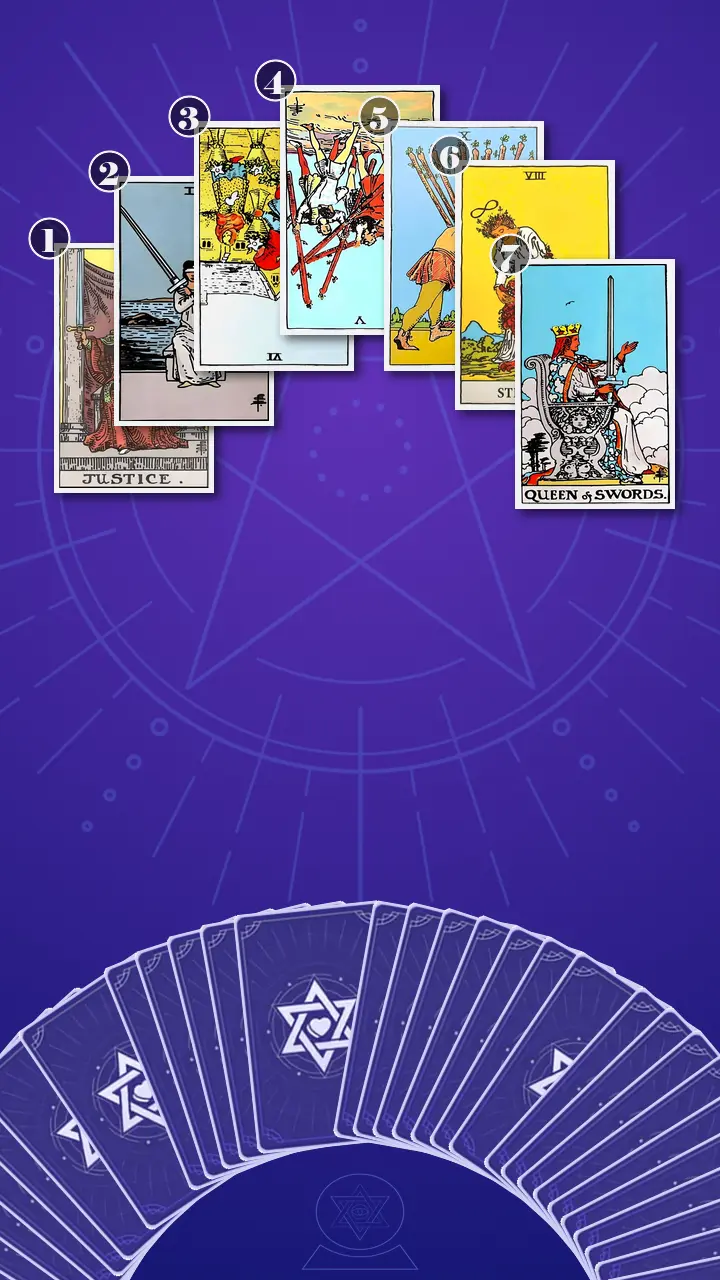
“Today I’m going to use a classic seven-card spread called the Horseshoe,” I said, keeping my voice calm and practical.
For you reading this: the Horseshoe spread is one of my favorite structures for questions like ‘Why does this old thing still run my reactions?’ It maps the arc from past imprint to present pattern, then moves beneath the surface—into the hidden driver and the true obstacle—before separating external pressure from internal habit. Only then do we ask for advice and integration. In other words: it’s designed for inner-pattern clarity, not fortune-telling.
I also like it because it doesn’t collapse everything into “it’s your trauma” or “it’s their fault.” It shows the system: what happened, what you learned, how it shows up now, and what you can actually do next.
“The first card will show the past imprint—what that custody schedule taught you about conflict,” I told Alex. “The top card is the core obstacle—what your avoidance is doing now. And the advice card will give us your most grounded way forward—what to practice when your jaw locks and your throat tightens.”
Reading the Arc: From Courtroom Brain to Muting the Room
Position 1 — The past imprint: what the custody schedule memory symbolizes
“Now turning over,” I said, “is the card that represents the past imprint: what the custody schedule memory symbolizes and taught you about conflict.”
Justice, upright.
I didn’t have to reach far for the translation—Alex practically lived inside it. “This is the part of you that learned: fairness equals safety, precision equals protection,” I said. “You find the custody schedule and your brain flips into: ‘be reasonable, be precise, don’t be blameable.’ A simple request starts feeling like you need airtight logic and perfect phrasing—like you’re preparing evidence so nobody can accuse you of being unfair.”
Justice isn’t a villain. In balanced form, it’s discernment and integrity. But in excess, it becomes what I call courtroom brain—when your body treats a kitchen-table conversation like a deposition.
I watched Alex’s shoulders stay lifted, braced, as if she were waiting for an objection. “Needing perfect wording isn’t a personality trait—it’s a safety strategy,” I added, naming it cleanly so she wouldn’t turn it into self-blame.
Alex let out a small laugh—quick, sharp, and a little bitter. “That’s… yeah. That’s actually cruelly accurate,” she said. “It’s like if I can make it sound neutral enough, I can’t be the bad guy.”
I nodded. “And that makes sense if, back then, the stakes of adult decisions were real. Justice shows me your system learned: the right phrasing might keep the ground from moving.”
Position 2 — The present pattern: how conflict avoidance shows up now
“Now turning over,” I said, “is the card that represents the present pattern: how conflict avoidance shows up in your current relationships and choices.”
Two of Swords, upright.
“This is neutrality as self-erasure,” I said simply. “In your current relationships, you keep yourself ‘neutral’ to keep things calm. You say, ‘I’m fine either way,’ delay decisions, and turn direct asks into long explanations. On the outside you look chill; internally you’re braced, tracking tone changes like they’re danger signals.”
In my mind, it was a split screen:
What you type: ‘Hey—could we do a quieter decompression hour after work?’
What you swallow: ‘I need you to take my nervous system seriously.’
“It’s like hovering over ‘Send’ like it’s a self-destruct button,” I continued. “Keeping two tabs open forever and never clicking confirm.”
Alex’s hand moved to her throat without her noticing. “I do that exact thing,” she said. “Agree now, resent later. And then I feel guilty, because I’m the one who said yes.”
“That guilt,” I said, “is often the price we pay for temporary peace.”
Position 3 — Hidden driver: the subconscious association that gets activated
“Now turning over,” I said, “is the card that represents the hidden driver: the subconscious emotional association that gets activated by the old schedule.”
Six of Cups, reversed.
“This is time travel,” I said, letting the words land. “The old schedule doesn’t just remind you of childhood—it flips a switch in your nervous system. A minor disagreement today gets processed as if it could reorganize access to love, stability, or belonging.”
Then vs. now is the whole game here. Then: adults’ decisions changed your life. Now: a disagreement is uncomfortable, but it doesn’t rewrite your access to love unless you choose to stay in a relationship that punishes honesty.
I’ve spent my life watching patterns move through families the way weather moves through a valley—quietly, predictably, until someone finally names it. In my family we call it Generational Pattern Reading: noticing what repeats, not to blame anyone, but to stop the repetition from running the present.
“This card tells me part of you still believes: ‘conflict equals instability and someone will leave,’” I said. “So you apologize fast, soften your truth, or disappear—because a younger part of you expects fallout.”
Alex went still in a three-step way I’ve come to recognize as a nervous system trying to catch up: her breath paused; her eyes unfocused like she was replaying an old room; then she exhaled, long and shaky. “That explains why small things hit me like big things,” she whispered. “I hate that it still works like this.”
“It doesn’t mean you’re broken,” I said. “It means your body is loyal to an old rule.”
Position 4 — Core obstacle: the specific way avoidance creates friction now
“Now turning over,” I said, “is the card that represents the core obstacle: the specific way avoidance creates friction or prevents resolution now.”
Five of Wands, reversed.
“This is ‘muting the room,’” I told her. “You treat everyday friction like a fire alarm. Instead of letting people disagree and working through it, you rush to smooth, validate, and compromise before you’ve even said what you want.”
In my head it sounded like sound design: a slightly sharper tone becomes sirens, so you become the volume knob. Not the problem-solver. The volume knob.
“The result is peace on the surface,” I said, “but the issue goes underground and returns as chronic tension and resentment. Like turning down the volume instead of addressing the feedback—so the static stays all day.”
Alex pressed her lips together. Her eyebrows lifted a notch, the way they do when something is both true and inconvenient. “I’m not avoiding conflict,” she said slowly. “I’m avoiding that feeling. The tone shift.”
“Exactly,” I said. “And we can work with that. Feelings are data. They’re not verdicts.”
Position 5 — External pressure: what intensifies the pattern
“Now turning over,” I said, “is the card that represents external pressure: what your environment or roles are asking of you that intensifies the pattern.”
Ten of Wands, upright.
“This is overload,” I said. “Your environment rewards you for being capable and collaborative, so you end up carrying emotional logistics like a second job—managing timelines, moods, expectations, harmony.”
Alex nodded immediately, like she didn’t even need translation. “I’m always the glue,” she said. “At work, with friends. At home. And then when there’s something I actually need, it feels like… I don’t have the bandwidth to deal with reactions.”
“Right,” I said. “Avoidance isn’t laziness here. It’s a bandwidth strategy. But the card shows the cost: carrying it alone blocks your view of the simplest option—asking directly and letting the other person share the load.”
When Strength Held the Lion, Finding Clarity Didn’t Require Perfect Words
Position 6 — Advice: the most grounded way to practice conflict as clarity
I let my fingers rest on the deck for one beat longer. The room felt quieter—not dramatic, just focused, like when a podcast stops and you suddenly hear your own breathing.
“Now turning over,” I said, “is the card that represents advice: the most grounded way to practice conflict as clarity rather than danger.”
Strength, upright.
“This is the moment the spread pivots,” I said. “The advice isn’t to become sharper—it’s to become steadier. You feel the surge of panic before a hard sentence, take two slow breaths, soften your shoulders, and still say the clean line you mean. You don’t try to control the other person’s reaction; you focus on staying present in your own body while you speak.”
Alex’s eyes flicked to the card and stayed there, like she was looking for instructions written in the lion’s fur.
It’s midnight, your phone is warm from being in your hand too long, and you’re rewriting the same text like one wrong word could change the whole relationship.
Stop trying to avoid the lion by perfecting your words; practice holding the lion gently, like Strength, by staying calm while you tell the truth.
I let the sentence hang. No rush. No softening. Just room for it to be true.
Alex reacted in a chain—three small movements that told the truth before her mouth could. First: a freeze, her inhale catching halfway. Second: her gaze went distant, like she was watching herself on the TTC hovering over Send, or hearing a tone change across a kitchen table. Third: her shoulders dropped a single notch, and her face tightened at the same time—relief and grief arriving together.
“But—” she started, and there it was: a flash of anger, almost protective. “If I don’t manage it… what if it does turn into a whole thing?”
I respected that question. “That’s not you being difficult,” I said. “That’s you being honest about what your body learned.”
I leaned in slightly, like you do when you’re talking to someone who’s about to bolt. “Strength isn’t pretending the lion isn’t there,” I told her. “The lion is the tone shift. It’s the heat in the room. Strength says: you don’t need to kill it. You need to stay present while it exists.”
Then I brought in my own framework—how I read patterns the way I read seasons. “In my family, we watch what repeats,” I said. “Not to blame the past, but to stop it from deciding the present. Your Justice card built a rule: ‘If I’m precise enough, I’ll be safe.’ Strength offers a new rule: ‘If I’m regulated enough, I can be honest.’ That’s the shift from bracing to belonging.”
“You don’t need to get louder—you need to get steadier,” I added, and I saw her eyes glisten—not in a dramatic way, in that private way people get when they realize they’ve been holding their breath for years.
“Now,” I said softly, “use this new lens and think about last week. Was there a moment when a small truth would’ve changed how you felt—even if it didn’t change the other person?”
She swallowed. Her voice lowered. “Yes,” she said. “I had a preference. I didn’t say it. I made a joke. And then I was mad at everyone for two days.”
“That,” I said, “is the first step from self-silencing to grounded confidence. Not a personality makeover—just a steadier nervous system in a real conversation.”
Position 7 — Integration: what healthier conflict looks like next
“Now turning over,” I said, “is the card that represents integration: what a healthier conflict relationship looks like as your next step.”
Queen of Swords, upright.
“This is the outcome direction I want for you,” I said. “Clean honesty. You can name a boundary without a disclaimer spiral. You can say, ‘That doesn’t work for me,’ and stop.”
Justice and the Queen of Swords both hold a sword—but it’s a different use of precision. Justice uses it like defense, bracing for a verdict. The Queen uses it like truth, cutting fog without cruelty.
“Clarity is not cruelty,” I said. “It’s self-respect with good manners.”
From Insight to Actionable Advice: The Next 48 Hours
I looked at the whole arc again—the way it bent from paperwork and rules (Justice) into suspended silence (Two of Swords), time travel (Six of Cups reversed), muted friction (Five of Wands reversed), overload (Ten of Wands), and then finally—Strength and the Queen: regulated courage and clean boundaries.
“Here’s the story your spread tells,” I said. “A real fairness system in childhood taught you to survive by being precise and reasonable. In adulthood, that precision turned into a freeze response: staying neutral to prevent instability. When you’re triggered, you time-travel—so minor disagreement feels like major risk. Then you mute the room to keep everyone calm, especially when you’re already overloaded. But the antidote isn’t becoming harsher. It’s building steadiness so you can state one true thing—and let disagreement be information, not a verdict on belonging.”
Her cognitive blind spot was clear: she kept treating other people’s reactions as something she had to manage to earn safety. “The blind spot,” I told her, “is believing: ‘If they react badly, it means I spoke wrong.’ Sometimes it just means they’re human. Or stressed. Or surprised. Your job isn’t to control the weather. Your job is to stop disappearing in it.”
Then I offered the smallest possible next steps—because this kind of change happens the way a season shifts: not in one dramatic sunrise, but in repetition you can feel in your bones.
- Breath-Then-Boundary Protocol (20 seconds)Before sending one potentially tense text/email this week, put both feet on the floor. Inhale for 4, exhale for 6, twice. Then send the shortest honest version you can tolerate—no extra disclaimers.If your jaw locks or your throat tightens, write the one sentence and wait 10 minutes—not to perfect it, just to let your body settle.
- The One-True-Sentence Rule (low stakes)Pick a small preference—what time to meet, where to eat, which movie—and practice: “I’d prefer X.” Full stop. Then pause and let the silence hold it.Expect it to feel “too blunt” even when it’s normal. That’s your old calibration talking, not a moral fact.
- 3-Minute Home Energy Check (houseplant version)Before a hard conversation at home, stand near a houseplant for three minutes. Notice: are the leaves drooping, reaching, or steady? Then mirror-check your body—jaw, throat, shoulders. Say to yourself: “I can be kind without disappearing,” and draft your message once.This isn’t magical thinking—it’s a sensory anchor. Nature helps your nervous system exit “courtroom mode” and return to “kitchen-table mode.”

A Week Later: The Quiet Proof
A week later, Alex sent me a short update. Not a paragraph. Not a “sorry for the long message.” Just a screenshot of a text bubble she’d actually sent.
It said: “Hey—after work I need a quiet hour to decompress. Then I’m all yours.”
Under it she wrote: “My body hated it. I did the two breaths. I didn’t add a disclaimer. And… nothing exploded. He said ‘yeah, totally.’ I still felt shaky after, but it was a different kind of shaky. Like I existed.”
That’s the Journey to Clarity I trust: not certainty, but ownership. Not perfect wording, but a steadier self who can stay in the room with a little heat.
When a conversation even hints at tension and your jaw locks up, it can feel like one wrong sentence could cost you connection—so you go quiet, not because you don’t care, but because part of you still thinks safety is something you have to earn by staying ‘easy.’
If you didn’t have to manage anyone’s reaction for just one moment, what’s the one true sentence you’d let yourself say this week?