From Wedding-Album Spirals to One Clean Ask in Dating Texts Today

The Album Glow and the Blue-Light Audit
If finding your parents’ wedding album made you immediately audit your own relationship for signs of permanence—like love needs receipts—you’re not alone.
Jordan (name changed for privacy) came to me on a grey Toronto Sunday with that particular kind of quiet panic that doesn’t look dramatic from the outside—until you notice what their hands are doing. Their thumbs kept rubbing the edge of their phone case like they were trying to erase a thought.
They described the moment like a time-stamped clip: 9:42 PM, cross-legged on their apartment floor, their parents’ wedding album open in their lap. The plastic sleeves stuck a little when they turned the pages. The photo paper had that dusty-sweet smell, like an old closet and a clean memory. Their phone screen threw a cold blue rectangle onto a picture of two smiling faces under warm lighting.
“I closed the album,” Jordan told me, voice careful, like they didn’t want to startle the feeling. “And my hand just… went to my messages. I reread the thread three times. Like it was evidence.”
I watched their chest rise in small, guarded sips of air. That tightness wasn’t abstract. It sat on them like a seatbelt pulled one click too far—secure in theory, constricting in practice. Their stomach had that restless, watchful buzz, like their body was bracing for a shift in someone’s mood.
“I hate that I need reassurance,” they said, then looked away, embarrassed at their own honesty. “But I also hate pretending I don’t.”
Underneath the album question was a sharper one: craving secure closeness versus fearing rejection if they wanted too much. Jordan wanted to feel chosen. But the moment they reached for that feeling, they started bargaining with themselves about being “too much,” then tried to win safety through perfect interpretation—tone, timing, emoji, reply speed.
I kept my voice soft and steady. “We can work with this,” I said. “Not by judging the spiral—by mapping it. Let’s figure out what attachment pattern the album is waking up, and what would actually help you feel grounded in real-time connection.”

Choosing the Compass: How This Tarot Spread Works for Attachment Triggers
I’m Alison Melody. Most people know me as a radio host who talks about music therapy—what a bass line does to your breath, why certain songs make you cry on the TTC, how sound can shift a nervous system without needing a TED Talk about it.
In my tarot practice, I don’t treat cards like fortune cookies. I treat them like a language for pattern-recognition—especially the kind of patterns that show up in relationships as “Why am I like this?” energy at 11:26 PM with seventeen Notes-app drafts.
I asked Jordan to take one slow inhale and an even slower exhale, just long enough to feel their feet on the floor. While I shuffled, I framed the ritual in plain terms: a small transition from “spinning” to “observing.” Not magic—focus.
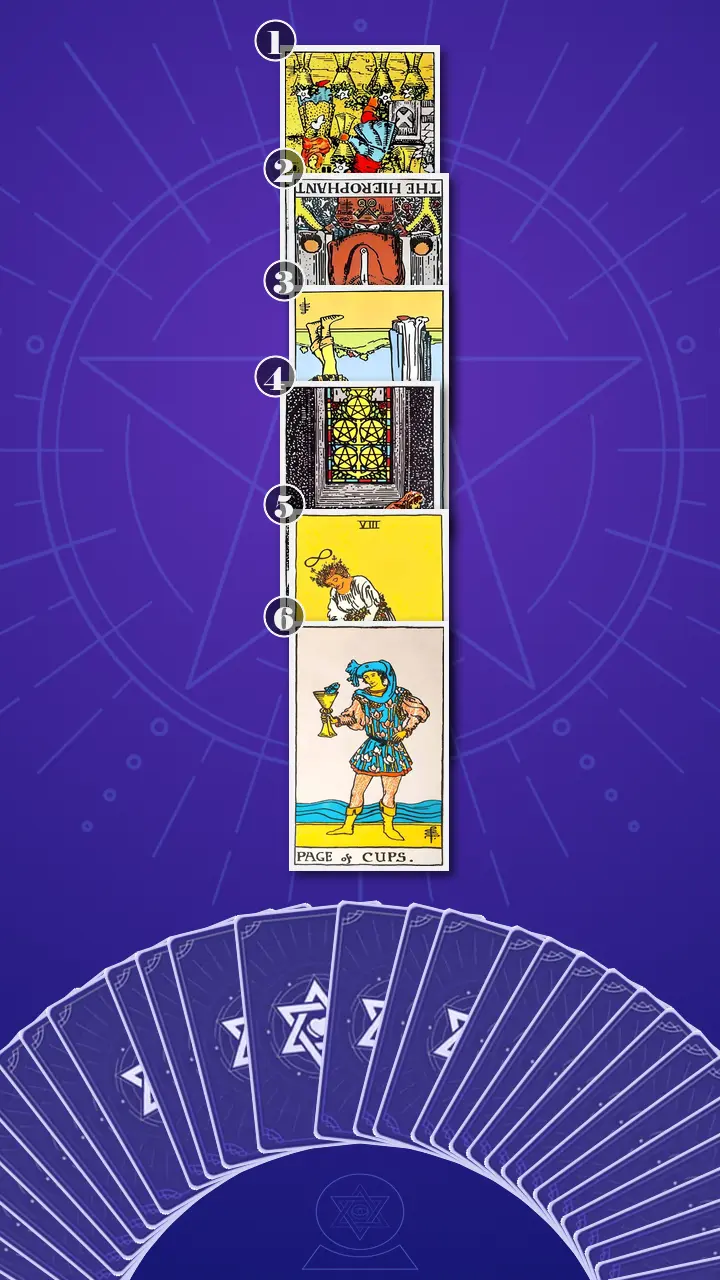
“For this,” I said, “I want to use a six-card layout called the Four-Layer Insight Ladder · Context Edition.”
If you’ve ever googled how tarot works for relationship anxiety, this is the kind of spread that’s actually useful: it’s not trying to predict whether someone will text you back. It’s designed to show why your system reacts the way it does—and what to do next.
The reason I chose this spread is simple. Jordan’s question wasn’t “What will happen?” It was “What am I replaying?” That’s deep inner work: identifying an inherited relationship script, tracking the repeating dynamic, finding the root fear beneath it, and then building one practical next step. A minimal six-card ladder gives enough structure to find clarity without drowning in a ten-card diagnosis.
I pointed to the empty vertical line where the cards would land. “Card 1 will show the album-trigger in the present—your first reflex. Card 3 will name the attachment pattern you run when uncertainty shows up. And Card 5 is the turning point: the inner resource that changes how you respond in real time.”
Reading the Ladder: From Highlight Reel to Root Need
Jordan’s eyes stayed on the deck like it was a weather report they were scared to hear. I’ve seen that look in studio guests right before they admit something true: the tiny flinch that says, If this is real, I’ll have to do something different.
Position 1: The Present Trigger Loop
“Now flipping over,” I said, “is the card that represents what the wedding album is triggering in the present: the observable replay loop and the immediate emotional reflex.”
Six of Cups, reversed.
I let the image sit between us. “This reversal is nostalgia becoming a pressure-cooker,” I said. “Not comfort—comparison.”
I tied it directly to what Jordan had told me, using the exact modern scenario that fit like a key: “This is you at 11:30 PM, scrolling that one perfect wedding photo again, then immediately opening your chat thread and comparing: ‘Why don’t I feel that safe?’ The memory isn’t landing as warmth. It lands as a standard.”
Reversed, the Six of Cups becomes an energy blockage: sweetness gets distorted into a measuring stick. A curated image of love starts acting like a scoreboard, and your body tightens as if it’s about to be graded.
I added one sentence I’ve learned people need to hear out loud: “The album is a highlight reel—not a rulebook.”
Jordan gave a small laugh that wasn’t really a laugh—more like air escaping through a cracked door. “That’s… rude,” they said, then swallowed. “But yeah. It’s exactly what I do. I look at it and then I’m like, ‘Okay, now prove it in my relationship.’” Their fingers tightened around their phone and then loosened, like they’d been caught doing something they didn’t want to admit.
Position 2: The Inherited Relationship Script
“Now we’re flipping the card that represents the inherited relationship script you internalized—what love was supposed to mean or look like based on family messaging.”
The Hierophant, reversed.
I nodded, almost to myself. “Okay. This is the ‘rules’ card. But reversed, it says: the script is not the truth.”
I used an analogy that usually lands—because it’s how modern life actually works. “Think of it like a relationship Terms & Conditions page you never actively agreed to. It’s an auto-renewing subscription. Every time you feel uncertainty, your brain opens the policy manual: ‘If it’s not official, it’s not real… right?’”
I pointed at the crossed keys in the imagery. “These keys are about access—what counts as valid love, who gets ‘in,’ what milestones feel like permission to relax.”
Then I translated it cleanly into their world: “The album doesn’t just show romance. It shows ‘approved’ romance. So you start chasing labels and public proof like they’re verification badges—even if what you truly need is day-to-day emotional reliability.”
Jordan exhaled fast, surprised. Then they did that thing people do when something is so accurate it’s almost funny. “Oh,” they said. “I say ‘should’ about love constantly.”
“That’s the pivot,” I told them. “Not to shame it—just to notice it. Hierophant reversed is your adult self deciding what to keep and what to unlearn.”
My mind flashed, briefly, to my radio booth: the way an old station jingle can live in your body for decades. Not because you chose it—because you heard it every morning. That’s what inherited scripts are like. The question isn’t ‘Why do I have it?’ The question is ‘Do I still want to play it on repeat?’
Position 3: The Attachment Pattern You Replay
“Now flipping over,” I said, “is the card for the attachment pattern being replayed today: how you try to secure closeness when uncertainty appears.”
Two of Cups, reversed.
“This is the major blockage,” I said gently. “Because the Two of Cups is mutual rhythm—two people meeting each other in the middle. Reversed, it turns connection into a signal-reading task.”
I used the modern montage exactly as it’s lived: “Read receipts. Drafts. Unsent paragraphs. Checking timestamps like it’s a relationship metrics dashboard—response time, emoji frequency, who initiated last.”
In my voice, I held up the split-screen conflict Jordan had already described: “On one side: ‘I want closeness.’ On the other: ‘I can’t look needy.’ And the inner monologue becomes: ‘If I explain it perfectly, they’ll reassure me. If I ask plainly, I’ll scare them off.’”
Reversed, the Two of Cups is not a lack of love—it’s misattunement. The energy is there, but it’s blocked by strategy. Instead of two nervous systems settling into a shared pace, one person (often Jordan) tries to engineer safety by monitoring the edges.
I said it plainly, because this is where people lose years: “If you need a paragraph, you probably need a pause.”
Jordan nodded so quickly it looked like their neck already knew. They swallowed hard, like they were trying not to cry but also trying not to laugh at themselves. “I literally have drafts,” they admitted. “Like… multiple versions. I’m trying to write the ‘perfect’ message instead of making the ‘clear’ message.”
Position 4: The Root Fear Beneath the Pattern
“Now we’re looking under the texting and the thinking,” I said. “This next card represents the core fear or need beneath the pattern—the belonging question driving the reaction.”
Five of Pentacles, upright.
The image always changes the room. It’s simple: cold outside, warm light inside. And your body understands it instantly.
I didn’t rush. “Under the spiral,” I said, “is the fear of being outside the warmth. Not being chosen. Not belonging.”
I translated it into a Toronto winter scene because Jordan had already lived it: “It’s like walking past a warmly lit restaurant on Queen West. You see a couple laughing behind the glass. Your phone is cold in your hand. No new message. And your nervous system says, ‘They’re inside. I’m outside. I knew it.’”
Jordan went very still—first the physiological freeze, then the distant focus like their brain was replaying a memory, and finally a small, shaky exhale that sounded like surrender.
“I don’t even think I’m mad at my partner,” they whispered. “I’m mad at… how fast I go there.”
“That makes sense,” I said. “This isn’t a moral failing. It’s a protection strategy. But it’s expensive.”
Then I anchored the reframe I wanted them to borrow this week: “Their reply is information—not a verdict on your belonging.”
When Strength Held the Lion: The Moment the Pattern Can Change
I touched the deck once—my way of marking a threshold. “We’re flipping the turning point now,” I said. “This is the card for the turning point toward secure attachment: the inner resource that changes how you respond in real time.”
Strength, upright.
For a second, even the radiator in my studio apartment seemed to click quieter, like the environment was conspiring to make space. Strength does that. It’s not loud. It’s stabilizing.
Setup. I looked at Jordan and named the loop without dramatizing it. “If you’ve ever closed a wedding album and immediately opened your messages to re-read a ‘goodnight’ text like it’s evidence, you know that tight, watchful feeling—like one missing emoji could mean your whole relationship is changing.”
I watched their shoulders lift a millimeter, bracing for the old conclusion: So I have to get better at reading people.
Delivery.
Not ‘tame your need’—tame the panic, and let gentle hands hold the lion so your request can be simple and real.
I let the sentence hang in the air like the last note of a song that doesn’t resolve right away.
Reinforcement. Jordan’s reaction came in layers—the kind that tells me something actually landed in the body, not just the brain. First: their breath stopped for half a beat, like their nervous system had been interrupted mid-script. Second: their gaze softened and unfocused, not dissociating—more like a mental rewind, seeing themselves hovering over “Send” on the fifth follow-up text. Third: their face changed. The tension around their mouth loosened, and their eyes went glossy with relief that looked almost suspicious, like, Wait, I’m allowed to need closeness without performing for it?
“So… I don’t have to pretend I’m chill,” they said, voice small.
“Exactly,” I told them. “Strength isn’t you becoming less needy. Strength is you becoming less hijacked.”
This is where my sound-research brain always chimes in. “When I’m producing audio,” I said, “and something’s distorting, I don’t fix it by rewriting the lyrics. I lower the gain. Panic is distortion. Your ‘perfect text’ is you rewriting lyrics. Strength is lowering the gain first.”
Then I brought in my signature lens—the one I call Conflict Mediation, even when the conflict is internal. “We can use frequency as a bridge here,” I said. “Not as a cure-all—just as a lever. A longer exhale is already a frequency shift. And humming—quietly, even under your breath—can be a way to cue your body into steadiness before you speak. You’re not taming the lion by wrestling it. You’re calming it by changing the room you’re asking it to live in.”
I leaned in, gentle but direct. “Now, with this new perspective, can you think back to last week—was there a moment when you felt that surge to send ‘just one more’ clarifying text? If Strength had been in the room, what would have been different?”
Jordan blinked, then nodded once, slow. “Tuesday,” they said. “They replied ‘busy tonight’ and my brain went straight to ‘they’re fading.’ I wrote this whole… PR statement. If I’d paused—like actually paused—I think I could’ve just asked for a plan. Like a normal person.”
I smiled, because that’s the shift: from hypervigilant proof-chasing and ‘perfect text’ performance to grounded self-regulation and one clear, direct ask. Not a personality transplant. A nervous-system move.
Position 6: The Next Step That’s Actually Doable
“Now we flip the last card,” I said, “representing a grounded next step: one small, doable way to communicate or act differently this week.”
Page of Cups, upright.
“This is your new relational language,” I said. “Curiosity. Emotional honesty. Beginner energy.”
I pointed to the fish popping out of the cup. “The fish is the surprise feeling—the younger part of you that gets activated by something random, like an album. Page of Cups says: don’t turn that surprise feeling into a courtroom case. Let it be a message.”
And I grounded it in Jordan’s exact modern-life scenario: “This is you saying, ‘Seeing my parents’ wedding photos stirred something in me.’ Then one small request: ‘Can we set a time to see each other this week?’ It’s not a breakup talk. It’s not a thesis.”
Jordan’s face softened into something like relief. A tiny smile, like they could imagine sending that message without feeling like they were handing someone a grenade.
“A clear ask beats a perfect text,” I reminded them. “And whatever comes back—remember—information, not verdict.”
From Proof-Chasing to Actionable Advice: Your Next 48 Hours
I slid the cards into a single story, so Jordan could feel the logic instead of getting lost in symbolism.
“Here’s the map,” I said. “The album (Six of Cups reversed) isn’t just memory—it’s a warped lens that makes your present feel like it has to match a curated standard. The Hierophant reversed shows why: you’re running inherited Terms & Conditions about what ‘real love’ looks like—official, obvious, publicly affirmed. Then the Two of Cups reversed is the lived pattern: when uncertainty hits, you try to secure closeness through monitoring and strategy instead of mutual rhythm. Under that is the Five of Pentacles truth: the fear of being outside the warmth. Strength is the antidote—steady the body first. Then Page of Cups: one human sentence, one clear request.”
“Your cognitive blind spot,” I added carefully, “is thinking that if you can just interpret the signals correctly, you’ll finally feel safe. But this spread is showing the opposite: safety comes from self-regulation plus one clean ask.”
Jordan raised a hand, practical objection ready. “But I swear I don’t have time,” they said, half-laughing. “Like… I’m working late. I can’t do a whole routine every time I get triggered.”
I nodded. “Good. Don’t do a whole routine. We’re not building a new personality. We’re building a two-minute bridge.”
Then I gave them the smallest, most usable steps—grounded, specific, and deliberately unglamorous.
- The 60-Second ‘Lower the Gain’ PauseBefore sending any reassurance-seeking text, put your phone face-down on the table. Plant both feet on the floor. Do one long exhale that’s longer than your inhale, then decide: are you asking for info (a time/plan) or reassurance (care/commitment)?If your brain says “This is silly,” do the 90-second version anyway and treat it as data. Self-regulation is not self-silencing—it’s how you ask without panicking.
- The One-Note Proof-to-Connection LogOpen a note titled “What I actually need (not what I’m trying to prove).” Each time you feel yourself checking timestamps or rewriting drafts, add one line: “Right now I need ____.” (Examples: “a plan,” “a check-in,” “a reminder I matter,” “sleep.”)Keep it to one line. If you start writing a paragraph, that’s your cue: pause, breathe, return to one sentence.
- The Page of Cups Message (One Feeling + One Request)Send one simple text this week: “Hey—seeing some family wedding stuff stirred me up. Can we pick a time to see each other this week? It helps me feel grounded.” No backstory. No evidence. Just human.If you feel the urge to add three softeners (“lol,” “no worries if not,” “sorry”), stop and re-read: a clear ask beats a perfect text. Their reply is information—not a verdict on your belonging.
Because I’m me, I offered one optional add-on from my sound-based toolkit—my Soundproof Barrier strategy. “If late-night scrolling is your trigger zone,” I said, “pick a specific ‘barrier sound’—brown noise, a low-volume ambient track, even a boring podcast you don’t care about. Not to numb you. To give your nervous system a boundary while you do the 60-second pause. Think of it as turning down the room’s emotional reverb so you can hear your own voice.”

A Week Later: The Quiet Proof
A week later, Jordan messaged me—not a novel, just a screenshot and one line: “I did the pause. I sent the one sentence. We’re seeing each other Thursday.”
They added, almost as an afterthought: “I still woke up the next morning thinking, ‘What if I ruined it?’ But then I remembered the lion. I didn’t spiral. I made coffee. That felt… new.”
That’s what a real Journey to Clarity usually looks like. Not certainty. Ownership. Not erasing the need for closeness—stopping panic from being the ghostwriter of your texts.
When love doesn’t come with a glossy caption or a guaranteed timeline, it’s easy to start scanning every message like it’s a test—because some part of you is trying not to feel like the person left out in the cold again.
If you didn’t have to earn safety by interpreting every signal perfectly, what’s one small, direct request you’d be willing to try—just to see what real-time connection feels like?