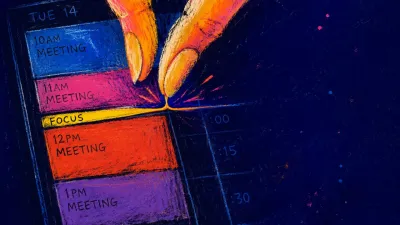
From Calendar Dread to Sustainable Focus: A One-Rule Rebalance
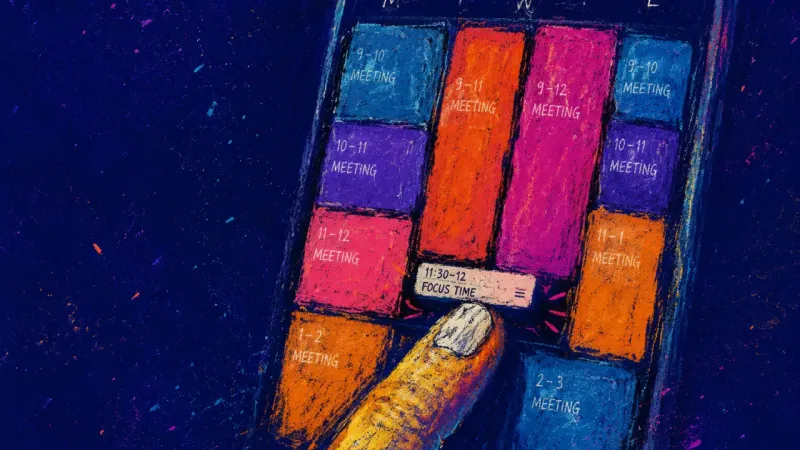
Finding Clarity in the Sunday Scaries Week View
You’re a London tech worker who can run a campaign launch but still feels panic when you see back-to-back meetings on Sunday night—classic Sunday Scaries calendar dread.
Taylor said it like it was a confession, not a schedule. They sat at my small marble café table with their phone face-up, Google Calendar in week view, the blue blocks stacked so tight they looked like a wall. Outside, the street was doing its usual London thing—someone dragging a suitcase over the pavement, a bus sighing at the stop—but inside my café the espresso machine hissed steadily, like it was trying to keep time for both of us.
“Last night,” Taylor added, “I opened my calendar and my stomach just… dropped. The first meeting is 9:00 a.m., and it’s like my whole body braces.”
I watched their jaw work without them noticing—tight, then tighter—like they were grinding something invisible. Their shoulders had that heavy-forward posture I’ve seen in a lot of people lately: the posture of carrying work the way you carry groceries when the tote bags are cutting into your fingers and you tell yourself, Just get to the door.
“My schedule looks organised,” they said, eyes on the screen, not on me, “but I feel like I’m constantly failing it.”
This is the part people don’t say out loud: it’s not just being busy. It’s the wired-tired buzz at 10:45 p.m., the fridge hum in a quiet kitchen, the Teams ping that hits like a tiny electric shock, the way rest feels like something you have to justify.
I let the silence sit for half a breath, the way you let coffee bloom before you pour. “A full calendar isn’t a plan—it’s just evidence,” I told them gently. “And it’s not evidence that you’re ‘bad at balance.’ It’s evidence that something is feeding this pace. Let’s figure out what—and then we’ll choose one step that actually rebalances it.”

Choosing the Compass: The Celtic Cross · Context Edition
I asked Taylor to take two slow breaths—not as a mystical ritual, just as a clean transition. Like closing a browser tab before you open another. While they exhaled, I wiped my hands on a towel that smelled faintly of citrus peel and coffee oils, then I shuffled my worn tarot deck on the table beside their untouched cappuccino.
“Today,” I said, “I’m going to use the Celtic Cross · Context Edition.”
For anyone reading along: this spread works beautifully for burnout and an overloaded calendar because it separates what’s visible (the schedule, the meetings, the constant juggling) from what’s underneath (the fear, the attachment, the pressure story). Then—crucially—it doesn’t leave you floating in insight. Position 10 is framed as guidance, not fate: one concrete integration move you can test in real life this week.
I pointed to the empty spaces where the cards would land. “The first card will show the burnout pattern you can feel in your body and see in your calendar. The card crossing it will show what’s actively tipping your day from ‘busy’ into ‘unmanageable.’ And the near-future card—this is the pivot—will show the most accessible balancing energy you can lean into next.”
Taylor nodded, but it wasn’t a confident nod. It was the nod of someone who’s been holding their breath for so long they’re not sure what it means to let it out.
When Temperance Poured Between Two Cups
I laid the cards down one by one. The café noise softened around us—milk steaming, a spoon tapping ceramic—until it felt like Taylor and I were in a small pocket of time that didn’t require instant replies.
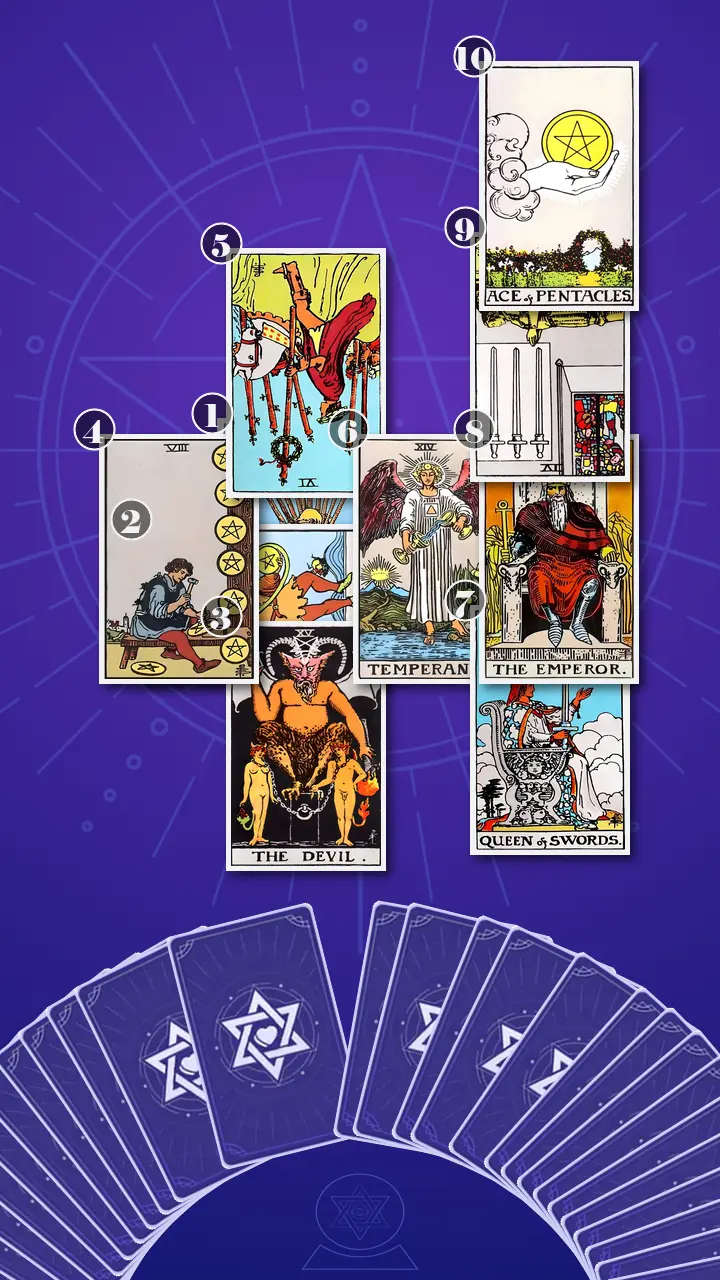
Position 1: The visible burnout pattern right now
“Now opening,” I said, “is the card that represents the visible burnout pattern right now—what your overloaded calendar looks and feels like in practice.”
Ten of Wands, upright.
There it was: the figure bent forward, arms full, vision narrowed to the next step.
In modern life, this is like when your week is so stacked with meetings and favours that you can’t even see what “done” looks like—only the next hour in front of you. It’s not one giant task. It’s ten “small” asks that become a whole-body weight.
Energetically, this is excess: too much responsibility carried too tightly, too personally, too alone. The card doesn’t say you’re lazy. It says your arms are full.
Taylor let out a small laugh that had no humour in it—more like a cough that found a sentence. “That’s… brutal,” they said. Then, quieter: “But yeah. That’s it. I keep thinking if I just get through this week, then I’ll breathe.”
I nodded. “You’re not behind. You’re over-allocated.”
Position 2: The immediate stressor tipping you into burnout
“Now opening is the immediate stressor that’s making the load unmanageable—what’s crossing you.”
Two of Pentacles, reversed.
Reversed, the juggling isn’t graceful anymore. The rhythm breaks.
This is the part where you spend half the afternoon dragging blocks around in Google Calendar—move the 1:1, squeeze the deck review, push the strategy doc to ‘tomorrow’—and by the time you open the doc, your brain feels like it’s buffering. Rearranging the tabs isn’t the same as closing a few.
Energetically, this is blockage: your system for balancing tasks is failing under volume. It’s not that you “need better time management.” It’s that the number of moving parts has exceeded what a human nervous system can juggle without cost.
“That’s exactly what I do,” Taylor said, staring at the card like it had been reading their screen history. “I’ll optimise the schedule for hours. And somehow… there’s still no air.”
Position 3: The underlying fuel that keeps you overcommitting
“Now opening is the underlying fuel—the belief or attachment that keeps you overcommitting even when it hurts.”
The Devil, upright.
I’ve always liked how blunt this card is. The chains are there, yes—but they’re loose. The bind is maintained by habit and fear more than true necessity.
In Taylor’s world, it looks like the ‘always-on’ notification setting you never chose consciously—but now it runs your life. It looks like treating responsiveness as a KPI even when your actual job is strategy and clarity. It’s the workplace version of an algorithm: the more you reward urgency, the more urgency you get served.
Energetically, The Devil is attachment. Not to work itself, but to what work is proving. The belief underneath sounds like: If I don’t say yes, I’ll fall behind and people will stop counting on me.
I watched Taylor’s body respond before their words did—three tiny tells in sequence: their breath paused, their gaze unfocused like a memory was loading, and then their shoulders lifted toward their ears as if bracing for impact.
“This,” I said softly, “is the part where you tell yourself: ‘I’m being dependable’—but another part of you whispers: ‘I’m being trapped.’”
Taylor swallowed. Their fingers tightened around the warm cup like it was a handrail. “If I don’t answer fast,” they admitted, “it feels like I’m failing a test.”
“Yeah,” I said. “And that’s not a character flaw. That’s fear management wearing a productivity costume.”
Position 4: What recently normalised the pace
“Now opening is what recently normalised this pace—the context you’re coming out of.”
Eight of Pentacles, upright.
This card is competence. Craft. The pride of getting better by doing the work.
In modern life, it’s that “heads down for months” mode: consistent delivery, reliable output, becoming the person who can save things. And then—because you always have—everyone assumes you can take on even more.
Energetically, this is balance with a hidden cost: your diligence built trust, and now that trust is being converted into demand. Without a stopping rule, craft becomes a treadmill.
I had a quick, private flashback—twenty years of pulling shots behind my counter. Over-extract the coffee and it turns bitter, no matter how good the beans are. Not because the coffee “failed,” but because the process demanded too much from it.
“You didn’t get here because you’re careless,” I told Taylor. “You got here because you’re good.”
Position 5: The conscious pressure story you’re operating under
“Now opening is the story on top of your mind—what you think you need to prove or maintain.”
Six of Wands, reversed.
Reversed, recognition doesn’t feel stable. It feels like you have to keep earning it, or it evaporates.
In modern life, this is saying yes to high-visibility work because being “the reliable one” feels safer than risking silence or mixed feedback. It’s refreshing messages after a deliverable goes out. It’s eating dinner at your laptop while someone on LinkedIn posts a win and your brain does that quiet math: Am I falling behind?
Energetically, it’s deficiency: not enough internal validation, so you reach outward. And your calendar becomes the place you try to earn approval in colour-coded rectangles.
Taylor’s mouth tightened again, almost like they were about to argue with the card and then decided not to waste the energy. “It’s embarrassing,” they said. “But yeah. I don’t want to look… replaceable.”
“Of course,” I said. “In a growing tech company, ‘high-performing’ quietly gets translated into ‘always available.’ That’s a system issue, not a you issue.”
Position 6 (Key Card): The pivot energy you can lean into next
I set my hand on the deck for a moment before turning the next card. The air felt different—like the café had gone quiet for a beat between grinder bursts. “We’re opening the pivot,” I said. “The most accessible rebalancing energy coming online.”
Temperance, upright.
The angel pours between two cups—measured transfer, not a flood. One foot on land, one in water. A path, not a cliff edge.
In modern life, Temperance is a weekly ratio, not a personality trait: output/recovery like income/savings. It’s the third option that isn’t ‘crash day’ or ‘grind week.’ It’s designing a rhythm you can repeat.
And because I’m me—because I’ve watched a thousand coffees go wrong the same way—I felt my own framework click into place. My Stress Flavor Profile is what I use when someone’s life tastes like over-extraction: too much heat, too much time, too little recovery, until even the good work turns sharp. Burnout isn’t just “tired.” It’s when you’re pulling yourself like a shot that’s already spent.
Setup. I could feel Taylor hovering in that familiar mental cage: I have to make the perfect schedule. I have to say yes. I have to keep the green dot. If I fix tomorrow, I earn rest. It’s 10:45 p.m., you drag the blocks like Tetris, and one late Slack ping collapses the whole plan—again.
Delivery.
Not “push harder until it breaks”; choose the middle path and start pouring your time with intention—like Temperance, one measured transfer at a time.
Reinforcement. Taylor’s reaction came in waves, not words. First, a freeze—eyes wide for a second, like their brain had been interrupted mid-loop. Then the thought landed: their gaze dropped to the card, unfocused, as if they were replaying every Sunday night they’d tried to “fix” the week like it was a broken appliance. And then—finally—an exhale so deep it looked like their ribs remembered how to move.
“But… doesn’t that mean,” they said, and their voice sharpened with a brief flash of anger, “that I’ve been doing it wrong? Like I’ve been—”
I held up one finger—not to hush them, but to steady the moment. “No,” I said, firm and kind. “It means you’ve been doing what worked in the short term. You got praise. You got relief. You got to feel indispensable for a minute. Temperance isn’t calling you reckless. It’s calling you ready.”
Then I leaned in. “Right now, open your calendar—in your mind, if you want—and do what I call a Temperance pour. Set a timer for seven minutes. Move exactly one 30–60 minute block from a draining obligation into a protected recovery or focus block. Name it clearly: ‘No-Meeting Focus’ or ‘Screen-Off Reset.’ Then add one boundary line you’ll use if something tries to take it: ‘I’m booked then—can we do 3 p.m., or I’ll send an update by EOD?’ Two breaths if your chest tightens. You can stop after naming the block. You don’t have to send any messages today.”
Taylor blinked, like they were adjusting to a new light level. “So… I don’t need a total overhaul,” they said slowly. “Just a ratio. And a rule.”
“Exactly,” I said. “Consistency—not constant availability—is what builds credibility.”
And I named it plainly, so their body could believe it: “This is a move from numb over-functioning toward cautious self-trust. Not overnight. But real.”
Position 7: The resource you can use to change your calendar behaviour
“Now opening is your inner stance—the resource you can use to change how you show up.”
Queen of Swords, upright.
This card is the clean cut. The respectful limit. The end of the apology spiral.
In modern life, it’s a Slack message that doesn’t turn into a novel. It’s the ‘No thanks’ button your inbox never shipped with. It’s yes/no/async—no vague maybe.
Energetically, it’s balance through clarity. When burnout is fuelled by over-availability, the Queen doesn’t give you a new productivity hack. She gives you language.
I read it to Taylor the way the card asked me to—like a DM you wish you could send.
“Old way,” I said, and I could see it in their face before I finished: “Hey! Totally! I can do that—what time works for you? I can also pull together a doc and stay late if needed.”
“New way,” I continued, keeping my tone calm and clean: “I’m at capacity today—can we do Thursday at 2, or I can send a written update by EOD?”
Taylor’s thumb moved unconsciously, like they were already hovering over ‘Send.’ A flicker of relief crossed their face—permission, in the shape of a sentence.
“One clean sentence can save your whole week,” I said.
Position 8: The system you’re operating inside
“Now opening is the environment—external demands and norms shaping your schedule.”
The Emperor, upright.
This is the stone throne: structure, hierarchy, expectations that reward control and predictability.
In modern life, it’s meeting culture. It’s the unspoken rule that being booked equals being important. It’s a company where “quick sync” is treated like oxygen.
Energetically, The Emperor is containment. The system will keep filling empty space unless you define rules for your time. The lesson here isn’t “escape the system.” It’s “design a container inside the system that protects you.”
I glanced at Taylor’s cappuccino. The foam had flattened, the surface cooling. “In my café,” I said, “if I don’t maintain the espresso machine, the whole day tastes off. It’s not because the machine is bad. It’s because the system needs upkeep. Your calendar is the same.”
Position 9: Your hopes and fears about rest and being seen differently
“Now opening is your hopes and fears—the inner conflict about rest and boundaries.”
Four of Swords, reversed.
Reversed, rest doesn’t land. The body lies down; the mind stays standing.
In modern life, it’s finally getting a free hour, opening Netflix, then picking up your phone and drafting emails in your Notes “just so you don’t forget.” It’s lying in bed with Slack ‘just to be safe,’ and somehow it becomes a midnight planning session.
Energetically, it’s blockage: recovery is present but inaccessible because stillness triggers guilt. This is where one of my favourite truths applies, especially in London: Rest feels ‘illegal’ when your worth is tied to urgency.
Taylor’s eyes went shiny—not tears, not yet, more like the thin film of someone who’s been pushing past themselves for too long. “I feel ridiculous,” they whispered. “Even when I have time off, I can’t… be off.”
“You’re not ridiculous,” I said. “You’re conditioned.”
Position 10: One concrete step that begins rebalancing
“Now opening is integration—the one practical move that starts rebalancing without a total life overhaul.”
Ace of Pentacles, upright.
This is the offered coin: small, boring, real. The first brick. The recurring calendar event that compounds like interest.
In modern life, it’s treating a focus block like rent—non-negotiable because your life depends on it. Not because you’re being dramatic. Because your capacity is the asset everything else is built on.
Energetically, it’s new beginning grounded in action. Not a mood. Not a manifesto. A block of time you can actually defend.
The One-Rule Rebalance: Actionable Advice You Can Start This Week
I gathered the reading into one coherent story, the way I’d pull the threads of different coffee notes into a single flavour you can name.
“Here’s what I see,” I said. “The Ten of Wands is the symptom: your week is physically heavy. The Two of Pentacles reversed is the mechanism: you’re constantly rescheduling and switching context, which drains you more than the tasks. The Devil is the fuel: a fear-based attachment to being needed and approved of. The Eight of Pentacles shows how you earned trust through real competence—and then the demand grew. The Six of Wands reversed shows the conscious pressure: you don’t want to look replaceable. Temperance offers the true exit ramp: a repeatable ratio and one protected pour. The Queen of Swords gives you the tool: one sentence, no essay. The Emperor reminds us the system will fill the gaps unless you define rules. The Four of Swords reversed explains why rest feels restless. And the Ace of Pentacles asks for one concrete anchor.”
Then I named the blind spot, carefully. “Your cognitive blind spot isn’t ‘I’m bad at time management.’ It’s: ‘If I’m not constantly available, my value drops.’ That belief turns every invitation into a test you feel you must pass.”
“The transformation direction,” I continued, “is exactly this: shifting from proving your value through constant availability to protecting your capacity through clear priorities and one firm boundary.”
I tapped the table lightly, like a metronome. “Let’s keep it practical. No grand life overhaul. Just a small experiment—Temperance plus Queen of Swords, grounded by an Ace of Pentacles move.”
- Plant one Protected Focus Block (Ace of Pentacles)Pick one recurring time slot this week (e.g., Tue/Thu 10:00–11:00) and label it “Focus Block (Protected)” as if it’s a client call. Then move one non-urgent meeting request to the nearest open slot instead of sacrificing the focus block.If the all-or-nothing reflex hits (“If I can’t fix the whole week, why bother?”), do the 15-minute version. The goal is a repeatable ratio, not a perfect schedule.
- Use the One-Sentence Boundary Script (Queen of Swords)Draft one reusable line in your Notes app: “I’m at capacity today—can we do Thursday at 2, or I can send a written update by EOD?” Use it once this week on a request that doesn’t match your priorities. Turn on a ‘Focus’ status for 60 minutes and let yourself be unreachable.Write one sentence, then stop. No justification paragraph. If someone pushes back, repeat the same sentence once.
- Do a 7-minute “Temperance Pour” + Cup Temperature ScanSet a timer for 7 minutes. Move exactly one 30–60 minute block from a draining obligation into either a recovery block or a focus block. Name it clearly. While you do it, notice your body like you’re holding a fresh cup: how fast does your energy cool when you don’t protect it? That’s your “energy loss rate.”If your chest tightens or you start bargaining with yourself, take two slow breaths. You can stop after naming the block—you don’t have to send any messages today.
And because Taylor’s nervous system had been running like a machine that never gets serviced, I added one piece of my own café strategy: “Treat your energy the way I treat my espresso machine,” I said. “Maintenance beats emergency repairs. If you want, schedule your alertness—not your ambition. One buffer before one meeting is already a system upgrade.”

A Week Later: Ownership, Not Certainty
Five days later, I got a message from Taylor while I was wiping down the counter after the lunch rush.
“Did the focus block,” it said. “Felt guilty for like… the first five minutes. Then I did actual thinking work in daylight. Used the script once. No one got mad. I’m weirdly emotional about it.”
I pictured it clearly: Taylor sitting alone in a Pret near Old Street, laptop open, not because they were cramming to survive, but because they’d protected an hour on purpose. The first thought in the morning still probably whispered, What if I’m wrong?—but now there was room beside it for something steadier.
This is what a Journey to Clarity often looks like in real life: not instant peace, but a small, repeatable proof. Temperance doesn’t demand you become a different person. It asks you to pour differently—one measured transfer at a time.
And if tonight you’re staring at a packed week view with your shoulders braced, I want you to hear this the way I said it to Taylor: when your calendar is packed and your shoulders stay braced, it’s not because you love being busy—it’s because part of you is still trying to prove you won’t become ‘less’ the moment you stop being constantly available.
If you trusted that your value doesn’t require instant access to you, what’s one small block of time you’d protect this week—just to see what changes?
Every reading at AceTarot is a Journey to connect with inner wisdom and empower next step.
Learn more about our Journey to Clarity.