When a Five-Year Plan Becomes Armor: Testing What Still Feels Alive

Why Updating a Five-Year Plan Feels Safer at 10:34 p.m.
If you keep reopening your Notion five-year plan at night, not because you are excited but because the tab makes you feel less exposed, I know that pattern well.
When Alex (name changed for privacy) sat with me, she did not dress it up. She looked at me and said, “Why do I keep updating my five-year plan if I don’t want it anymore?”
Then she gave me the scene. Tuesday, 10:34 p.m., condo kitchen in downtown Toronto. The fridge humming. Blue laptop light spreading over an almost-finished mug of peppermint tea gone cold. A Notion tab open “for five minutes.” She changed a title, dragged one milestone into Q3, recolored a database tag, and closed the window with her shoulders still tight and her jaw locked. She told herself she was getting organized, but what she was really doing was trying not to feel exposed without a polished answer.
I could hear the contradiction immediately: one part of her wanted to stop maintaining a future that no longer felt alive, and another part was afraid of who she would be without that future on file. Her anxiety was not abstract. It sounded like trying to breathe normally while a tiny project manager kept flicking fluorescent office lights on and off inside her ribcage.
“I know how to plan,” she said. “I just do not know why I am still planning this.”
I nodded. “That makes sense. We are not here to shame the planning. We are here to see what it has been protecting, and to find clarity without making you perform certainty on demand.”

Choosing the Compass: The Situation-Obstacle-Advice-Outcome Spread
I asked her to put both feet on the floor and take one slow breath while I shuffled. I keep the ritual simple on purpose. For me, tarot works best as a way to focus attention and reveal pattern, not as theatre and never as a verdict.
For this session, I chose the Situation-Obstacle-Advice-Outcome spread. When someone is stuck refining goals that no longer fit, a clean four-card structure does more than a sprawling spread ever could. A larger layout would only feed the same overplanning habit that already has her in a loop. This one lets me trace the whole chain clearly: the visible behavior, the hidden resistance, the key shift, and the grounded next step.
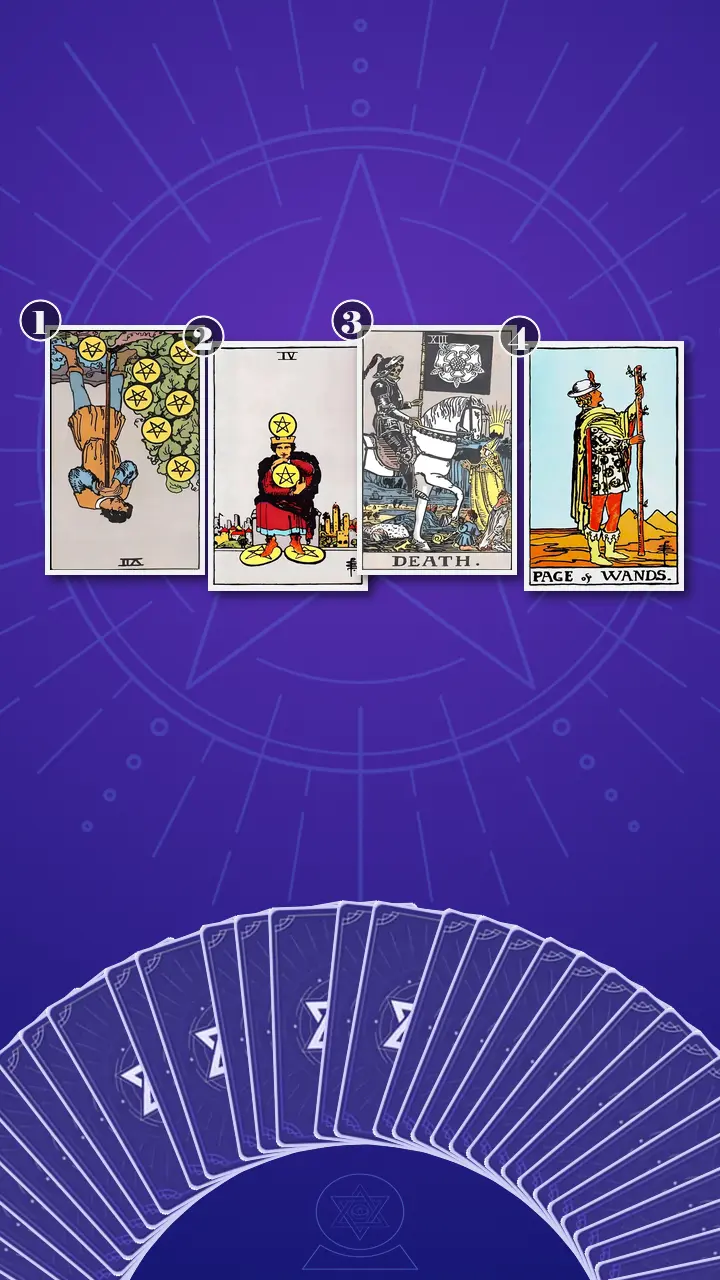
I laid the cards in a straight line from left to right, like a sentence. The first would show the symptom she was living inside. The second would reveal what fear had its hands on the wheel. The third—the turning point—would tell us what needed to end instead of getting optimized again. The fourth would show what forward motion looks like when it comes from experimentation, not another master plan.
Reading the Map: The Loop That Calls Itself Strategy
The Present Situation: Seven of Pentacles, Reversed
I turned over the card representing the visible symptom from her diagnosis: the repeated maintenance of a five-year plan that no longer felt genuinely wanted. It was the Seven of Pentacles, reversed.
I told her this card was almost painfully literal. After work, once the messages are answered and the apartment is finally quiet, she opens the same Notion document again and adjusts titles, timelines, and milestones for a future she is no longer emotionally investing in. The edits create a brief sense of order, but the deeper feeling is flatness. It is like refreshing Google Maps for a city you already know you do not want to move to.
In reversed form, the energy here is blocked and misaligned. Effort is still being spent, but the investment no longer matches the desire. A polished plan can still be emotionally expired. This card does not say she lacks discipline. It says maintenance has quietly replaced honest evaluation.
I asked, “The last time you opened the plan, what feeling were you trying to get away from for ten minutes?”
She gave a short laugh that landed bitter before it landed funny. “That everyone else had momentum,” she said. “And I didn’t.” Her fingers tapped the side of her mug once, then went still. That sharp little wince of recognition told me the card had already done its job.
The Hidden Knot: Four of Pentacles, Upright
Next I turned over the card representing the hidden resistance: the fear, attachment, or self-protective pattern keeping the old plan in place. It was the Four of Pentacles, upright.
I told her this was not about money in the simple sense. It was about grip. When somebody at brunch, in a quarterly review, on a date, or on a family call asks what comes next, the old plan gives her a clean answer she can hold against her chest like armor. In a city where ambition slips into casual conversation, that answer buys social legibility.
This is excess earth energy: structure turning rigid, safety turning into self-protection. Control can look like clarity when you are scared to grieve. The plan is not exciting her anymore; it is functioning like an emotional support object with excellent formatting.
Looking at that card, I had a brief flash of my old Wall Street life. I used to watch brilliant people cling to a position long after the thesis had changed, not because the numbers still worked, but because exiting meant admitting the market had moved. A hedge can protect you; it can also become the whole strategy. Four of Pentacles carries that same contracted logic.
I asked her, “If you stopped giving the old answer the next time someone asked what is next for you, what exactly do you fear they would assume?”
She exhaled through her nose, but her shoulders rose instead of falling. “That I’m flaky. Ungrateful. That I built all this and still don’t know what I’m doing.”
“Right,” I said gently. “You are not confused; you are over-loyal to a version of yourself that once made sense.” Her thumb pressed into the base of her palm as if she were literally holding something in place.
When Death Carried the White Rose
The Turning Point: Death, Upright
When I reached for the third card, the room changed. Even the small sounds around us seemed to pull back for a second. This was the advice position, the antidote in the spread, the place where the reading either stays theoretical or becomes honest.
I turned it over. Death, upright.
I saw the flicker in her face immediately, because most people brace when they hear that name. So I slowed the pace down. I asked her to picture Tuesday night again: the blue laptop light, the cold tea, Notion open, shoulders up by her ears, quietly renaming milestones for a future that no longer gives her anything back. This is the moment people usually mislabel as a strategy problem, when really they are trapped between consistency and self-abandonment.
I told her, “A cleaner plan will not revive a future that has already gone quiet. The shift is not better optimization; it is letting the old chapter be over.”
You do not need to keep embalming an expired future; let Death's white rose mark the ending so curiosity can grow where control used to sit.
I let that line stay in the air.
First her breath stopped. Then her eyes went slightly unfocused, as if some private reel had started playing behind them: performance reviews, brunch answers, late-night edits, the tiny relief of saving a cleaner version. Then came the resistance. She looked back at me with a flash of anger that was really pain in sharper clothes. “But if I let it end,” she said, “doesn’t that mean I wasted years?”
This was the hinge, so I answered it directly. “No. This is what I call Sunk Cost Decoupling. Your time, education, titles, and all the energy you spent becoming this version of yourself are real. They shaped you. But they do not get to invoice your future forever. Past investment is data, not debt.” As I said it, I watched her jaw release a fraction. One shoulder dropped. Her hand, which had been clenched around the mug handle, opened on the table. There was relief in that movement, but also the strange lightheadedness that comes when the thing holding you upright turns out to be the thing exhausting you. Her eyes brightened, then watered, and she gave a shaky little laugh. “So I’m not indecisive,” she said. “I’m grieving.”
“Exactly,” I said. “Now, with that lens, think back to last week. Was there a moment this would have changed how you felt?”
She nodded almost immediately. “At brunch. I gave the polished answer, and halfway through I felt myself leave the room.”
When I read the Death card in a career change context, I do not read doom. I read dignity. The white rose on the black banner is a clean ending, not a punishment. The rising sun is what comes after honesty, not before it. This was the exact move from anxious control and grief-disguised optimization toward cautious curiosity and steadier self-trust.
A Beta Test, Not a Rebrand
The Lived Next Step: Page of Wands, Upright
Then I turned over the final card, the one showing how integration begins when the advice is practiced. It was the Page of Wands, upright.
The visual texture of the reading changed immediately. We moved from crops, walls, and clenched coins to a figure standing in open land with a sprouting wand. I told her this is what movement looks like after release: not a new master plan, not a perfect personal brand, just one live spark receiving real attention. Beta test, not full product launch.
In upright form, the energy here is balanced fire—early momentum, curiosity, beginner energy. Instead of asking a new interest to justify the next five years, this card asks for one honest week. One message. One class. One adjacent conversation. You do not need a new five-year identity to test one live spark.
I asked her, “What interest keeps returning before your inner committee shuts it down?”
For the first time, she smiled without strain. “Brand storytelling,” she said. “Not the KPI version. The human version. Workshops, long-form stuff, maybe facilitation.”
“Good,” I said. “Then we do not make it explain your whole life tonight. We just let it be alive.” Her energy lifted visibly then—not a movie-ending transformation, just the smallest return of color.
From Blueprint to Compass in the Next 72 Hours
When I looked across the whole spread, the story was clean. Seven of Pentacles reversed showed the late-night maintenance loop: rewriting a future on paper because it temporarily calms the body. Four of Pentacles showed why the loop is so sticky: the old plan has been doubling as social armor, proof of worth, and a clean answer for other people. Death named the real task—grieve the ending instead of optimizing around it. Page of Wands showed the replacement for false clarity: small, honest experiments that generate signal in real time.
The blind spot was not lack of discipline. It was the assumption that her only options were to keep the old plan alive or become reckless and drift. That is a false binary. She had been polishing a map to a city she no longer wanted to live in because the map still looked impressive in meetings. The transformation direction was simpler and harder: shift from preserving the most legible future to testing what actually feels alive now.
Before I gave her next steps, I ran what I call Strategic Path Valuation on the two macro-directions in front of her. The old path still had optics, recognizability, and predictable language. But its long-term ROI in actual aliveness was collapsing. The emerging path had less polish and no five-year guarantee yet, but it had signal, energy, and room to scale into a life she could actually inhabit. That difference matters.
Then I gave her a stripped-down version of my 5-Year Horizon Stress Test. Not the usual late-20s panic question of where she should be by 2029, but this: if nothing changed, would staying on this exact path for five more years feel like expansion or like a tidy form of self-abandonment? I asked her to make a Hold or Pivot micro-decision within 72 hours using these three actions:
- Run the Alive vs Safety Audit Duplicate your current five-year plan tonight, rename it ‘Signal Check - This Week Only,’ set a 10-minute timer, and tag each line with only one label: ‘alive’ or ‘for safety.’ If a goal clearly belongs to the past, move it into a page called ‘Completed Season’ instead of deleting it. Do not rewrite, justify, or add new categories. The point is signal, not better formatting. If your chest tightens, plant both feet on the floor and stop after one section.
- Retire One Outdated Answer Write a private two-sentence retirement note for one goal you no longer want, archive one related input this week—one newsletter, one job alert, one bookmarked course, or one podcast queue—and practice one low-stakes sentence with a trusted person: ‘I am re-evaluating what I want next, so I am letting it be more experimental than fixed right now.’ Start in private if saying it out loud feels too exposed. Archiving counts. Whispering the truth into your Notes app counts.
- Give One Spark a Seven-Day Trial Pick one interest that has actual energy in it right now and give it one honest week: three 20-minute sessions, one message to someone in that space, or one low-cost class or reading block. At the end of the week, answer only two questions: ‘Did this make me more awake or more drained?’ and ‘Do I want one more week?’ Keep it reversible. No announcement, no rebrand, no forcing a business case by day two. Curiosity first, identity later.
I told her something I wish more ambitious people heard earlier: you are allowed to stop making your future legible on demand.

A Week Later: The Quiet Proof
A week later, Alex sent me a screenshot of the duplicated page. Half the items were tagged ‘for safety.’ One line—her director-track timeline—had been moved into ‘Completed Season.’ Under it she had written, ‘This used to matter to me. It does not need to keep running my life now.’ On the same day, she booked a Saturday workshop on brand storytelling and messaged someone who facilitated narrative strategy sessions.
She also wrote, “I still do not have the big answer. But I did not open the five-year plan last night, and that feels weirdly huge.”
She slept a full night, but her first thought the next morning was still, What if I am wrong? This time, she smiled, made coffee, and left Notion closed.
That is the kind of clarity I trust. Not certainty on command. Ownership. This Situation-Obstacle-Advice-Outcome reading did not hand her a destiny; it helped her stop keeping an outdated future on life support and start listening for what was actually alive.
Sometimes the hardest part is sitting in the blue glow of your laptop, jaw tight, trying to make an old future look convincing enough that you do not have to feel the grief of not wanting it anymore. Clarity can begin there—not as a perfect answer, but as the moment your grip softens enough to tell the truth.
So when that old tab calls you back again, what one sprouting-wand thing in your life could you let be a seven-day signal instead of a five-year verdict?
Every reading at AceTarot is a Journey to connect with inner wisdom and empower next step.
Learn more about our Journey to Clarity.