Two LinkedIn Promotion Posts, Then a Pause That Changed the Pace

The 7:40 a.m. Commute and the LinkedIn Promotion Spiral
If you’re a late-20s, mid-level city worker with expensive rent and a decent job, and one LinkedIn promotion post can hijack your whole commute before 8 a.m., I want to say this first: I do not read that as weakness. I read it as a pattern.
When Jordan (name changed for privacy) sat down with me, I could picture the scene she described so vividly it almost felt like I had been on the 504 King streetcar with her: 7:40 a.m., wedged near the back door, paper cup warming one palm, phone heating the other, brakes screeching, cold air slipping in at every stop. Two “thrilled to share” promotion posts later, her thumb was flying between LinkedIn, salary articles, and Apple Notes. Her coffee had already gone bitter. Nothing in her actual job had changed, but within ninety seconds her body had started acting like an emergency had.
“I know comparison is unhealthy,” she told me, with a laugh that sounded more worn out than amused, “but I still treat it like market research.”
What lived underneath that sentence was the real contradiction: she wanted to trust her own career pace, but every public title change made slower progress feel like proof she was falling behind. The anxiety sat in her body like a blazer button fastened one notch too tight—chest pinched, pulse sprinting ahead, hands itching to do something immediately. Not every urgent career plan is clarity. Sometimes it is comparison looking for an exit.
I kept my voice warm and steady. “That makes sense to me. After a decade of helping people read timing more clearly, I’ve learned that low tide and personal failure can feel almost identical from the inside. But they are not the same thing. Let’s map this. Today, I want to help you separate real ambition from borrowed urgency so we can find some actual clarity.”

Choosing the Ladder: How Tarot Works for Career Comparison Anxiety
I asked Jordan to take one slow breath and hold the question in plain language: Why do LinkedIn promotions make me rush my own timeline? Then I shuffled slowly. Not as theater, and not as some dramatic prediction ritual, but as a way to move her out of the reflex to react and into the ability to observe.
For this reading, I used my Four-Layer Insight Ladder · Context Edition, a four-card career tarot spread I reach for when a question sounds strategic on the surface but is really about the psychology underneath. This is how tarot works best for career anxiety: not as fate, not as a verdict, but as a structure that separates trigger from root fear, reframe from next steps.
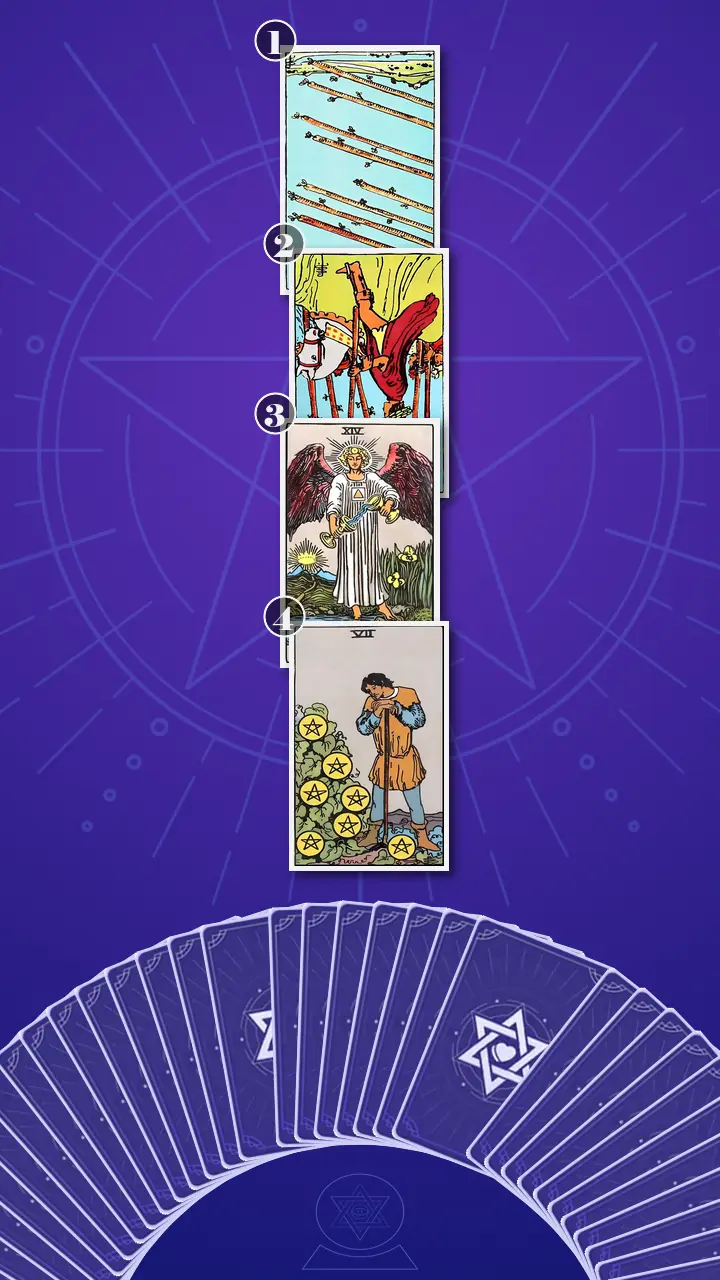
I chose it because Jordan did not mainly need another opinion on whether to apply, wait, or optimize harder. She needed to see why one external cue could compress time so fast. So I laid the cards in a vertical line, like a narrow staircase: the first for the visible trigger pattern, the second for the deeper validation wound, the third for the turning point, and the fourth for the grounded practice that could help her embody a new pace. When someone is stuck in a career comparison spiral or feeling behind after LinkedIn, that order matters.
I told her, “This spread keeps the story clean. First we name what happens. Then we name why it hurts. Then we find the shift. Then we make it usable.” That, to me, is one of the clearest ways tarot helps with career comparison anxiety: it turns one tangled feeling into parts you can actually work with.
Reading the Heat in the Feed
Position 1: The Tab Storm That Calls Itself Research
I turned over the card in the position that shows the visible trigger pattern from the diagnosis: the specific rushing behavior that begins after seeing promotion posts.
The card was the Eight of Wands, in reversed position.
“This,” I told her, “is the streetcar tab storm.” I described it exactly as it had been living in her real life: one peer promotion post becoming forty minutes of LinkedIn profiles, marketing salary articles, old performance notes, job alerts, and a stricter Q3 plan. Nothing concrete in her role had changed, but her body was treating the feed like an urgent instruction addressed personally to her.
In this position, the reversed Eight of Wands shows blocked fire with too much incoming motion and no grounded direction. The energy is not missing; it is overfired and scrambled. The flying wands in the Rider-Waite image always make me think of notifications with no human hand on the steering wheel—motion everywhere, agency nowhere. Jordan was not lacking drive. She was confusing activation with direction, like letting LinkedIn notifications set the speed on her treadmill.
That card meaning landed fast. Jordan gave a short, bitter laugh. “That’s annoyingly accurate,” she said. “I’ll call it research, but honestly it feels more like I’m bracing for impact.” Her fingers tapped the paper sleeve around her cup once, then stopped. That was the exact recognition I wanted: not shame, just precision.
Position 2: The Crowd in Your Head
Next, I turned over the card in the position that reveals the core fear and validation-based belief driving the spiral underneath the surface.
The card was the Six of Wands, in reversed position.
“This is the deeper ache,” I said. “The sting isn’t only that other people moved. It’s that their movement is public. The new title, the banner post, the comments, the Slack applause—it all turns visibility into a ranking system. Then your quieter progress starts to feel invisible, and you begin craving a visible marker more than an actually fitting next step.”
Here the energy looked like a deficiency of internally sourced validation paired with an excess of dependence on public proof. The laurel wreath becomes the polished announcement post; the watching crowd becomes comment counts, clap emojis, and the imagined audience in her own head. This is the career version of highlight-reel logic: everybody else’s headline moment starts grading your ordinary Tuesday.
I asked her, “When did visibility start counting more than fit?”
She did not answer immediately. First her breath paused. Then her eyes drifted away from the cards, as if an old sequence had started replaying on a hidden screen. When she finally spoke, her voice had gone quieter. “I think when staying steady started looking embarrassing.” Her hand tightened around the cup, then relaxed. The room went still around that sentence.
I nodded. “That’s the worth wound. And it matters because it turns someone else’s win into evidence against you. But you can be ambitious without letting the feed set your pace.”
When Temperance Poured Between Two Cups
Position 3: Temperance and the Filter Before the Fix
When I reached the third card, the atmosphere shifted with it. The light at my window had softened from glare into something cooler, and even the traffic noise below seemed to lose its edge. We had arrived at the core card of the reading—the antidote.
I turned over the card in the position that introduces the key shift from borrowed urgency to self-paced integration.
The card was Temperance, upright.
Whenever Temperance appears, my mind goes to orbital mechanics. A planet does not speed up because a neighboring planet happens to look brighter from where you’re standing. One of my signature lenses is what I call Macro-Cycle Phase Identification: locating whether someone is in expansion, consolidation, recovery, or redirection, so they stop reading a slower phase as a personal defect. Jordan’s cards were clear. She was not in a dead zone. She was in an integration phase—building skill, capacity, and fit—while her environment kept rewarding only visible acceleration.
Then I used my other lens, Systemic Friction Auditing. “Your panic isn’t coming from nowhere,” I told her. “There’s office culture, expensive-city pressure, title talk, polished feeds, and the way LinkedIn packages public milestones like a scoreboard. Hustle can’t simply override all that. So the answer is not to run faster every time the feed flares up. The answer is to build a filter.”
That is Temperance in career timing. It separates activation from information. It says your ambition is real, but the speed you borrow from other people’s announcements is not the same thing as direction. It hands you a cleaner question: what pace lets you build skill, confidence, and fit without burning yourself hollow?
I gave her the setup as plainly as I could. “Picture that streetcar again. Coffee in one hand, phone in the other. Two promotion posts later, you’ve checked titles, comp bands, and rewritten your goals before the workday even starts. Your circumstances did not change; your sense of safety did.”
Your career is not late because someone else's laurel arrived first; let Temperance pour your ambition and capacity into the same cup so your pace becomes sustainable instead of performative.
I let the sentence rest between us for a beat.
Jordan’s reaction came in a chain I could almost see traveling through her body. First: stillness. Her breath caught, and even her thumb stopped moving against the cardboard cup. Second: cognition. Her eyes lost focus for a second, as if she were suddenly replaying every commute, every lunch break, every Sunday-night Notion rewrite with a different caption under it. Third: feeling. Her jaw unclenched. Her shoulders dropped a little. Her eyes brightened—not quite tears, more like the sting that comes when something painfully accurate finally becomes useful.
But the first thing she gave me was not relief. It was resistance. “But doesn’t that mean I’ve been handing my nervous system to people who don’t even know me?”
“It means your nervous system learned a shortcut,” I said. “Public proof started masquerading as safety. That is not a moral failure. It is a pattern. And patterns can be interrupted.” I slid a notepad toward her. “For the next promotion post that spikes you, set a ten-minute timer and make two columns in Notes: ‘What I actually want’ and ‘What just got triggered.’ No researching titles until the timer ends. If the exercise makes you more activated, stop there. Even naming the trigger once is enough.”
Then I asked the question I ask when a real reframe has arrived. “Now, with this new lens, think back to last week. Was there a moment when this would have changed the way your body moved?”
She exhaled hard, almost laughing from the force of it. “Tuesday. On the TTC. I didn’t want their exact job. I wanted relief from feeling like I was losing.”
That was the actual crossing. Not from ambition to passivity, but from comparison-shocked urgency to grounded self-trust in organic career timing. Their promotion is data, not a deadline.
The Garden Below the Feed
Position 4: The Quiet Growth Scoreboard
Finally, I turned over the card in the position that grounds the target state in a concrete practice for measuring growth without using public milestones as the standard.
The card was the Seven of Pentacles, upright.
“This is the practical reset,” I said. “Instead of asking whether your career looks advanced enough right now, this card asks whether what you are building can actually support the next stage.” In real life, that looks like tracking the skills, work samples, stronger stakeholder conversations, clearer analytics thinking, and portfolio pieces that are compounding before they ever become a title line.
Here the energy is earth in balance. No frantic fire. No deadness either. Just cultivation. The figure leaning on the staff is not being passive; they are evaluating living growth. The pentacles on the vine remind me of compound interest on boring weekly reps, or a garden doing real work underground before anything dramatic shows above the soil. Track what is growing, not just what is visible.
Jordan nodded more slowly this time. “So I might actually be progressing,” she said, “just not in a way the feed knows how to describe.”
“Exactly,” I told her. “A private win still counts, even if LinkedIn never hears about it.”
From Borrowed Urgency to Finding Clarity
When I stitched the reading together for her, the story was clean. The reversed Eight of Wands showed the symptom: outside updates hitting too fast and turning into rushed planning. The reversed Six of Wands showed the root: a worth wound that equated visibility with value. Temperance offered the turning point by placing a filter between trigger and action. Seven of Pentacles grounded the new standard: fit, skill-building, and cultivation over public timing.
The blind spot was not that Jordan lacked ambition or discipline. It was that she kept treating activation as truth. She had been reading stability as stagnation and public milestones as proof of personal worth. The new direction was steadier and far more powerful: fit before title, filter before fix, and progress measured by what her life and nervous system could actually sustain.
I told her I wanted the next steps to be small enough that her body would believe them. That is where I brought in my Orbital Sync Protocol, a 72-hour reset I use when someone has been letting other people’s trajectories scramble their own timing. The point is not to become less driven. The point is to let your internal clock come back into contact with reality.
Jordan made a face. “But my job literally involves LinkedIn. I can’t just delete the internet.”
I smiled. “I would never give you fake wellness advice like that. This isn’t about disappearing from a tool you genuinely use. It’s about separating networking from nervous-system roulette.”
- Promotion Post Pause The next time a promotion post spikes you—on the streetcar, at your desk, or in bed at 10:31 p.m.—open a phone note titled “Promotion Post Pause” and answer three prompts: What did I see? What feeling hit first? What do I actually want right now? Give it one full song or ten minutes before you open any salary tab, job board, or Notes plan. If ten minutes feels impossible, start with one song. This is a filter, not a ban.
- Orbital Sync Protocol: 72 Hours For the next 72 hours, do not edit your career roadmap, send an application, or add a fresh quarter goal within 24 hours of a triggering LinkedIn scroll. If LinkedIn is part of your work, keep it to one planned window so networking time stays separate from panic time. You are not wasting momentum. You are stopping panic from impersonating strategy.
- Quiet Growth Scoreboard Before you open LinkedIn in the morning, write down one private win: a tricky email handled well, a cleaner stakeholder meeting, a metric you explained more confidently than last month. On Friday, spend five minutes asking: what got easier, what skill is maturing, and what is worth continuing. One line counts. A voice note counts. Boring evidence compounds faster than dramatic panic.

A Week Later: The Quiet Proof
A week later, Jordan sent me a screenshot from the 504. At the top was her note: Promotion Post Pause. Two new title-change posts had shown up before 8 a.m. The first jolt still came—jaw tight, stomach dropping—but this time she locked her screen, let one full song play, and wrote, “What I actually want: more strategic campaign ownership. What got triggered: fear of looking stalled.” She told me she never opened Glassdoor that morning.
That was the proof I cared about. Not a reinvention. Not some cinematic career breakthrough. Just one moment in which her ambition stopped being dragged behind someone else’s timeline. That is what this Four-Layer Insight Ladder reading gave her: not certainty, but ownership. Enough distance to tell the difference between a real desire and a panic spike.
When one “thrilled to share” post can tighten your chest and send your hands reaching for a stricter plan before your coffee is even cold, the wound is rarely just ambition. It is the fear that a quieter timeline might mean you matter less.
If you stopped treating the next public milestone as a verdict, what small sign of fit or growth would you want to notice in your own week first?
Every reading at AceTarot is a Journey to connect with inner wisdom and empower next step.
Learn more about our Journey to Clarity.