Five Tabs at Midnight—and the 10-Day Trial That Quieted the Spiral

Finding Clarity in the 11 p.m. Commute Math
You open five tabs—APR calculators, insurance quotes, AutoTrader, TTC Trip Planner, car-share pricing—then close your laptop feeling worse, not smarter (hello, decision fatigue).
Jordan said that to me in the flat, exhausted voice I’ve heard from a lot of late-20s/early-30s city people who are doing fine… right up until one practical thing breaks and suddenly adulthood feels like a pop quiz you didn’t study for.
They were 29, non-binary, living in Toronto, working a hybrid project coordinator job that could be chill for two weeks and then abruptly not chill at all when an in-office day landed on a snowy Thursday. Their car had died—properly died. Not “needs a boost” died. The kind where the dashboard throws a warning light like a flare and the whole routine detonates.
As they spoke, I pictured the scene they described because it was painfully specific: 8:47 p.m. on a Tuesday in their apartment, radiator clicking like an impatient metronome. Phone screen warm from overuse. A stale coffee taste lingering on the back of the tongue. Their shoulders up by their ears while they flipped between an APR calculator and the TTC Trip Planner, thinking, I need the adult answer tonight—even though they were too fried to read the fine print.
“If I finance, I’m trapped,” Jordan said, rubbing their jaw as if they could physically knead the decision into shape. “If I don’t, I’m stranded. I just want an answer that doesn’t make future-me hate me.”
The core contradiction was clear: dependable mobility and autonomy vs. fear of debt and being locked into ongoing costs. And the stress had a texture—like trying to breathe through a winter scarf pulled too tight, while your brain insists you should also build a five-year plan in the same inhale.
I leaned forward slightly, softening my voice the way I do when someone is carrying embarrassment on top of urgency. “You’re not failing at adulting,” I said. “You’re responding to a real disruption. Let’s do what you can’t do alone at 11 p.m.: slow this down enough to see it clearly. We’re going to make a map through the fog—something practical, something you can actually use.”

Choosing the Compass: The Decision Cross Tarot Spread
I asked Jordan to take one breath that wasn’t for solving—just for arriving. While they did, I shuffled slowly, not as theatre, but as a way to move the mind from frantic comparison into focus. The cards aren’t here to make the choice for you; they’re here to show you the pattern you can’t see from inside it.
“For this,” I said, “I’m going to use a classic spread called the Decision Cross.”
For anyone reading along who’s ever Googled ‘my car died—should I finance a new one or go car-free?’ at midnight: the Decision Cross is ideal when the question is a clean two-path comparison. It keeps a reading grounded because it does four things in order: it names the disruption, reveals the psychological pull behind each option, identifies the one non-negotiable factor that should anchor the decision, and ends with an integration step—an actionable plan, not a prediction.
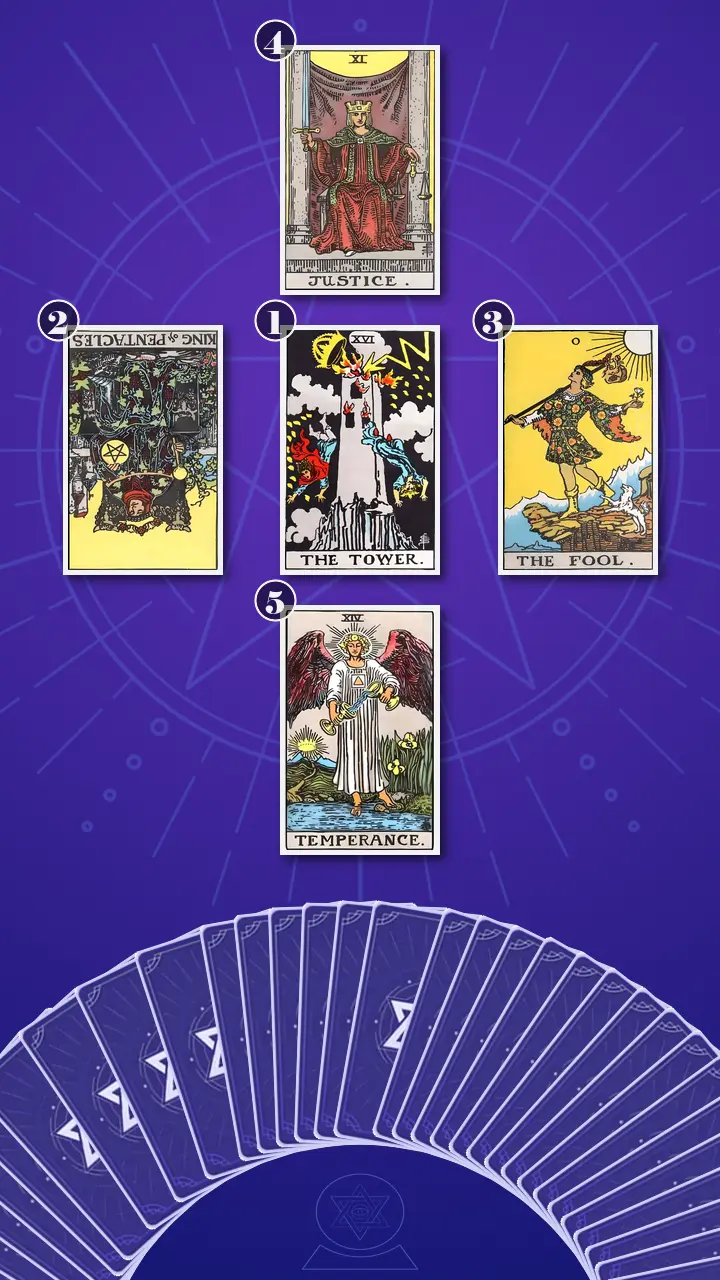
I told Jordan what to expect: “The first card is the pressure point—what’s happening right now and why it feels like an emergency. Then we’ll lay out Option A—financing a new car—and Option B—going car-free—so we can see the true draw and the true price of each. Above that, we’ll place the deciding factor you can’t afford to ignore. And at the bottom, we’ll build a next step that turns this from a binary identity choice into a workable plan.”
Reading the Map: When the Tabs Stop Being ‘Research’
Position 1 — The current situation as it really is
“Now we turn over the card that represents the current situation as it really is,” I said, and flipped it.
The Tower, upright.
Jordan gave a small, sharp laugh—more air than humor. “That feels… ominous.”
“It’s blunt,” I agreed. “But not ominous in the way people fear. It’s accurate.”
I anchored it in their real life: their car didn’t just die; it detonated the invisible infrastructure of their week. Suddenly they were pricing loans, insurance, parking, winter commuting time—like it was a crisis sprint. The Tower is the moment transportation stops being background and becomes a flashing-red ‘life stability’ problem. That’s why every option feels high-stakes and personal.
In energy terms, The Tower is excess fire: panic-driven control-seeking. It’s the internal fire alarm that makes every choice feel permanent. And that’s the trap—because when the alarm is blaring, you don’t choose what fits; you choose what stops the noise fastest.
Jordan’s fingers tightened around their mug, then loosened. Their shoulders stayed high, but their exhale sounded like a small surrender to being seen.
“Here’s the line I want you to borrow for the next ten minutes,” I said gently. “You’re not indecisive—you’re trying to buy certainty with research. The Tower makes ‘more information’ feel like ‘more control.’ But it isn’t giving you control. It’s giving you decision fatigue.”
Jordan nodded with a quiet wince. “Yeah… that’s exactly what I’ve been doing.”
Position 2 — Option A: financing a new car (the true draw and the true price)
“Now we turn over the card that represents Option A: what financing a new car is offering you psychologically and practically,” I said.
King of Pentacles, reversed.
This card’s modern translation is painfully common: financing promises, You’ll never have to think about this again—but it can become a stability performance. The reversed King is the temptation to buy peace of mind at a premium, then spend the next few years quietly controlled by a monthly cost.
“This is where I say something I mean with kindness,” I told Jordan. “Don’t finance a feeling. The feeling being: ‘If I own the right thing, I’ll finally be safe and taken seriously.’”
Reversed, the King’s earth energy is blocked—not absent. Jordan had competence. They had budgeting instincts. But under stress, that competence was being pressured into overcommitment: a longer term, a slightly nicer trim, a payment they could ‘technically’ afford if they canceled half their joys.
Jordan swallowed. Their eyes flicked away from the card, like it had accused them of something they didn’t want on record.
“My friend literally said, ‘Just do the 84-month. That’s what everyone does.’” Their mouth twisted. “And I hated how relieved I felt for half a second.”
“That relief is the King’s promise,” I said. “And the reversal is the price: the promise can turn into a lifestyle tax. The question isn’t ‘Can you get approved?’ The question is: what would that payment quietly limit in your life—savings, spontaneity, sleep?”
Position 3 — Option B: going car-free (the true draw and the true price)
“Now we turn over the card that represents Option B: what going car-free is offering you psychologically and practically,” I said.
The Fool, upright.
Jordan’s face changed—subtly—but it changed. Not relaxation exactly. More like a window cracking open in a stuffy room.
The Fool here isn’t reckless. It’s a new beginning: transit + biking + walking + car-share when needed. It’s stepping into unknowns—winter reliability, timing, spontaneity—and learning through lived experiments instead of hypotheticals. The bindle on the Fool’s shoulder is that light, flexible setup: apps, a transit pass, a backup budget. And the dog at their heels is the part of you that says, “Use the rideshare when it’s -15°C and you’re already late—no suffering for the aesthetic.”
In energy terms, The Fool is balanced air: willingness to try, to not know yet, to let the week teach you. The risk isn’t that it will be impossible; it’s that the first delay on Line 1 will feel like proof you were naïve, and you’ll abandon the experiment before it gives you data.
Jordan rubbed their forearm, a self-soothing move. “I want it to work,” they admitted. “But I’m scared of that streetcar-stop feeling. Like… if this is my life now, I’m going to be late all the time.”
“That fear makes sense,” I said. “And it’s useful. It tells us you don’t need ideology—you need guardrails.”
Position 4 — The deciding factor you must look at clearly
“Now we turn over the card that represents the deciding factor you must look at clearly—the thing you can’t afford to ignore,” I said.
Justice, upright.
Justice is where the endless tabs can end. This is the moment you stop comparing vibes and start comparing terms and trade-offs with one consistent standard: total cost of ownership, parking, insurance, the fine print—and also the time/energy cost of a commute that quietly drains you.
Justice’s energy is balance, but not the soft kind. It’s the clear kind. Scales for measurement. Sword for decisiveness.
“Here’s the magic trick,” I said, and I felt my old academic brain click into a familiar mode—the way it used to when I taught students how to evaluate sources. “In archaeology, we don’t get infinite information. We get fragments. And we don’t cope by digging forever. We cope by choosing a method, a standard, and stopping when we have enough to make a responsible claim.”
I met Jordan’s eyes. “A clean rule beats another tab. Justice asks you to write one non-negotiable criterion you can defend to yourself without over-explaining. For you, that might be an all-in monthly ceiling. Or a maximum commute time you will tolerate in winter. Once you choose the rule, anything that breaks it gets closed—no negotiation with your stressed brain.”
Jordan’s hand twitched toward their phone like they wanted to open Notes immediately. Then they stopped themselves. A tiny smile appeared—half impressed, half annoyed at how obvious it sounded.
When Temperance Poured Between Two Cups
Position 5 — Integration and next step
I let the silence sit for a moment—the good kind, the kind where the room stops trying to fix you. Outside, the muted city hissed through a slightly cracked window: tires on wet pavement, a far-off streetcar bell.
“Now we turn over the card that represents integration and next step: how to turn a binary choice into a plan you can actually live with,” I said.
Temperance, upright.
Jordan’s first reaction wasn’t relief. It was resistance—quick and hot.
“But… isn’t that just avoiding the decision?” they snapped, then immediately looked guilty for snapping. “Like, if I do some blended thing, does that mean I was wrong to need an answer?”
I didn’t rush them past it. “No,” I said, steady. “It means you’re refusing to let panic write your constitution.”
Setup. It was 11 p.m. in their body even though the clock said afternoon: tabs everywhere, jaw tight, shoulders braced, as if this decision were a forever sentence—because they were trying to solve adulthood in one night.
Delivery.
Not “all-in debt” or “all-or-nothing car-free”—blend what works, like Temperance pouring between two cups until the mix fits your life.
I let it hang in the air, the way a good line from an old text does when you finally hear what it’s been saying the whole time.
And then I added, because Temperance is not just poetry—it’s method: You don’t have to choose a permanent identity today. You can build a transportation system you test, adjust, and trust—because real feedback beats perfect information.
Reinforcement. Jordan’s body went through the kind of three-step reaction I’ve watched in fieldwork when someone realizes a “problem site” is actually a whole new layer of understanding: first, a freeze—breath caught, eyes fixed on the card. Second, the mind trying to replay the last week in fast-forward—pupils widening slightly, as if they were scanning scenes of spreadsheets, APR quotes, TTC alerts. Third, the release—an exhale that started in the chest and traveled down the shoulders, loosening them by a fraction, like someone had quietly lowered a weight they didn’t know they were holding.
Then their brow furrowed again—not in panic, but in the new vulnerability of responsibility. “So I have to… design it,” they said softly. “Not just pick.”
“Yes,” I said. And this is where my archaeology brain becomes useful in a very un-mystical way. “I use something I call Time Stratigraphy. In an excavation, the top layer is recent—loud, chaotic, full of what just happened. Deeper layers tell you what actually lasts. Right now your top layer is Tower urgency: ‘Fix it immediately.’ Temperance asks you to separate layers: what’s a momentary impulse, and what’s a long-term value?”
Jordan’s gaze dropped to their hands. Their fingers uncurled. “Long-term value is… not being trapped. But also not being stranded.”
“Exactly. Which is why I’ll say this clearly,” I continued. “This isn’t a personality test. It’s a transportation system. Cities have always survived by building mobility networks, not by betting everything on one road. The Romans didn’t maintain an empire on one perfect cart. They built redundancy: roads, ports, waystations. Temperance is your redundancy.”
I leaned in just slightly. “Now—using this new lens—can you think of one moment last week when this would have changed how you felt? A moment where you were about to open another tab, and instead you could have said, ‘I’m not deciding forever; I’m designing a trial’?”
Jordan blinked, then laughed—this time with real warmth. “Tuesday night. I reopened r/PersonalFinanceCanada for the third time like the comments were going to solve my life.”
“That’s the moment,” I said. “That’s the pivot.”
And I named it explicitly so it would stick: “This is the shift from Tower-driven urgency and control-seeking to Temperance-style measured experimentation and self-trust built through real-world feedback.”
The One-Page Rulebook That Ends the Spiral
I gathered the reading into a single, coherent story for Jordan, the way I’d summarize a dig site to a team before we made a plan.
“Your car dying was The Tower—a forced reset, not a personal failure. It knocked out a system you relied on, so your nervous system tried to replace stability with speed. Financing is tempting because it offers a clean ‘adult’ symbol of competence—but King of Pentacles reversed warns against overcommitting, or letting status and fear inflate the budget. Going car-free has real promise—the Fool says you can learn fast and feel free—but only if you build guardrails so one winter delay doesn’t become ‘proof’ you can’t do it. Justice says: pick a clean criterion and stop restarting the comparison. And Temperance says: build a blended mobility setup and set a review date, so the decision becomes adjustable rather than permanent.”
“Your cognitive blind spot,” I added gently, “is treating this as a referendum on whether you’re capable. The transformation direction is the opposite: treat it as a systems design problem. You don’t need the perfect forever answer. You need a plan you can live with and evaluate.”
Then I shifted into what I call Voyage Log Technique—planning like ancient navigators who didn’t pretend the sea would be consistent. They traveled with headings, checkpoints, and logs. Not certainty.
- Run a 10-day “Temperance Trial”Pick 10 consecutive days and live as if you’re car-free in Toronto: TTC + walking + biking if you do that, with Communauto / rideshare as backup. Pre-load a backup budget cap (e.g., $20–$40/day) so you’re not debating every ride.If your jaw clenches and you think “this is silly, I need the final answer now,” do the 3-day version. It’s still valid data. Pre-decide: “If it’s below -10°C or I’m running late, I take a ride-share without negotiating.”
- Write your “Justice Rule” (one clean ceiling)Open Notes and write one sentence: “I will not commit to an all-in monthly cost above $X (payment + insurance + parking + average maintenance).” Then only look at cars/loans under that ceiling. Everything else gets closed—no exceptions while you’re stressed.Literally say it out loud once: “A clean rule beats another tab.” Your brain will try to add loopholes; catch it and return to the one sentence.
- Keep a tiny “Justice Scorecard” during the trialMake a 2-column note: (1) dollars spent, (2) minutes + stress. After each errand/commute, add one line: “Grocery run: 38 min + $8 rideshare + stress 4/10.” No interpretation yet—just logging.Your only job is data, not meaning. This replaces doom-scrolling reviews with lived evidence—real feedback beats perfect information.

A Week Later: The Quiet Proof
Six days after our session, Jordan texted me a screenshot—not of a car listing, not of an APR quote. A calendar event.
“Transport Decision Review (data only) — 5 weeks.”
“I did the three-day trial,” their message continued. “I didn’t love everything, but I didn’t die. I used Communauto once for a bulky errand, and I didn’t spiral about it. Also I wrote the monthly ceiling and closed every tab that broke it. It felt weirdly… grown-up?”
The bittersweet part was there too, honest and human: they said they celebrated by sitting alone in a café for an hour after work—no big victory lap—just the quiet relief of not being chased by their own browser history.
I thought about what Temperance always teaches, whether you’re rebuilding after a collapsed wall at an excavation site or after a dead car in Toronto: you don’t restore the past by panic. You restore a life by choosing a method, setting a checkpoint, and letting reality—patient, measurable reality—teach you what fits.
We’ve all had that moment where one broken thing—like a dead car—makes you feel like your whole adulthood is on trial, and your body locks up because you’re terrified the wrong choice will prove you don’t have control.
If you let this be a 4–6 week experiment instead of a forever identity choice, what’s one tiny rule or checkpoint you’d set so future-you feels protected?